
What Is Binance? The World's Largest Crypto Exchange, Explained
What is Binance and how does it work? A plain-English beginner's guide to the world's largest crypto exchange — what it does, what BNB is, fees, safety, and how to get started.
 Lucas Almeida 5 min read
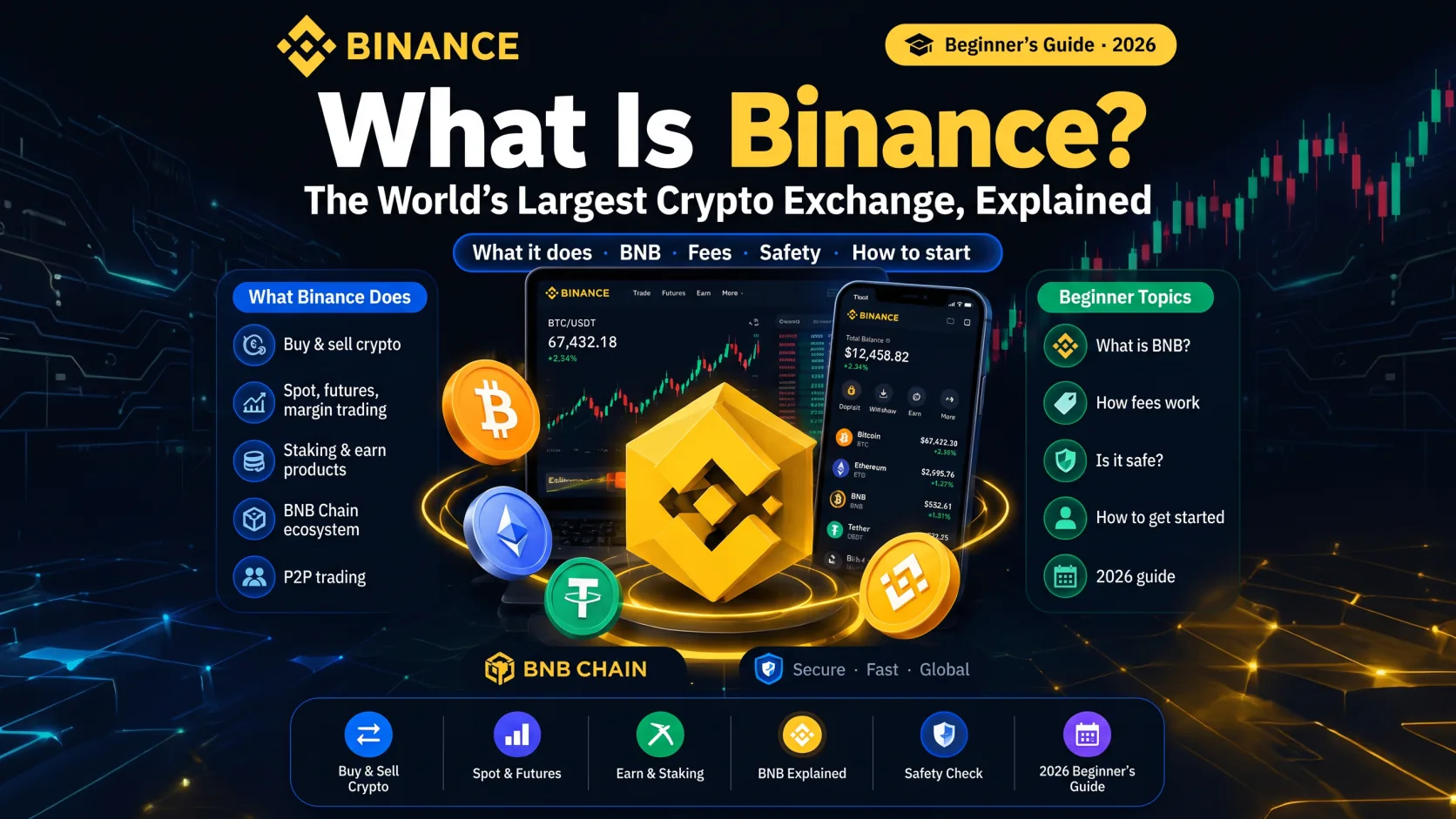
Key takeaways
- Binance is the world's largest cryptocurrency exchange: a platform where you can buy, sell, and trade 500+ cryptocurrencies. It launched in July 2017 and reports 300 million+ registered users as of late 2025 (all figures checked October 2026).
- It handles roughly 40% of all centralized-exchange trading volume — more than the next several exchanges combined — which is why its prices and fills are the industry benchmark.
- Spot trading costs 0.1% per trade, dropping to 0.075% if you pay fees with its own token, BNB — among the lowest rates at any major exchange.
- Binance is also a company behind its own blockchain (BNB Chain) and the BNB token, currently the #4 cryptocurrency by market cap.
- The main catch is where you live: US residents are routed to the separate Binance.US, and Binance held no EU MiCA licence as of October 2026. Everywhere else, it is the default starting exchange for beginners.
If you have spent any time around crypto, you have seen the name. Binance is the world’s largest cryptocurrency exchange — an online marketplace where ordinary people buy, sell, and trade digital currencies like bitcoin and ethereum. It launched in July 2017, today reports 300 million+ registered users, and processes roughly 40% of all centralized-exchange trading volume — more than its closest competitors combined (figures checked October 2026).
In plain terms: Binance does for crypto what a brokerage app does for stocks. You create an account, verify your identity, deposit money (bank transfer, card, or crypto), and exchange it for any of 500+ supported cryptocurrencies. Spot trading starts at 0.1% per trade — 0.075% if you pay fees in BNB, Binance’s own token — which is among the lowest rates at any major exchange.
This guide explains exactly what Binance is, what you can actually do there, what BNB is, how safe it is, and where it is (and isn’t) available — everything a complete beginner needs before creating an account.
⚠️ The most important thing first: don’t tap Sign Up directly in the app — you’ll miss the new-user rewards. The welcome benefits only apply when you register through an invite link or enter the referral code BN2688. Remember this.
Binance at a glance
| What it is | A centralized cryptocurrency exchange (CEX) — a company that matches buyers and sellers |
| Founded | July 2017 by Changpeng Zhao (“CZ”); CEO Richard Teng since November 2023 |
| Users | 300 million+ registered (first exchange to cross 300M, announced 31 December 2025) |
| Cryptos listed | 500+ coins across 1,300+ trading pairs |
| Market share | ~40% of centralized-exchange spot volume (2025: ~41% among top-10 CEXs) |
| Spot fee | 0.1% per trade — 0.075% with the BNB discount |
| Own token | BNB — #4 cryptocurrency by market cap (~$97 billion, October 2026) |
| Availability | 180+ countries, excluding US retail (routed to Binance.US) with an unresolved EU licence question |
Two numbers put the scale in perspective. First, 300 million accounts is roughly 1 in every 27 people on Earth — no financial platform in crypto comes close. Second, that ~40% market share means the deepest order books in the industry: when you place a small order, it fills instantly at a fair price, even in wild markets. That liquidity is the practical reason Binance became the default exchange for most of the world.
What Binance actually does
The core of Binance is simple: it is a marketplace that matches people who want to buy crypto with people who want to sell it. When you “buy bitcoin on Binance,” you are not buying from Binance itself — you are matched with another user’s sell order through an order book. The exchange charges a small fee (that’s the 0.1%) for running this marketplace and holding the funds in between.
This is what makes it a centralized exchange (CEX): a company — not a blockchain, not a smart contract — holds the funds, runs the matching engine, and provides support. Our guide on how crypto exchanges work explains the trade-offs of that model versus decentralized exchanges.
Around that core marketplace, Binance has built a full financial platform — savings accounts for your crypto, peer-to-peer trading, new-token launches, and automated investing. Here is what each of those actually means for a beginner.
What you can do on Binance
Buy your first crypto
The most common use: deposit local currency and buy bitcoin, ethereum, or a stablecoin like USDT. Depending on your country you can pay by bank transfer, debit/credit card, or peer-to-peer. Our step-by-step guide to buying crypto on Binance walks through the first purchase, and the deposit guide compares the three funding methods and their costs.
Trade between cryptocurrencies
Beyond the first purchase, you can exchange any listed coin for any other — BTC for ETH, SOL for USDT, and so on — across 1,300+ pairs. Beginners should stick to the “simple” buy/sell interface at first; the full trading terminal (charts, order types) is there when you grow into it. Our beginner’s guide to trading crypto covers the basics.
Earn yield on coins you hold
Binance Earn is a menu of savings-style products: flexible savings you can withdraw anytime, locked terms that pay more, and staking. Rates change constantly and carry real risk, so read how Binance Earn works before putting anything in.
Buy and sell directly with other people (P2P)
In many countries, P2P trading is how money actually gets in: you pay another user via local bank transfer or wallet, and Binance holds the crypto in escrow until payment confirms. It is popular because it supports local payment methods exchanges don’t — but it is also where most Binance-related scams happen, so read the P2P safety guide first.
New tokens, automation, and (later) derivatives
- Launchpad and Launchpool — early access to new token sales, usually by temporarily holding BNB.
- Auto-Invest — scheduled recurring purchases: dollar-cost averaging on autopilot (the strategy is explained in our DCA guide).
- Futures and margin — leveraged trading where you can lose more than you deposit. Beginners should skip these entirely for at least their first year. They are mentioned here only so you know to ignore them.
That is the honest map of Binance: a beginner needs the first two bullets and nothing else on day one. Deposit, buy, and secure the account — everything else can wait.
What is BNB? (Binance’s own token)
You will meet BNB within your first hour on Binance, so it helps to know what it is:
- Originally “Binance Coin,” created in Binance’s July 2017 ICO, which raised about $15 million — the company’s entire launch financing, with no venture-capital round (CZ’s own announcement).
- The fee-discount token. Holding a little BNB and enabling the discount cuts your trading fee from 0.1% to 0.075%. This is the main reason small traders keep some.
- The fuel of BNB Chain, a blockchain network that originated from Binance and now operates independently. BNB Chain has become one of the major smart-contract platforms — in 2026 it led the market for tokenized real-world assets and stocks.
- A top-5 cryptocurrency in its own right: BNB ranks #4 by market cap at roughly $97 billion (October 2026, per CoinGecko).
You do not need BNB to use Binance. But if you plan to trade regularly, the 25% fee discount alone usually pays for keeping a small amount.
How much Binance charges
Fees are the reason many people choose Binance over rivals (checked October 2026 on Binance’s fee page):
| Action | Typical cost |
|---|---|
| Spot trade (regular user) | 0.1% — so $1.00 on a $1,000 trade |
| Spot trade with BNB discount | 0.075% — $0.75 on $1,000 |
| Depositing crypto | Free (network fees apply when withdrawing) |
| Card purchase | Extra processing fee + often a spread — usually the priciest way in |
| Futures | 0.02% maker / 0.05% taker (skip these as a beginner) |
Compare that with the 0.4–0.6% “instant buy” pricing at some competitor apps and the saving compounds quickly if you trade weekly. The full breakdown, including withdrawal fees and how to enable the BNB discount, is in Binance fees explained.
Is Binance safe?
Short answer: its technical record is the strongest among large global exchanges, while its regulatory history is the weakest part of the story. Both are true, and both matter.
On the technical side (all checked October 2026, full detail in Is Binance Safe?):
- A $6.3 billion hack in October 2026, absorbed by Binance. Roughly $6.3 billion left hot wallets on 29 October; Binance covered about 90% within two days and 95% within four from its own funds, and users were not charged the loss. The earlier major breach (May 2019, 7,000 BTC) was likewise repaid in full from its emergency fund.
- SAFU: an emergency insurance fund that held about $1 billion before October 2026 and now holds roughly $580 million after covering the hack, with a commitment to rebuild it to about $1 billion.
- Proof of Reserves: quarterly cryptographic proof that customer balances are backed, now verifiable by users themselves through a zk-SNARK proof.
On the regulatory side:
- In November 2023, Binance paid a $4.3 billion settlement with the US Department of Justice over anti-money-laundering failures, and founder CZ stepped down as CEO (DOJ announcement). Richard Teng, formerly Binance’s head of regional markets, has run the company since.
- US residents cannot use the global platform — they are routed to Binance.US, a separate company.
- In the EU, Binance held no MiCA licence as of October 2026, leaving availability in several member states uncertain.
The practical takeaway: where Binance is licensed, you have real consumer protections. Where it is not, you are relying on the company’s own good behavior — which its custody record has so far backed up, but which you should weigh honestly. Either way, most losses at Binance don’t come from the exchange at all: they come from phishing sites and weak passwords, so set up account security properly from day one.
A short history of Binance
Binance’s story explains a lot of what people like and dislike about it:
- July 2017 — Founded by Changpeng Zhao (CZ), a Chinese-Canadian developer who had previously built high-frequency trading systems. The BNB ICO raises ~$15 million; the exchange goes live within weeks.
- 2018 — Within roughly 180 days of launch, Binance is already among the world’s largest exchanges by volume. It relocates as China cracks down on crypto.
- May 2019 — A hack takes 7,000 BTC (~$41 million). Binance absorbs the loss entirely, repaying all affected users from its SAFU fund — a precedent that defined its reputation.
- 2021 — Peak bull-market growth; Binance becomes the industry’s center of gravity and regulators worldwide begin scrutinizing it.
- November 2023 — The $4.3 billion US settlement; CZ pleads guilty and steps down. Richard Teng becomes CEO and pivots the company toward regulatory licensing.
- December 2025 — Binance becomes the first exchange to surpass 300 million registered users.
- 29 October 2026 — About $6.3 billion is drained from hot wallets across roughly ten chains, the largest crypto theft on record. Binance sets aside $6.34 billion of its own money, reports about 90% of losses covered within two days and 95% within four, and pauses then phases withdrawals back on. Investigators attribute the attack to North Korea’s TraderTraitor group.
- 2026 — Still #1 by market share (~40%), though locked out of the US and with its EU licensing unresolved — while expanding under full local licences in parts of the Middle East and Asia.
That last point is the fair summary of Binance in 2026: dominant in most of the world, contested in the richest regulatory markets, and fresh from the most expensive security lesson in the industry’s history.
Binance vs the alternatives
How does it stack up against the names you’ll also see?
- vs Coinbase — the polished, heavily regulated US/EU choice, at much higher fees and a smaller coin menu. See Binance vs Coinbase.
- vs Binance.US — not a choice at all for Americans; it is the only “Binance” available there, and a smaller one.
For most beginners in supported countries the decision is simple: Binance for the lowest fees and widest selection; Coinbase if you are in the US or prioritize a regulated household name.
Who should (and shouldn’t) use Binance
| If you are… | Binance is… |
|---|---|
| A beginner in a supported country | The default starting exchange — low fees, 500+ coins |
| A US resident | Unavailable — compare Coinbase and other alternatives |
| An EU resident | Check your country’s current status first (no MiCA licence as of Oct 2026) |
| A small, cost-conscious trader | Excellent — the 0.1%/0.075% fees are the mainstream low |
| Holding large amounts long-term | Fine as an on-ramp, but long-term holdings belong in your own wallet |
| Someone who wants hand-holding support | A weaker fit — support is the most common complaint about Binance |
How to get started on Binance
If the picture above sounds right for you, the whole path from zero to first bitcoin takes an afternoon:
- Create your account — email or phone, password, and a referral code if you want the trading-fee rebate. Important: a referral code cannot be added after registration, so enter it during sign-up.
- Complete identity verification (KYC) — a government ID and a quick selfie; usually approved in minutes to hours (what to expect).
- Secure the account — authenticator-app 2FA and the withdrawal whitelist, before depositing anything (setup guide).
- Deposit — via the cheapest method available in your country (3 ways compared).
- Make your first purchase — via the simple buy interface (walkthrough).
One habit from day one: reach Binance only by typing its address yourself or via your own bookmark. Lookalike phishing sites — not exchange hacks — are how beginners most often lose money.
Frequently asked questions
The most common beginner questions are answered in the FAQ section above. Two more worth knowing:
How do you pronounce Binance? It is pronounced BY-nans (a blend of “bitcoin” + “finance”) — useful to know, since searching misspellings like “binanse” is a common way people land on phishing sites.
What does “centralized exchange” mean for my money? It means Binance holds your funds, like a bank holds deposits. That is convenient — forgotten passwords can be reset, unlike self-custody wallets — but it also means you are trusting the company. Keep only trading funds on the exchange and move long-term holdings to a wallet you control.
💡 Don't have a Binance account yet? Sign up now — 20% fee rebate on spot and futures — enter the referral code BN2688.
The bottom line
Binance is the world’s largest crypto exchange for concrete reasons: 500+ coins, the lowest mainstream fees (0.1%, or 0.075% with BNB), liquidity that guarantees fair fills, and a custody operation that absorbed the largest theft in crypto history within four days. Its weaknesses are equally concrete: no US availability, an unresolved EU licence as of late 2026, a $4.3 billion compliance settlement in its past, and slow customer support.
If you are a beginner in one of the 180+ countries where it operates fully, Binance remains the sensible default first exchange — registered with a referral code, secured with 2FA, and funded through the cheapest local method. If you are in the US or EU, check availability first and consider Coinbase instead.
Don't have a Binance account yet?Sign up nowenter the referral codeBN2688
Frequently asked questions
What is Binance in simple terms?
Is Binance safe for beginners?
What is BNB and do I need it?
How much does Binance charge?
Is Binance available in my country?
What is the difference between Binance and Binance.US?
Editor-in-Chief & Lead Researcher
Editor of MyCryptoStart. Independent researcher of cryptocurrency exchanges, focused on fees, security, KYC, and onboarding — publishes step-by-step guides in plain English for beginners.
View author page →Some links on this page are affiliate links: we may earn a commission at no extra cost to you. This content is educational and is not financial, investment, or legal advice. Affiliate disclosure · Disclaimer.
Continue reading
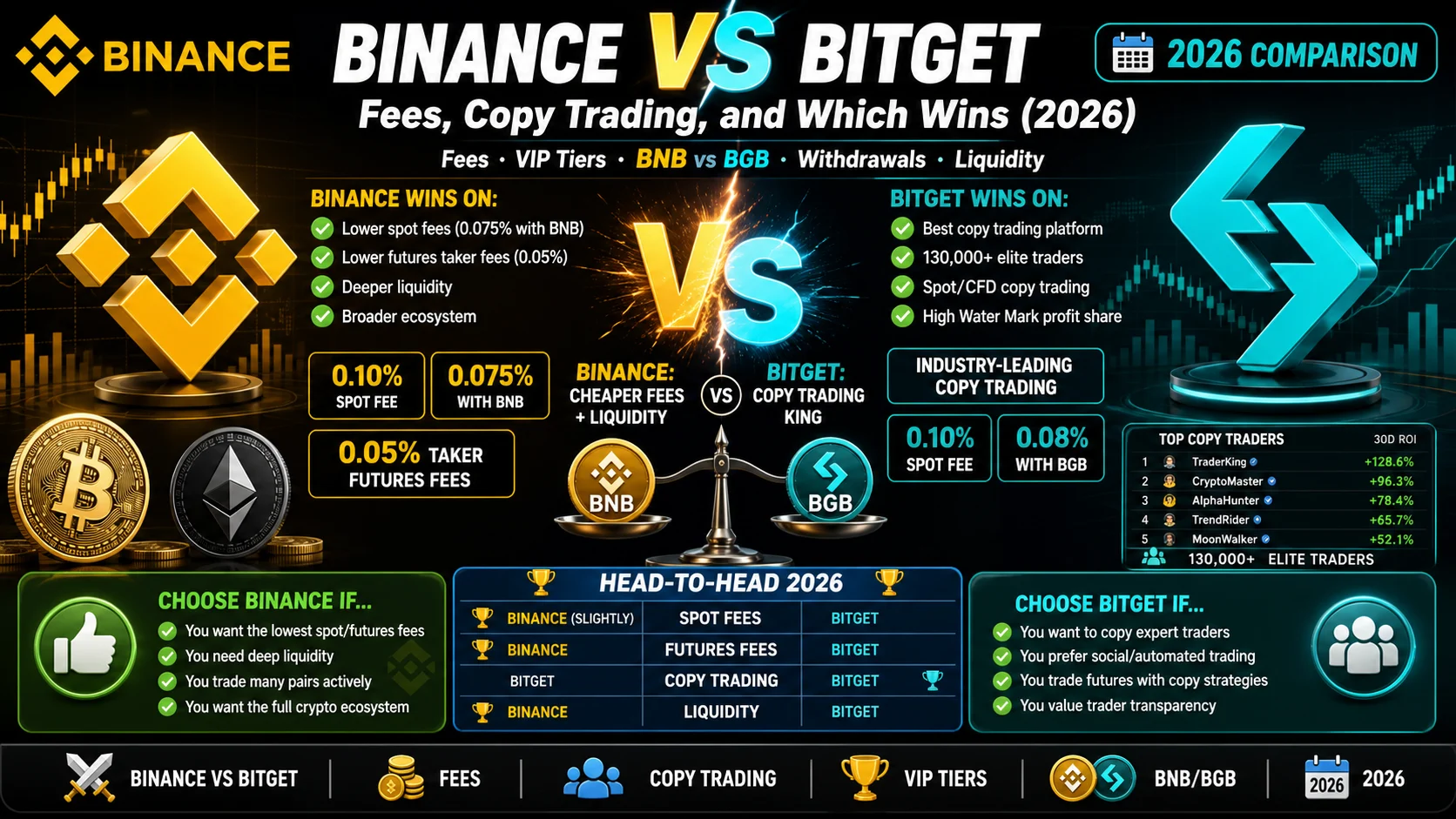
Binance vs Bitget (2026): Fees, Copy Trading, and Which Wins
Binance is cheaper for spot and futures; Bitget wins on copy trading. Compare 2026 fees, VIP tiers, BGB vs BNB discounts, withdrawals, and liquidity.
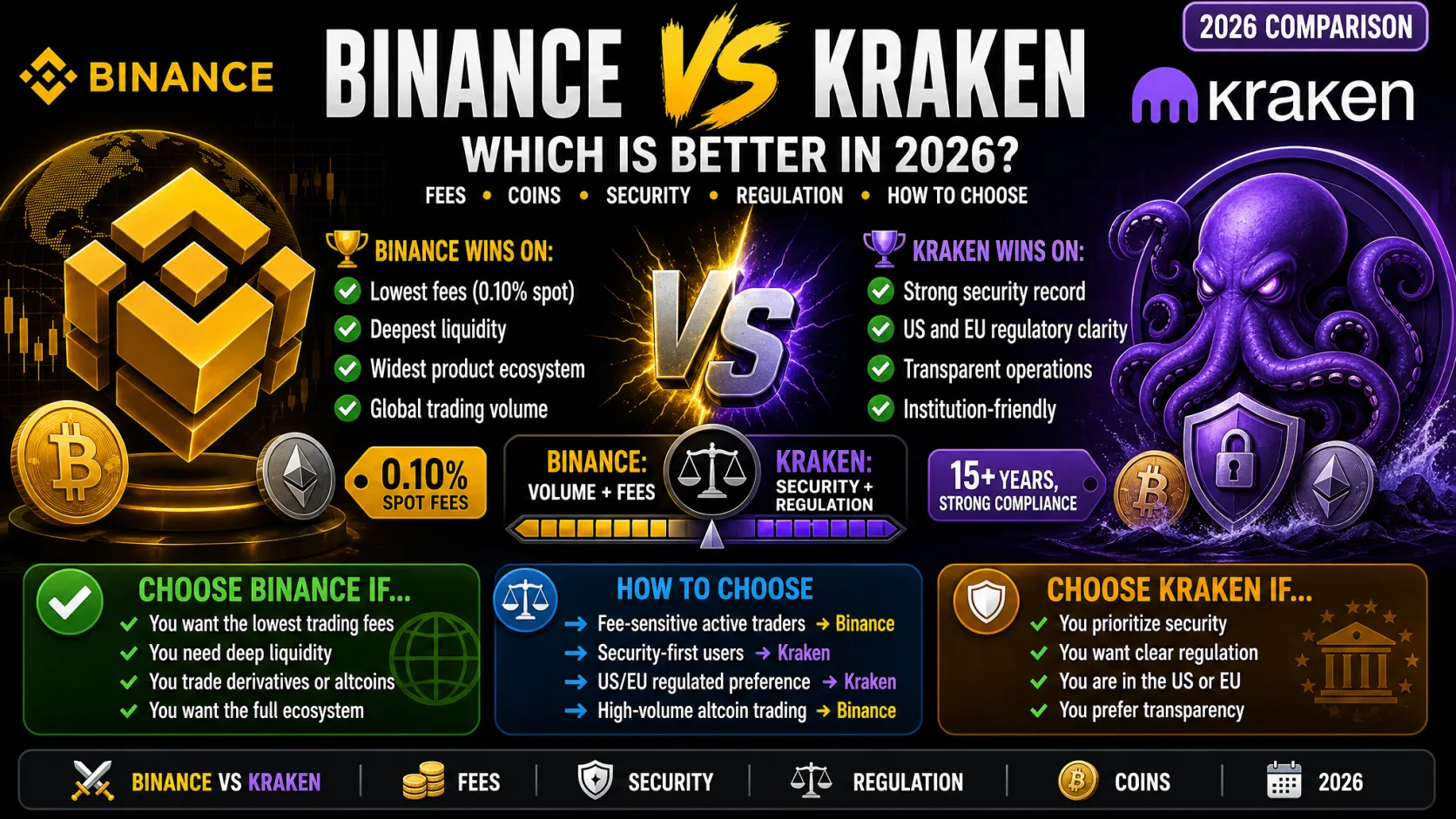
Binance vs Kraken: Which Is Better in 2026?
Binance charges 0.10% spot (0.075% with BNB). Kraken's entry tier is 0.40%/0.80% after its July 2026 rework. Fees, access, safety, and how to choose.
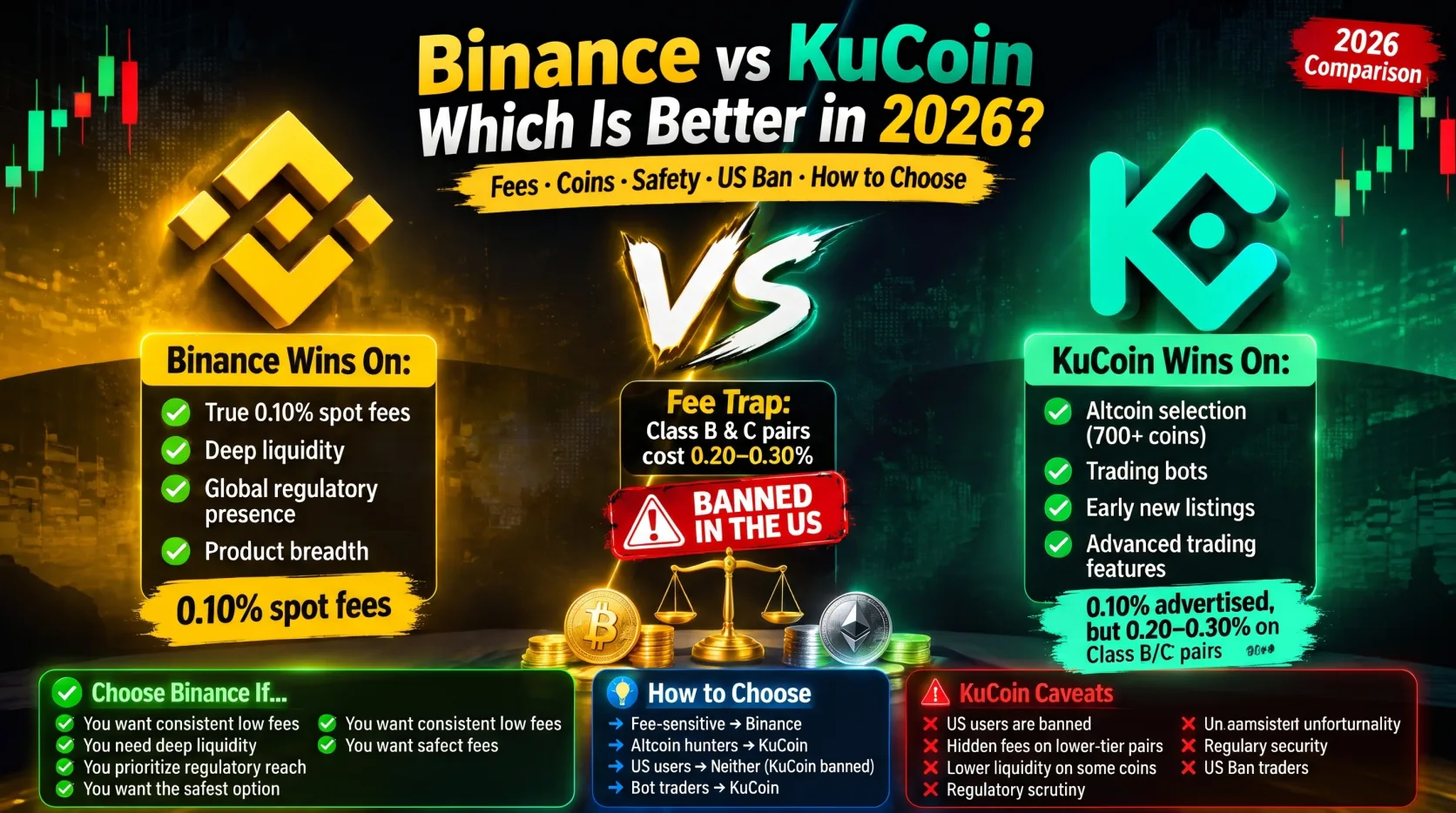
Binance vs KuCoin: Which Is Better in 2026?
Both advertise 0.10% spot, but KuCoin's Class B and C pairs cost 0.20–0.30% and it is banned in the US. Fees, coins, safety, and how to choose.