
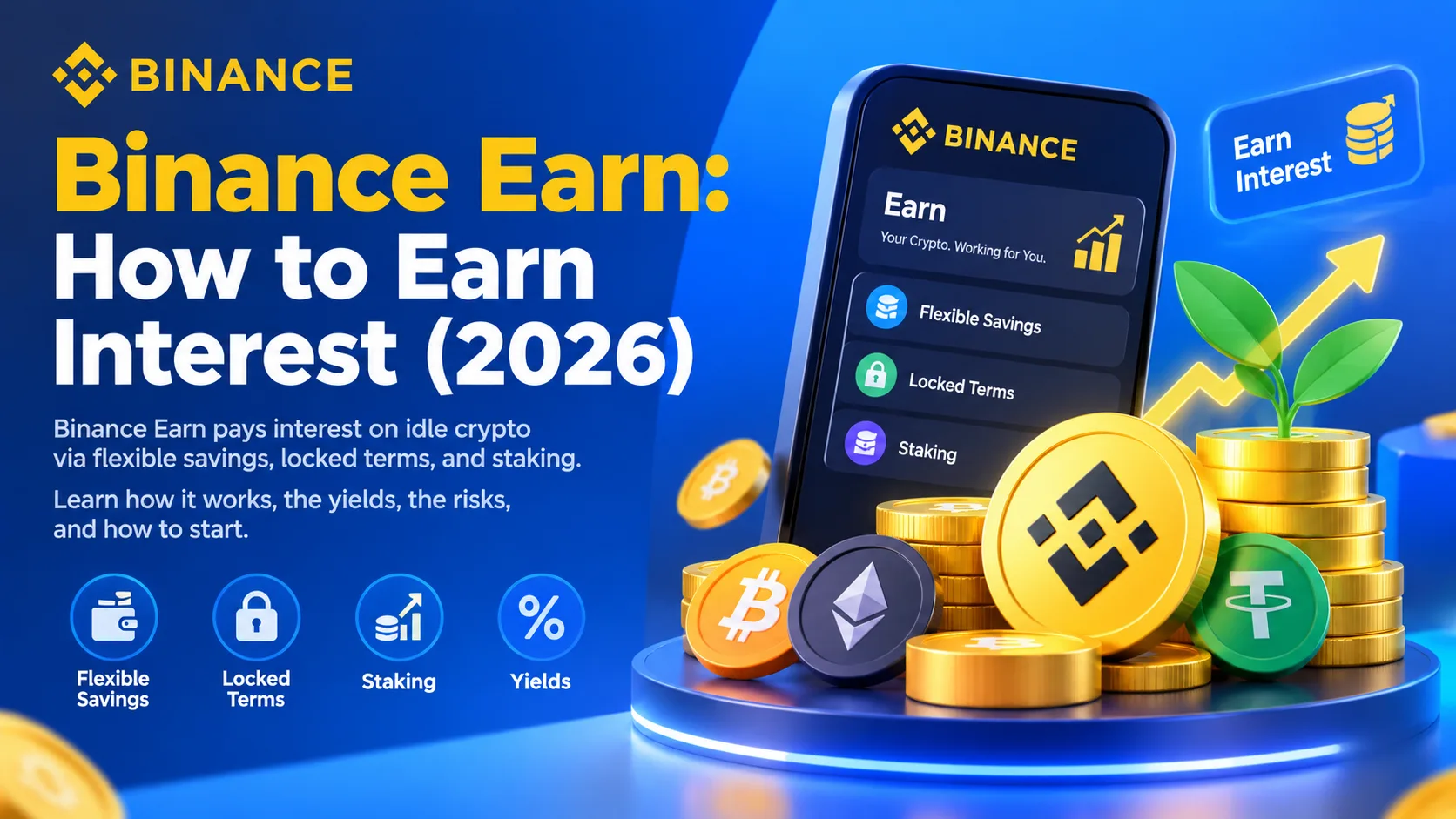
Binance Earn: How to Earn Interest (2026)
Binance Earn pays interest on idle crypto via flexible savings, locked terms, and staking. Learn how it works, the yields, risks, and how to start.
 Lucas Almeida 5 min read
Key takeaways
- Binance Earn is Binance's suite of products that pay interest or yield on your crypto — from flexible savings and locked terms to ETH and SOL staking.
- Flexible products redeem any time and pay a real-time APR; locked products pay more but forfeit accrued interest if you redeem early.
- Real yields in October 2026 cluster around 0.5–4% on major coins (ETH ~1–2.4%, USDT ~2.4–4.5%), with SOL staking around 5–8%.
- Your coins are 'principal-protected' by token amount, but their dollar value still swings with the market — a falling coin can erase the yield.
- Most Earn products require a verified Binance account (KYC), and the rewards are usually taxable income, so keep records.
Binance Earn is Binance’s suite of products that pay interest or yield on the crypto you already hold — covering flexible savings, fixed terms, and ETH and SOL staking in one place. Real yields in October 2026 are modest and variable: roughly 0.5–1.5% on BTC, 1–2.4% on ETH, and 2.4–4.5% on USDT in flexible products, with SOL staking around 5–8%. The catch that matters most: your coins are protected by token amount, not by dollar value — so a falling market can still erase the yield.
This guide explains what Binance Earn actually is, how much you can realistically earn, the risks most summaries skip, and how to start in a few minutes.
⚠️ The most important thing first: don’t tap Sign Up directly in the app — you’ll miss the new-user rewards. The welcome benefits only apply when you register through an invite link or enter the referral code BN2688. Remember this.
What Is Binance Earn?
Binance Earn is an umbrella of passive-income products inside a Binance account, not a single thing. You deposit cryptocurrency you already own, and Binance puts it to work — lending it out, staking it on a proof-of-stake network, or locking it in a fixed-term product — and pays you rewards for the trouble.
The suite splits into two broad buckets that matter because they carry different risk:
- Simple Earn — the lower-risk, “principal-protected” products most beginners use. Your coins are protected by token amount (you get back the number of coins you deposited), but their dollar value still moves with the market.
- Advanced Earn — higher-yield products that can put your principal at risk, such as Dual Investment, where your crypto may be converted at a target price if the market moves against you.
The key idea to internalize up front: Binance Earn is not a bank savings account. Some products are closer to lending your coins out, others are closer to staking them on a blockchain. The line matters because the risks differ — a point the staking guide walks through in detail.
The Binance Earn products, explained
There are several products under the Earn umbrella, and they are easy to mix up. Here they are side by side.
| Product | How it works | Liquidity | Risk level |
|---|---|---|---|
| Flexible | Redeem any time; pays a real-time APR | Any time (short delay) | Low |
| Locked | Fixed term (e.g. 30/120 days); higher rate | Locked until term ends | Low–medium |
| ETH staking (WBETH) | Stakes ETH on the Beacon Chain for you | Redeemable via WBETH token | Low–medium |
| SOL staking (BNSOL) | Delegates SOL to validators | Redeemable via BNSOL token | Low–medium |
| Dual Investment | Deposit + choose a target price; high yield if price stays put | Locked until settlement | High |
| Auto-Invest | Dollar-cost-averages your buys on a schedule | You set the cadence | Varies |
| Launchpool | Stake BNB (or other coins) to farm newly launched tokens | Locked during the farming period | Medium |
The two products most beginners should start with are Flexible and Locked, because they are the most predictable. Here is what actually distinguishes them in practice:
- Flexible pays a real-time APR that can update every minute, and rewards accrue every minute into your Earn Wallet. The “Max APR” you see often includes a separate bonus tiered APR on top of the real-time rate — read the breakdown, not just the headline.
- Locked pays more for committing your coins for a fixed term, but the rate resets weekly and redeeming early forfeits the accrued interest — the single most common surprise new users hit.
For a deeper look at how staking itself works under the hood, see the crypto staking guide.
How much can you actually earn?
The honest answer is a low single-digit percentage a year on major coins — not the double-digit numbers marketing sometimes implies. Here are current, sourced ranges for Binance Earn flexible products, checked in October 2026:
| Asset | Flexible APR (Oct 2026, approximate) | Notes |
|---|---|---|
| Bitcoin (BTC) | ~0.5–1.5% | Low but steady |
| Ethereum (ETH) | ~1.2–2.4% | ETH staking via WBETH pays ~3–4% separately |
| USDT (Tether) | ~2.4–4.5% | Promos can push the headline higher for a short window |
| USDC | ~3–8% | Rates vary by region and page |
| BNB | ~1–3% | Also used to farm new tokens in Launchpool |
| Solana (SOL) | ~5–8% via staking | Delegated to validators, returned as BNSOL |
Three things the numbers don’t tell you, and they matter more than the rate:
- Rates are live snapshots, not guarantees. Flexible APRs update constantly, and locked rates reset weekly. The number you saw last week is not today’s number.
- Rates vary by region. Binance runs separate local entities, so a rate shown on a page in one country may not match what you see in yours. Check what your account actually displays.
- Higher yield usually means more risk or more inflation. A small coin advertising 20% is paying that from heavy token inflation or from a riskier product — both of which tend to end badly for the yield-chaser.
A useful rule of thumb: the more flexible and liquid the product, the lower the rate. Flexible pays the least because you can leave any time; locked pays a bit more; and advanced products pay the most precisely because you are taking real risk.
APR vs APY: what is the difference?
Binance Earn advertises almost everything in APR, not APY, and the distinction changes the real return.
- APR (annual percentage rate) is the simple rate — it does not account for compounding.
- APY (annual percentage yield) does account for compounding — reinvesting your rewards so they earn rewards of their own.
For most Binance Earn products, the advertised APR is the number to read, because rewards are not automatically compounded at that advertised rate. If you manually reinvest your rewards, your effective return approaches the APY, which is slightly higher. The difference is small at low single-digit rates — a 3% APR compounding monthly becomes about 3.04% APY — so it matters far less than picking the right product and understanding the lock-up.
What are the risks of Binance Earn?
Binance Earn is often pitched as “free money,” which is misleading. Before you deposit anything, these are the risks that actually matter:
- Price volatility is the biggest one. Your coins are “principal-protected” by token amount, but their dollar value still swings with the market. A 20% drop in the coin you deposited wipes out a 3% yield — and it can happen in a day. This, not any platform failure, is how most Earn users end up down.
- Advanced products can lose principal. Dual Investment and similar products are not protected the way Simple Earn is. If the price moves against your target, your deposit can be converted into the other asset at a worse price — a real loss, not a smaller yield. Don’t touch these until you understand exactly what happens in each scenario.
- Locked products can trap your money. When you redeem early from a locked term, you usually forfeit the accrued interest, and some products have a redemption queue that delays your exit — exactly when you might want to sell in a crash.
- Platform (custody) risk. Binance holds the coins, so you are trusting Binance’s security and solvency, not your own wallet. This is the trade-off for the convenience of exchange products.
- Taxes. In most jurisdictions, Earn rewards are taxable income in the year you receive them, on top of any capital gains when you later sell the underlying coins. See the crypto taxes guide for the detail.
None of this makes Binance Earn bad — it makes it a low-return, low-to-medium-risk way to earn on coins you were going to hold anyway, not a way to get rich.
How to start earning on Binance
Here is the beginner path, end to end. It takes a few minutes once your account is funded.
Step 1: Create and verify a Binance account
You need a Binance account with identity verification (KYC) completed before most Earn products will let you subscribe. If you don’t have one yet, walk through creating a Binance account.
💡 Don't have a Binance account yet? Sign up now — 20% fee rebate on spot and futures — enter the referral code BN2688.
Step 2: Deposit crypto (or buy some)
Earn works on the coins you already hold, so move some into your account — see how to deposit into Binance — or buy a small amount first. Only commit money you can afford to leave untouched, especially for locked products.
Step 3: Open Binance Earn and pick a product
In the app, tap Wallet → Earn, or find Earn in the main menu on the website. Start with Flexible (redeem any time) or Locked (higher rate, fixed term), and leave ETH/SOL staking and advanced products for once you understand the trade-offs.
Step 4: Subscribe and confirm the live APR and terms
Enter the amount, then read the confirmation screen carefully before you confirm:
- The live APR — this is what you are actually getting, not the marketing number.
- The bonus APR breakdown — the “Max APR” often stacks a bonus tiered APR on top of the real-time rate.
- The early-redemption rule — locked products usually forfeit accrued interest if you redeem early.
- The term and reset schedule — locked rates reset weekly, so the rate can change mid-term.
Step 5: Redeem and withdraw when you want out
When you are done, redeem the product back to your spot wallet, confirm the processing time (flexible is quick; locked waits out its term), then withdraw — see how to withdraw from Binance. Rewards land in your Earn Wallet, so you may need to redeem those back to spot before you can trade or withdraw them.
Common problems and fixes
| Problem | Why it happens | What to do |
|---|---|---|
| The APR dropped after I subscribed | Flexible APRs update in real time; locked rates reset weekly | Accept the variable rate, or move to a different product |
| I can’t redeem my coins | You’re inside a locked term or a redemption queue | Check the product’s exit terms before subscribing next time |
| My locked product “lost” its interest | You redeemed early, which forfeits accrued rewards | Confirm the early-redemption rule up front |
| The product won’t let me subscribe | KYC incomplete, or the product isn’t available in your region | Finish verification and check regional availability |
| Rewards aren’t showing in my balance | Rewards accrue to the Earn Wallet, not spot | Redeem Earn rewards back to your spot wallet |
| The “Max APR” is higher than my actual rate | It includes a temporary bonus tiered APR | Read the real-time APR separately from the bonus |
The bottom line
Binance Earn is a legitimate way to earn a modest, variable return on crypto you were going to hold anyway — roughly 0.5–8% a year depending on the coin and product, with the highest rates attached to the most risk. It is not free money: rates float, locked products can trap your coins and forfeit interest, advanced products can lose principal, and a falling market can erase the yield faster than it accrues.
The sensible way to start is to deposit a small amount you can leave untouched, pick a Flexible or Locked Simple Earn product on a major coin like ETH or a stablecoin, read the live APR and exit terms before you confirm, and keep records because the rewards are usually taxable. Let the interest be a small bonus on coins you already planned to hold — not the reason you bought them.
Ready to start? Open a Binance account, make your first deposit, and if you want to understand the mechanics behind the yield, read the staking guide first.
The information in this article is for education only and is not financial advice. Earning yield on crypto involves risk, including loss of principal, and the rates cited here are snapshots checked in October 2026 that can change at any time.
Don't have a Binance account yet?Sign up nowenter the referral codeBN2688
Frequently asked questions
What is Binance Earn?
How much can I earn with Binance Earn?
Is Binance Earn safe?
Can I withdraw my crypto from Binance Earn at any time?
What is the difference between Flexible and Locked products?
Do I pay taxes on Binance Earn rewards?
Editor-in-Chief & Lead Researcher
Editor of MyCryptoStart. Independent researcher of cryptocurrency exchanges, focused on fees, security, KYC, and onboarding — publishes step-by-step guides in plain English for beginners.
View author page →Some links on this page are affiliate links: we may earn a commission at no extra cost to you. This content is educational and is not financial, investment, or legal advice. Affiliate disclosure · Disclaimer.
Continue reading
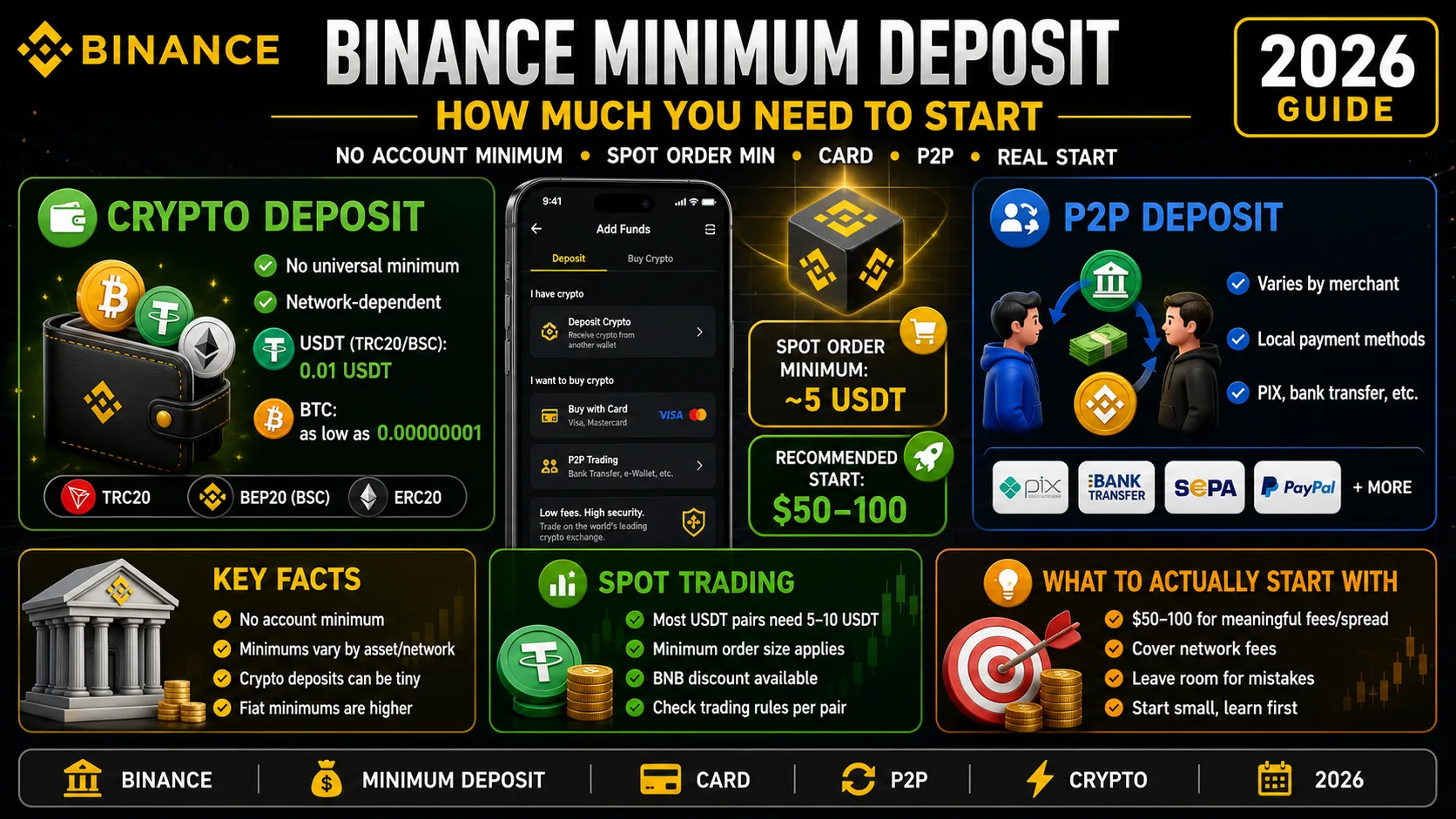
Binance Minimum Deposit: How Much You Need in 2026
Binance has no account minimum, but most spot orders need 5 USDT. The real deposit, card and P2P minimums — and how much to actually start with.
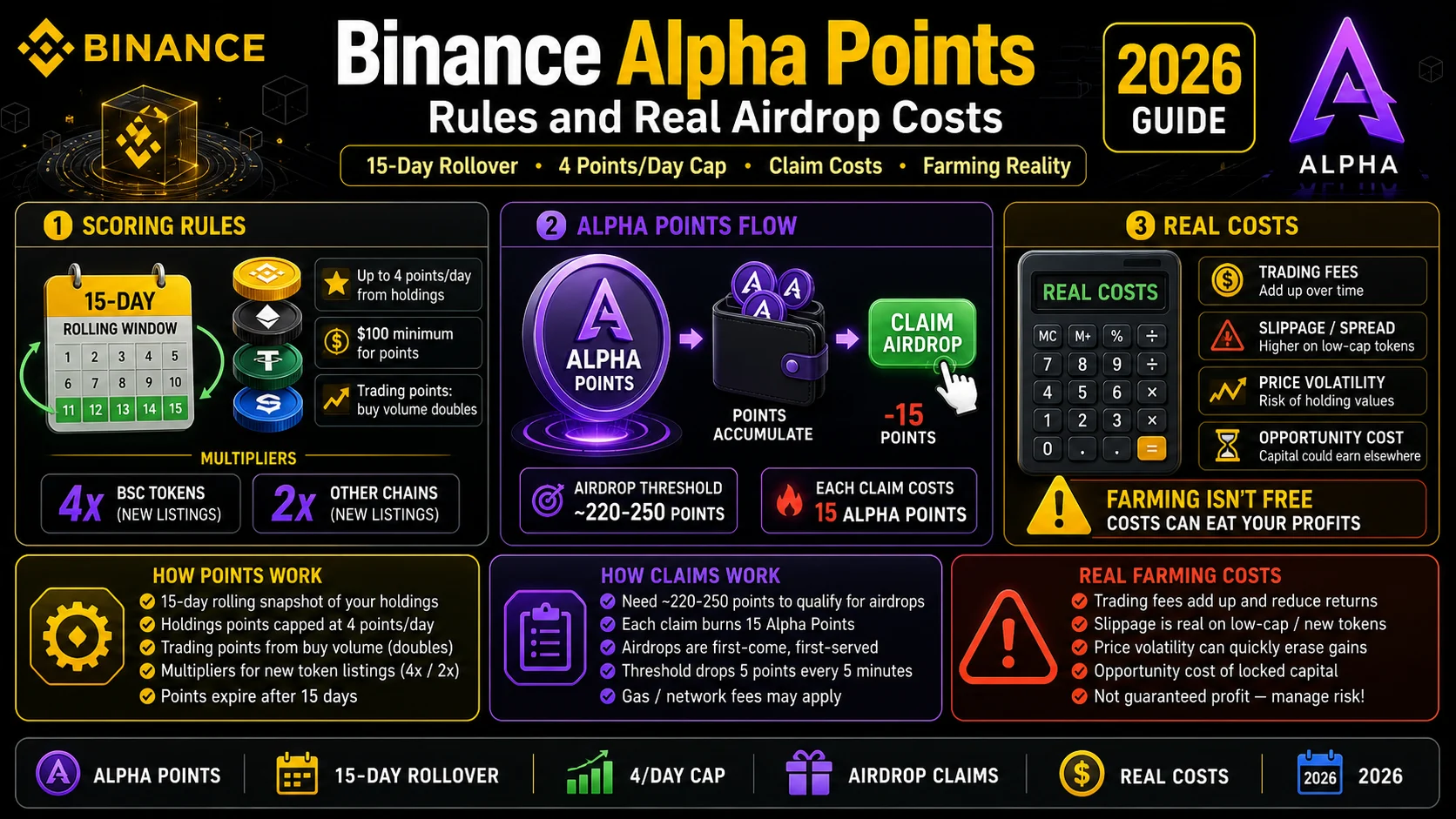
Binance Alpha Points (2026): Rules and Real Airdrop Costs
Alpha Points roll over 15 days and cap at 4 points a day from holdings. Here is how the scoring works, how claims work, and what farming really costs.

Binance in Chinese: Android Download and Registration (2026)
An Android walkthrough for Chinese speakers: official download sources, OEM install blocks, language settings, registration, KYC, and a first deposit.