
Binance vs Bitget (2026): Fees, Copy Trading, and Which Wins
Binance is cheaper for spot and futures; Bitget wins on copy trading. Compare 2026 fees, VIP tiers, BGB vs BNB discounts, withdrawals, and liquidity.
 Lucas Almeida 5 min read
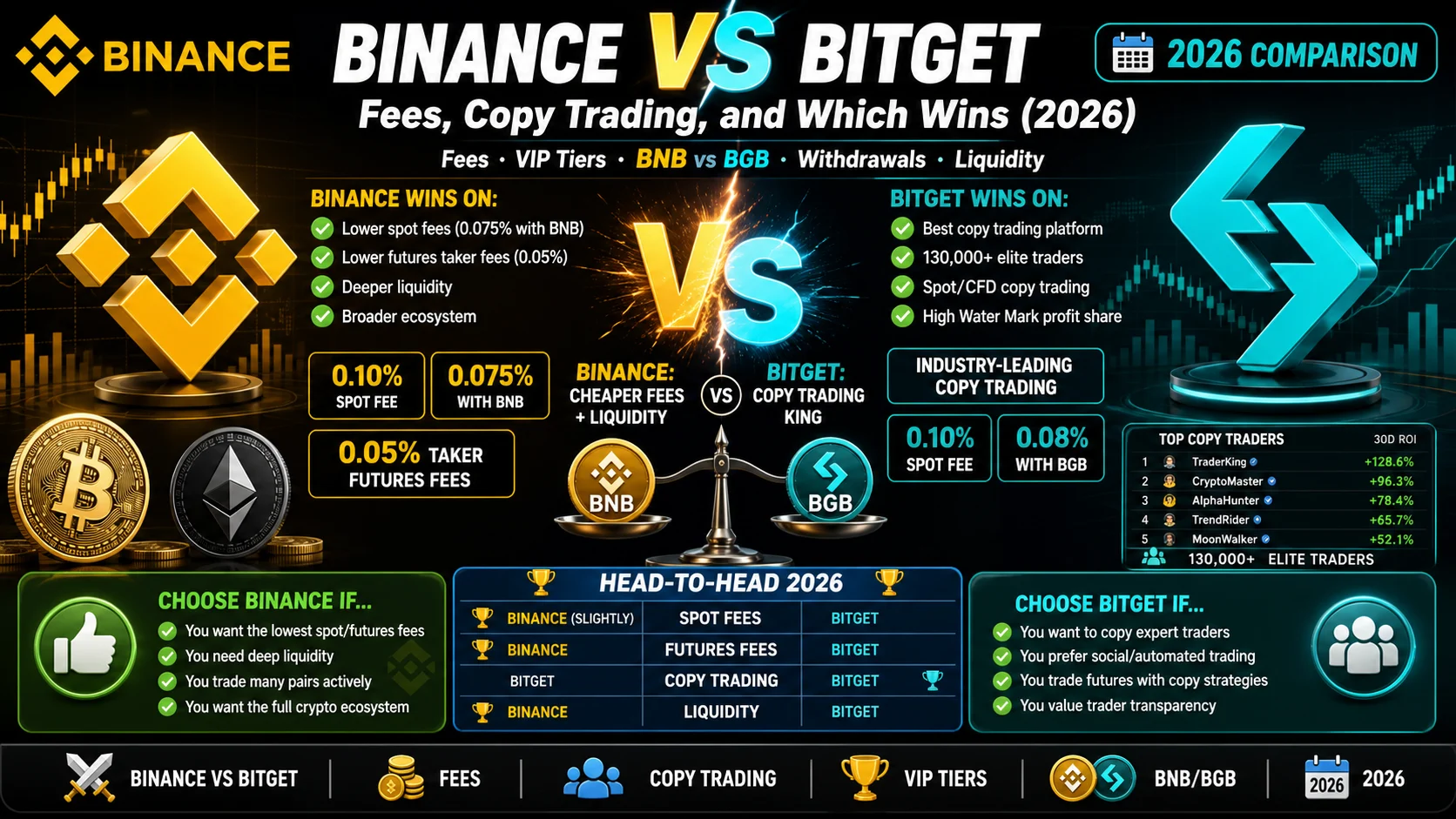
Key takeaways
- Binance is cheaper on the fees most traders pay: about 0.06% spot after BNB and a 20% rebate, versus Bitget's 0.064% after BGB, and 0.036% futures taker versus Bitget's 0.048%.
- Bitget wins clearly on copy trading: roughly 190,000 elite traders, profit shares commonly 10%–20%, and a 50 USDT entry point.
- Bitget's BGB discount is spot-only; it does not reduce futures fees. Binance's BNB discount applies to both spot and futures.
- On $1 million of monthly futures volume, Binance costs about $3,024 a year after rebate; Bitget costs about $3,840 — a $816 gap.
- Withdrawal fees are similar at the cheap end: both charge 0.01 USDT for USDT on BEP20, while Bitget is cheaper on TRC20 (1.5 versus 4 USDT).
There is no single winner, but the split is clear. Binance is cheaper on the fees most traders actually pay: about 0.06% spot after BNB and a 20% rebate, versus Bitget’s 0.064% after BGB, and 0.036% futures taker versus Bitget’s 0.048%. Bitget wins on copy trading, where it has the deepest roster of lead traders and more flexible profit-sharing, and on a few altcoin and multi-asset products.
On $1 million of monthly futures volume, the annual fee gap is about $816 — larger than the gap against most other major exchanges, because Bitget’s base futures taker fee is 0.06% rather than 0.05%. That is real money, but it is still smaller than a month of funding on the same notional.
This comparison uses the fee schedules, withdrawal data, and product terms published in 2026, and separates the numbers from the marketing.
⚠️ The most important thing first: don’t tap Sign Up directly in the app — you’ll miss the new-user rewards. The welcome benefits only apply when you register through an invite link or enter the referral code BN2688. Remember this.
Binance vs Bitget at a glance
| Category | Binance | Bitget | Edge |
|---|---|---|---|
| Spot base fee | 0.10% / 0.10% | 0.10% / 0.10% | Tie |
| Spot with platform token | 0.075% with BNB | 0.08% with BGB (20% off) | Binance |
| Spot after 20% rebate | 0.060% | 0.064% | Binance |
| Futures maker / taker (VIP 0) | 0.02% / 0.05% | 0.02% / 0.06% | Binance |
| Futures taker after 20% rebate | 0.036% | 0.048% | Binance |
| Platform token on futures | 10% off with BNB | No BGB futures discount | Binance |
| Copy trading | Smaller pool, higher fees | ~190,000 lead traders, 10%–20% shares | Bitget |
| BTC/USDT liquidity | 5–10× deeper | Thinner | Binance |
| USDT withdrawal on BEP20 | 0.01 USDT | 0.01 USDT | Tie |
| USDT withdrawal on TRC20 | 4.00 USDT | 1.50 USDT | Bitget |
| Protection fund | SAFU >$1B | ~$300M+, on-chain verifiable | Binance on size |
The table compresses the whole argument: Binance wins on price and depth; Bitget wins on copy trading and a handful of withdrawal routes. The rest of this guide explains where each difference actually matters.
Fee data was read from the public Binance and Bitget fee pages and independent 2026 comparisons on 7 November 2026. Rates and thresholds change; confirm on the live fee page before trading.
Which exchange is cheaper for spot trading?
Binance is cheaper for spot once both platform-token discounts are applied: 0.06% versus 0.064% after a 20% rebate. The gap is small, but it is consistent.
| Step | Binance | Bitget |
|---|---|---|
| Base rate | 0.10% | 0.10% |
| Platform-token discount | 0.075% with BNB (25% off) | 0.08% with BGB (20% off) |
| 20% referral rebate | 0.060% | 0.064% |
On a $100,000 monthly spot turnover, that is $60 versus $64 a month — $48 a year. Not a reason to switch on its own.
The more important difference is scope. Bitget’s BGB discount applies only to spot; Binance’s BNB discount applies to spot and futures. A trader who does both products gets more value from BNB, while a spot-only trader gets a similar benefit from either.
Bitget’s spot VIP 1 is cheaper than Binance’s VIP 1: 0.08% maker and taker at Bitget, versus 0.09% maker / 0.10% taker at Binance. By VIP 3 the picture reverses — Binance charges 0.04% maker / 0.06% taker, while Bitget charges 0.05% / 0.06%. Check the live schedules rather than assuming one venue is always cheaper at every tier.
Which exchange is cheaper for futures?
Binance is cheaper at every futures tier except VIP 2, where the two tie, and that is before Binance’s BNB discount is applied. The gap is largest at VIP 0, where Bitget charges 0.06% taker versus Binance’s 0.05%.
| Tier (30-day volume) | Binance maker / taker | Bitget maker / taker | Lower |
|---|---|---|---|
| VIP 0 | 0.020% / 0.050% | 0.020% / 0.060% | Binance |
| VIP 1 ($5M) | 0.018% / 0.050% | 0.019% / 0.060% | Binance |
| VIP 2 ($10M) | 0.016% / 0.040% | 0.016% / 0.040% | Tie |
| VIP 3 ($20M–$50M) | 0.012% / 0.032% | 0.014% / 0.0375% | Binance |
| VIP 5 | 0.008% / 0.027% | 0.010% / 0.032% | Binance |
Bitget’s VIP 1 is a trap for taker-heavy traders: the maker fee falls from 0.020% to 0.019%, but the taker fee stays at 0.060%. The first meaningful taker cut comes at VIP 2, which requires $10 million in 30-day futures volume. Binance’s VIP 1 already reduces the taker fee to 0.05%.
The tier labels are not perfectly comparable: Bitget reaches VIP 3 at $20 million in 30-day futures volume, while Binance requires $50 million. Compare the volume band you can actually reach, not just the VIP number.
With Binance’s BNB discount applied, the gap widens further: 0.045% taker at VIP 0 becomes 0.036% after a 20% rebate. Bitget has no equivalent futures discount, so its 0.06% taker becomes 0.048% after rebate.
Where does Bitget actually win?
Bitget’s real advantage is copy trading, not trading fees. It built its brand on letting users mirror professional traders, and the ecosystem is much larger than Binance’s.
| Feature | Binance | Bitget |
|---|---|---|
| Lead-trader pool | Smaller verified pool | ~190,000 elite traders, ~800,000 followers |
| Products you can copy | Futures first, spot added later | Spot, futures, and bots natively |
| Profit share | Up to 30% of profits plus 10% of trading fees | Commonly 10%–20%, up to ~30% |
| Minimum to start | Varies by trader | Often around 50 USDT |
| Exit flexibility | Some lead traders impose lock-ups up to 30 days | Generally more flexible |
The profit-share difference matters more than the fee difference. If you copy a trader with $10,000 and make $1,000 profit, Bitget’s 10%–20% share costs $100–$200. Binance’s structure can cost $300 plus 10% of your trading fees. For a copy-trading user, that can be several times the annual spot-fee gap.
Copy-trading figures above come from third-party 2026 comparisons and platform pages; exact terms vary by trader and region, so read the profit-share and lock-up terms before copying.
Bitget also supports multi-asset trading — crypto plus gold, stocks, and ETFs in some regions — which Binance’s global platform does not offer in the same form. If that is your use case, the fee comparison is secondary.
What about withdrawal fees?
Withdrawal costs are similar at the cheap end and diverge on Tron. The table uses public USDT withdrawal fees and minimums from 3 November 2026.
| Network | Binance | Bitget | Edge |
|---|---|---|---|
| BEP20 (BSC) | 0.01 USDT (min 5) | 0.01 USDT (min 5) | Tie |
| TRC20 (Tron) | 4.00 USDT (min 10) | 1.50 USDT (min 5) | Bitget |
| ERC20 (Ethereum) | 0.60 USDT (min 5) | 0.3–2 USDT (varies) | Mixed |
| Low-cost chains | Arbitrum 0.3 / Solana 0.7 | TON 0 / Optimism ~0.15 | Bitget on niche routes |
For small, frequent withdrawals, the TRC20 difference is the one that adds up. Sending $100 a week on Binance TRC20 costs $208 a year; on Bitget it costs $78. On BEP20 both are effectively free at $0.52 a year.
As always, the network must match what the receiver supports. Saving $2.50 on a TRC20 withdrawal is not worth sending funds to a chain the destination cannot credit.
Does liquidity matter more than fees?
Yes, once your order size is large enough to move the book. Binance is the deeper venue on major pairs, and the slippage difference can exceed the fee difference.
Third-party 2026 comparisons put Binance’s BTC/USDT order book at roughly five to ten times Bitget’s depth. For a $1,000 retail order, neither venue moves; for a $500,000 market order, the thinner book can cost several basis points in slippage — more than the 0.01%–0.02% fee gap.
The practical rule: use limit orders on Bitget for smaller altcoin futures, and route large BTC/ETH market orders to Binance. If you are a taker on size, depth is part of your fee.
How do they compare on safety and regulation?
Both are large, both publish reserves, and neither is risk-free. The differences are in scale and regulatory posture.
| Item | Binance | Bitget |
|---|---|---|
| Founded | 2017 | 2018 |
| Protection fund | SAFU, >$1B | ~$300M+, largely in BTC, on-chain verifiable |
| Proof of reserves | Periodic PoR | Merkle-tree PoR, reported ~169% |
| Regulatory history | 2023 US settlement, independent monitor | Fewer public enforcement actions; licenses/registrations in multiple jurisdictions |
| Restricted markets | US, parts of Europe and Asia | US, Canada, Singapore; Japan registrations reported stopped in 2026 |
Binance’s scale and liquidity come with a longer regulatory history, including the 2023 settlement and monitor. Bitget’s smaller footprint means fewer public enforcement actions, but also fewer licenses and less transparency in some markets. Check availability in your country before comparing anything else — a platform you cannot legally use is not cheaper.
Worked example: what the difference costs
Put volume, platform tokens, and rebates into one calculation. All figures use 2026 base rates and a 20% rebate.
$100,000 monthly spot volume
| Item | Binance (BNB + rebate) | Bitget (BGB + rebate) |
|---|---|---|
| Effective rate | 0.060% | 0.064% |
| Monthly fee | $60 | $64 |
| Annual fee | $720 | $768 |
| Difference | — | $48 a year |
$1 million monthly futures notional
| Item | Binance (BNB + rebate) | Bitget (rebate) |
|---|---|---|
| Average rate (50/50) | 0.0252% | 0.032% |
| Monthly fee | $252 | $320 |
| Annual fee | $3,024 | $3,840 |
| Difference | — | $816 a year |
Copy trading $10,000 with $1,000 profit
| Item | Binance | Bitget |
|---|---|---|
| Profit share | Up to $300 | $100–$200 |
| Trading-fee commission | 10% of your fees | Usually included |
| Total cost | ~$300 + fees | ~$100–$200 |
The copy-trading difference can outweigh years of spot-fee savings. That is why “which is cheaper” depends on which product you actually use.
Which should you choose?
| Your situation | Choose | Why |
|---|---|---|
| Spot trading, willing to hold a platform token | Binance | 0.06% after BNB and rebate |
| Futures at VIP 0–VIP 5 | Binance | Lower taker fees at every tier |
| Copy trading is your main strategy | Bitget | Larger trader pool and lower profit shares |
| Small altcoin futures | Bitget | More listings and flexible copy products |
| Large BTC/ETH orders | Binance | 5–10× deeper order book |
| Frequent TRC20 withdrawals | Bitget | 1.5 versus 4 USDT |
| Multi-asset (gold, stocks, ETFs) | Bitget | Broader product line in supported regions |
| You want one account for everything | Binance | Wider product breadth and liquidity |
A sensible combination is Binance as the main account for spot, futures, and large orders, with Bitget as a secondary account for copy trading and altcoin futures. Both should have 2FA, an anti-phishing code, and a withdrawal whitelist.
💡 Don't have a Binance account yet? Sign up now — 20% fee rebate on spot and futures — enter the referral code BN2688.
For the next steps, read how Binance fees work, how to register, and how Binance compares with Bybit and Coinbase. If you are evaluating copy trading specifically, start with how to use Binance before committing capital.
Disclaimer: This article is for education only and is not investment advice. Fees, VIP thresholds, copy-trading terms, and withdrawal charges change with platform policy and network conditions. Figures were checked on 3–7 November 2026; confirm the live fee page before trading. Futures and copy trading use leverage and can lose more than your initial margin. Availability varies by country — check the rules for your jurisdiction.
Don't have a Binance account yet?Sign up nowenter the referral codeBN2688
Frequently asked questions
Which is cheaper, Binance or Bitget?
Does Bitget's BGB discount apply to futures?
Is Bitget better than Binance for copy trading?
Is Bitget safe?
Which exchange has better liquidity?
Can I use both exchanges?
Editor-in-Chief & Lead Researcher
Editor of MyCryptoStart. Independent researcher of cryptocurrency exchanges, focused on fees, security, KYC, and onboarding — publishes step-by-step guides in plain English for beginners.
View author page →Some links on this page are affiliate links: we may earn a commission at no extra cost to you. This content is educational and is not financial, investment, or legal advice. Affiliate disclosure · Disclaimer.
Continue reading
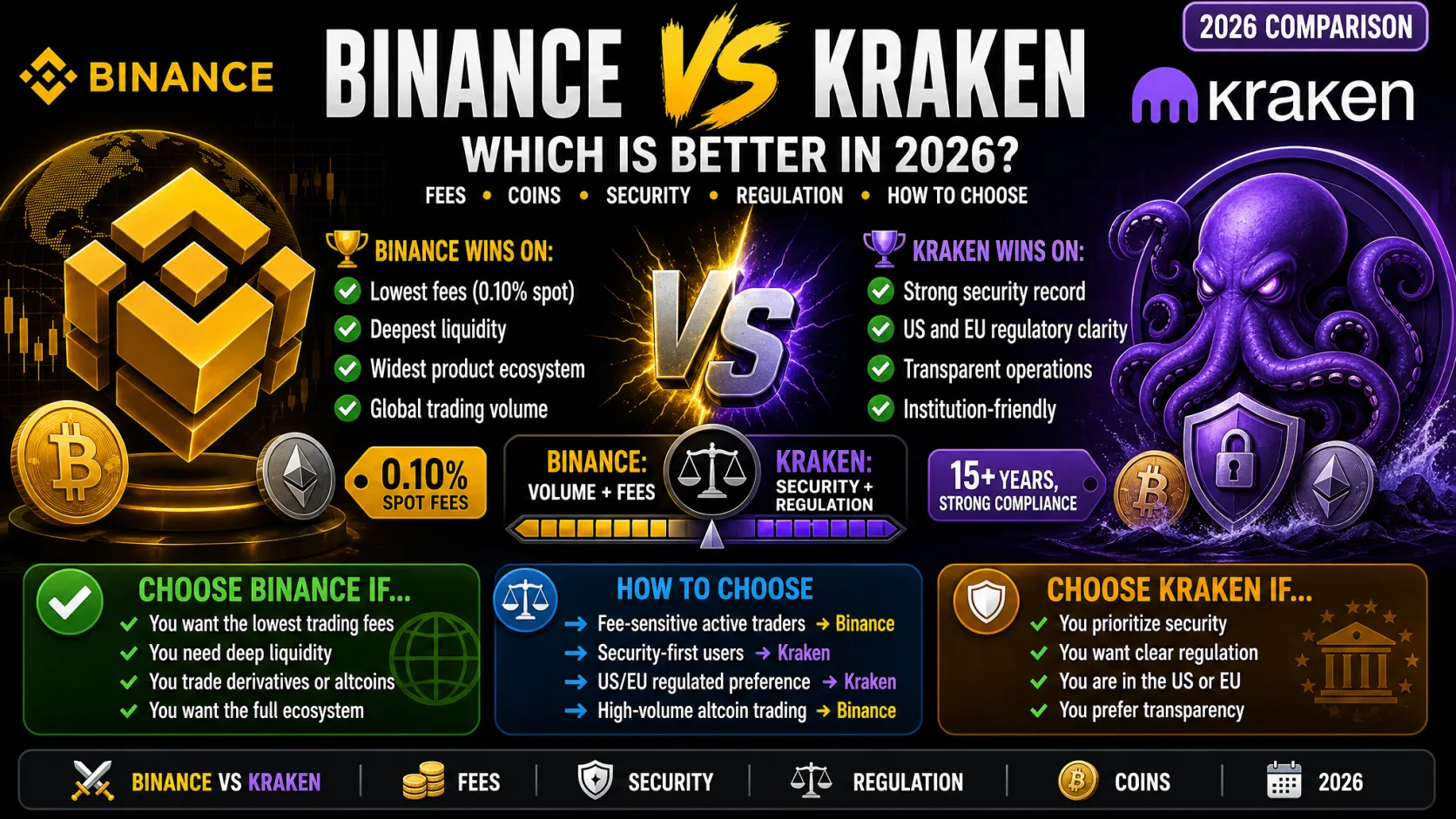
Binance vs Kraken: Which Is Better in 2026?
Binance charges 0.10% spot (0.075% with BNB). Kraken's entry tier is 0.40%/0.80% after its July 2026 rework. Fees, access, safety, and how to choose.
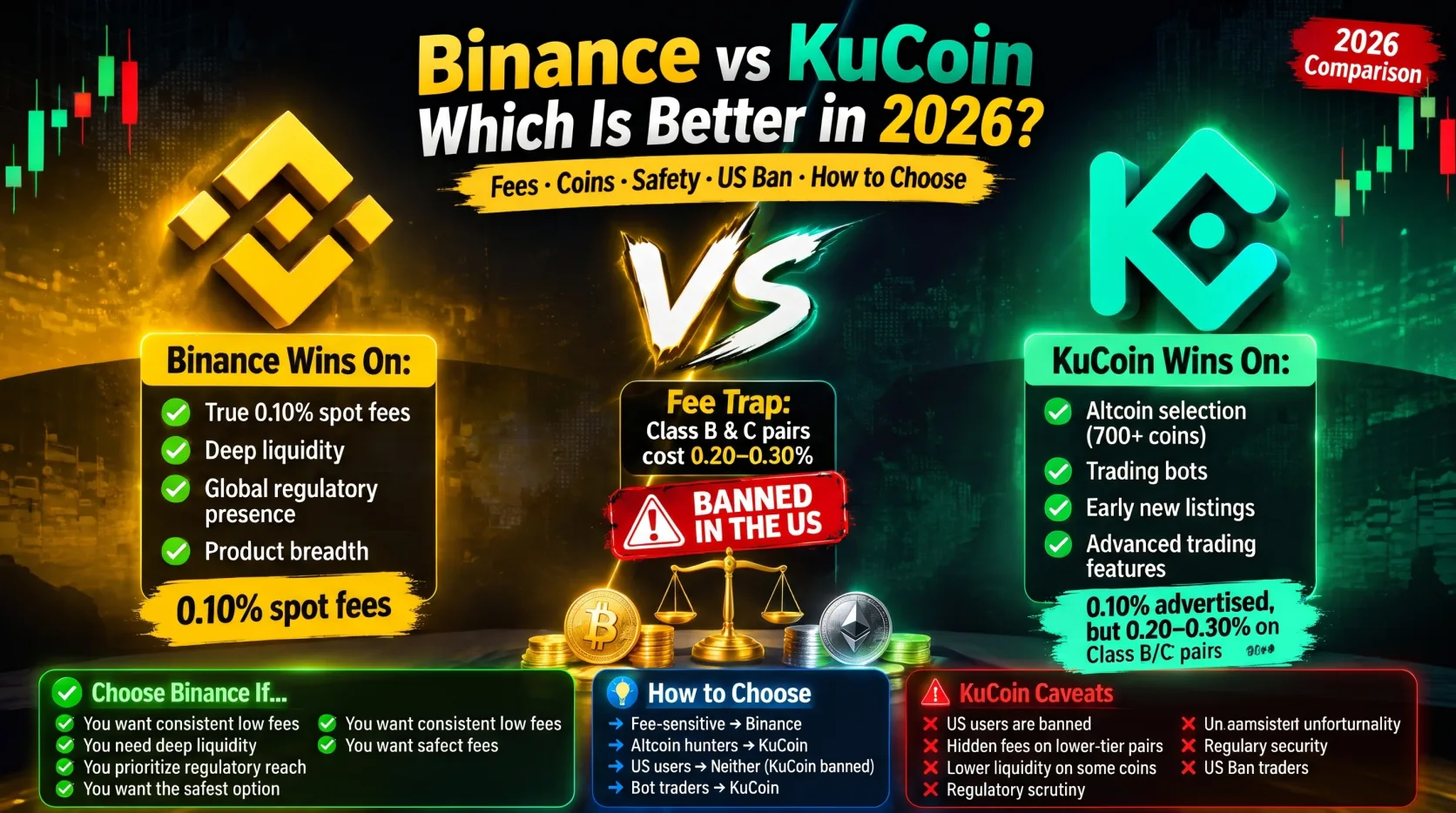
Binance vs KuCoin: Which Is Better in 2026?
Both advertise 0.10% spot, but KuCoin's Class B and C pairs cost 0.20–0.30% and it is banned in the US. Fees, coins, safety, and how to choose.
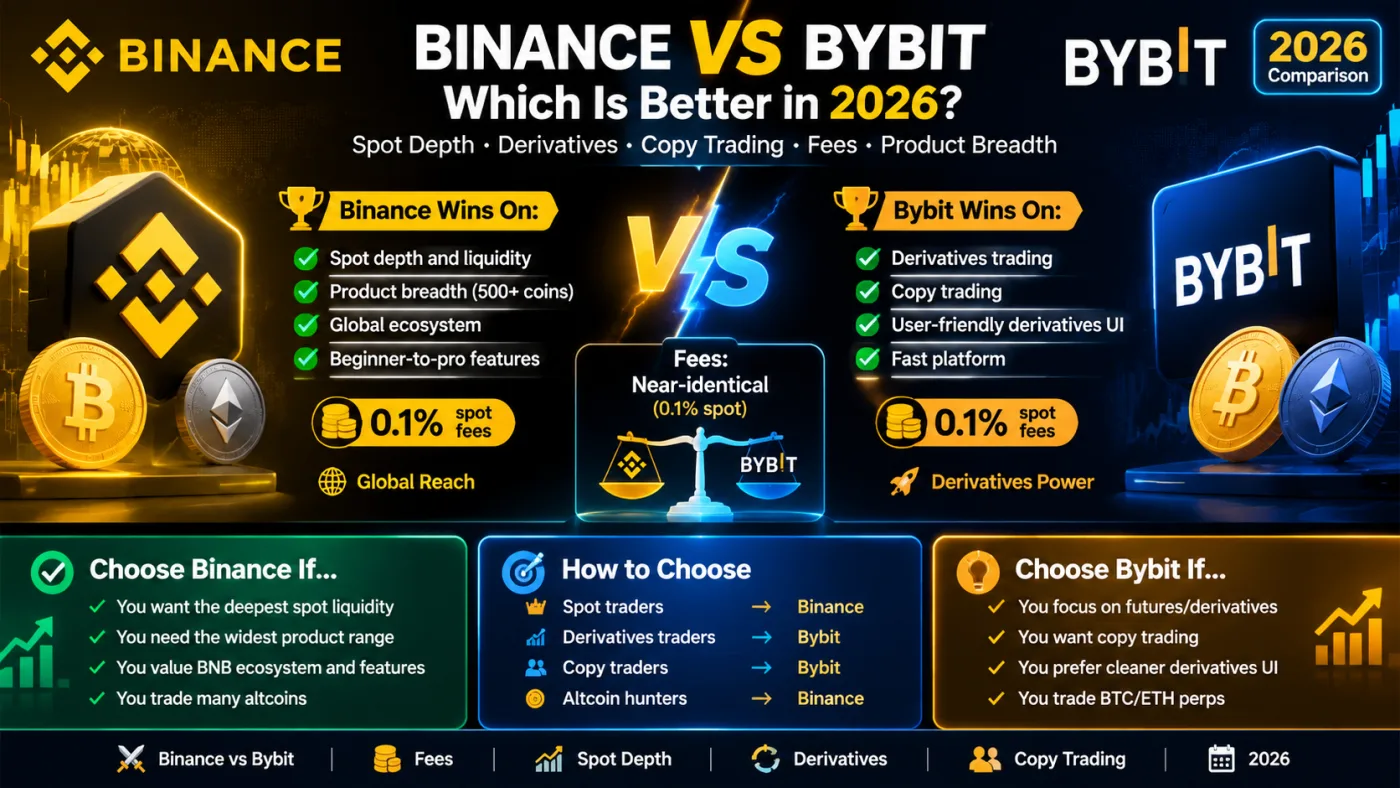
Binance vs Bybit: Which Is Better in 2026?
Binance wins on spot depth and product breadth; Bybit wins on derivatives and copy trading. Fees are near-identical (0.1% spot). Here's how to choose.