
Binance Fees Explained: What You'll Pay
A plain-English breakdown of Binance fees — the 0.1% spot fee, 25% BNB discount, free crypto deposits, and withdrawal costs.
 Lucas Almeida 5 min read
 Key takeaways
- Binance charges a standard spot trading fee of 0.10% for both makers and takers at the base level.
- Paying fees with BNB reduces the spot fee by 25%, bringing it to 0.075% per trade.
- Crypto deposits are free; crypto withdrawals carry a per-coin network fee that varies by coin and network.
- Buying crypto with a card or depositing fiat by bank transfer carries its own, separate fees that depend on your region and method.
- Fees change over time, so always check the official fee schedule before assuming today's rates still apply.
Binance’s standard spot trading fee is 0.10% for both makers and takers at the base level. If you pay fees with BNB, you get a 25% discount, bringing the rate to 0.075%. Crypto deposits are free; crypto withdrawals carry a per-coin network fee, and card or bank purchases add their own separate costs.
Those are the headline numbers. The rest of this guide explains where each fee comes from and how to keep your total cost low.
The Binance fee structure at a glance
Binance’s fees fall into a few clean buckets. Here they are side by side.
| Activity | Fee (base level) |
|---|---|
| Spot trading | 0.10% maker / 0.10% taker |
| Spot trading with BNB | 0.075% maker / 0.075% taker (25% off) |
| Crypto deposit | Free |
| Crypto withdrawal | Per-coin network fee (varies) |
| Card purchase | Card processing fee + possible bank fee |
| Fiat bank transfer | Varies by region and method |
Fees change over time, and some pairs or promotions are exceptions. Treat this table as the base case, and check the official fee schedule for the pair and amount you actually plan to trade.
Spot trading fees: the 0.10% that matters most
When you trade on the spot market, Binance takes a small percentage of the trade value. At the base VIP 0 level that is 0.10% — one-tenth of one percent — for both sides of the trade.
A concrete example makes it clear. If you buy $1,000 of Bitcoin, the fee is:
$1,000 × 0.10% = $1.00
Buy $1,000 and later sell it, and you pay roughly $2.00 in total trading fees. Small on a single trade, but it adds up across many trades — which is why the next section matters.
The rate is the same whether you are a maker (you place an order that sits on the order book) or a taker (you fill someone else’s order immediately). At base level they are equal; at higher VIP tiers the maker fee drops first.
VIP tiers: how trading volume lowers your fee
Binance prices fees by VIP tier, based on your rolling 30-day trading volume. The table below reflects the fee schedule following Binance’s VIP 3–9 update in late 2024; rates can change, so treat it as a snapshot and confirm the current numbers on Binance’s official fee page.
| Tier | 30-day volume (USD) | Maker fee | Taker fee |
|---|---|---|---|
| VIP 0 (regular) | under 1M | 0.1000% | 0.1000% |
| VIP 1 | ≥ 1M | 0.0900% | 0.1000% |
| VIP 2 | ≥ 5M | 0.0800% | 0.1000% |
| VIP 3 | ≥ 20M | 0.0400% | 0.0600% |
| VIP 4 | ≥ 75M | 0.0400% | 0.0520% |
| VIP 5 | ≥ 150M | 0.0250% | 0.0310% |
| VIP 6 | ≥ 400M | 0.0200% | 0.0290% |
| VIP 7 | ≥ 800M | 0.0190% | 0.0280% |
| VIP 8 | ≥ 2B | 0.0160% | 0.0250% |
| VIP 9 | ≥ 4B | 0.0110% | 0.0230% |
The pattern is clear: the maker fee falls much faster than the taker fee. For a retail trader placing occasional market orders, VIP tier barely matters — the base 0.10% is what you pay. Tiers start to matter once you trade in the hundreds of thousands per month, and you can also reach some tiers by holding BNB. The BNB discount stacks on top of your tier rate, which is the next section.
The BNB discount: how to cut the fee by 25%
Binance offers a discount if you hold its own token, BNB, and pay your trading fees with it.
Enable the “use BNB to pay fees” setting, and the spot fee drops 25%, from 0.10% to 0.075%. On that same $1,000 trade:
$1,000 × 0.075% = $0.75
The discount is applied automatically when the setting is on and you hold BNB in your account. It is the easiest way for a regular retail trader to reduce costs, with no special tier or volume requirement.
Two caveats. First, paying in BNB means you hold and spend BNB, which is a separate asset with its own price moves — the discount should not be the only reason to hold it. Second, the exact discount percentage has changed over time, so confirm today’s rate in the fee schedule before relying on it.
The fee at a few trade sizes
To make the 0.10% rate concrete, here is the spot fee on a single buy at several amounts, with and without the BNB discount:
| Trade size | Fee at 0.10% | Fee at 0.075% (BNB discount) |
|---|---|---|
| $100 | $0.10 | $0.075 |
| $1,000 | $1.00 | $0.75 |
| $10,000 | $10.00 | $7.50 |
Remember you pay this on the way in and the way out — a full buy-and-sell round trip costs roughly twice the number above. On a $10,000 position traded once in and once out at base rate, that is about $20 in total trading fees. Small per trade, but it compounds if you trade often.
Deposit fees: free, with one exception
Depositing cryptocurrency into Binance is free. Binance charges nothing to receive crypto — its deposit and withdrawal schedule lists the exact fees per coin and network.
The only cost is the network (blockchain) fee, and that is paid by the sender, not by Binance. If you send Bitcoin from your own wallet, your wallet pays the Bitcoin network fee. Binance does not add anything on top.
The exception is fiat funding. Buying crypto with a card carries a card-processing fee, and your bank may add a foreign-transaction fee. Bank transfers are often cheaper but slower. Both depend on your region and method, and the exact cost is shown on the deposit or purchase screen before you confirm.
Here is how the funding routes compare on cost:
| Method | Typical cost | Speed |
|---|---|---|
| Crypto transfer | Free (sender pays the network fee) | Minutes |
| Bank transfer | Low, but varies by region and method | Hours to days |
| Card purchase | Card-processing fee, sometimes plus a bank foreign-transaction fee | Instant |
The pattern: the more convenient the method, the more it tends to cost. A crypto transfer is the cheapest way in; a card purchase is the fastest and most expensive.
Withdrawal fees: per coin, per network
Withdrawal fees are the least predictable part of the structure, because they are per coin and per network — Binance’s withdrawal fee schedule is the authoritative place to check the current rate for any coin.
- Different coins cost different amounts. The fee to withdraw Bitcoin is not the same as the fee to withdraw Ethereum or USDT.
- The same coin costs different amounts on different networks. Withdrawing USDT on ERC20 usually costs more than on TRC20 or BNB Smart Chain.
- The fee is shown before you confirm. The withdrawal page always displays the exact fee for your coin, network, and amount.
These fees go toward covering the network cost of moving your funds on-chain. For a detailed walkthrough of how to withdraw and check the fee, see our withdrawal guide.
Other fees worth knowing about
Beyond spot trading, Binance charges fees on other products. You only pay these if you use them:
- Futures and margin. These have their own, generally different fee schedules, usually separate from spot.
- P2P. Peer-to-peer trading is typically zero-fee on Binance’s side — the “price” is the exchange rate the seller sets. See our P2P guide.
- Convert / one-click buy. Simple conversion features embed a spread or small fee, shown before you confirm.
- Card and fiat. Covered above — the convenience carries a cost.
The theme is the same everywhere: the fee is always displayed before you commit. Read that number, and you will not be surprised.
How to check your actual fees
Your real fee depends on your account, so verify it in a few places rather than trusting a table from memory.
- Fee schedule. Binance publishes a full schedule covering spot trading fees and deposit and withdrawal fees. Check them for the exact current rates.
- Trade confirmation. Every order shows the fee you paid once it fills.
- Withdrawal screen. Shows the exact withdrawal fee before you confirm.
- VIP level. Your account page shows your current tier and whether you qualify for lower fees.
Fees change, and promotions come and go. A quick check before a large trade is worth more than any remembered number.
How to keep your total cost low
A few habits keep fees from eating into your returns:
- Enable the BNB discount if you already hold or are comfortable holding BNB.
- Use limit orders where possible — at higher tiers maker fees are cheaper, and even at base level a limit order never costs more.
- Deposit crypto rather than buying by card when you can, since crypto deposits are free.
- Batch withdrawals. Because withdrawal fees are per transaction, one larger withdrawal costs less than several small ones.
- Check the fee schedule before large trades, since rates change.
None of this is about beating the market. It is about not paying more than you have to for the same trade.
The bottom line
Binance’s base spot fee is 0.10%, cut to 0.075% with the BNB discount. Crypto deposits are free, and withdrawal fees vary by coin and network. The most reliable way to pay less is to enable the BNB discount if you hold BNB, prefer crypto deposits over card purchases, and read the fee shown on the screen before every trade and withdrawal.
💡 Don't have a Binance account yet? Sign up now — enter the referral code BN2688.
Ready to put this into practice? Start with creating an account and making your first deposit.
Don't have a Binance account yet?Sign up nowenter the referral codeBN2688
Frequently asked questions
What is Binance's standard spot trading fee?
How does the BNB fee discount work?
Are there any free ways to deposit or trade on Binance?
How much are Binance withdrawal fees?
Do I pay fees when I buy crypto with a card?
What is the difference between a maker and taker fee?
Editor-in-Chief & Lead Researcher
Editor of MyCryptoStart. Independent researcher of cryptocurrency exchanges, focused on fees, security, KYC, and onboarding — publishes step-by-step guides in plain English for beginners.
View author page →Some links on this page are affiliate links: we may earn a commission at no extra cost to you. This content is educational and is not financial, investment, or legal advice. Affiliate disclosure · Disclaimer.
Continue reading
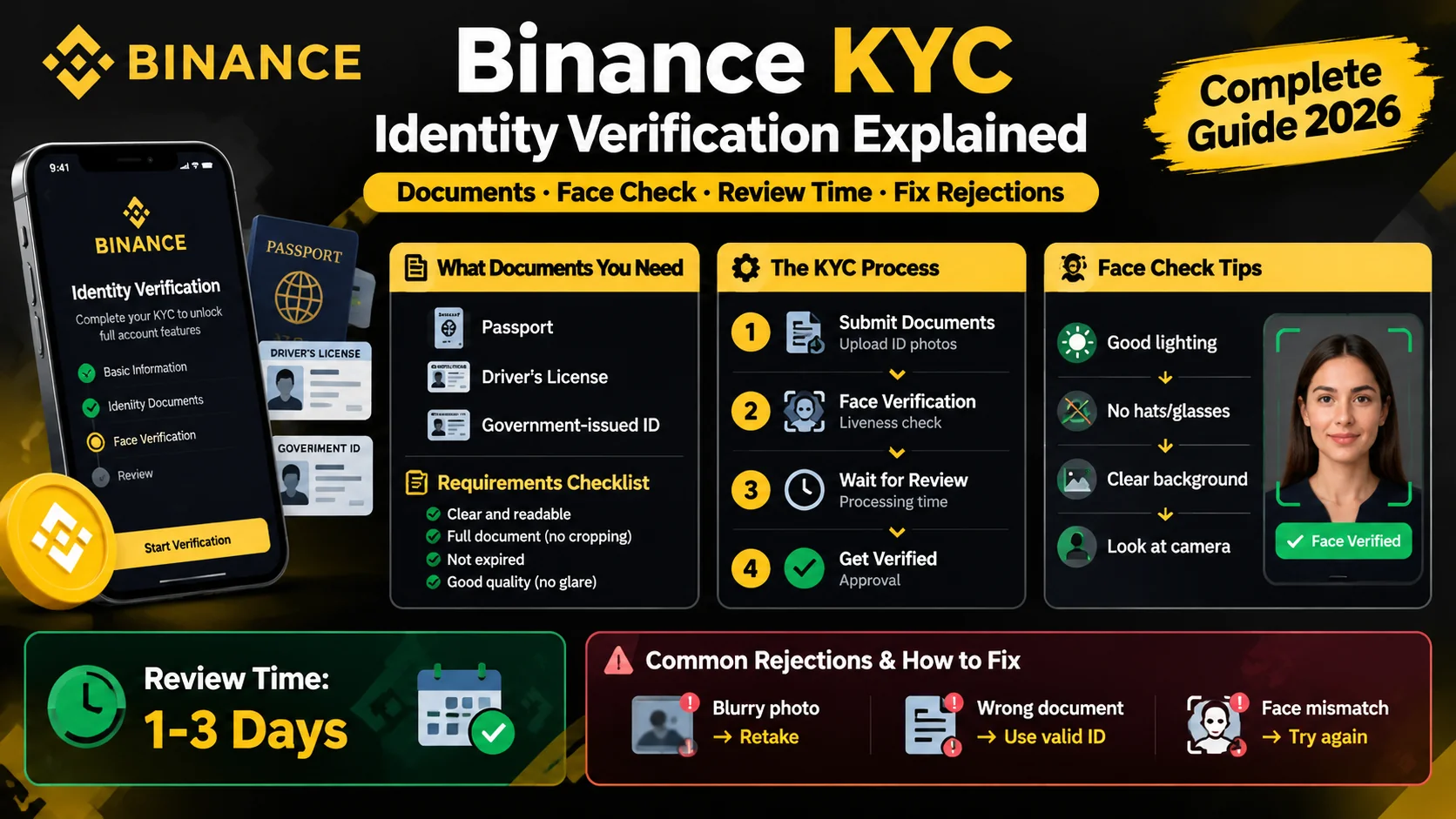
Binance KYC: How Identity Verification Works
Binance requires KYC before you trade. Learn the documents you need, how the face check works, how long review takes, and how to fix rejections.
Binance P2P: Buy and Sell Crypto Peer-to-Peer
How Binance P2P works — buy and sell crypto directly with other users, with zero fees and an escrow system that holds funds until payment is confirmed.
How to Create a Binance Account (2026 Guide)
Create a Binance account in about five minutes: sign up with email or phone, verify KYC, and turn on 2FA. Step-by-step guide for beginners.