
Dollar-Cost Averaging (DCA) in Crypto (2026)
Dollar-cost averaging buys a fixed dollar amount of crypto on a set schedule. Learn how DCA works, what backtests show, and when lump sum wins.
 Lucas Almeida 5 min read
Key takeaways
- Dollar-cost averaging means buying a fixed dollar amount of crypto on a set schedule — say $100 every week — no matter the price, which automatically buys more when prices are low and less when they are high.
- The payoff is behavioral, not guaranteed: DCA removes the need to time the market and smooths your average entry price, but it does not promise a profit.
- The honest statistical truth cuts the other way: Vanguard's research found lump-sum investing beat DCA about two-thirds of the time, because markets rise more often than they fall.
- DCA earns its keep in choppy or falling markets — one backtest found it beat lump sum in the 20–70% drawdown zone below Bitcoin's all-time high.
- DCA is best used on a large, liquid asset like Bitcoin or Ethereum, with money you can afford to leave untouched for years — not on speculative altcoins.
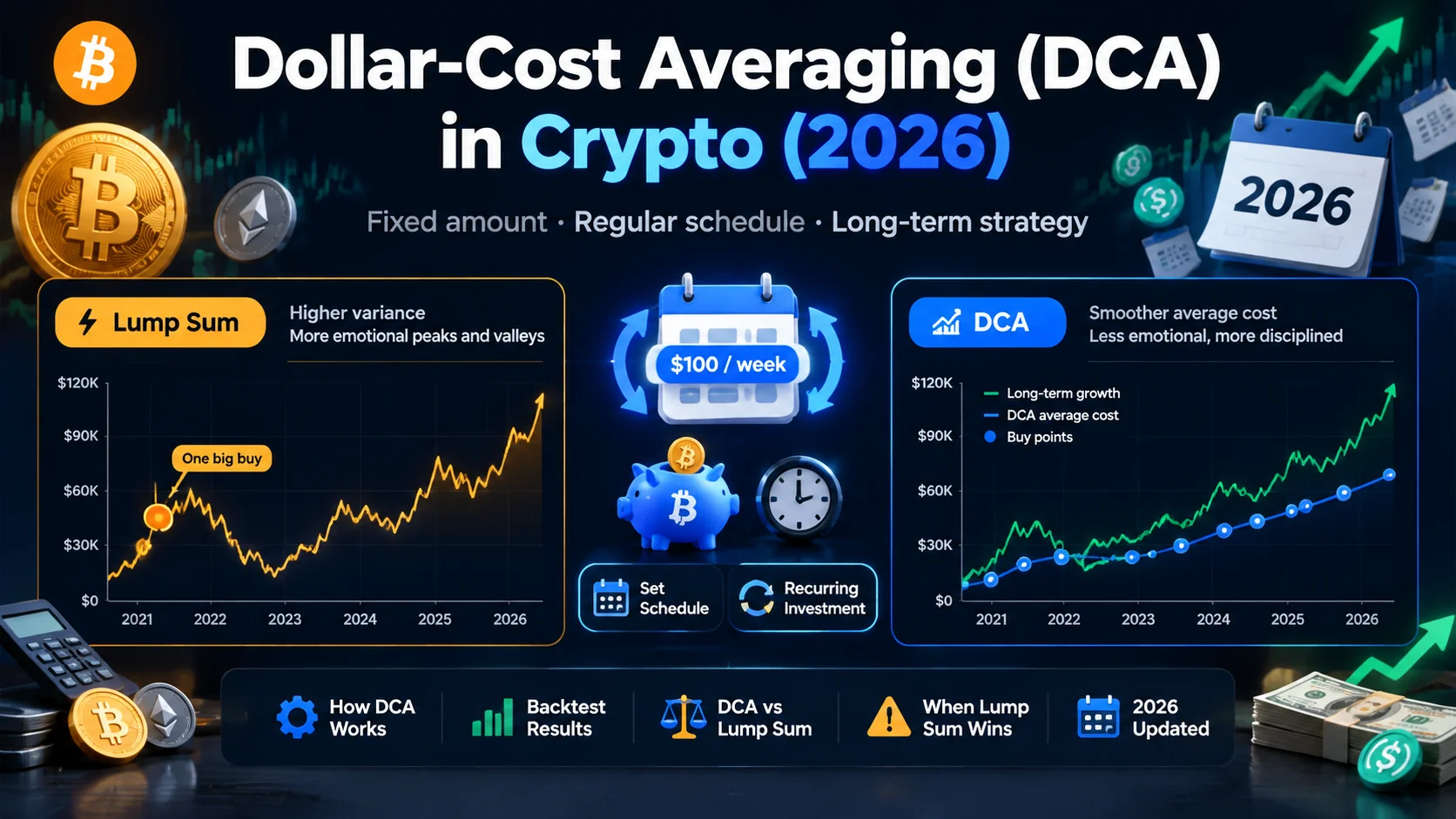
Dollar-cost averaging (DCA) means buying a fixed dollar amount of crypto on a set schedule — such as $100 of Bitcoin every week — instead of trying to time the market. The honest summary of the evidence is equally simple: DCA will not usually beat investing a lump sum in a rising market, but it removes the single biggest reason beginners lose money — making one large, badly-timed bet and then panicking.
This guide explains what DCA is, walks through the math with a concrete example, and — more importantly — shows you what the historical data actually says, including where DCA genuinely wins and where it does not. Because the whole point of DCA is discipline over prediction, we end with how to set it up so it runs on autopilot.
What Is Dollar-Cost Averaging (DCA)?
Dollar-cost averaging is a strategy where you invest the same dollar amount at regular intervals, no matter what the price is doing. If you commit to $100 of Bitcoin every Monday, you make that purchase whether Bitcoin is at $30,000 or $120,000 — the amount stays fixed, and the price determines how much coin you get.
The name comes from exactly what happens to your cost: because you spend a flat amount, you buy more units when the price is low and fewer when it is high, and the average price you paid drifts toward the lower end of the range over time. That is the “averaging” part.
The opposite approach is a lump sum — putting your whole budget in at once. DCA spreads the same budget across many small purchases over weeks, months, or years.
How Does Dollar-Cost Averaging Work?
The mechanism is easiest to see with a deliberately exaggerated example. Say you buy $100 of Bitcoin every week for five weeks, and the price swings wildly:
| Week | Bitcoin price | BTC you buy |
|---|---|---|
| 1 | $100 | 1.0 BTC |
| 2 | $50 | 2.0 BTC |
| 3 | $25 | 4.0 BTC |
| 4 | $50 | 2.0 BTC |
| 5 | $100 | 1.0 BTC |
You spent $500 total and received 10 BTC. Your average cost is therefore $500 ÷ 10 = $50 — even though the “typical” price across those five weeks was much higher (the simple average is $65). DCA tilted your buys toward the cheap weeks: you bought four coins in week 3 at $25 and only one coin in week 1 at $100.
That is the entire engine of DCA in one table. The one formula worth remembering:
Average purchase price = total dollars invested ÷ total coins bought
The more the price falls, the harder your fixed dollar amount works, which is why DCA’s fans describe it as “buying the dip automatically, without having to guess where the bottom is.” Binance’s DCA explainer and Crypto.com’s guide both frame it this way: the strategy converts an unpredictable market into a single, repeatable habit.
Why People Use DCA in Crypto
Crypto is the asset class DCA was arguably made for, because its price swings are far larger than stocks. The benefits break into four clear ones:
- It removes timing risk. A lump sum invested the week before a crash loses a large amount immediately; the same budget spread across a year absorbs that crash across many price points. This is the core insurance DCA provides.
- It removes emotion. FOMO buying near the top and panic selling near the bottom are the classic beginner losses. A scheduled purchase happens whether you feel bullish or terrified, so the strategy enforces the discipline you would otherwise fail to maintain.
- It is simple and accessible. You decide three things — the asset, the amount, and the frequency — and nothing else. There is no chart analysis or entry-point guessing involved, which is why it is the most commonly recommended first strategy for new investors.
- It can run on autopilot. Every major exchange offers a recurring-buy feature: Binance calls it Convert Recurring (it was Auto-Invest until 2025), and Crypto.com has a DCA bot. Once set, the purchase fires on its own.
The one caveat that must sit next to all four benefits: none of them is “higher returns.” DCA’s payoff is lower stress and lower timing risk, not a guaranteed edge — and the data makes that distinction sharply.
What the Data Actually Shows
The uncomfortable but well-documented finding is that in a rising market, DCA usually underperforms a lump sum. Vanguard’s research on the question — the most cited academic treatment — found that investing a lump sum beat dollar-cost averaging roughly two-thirds of the time, across US, UK, and Australian markets and rolling periods. The reason is “cash drag”: because markets rise more often than they fall, money sitting in cash waiting to be deployed misses out on gains. The longer you stretch a DCA schedule, the bigger that drag grows. You can read Vanguard’s own framing in its cost-averaging research.
So where does DCA actually win? Three specific, sourced patterns:
- In choppy or falling markets. A widely cited backtest (the “Nobrainflip” study, summarized by CoinMarketCap) found DCA outperformed lump sum in the 20–70% drawdown zone below Bitcoin’s all-time high — precisely where Bitcoin has spent a large share of its history. Once the market is already down more than 70% from its peak, the study found lump sum regains the edge, because such capitulation often marks the end of a major decline.
- Over a full boom-and-bust cycle. Swan Bitcoin analyst Adam Livingston’s comparison of $100 per week over five years (reported by CoinMarketCap) found Bitcoin DCA returned 62.9%, versus 43.6% for the same dollar schedule into the S&P 500 — despite crypto’s higher volatility.
- When you simply never sell. Coinbird’s long-horizon simulation found that buying $100 of Bitcoin every month since 2015 turned $13,700 of contributions into roughly $632,000 by the mid-2020s — a gain of thousands of percent — though the same investor had to sit through a 76% drawdown at the worst point, which is the part summary headlines usually leave out.
The real-world case study is El Salvador, which has bought one Bitcoin per day since November 2022 as an explicit DCA policy. Blockchain tracker Lookonchain estimated the daily-buy program alone had produced an unrealized profit of about 113% by late 2025, with an average purchase price around $55,886 per BTC — an example of a government doing what individual investors do, and a reminder that DCA’s results depend entirely on the entry window you happen to live through.
The balanced conclusion from all of this: DCA is not a return-maximizing strategy — it is a risk-reduction and behavior strategy that happens to perform best in exactly the volatile, drawdown-heavy markets crypto is famous for.
The Downsides of Dollar-Cost Averaging
Being honest about DCA means naming its costs:
- Cash drag in a bull market. If you have a lump sum ready and spread it over 12 months during a strong rally, you simply buy in higher and higher and end up with fewer coins than if you had gone all in on day one. This is why lump sum wins the majority of historical scenarios.
- It does not guarantee a profit. DCA applied to an asset that trends downward still loses money — it just loses it more slowly. The strategy only makes sense on assets you genuinely expect to recover over years.
- Fees can stack up. Frequent small purchases can mean paying a spread or trading fee on every single buy, which adds up. On major exchanges the maker/taker fee on a recurring buy is small, but it is not zero.
- Tax and record-keeping complexity. Every buy creates a lot with its own cost basis, so tracking your capital gains later involves more line items than a single purchase would. If you plan to hold for years, keep a record of each buy.
None of these make DCA wrong; they make it a choice, not a default that is always optimal. The right framing is that DCA is what you use when you cannot stomach — or cannot afford — being fully wrong on a single big bet.
Is DCA or Lump Sum Better for You?
The decision is genuinely rule-based, not a matter of taste, and it comes down to one question: do you already hold the money as cash, or are you investing out of future income?
- If you already have a lump sum and a multi-year horizon, the evidence says to lean toward investing it sooner — the Vanguard two-thirds finding applies. The main reason to DCA a lump sum instead is purely psychological: if you know a 30% drop right after investing would make you panic-sell, spreading the entry over 6–12 months is worth the expected return you give up, because staying invested beats any entry-timing skill.
- If you are investing out of each paycheck, DCA is not even a “strategy choice” — it is just what you are already doing. Your income arrives on a schedule, so your investments do too. Here DCA is the natural, correct default.
- If the market is in a deep, confirmed drawdown (down 20–70% from its peak), the data flips in DCA’s favor, because spreading your entry avoids guessing the exact bottom.
The rule of thumb that survives all three cases: DCA for peace of mind and regular income; lump sum for an existing cash pile and a long, calm time horizon. Neither is “the smart one” in the abstract — the one that beats the other is whichever you will actually stick with.
How to Start Dollar-Cost Averaging
Getting started takes about ten minutes and should then be forgotten:
- Pick a liquid asset. For almost everyone this is Bitcoin, and Ethereum as a second option. Skip speculative altcoins — DCA on a coin that collapses to zero is just feeding a fire.
- Pick an amount you can genuinely lose. The rule is the same as any crypto position: only money you will not need for years, and only what you could write off entirely.
- Set a fixed schedule. Weekly or monthly are the sweet spots. The amount matters more than the frequency; consistency matters more than the amount.
- Automate it. On Binance, the feature is now Convert Recurring — Auto-Invest was folded into Convert in 2025, and our Auto-Invest guide covers where the screen moved and what it costs. Setting it to fire automatically is what makes the strategy actually work — the moment you have to make a manual decision every week, you are back to timing the market with your emotions.
- Leave it alone. Resist checking the price before each buy. The entire point is that the schedule, not the chart, makes the decision.
💡 Don't have a Binance account yet? Sign up now — 20% fee rebate on spot and futures — enter the referral code BN2688.
If you have not opened an account yet, start with our step-by-step guide to buying crypto, which walks through the first purchase on a regulated exchange, then switch on the recurring-buy feature — on Binance that is Convert Recurring — so your DCA runs without further input. And before you commit real money, confirm you actually understand what you are buying — our Bitcoin guide and Ethereum guide are the two to read first.
The Bottom Line
Dollar-cost averaging is buying a fixed dollar amount of crypto on a schedule, so the market’s swings work in your favor instead of against your emotions. It will not usually out-return a well-timed lump sum — the data is clear that lump sum wins about two-thirds of the time in rising markets — but it removes the timing risk and the emotional mistakes that cost beginners far more than any fee or missed percentage point.
The honest way to use it: if you are investing out of regular income, or you would panic after a crash, DCA is the right tool. If you already hold a cash pile and have a long, calm horizon, the evidence points to investing it sooner. Either way, the deciding factor is the same one that matters most in crypto — picking a plan you will actually follow, then letting it run.
The information in this article is for education only and is not financial advice. Past performance — including the backtests cited here — does not guarantee future results.
Don't have a Binance account yet?Sign up nowenter the referral codeBN2688
Frequently asked questions
What is dollar-cost averaging in crypto?
How does dollar-cost averaging actually work?
Is dollar-cost averaging better than lump-sum investing?
Does dollar-cost averaging guarantee a profit?
What is the best crypto to dollar-cost average into?
How do I start dollar-cost averaging?
Editor-in-Chief & Lead Researcher
Editor of MyCryptoStart. Independent researcher of cryptocurrency exchanges, focused on fees, security, KYC, and onboarding — publishes step-by-step guides in plain English for beginners.
View author page →Some links on this page are affiliate links: we may earn a commission at no extra cost to you. This content is educational and is not financial, investment, or legal advice. Affiliate disclosure · Disclaimer.
Continue reading
How to Stake Crypto and Earn Yield (2026)
Crypto staking locks your coins to secure a proof-of-stake network and earn rewards — typically 2–8% a year. Learn how it works, the real risks, and how to start.
Crypto Taxes Explained: Rates & Rules (2026)
Selling, swapping, or spending crypto is a taxable event; buying and holding is not. How US crypto taxes work in 2026: rates, rules, and how to file.
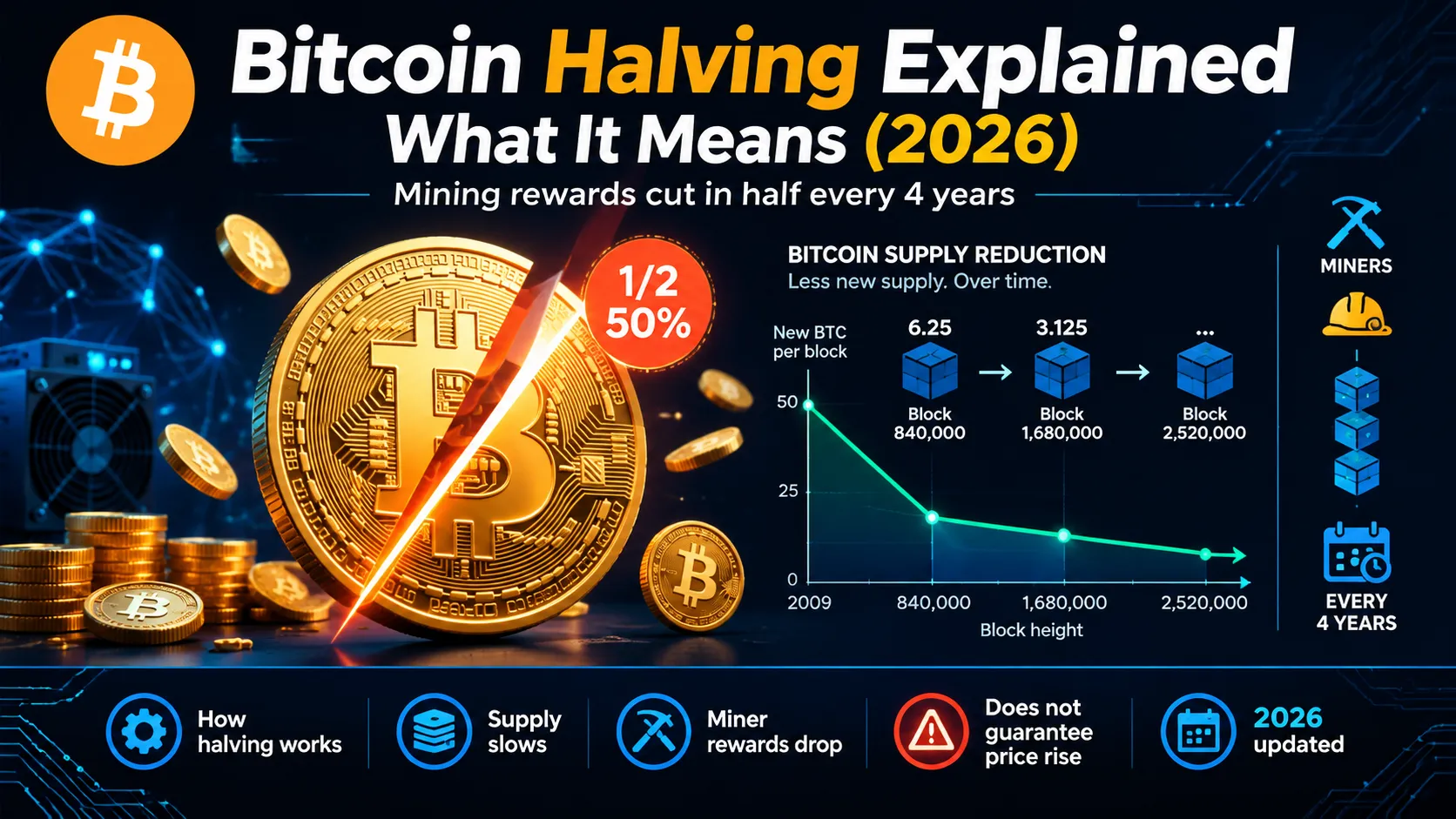
Bitcoin Halving Explained: What It Means (2026)
The halving cuts Bitcoin's mining reward in half every four years, slowing new supply. Learn how it works and why it does not guarantee a price rise.