
Binance vs Coinbase: Which Is Right for You?
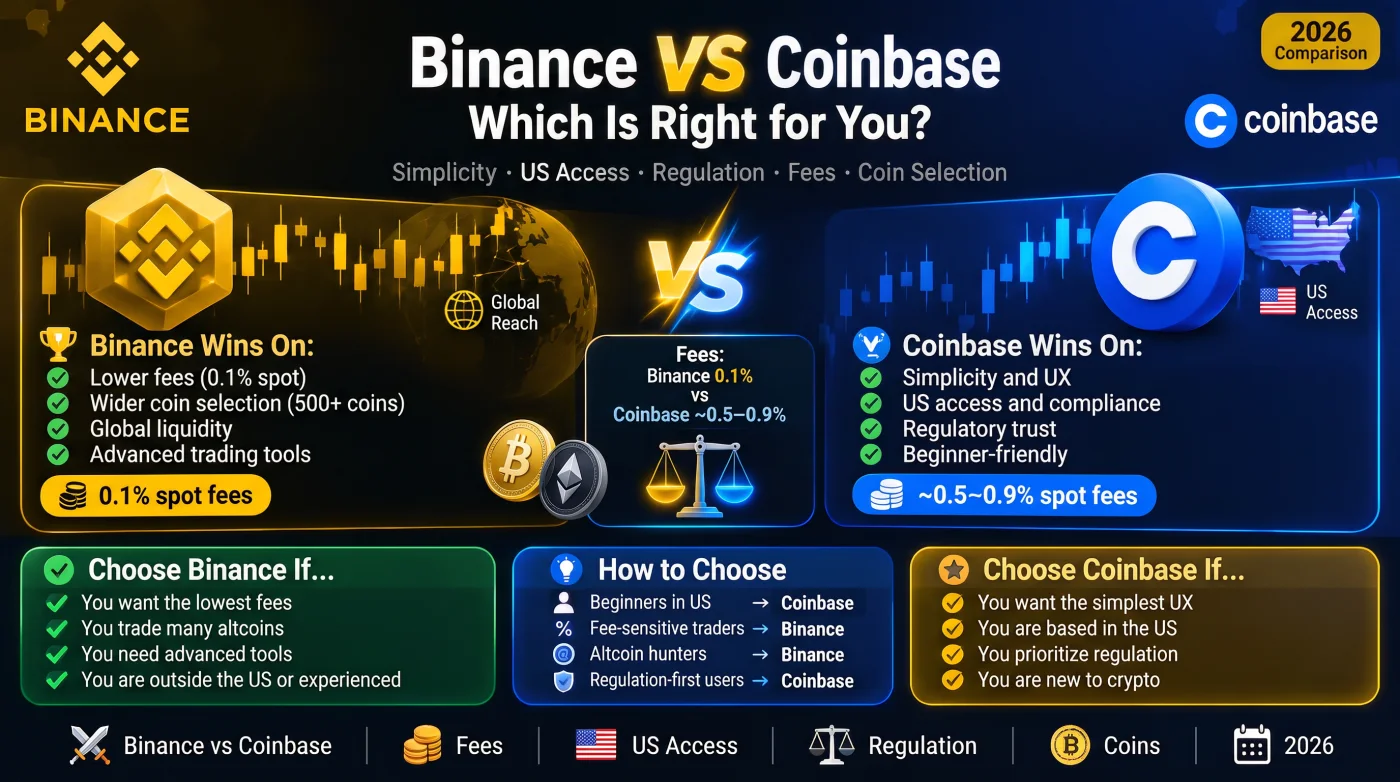
Coinbase wins on simplicity, US access, and regulation; Binance wins on fees (0.1% vs ~0.5–0.9%) and coin selection. Here's how to choose.
 Lucas Almeida 5 min read
Key takeaways
- There is no universal winner — for US users Coinbase is usually the only practical choice, since Binance's global platform is closed to US residents.
- Binance is much cheaper: 0.1% spot (0.075% with BNB) versus Coinbase Advanced's 0.5% maker / 0.9% taker in the US, and even more on Coinbase's simple buy/sell.
- Coinbase is the simpler, more regulated on-ramp: NASDAQ-listed, available in all 50 states, with its SEC lawsuit dismissed in 2025.
- Binance offers the wider product range — 500+ coins, futures, options, Launchpad, and Earn — while Coinbase deliberately keeps a smaller, simpler lineup.
- The deciding factors are where you live, whether you value simplicity or low fees, and how much trading you actually plan to do.
There is no single “better” exchange between Binance and Coinbase — the honest answer depends on where you live and what you value. Coinbase wins on simplicity, US access, and regulatory clarity; Binance wins on low fees and the widest coin selection. On price the gap is stark: Binance charges 0.1% for spot trading (0.075% with BNB), while Coinbase Advanced charges 0.5% maker / 0.9% taker in the US as of its September 2026 update.
This guide walks through the differences that actually matter — fees, availability, KYC, regulation, and products — and ends with a decision rule you can apply to your own situation.
⚠️ The most important thing first: don’t tap Sign Up directly in the app — you’ll miss the new-user rewards. The welcome benefits only apply when you register through an invite link or enter the referral code BN2688. Remember this.
Binance vs Coinbase at a glance
Here is the whole comparison compressed into one table. The sections that follow explain each row.
| Binance | Coinbase | |
|---|---|---|
| Spot fee (base) | 0.10% maker / 0.10% taker | 0.50% maker / 0.90% taker (US Advanced) |
| Spot fee (cheapest) | 0.075% with BNB | ~0.09–0.10% in some international tiers |
| Simple buy/sell | Small spread on Convert | Spread ~0.5% plus fees (~1.49%+) |
| Regulatory reach | Closed to US; restricted UK, EEA | All 50 US states, UK, EEA, Canada, Australia |
| Listed assets | ~500+ coins | ~200–280 coins |
| Standout product | Futures, options, Launchpad, Earn | Simplicity, NASDAQ listing, Base chain |
| Beginner fit | Powerful but busy | The simplest on-ramp |
The rest of this guide unpacks each row so you can see which differences matter for you.
Which exchange can you actually use?
This is the first question to answer, because it overrides everything else. If one exchange is not licensed in your country, the comparison ends there.
Availability changes as regulators move, so treat this as a snapshot (checked October 2026) and confirm on each exchange’s official site before you commit:
| Market | Binance | Coinbase |
|---|---|---|
| United States | Global platform closed; Binance.US is separate and unavailable in ~14 states | Available in all 50 states |
| United Kingdom | Not open to new retail customers | Available |
| European Economic Area | Global services suspended mid-2026 under MiCA | Available |
| Canada, Australia | Mixed availability by province/state | Broadly available |
| Most of the rest of the world | Broad coverage | Broad coverage |
The pattern is consistent: Binance has pulled back from regulated Western markets, while Coinbase has leaned into them. If you live in the US, Coinbase is often the only one of the two you can realistically use — and even where Binance is available, its US entity is a much-reduced version of the global platform. If both are available where you are, the rest of this guide matters.
What are the trading fees on each exchange?
Fees are the single biggest practical difference, and where most comparison pages either oversimplify or mislead.
Binance is straightforward and cheap. Spot trading is 0.10% for both makers and takers at the base level, dropping to 0.075% if you hold BNB and pay fees with it. Futures are 0.02% maker / 0.05% taker. That is the whole story — see our Binance fees guide for the full breakdown.
Coinbase is more complicated because it runs two fee systems side by side:
| Coinbase product | Typical cost (2026) |
|---|---|
| Simple buy/sell | Spread of ~0.5% built into the price, plus a fee — often ~1.49%+ all-in |
| Advanced Trade (US) | 0.50% maker / 0.90% taker (as of the Sept 16, 2026 update) |
| Advanced Trade (EU/UK) | 0.25% maker / 0.50% taker |
| Advanced Trade (some international) | 0.09% maker / 0.10% taker |
Two conclusions fall out of these tables:
- Binance is dramatically cheaper for spot trading. On a $1,000 market buy, Binance takes about $1.00, while Coinbase Advanced in the US takes around $9.00 — and Coinbase’s simple buy/sell costs even more. That gap compounds on every trade.
- Coinbase’s own pricing is inconsistent across its own surfaces. The simple app is the most expensive, Advanced Trade is cheaper, and the international tiers can nearly match Binance. Most casual users never find the cheaper path.
Coinbase’s Coinbase One subscription ($4.99–$299.99/month) waives trading fees up to a monthly cap, but it does not remove the spread on simple trades or the separate 1% limit-order fee. For most people it does not pay for itself — a casual buyer is cheaper on Coinbase Advanced or on a lower-fee exchange.
Fees change regularly, so confirm current rates on each exchange’s fee page before a large trade. The direction of the gap, though, has been stable for years: Binance is the cheaper place to trade, and by a lot.
How do registration and KYC compare?
Both require identity verification before you can deposit, trade, or withdraw, but the experience differs in ways that affect your first hour.
| Binance | Coinbase | |
|---|---|---|
| Sign-up requirement | Email or phone number | Email and phone number |
| KYC model | ID upload plus a face check; Verified and Verified Plus levels | ID upload plus selfie; tiered limits |
| Verification review | Usually minutes, up to 48 hours | Usually minutes |
| Beginner onboarding | Busy dashboard, many menus | Guided, hand-holding flow |
The practical takeaway: Coinbase holds your hand more. Its onboarding is designed for first-time buyers — it tells you what to do next, and its interface hides the advanced tools by default. Binance’s dashboard is far more powerful but assumes you know what everything is. If you want the full step-by-step, see how to create a Binance account.
How do they compare on security and regulation?
Both are large, established platforms with real security programs. The difference is in how much of their business is exposed to public scrutiny.
Coinbase is the more transparent of the two. It is NASDAQ-listed, publishes quarterly audited financials, and its SEC lawsuit was dismissed in 2025 — a major regulatory win. For many users, a publicly traded company with audited disclosures is simply easier to trust with a first deposit.
Binance operates under an independent compliance monitor after a $4.3 billion settlement with US authorities in 2023, and that monitor has remained in place through 2026. Binance also maintains a $1 billion SAFU insurance fund and publishes proof-of-reserves.
Neither is “clean,” and neither is risk-free. The honest framing is not “pick the safe one” — it is that Coinbase’s regulatory posture is the more reassuring of the two, while Binance’s reserve program and fund are also meaningful. And remember: exchange safety is only half the story. Any account is only as safe as your own login — use a unique password, turn on two-factor authentication, and move long-term holdings into a wallet you control. Our guides to private keys and common crypto scams cover both halves.
What products does each exchange offer?
The two platforms are built for different people, and it shows in what they include.
Binance is the breadth leader: roughly 500+ listed coins, and the widest product range — spot, margin, futures, options, P2P, a staking and Earn hub, and Launchpad token sales. It also has the deepest order books in crypto and the largest ecosystem of trading bots and API integrations. If there is a way to trade or earn on a coin, Binance probably has it.
Coinbase is deliberately simpler: roughly 200–280 assets, a clean buy/sell flow, staking on a handful of major coins, a debit card, and a self-custody wallet. Its Advanced Trade surface exists for order-book trading, but Coinbase omits many of Binance’s riskier products (futures for most users, high-leverage margin, token launch sales) on purpose, to keep retail users out of trouble.
The beginner’s version: Binance is the biggest supermarket — everything is there, including the things that can hurt you. Coinbase is a smaller, curated store designed not to overwhelm you. If you want to earn on your coins on Binance specifically, see our Binance Earn guide.
Binance vs Coinbase: which should you choose?
Rather than a fake “winner,” here is a decision rule you can run yourself.
Choose Coinbase if any of these apply:
- You live in the United States — it is usually your only fully-available option.
- You value simplicity, a clean interface, and guided onboarding over low fees.
- You want a NASDAQ-listed, audited, publicly traded company holding your first deposit.
- You only buy occasionally, so the fee difference barely matters.
Choose Binance if any of these apply:
- You live in a country Binance serves and you trade actively enough for fees to matter.
- You want the widest coin selection and access to futures, options, Launchpad, and Earn.
- You hold (or are happy to hold) BNB to unlock the 25% fee discount.
- You want the deepest liquidity for larger trades.
The fee gap in real numbers. On $1,000 of spot trading, Binance takes about $1.00 while Coinbase Advanced in the US takes about $9.00. On $10,000, that is roughly $10 versus $90. If you trade monthly, that difference alone makes Binance the answer — if Binance is available where you live.
A lot of people hold both: Coinbase for the simple fiat on-ramp and regulatory comfort, Binance for low fees, more coins, and Earn. The only real cost of both is that you now have two accounts to keep secure.
What should you watch out for?
- Availability changes. Binance’s EEA suspension landed in mid-2026 with little notice. Treat every availability and fee figure in this guide — including this one — as a snapshot, and confirm your country’s status on the official site before you register.
- Coinbase’s simple app is a fee trap. The default buy/sell flow builds in a spread and charges more than Advanced Trade. If you use Coinbase, switch to Advanced Trade for any trade of real size.
- “Which is better” pages are often affiliate pitches. Many comparison articles rank whichever exchange pays them more. This article is honest about the trade-offs and works regardless of which link you use. Note that Coinbase is not one of our referral partners, so there is no Coinbase link to bias this comparison.
- Security is on you, not just the exchange. The biggest risk for most beginners is a reused password, a phishing link, or a skipped two-factor setup — not the exchange’s reserves.
The bottom line
Binance and Coinbase are both excellent at different things, and the honest answer to “which is better” is “it depends on you.” Coinbase wins on simplicity, US availability, and regulatory clarity; Binance wins on fees and coin selection by a wide margin. For most US residents the choice is made by jurisdiction before any feature comparison — and for most active traders outside the US, the fee math points clearly to Binance.
If Binance is available where you are, it is the cheaper, broader platform — start with how to create a Binance account, and see our Binance fees guide and Binance Earn guide for what you can do once you are in. If you are in the US or value simplicity above all, Coinbase’s cleaner, more regulated experience is the reasonable first step.
💡 Don't have a Binance account yet? Sign up now — 20% fee rebate on spot and futures — enter the referral code BN2688.
The information in this article is for education only and is not financial advice. Fees and availability cited here are snapshots checked in October 2026 and change over time, so confirm current terms on each exchange’s official site before you trade.
Don't have a Binance account yet?Sign up nowenter the referral codeBN2688
Frequently asked questions
Which is better, Binance or Coinbase?
Is Binance cheaper than Coinbase?
Is Binance available in the United States?
Is Coinbase regulated and safe?
Which is better for beginners?
Can I use both Binance and Coinbase?
Does Coinbase One actually save money?
Which exchange has more cryptocurrencies?
Editor-in-Chief & Lead Researcher
Editor of MyCryptoStart. Independent researcher of cryptocurrency exchanges, focused on fees, security, KYC, and onboarding — publishes step-by-step guides in plain English for beginners.
View author page →Some links on this page are affiliate links: we may earn a commission at no extra cost to you. This content is educational and is not financial, investment, or legal advice. Affiliate disclosure · Disclaimer.
Continue reading
Binance vs Bitget (2026): Fees, Copy Trading, and Which Wins
Binance is cheaper for spot and futures; Bitget wins on copy trading. Compare 2026 fees, VIP tiers, BGB vs BNB discounts, withdrawals, and liquidity.
Binance vs Kraken: Which Is Better in 2026?
Binance charges 0.10% spot (0.075% with BNB). Kraken's entry tier is 0.40%/0.80% after its July 2026 rework. Fees, access, safety, and how to choose.
Binance vs KuCoin: Which Is Better in 2026?
Both advertise 0.10% spot, but KuCoin's Class B and C pairs cost 0.20–0.30% and it is banned in the US. Fees, coins, safety, and how to choose.