
Binance vs KuCoin: Which Is Better in 2026?
Both advertise 0.10% spot, but KuCoin's Class B and C pairs cost 0.20–0.30% and it is banned in the US. Fees, coins, safety, and how to choose.
 Lucas Almeida 5 min read
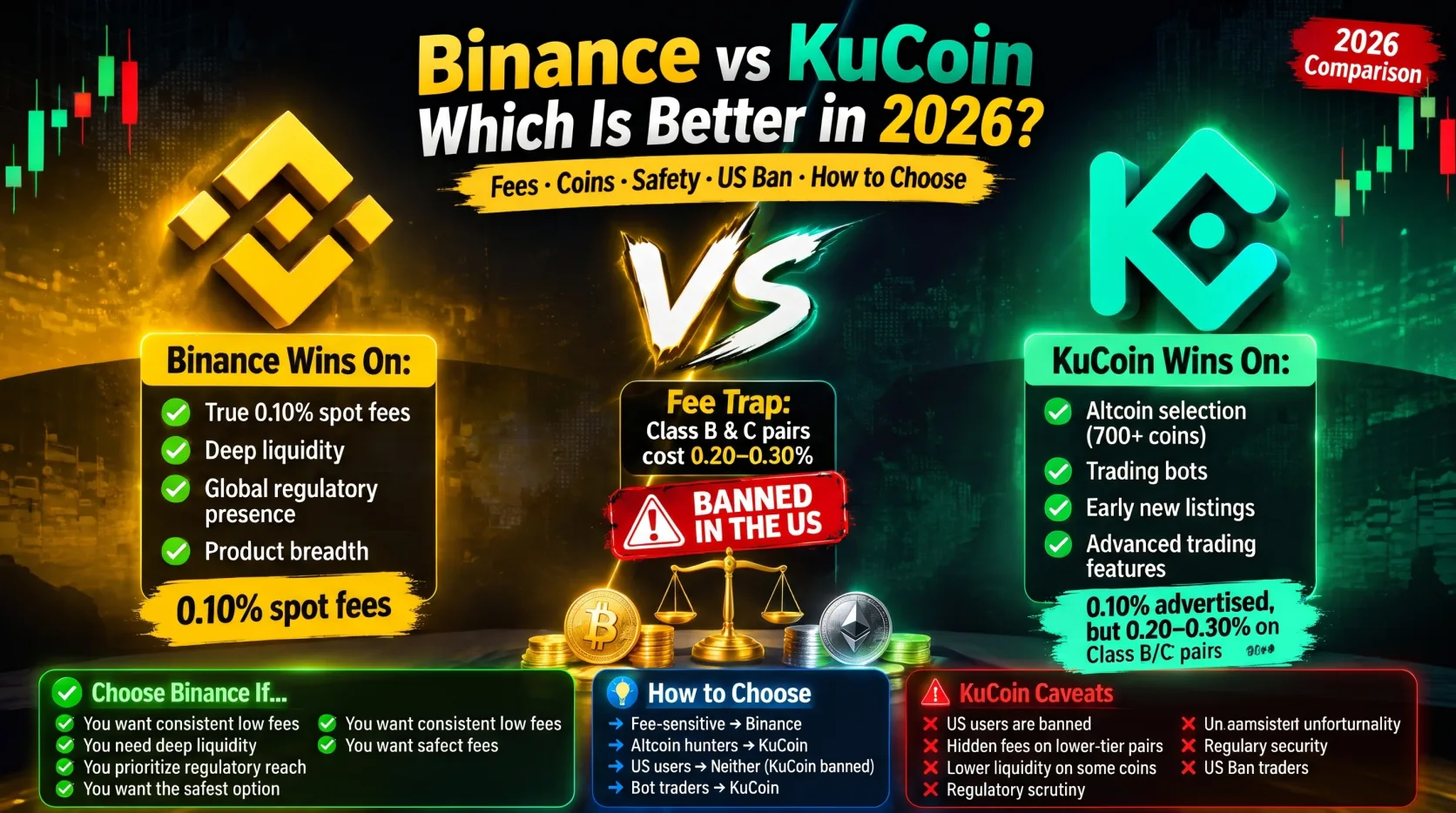
Key takeaways
- The 0.10% headline is not the whole KuCoin fee table: Class A pairs cost 0.10%, Class B pairs 0.20% and Class C pairs 0.30%. Many altcoins sit in B or C.
- Binance is cheaper once discounts are counted: 0.075% with BNB versus 0.08% with KCS, and Binance futures cost 0.05% taker versus KuCoin's 0.06%.
- KuCoin wins on altcoin breadth, with roughly 800–900 listed coins against Binance's 500+, plus free built-in trading bots and earlier small-cap listings.
- KuCoin is permanently barred from the US after its 2025 DOJ plea and a March 2026 CFTC order. It is also restricted in parts of Canada, Singapore, Hong Kong, Malaysia, France and the Netherlands.
- Use KuCoin only for a specific coin Binance does not list, and check the pair's fee class before you trade. For everything else, Binance is cheaper and deeper.
Binance and KuCoin both advertise 0.10% spot fees, which makes them look like twins. They are not. Binance charges a flat 0.10% on standard spot pairs, or 0.075% with BNB, and offers the deepest liquidity in crypto. KuCoin lists more altcoins, around 800–900, and gives you free trading bots — but its 0.10% applies only to Class A pairs. Class B pairs cost 0.20% and Class C pairs cost 0.30%, and many of the small caps people go to KuCoin for sit in those higher classes. KuCoin is also permanently barred from the US.
That makes the choice narrower than the marketing suggests. If Binance is available where you live, it is the cheaper and safer default for BTC, ETH and liquid majors. KuCoin has a real use case only when you need a specific altcoin that Binance does not list — and even then, you should check the pair’s fee class before you buy.
⚠️ The most important thing first: if Binance is available in your country, don’t tap Sign Up directly in the app — you’ll miss the new-user rewards and the fee rebate. Register through an invite link or enter the referral code BN2688 so the 20% trading-fee rebate is attached to your account. It cannot be added later.
Binance vs KuCoin at a glance
Here is the whole comparison in one table. The sections below explain each row and the exceptions behind it.
| Binance | KuCoin | |
|---|---|---|
| Founded | 2017 | 2017 |
| Spot fee (cheapest class) | 0.10% maker / 0.10% taker | 0.10% maker / 0.10% taker (Class A) |
| Spot fee (other classes) | Flat 0.10% on standard pairs | 0.20% (Class B) / 0.30% (Class C) |
| Token discount | 25% with BNB, to 0.075% | 20% with KCS, to 0.08% on Class A |
| Futures fee | 0.02% maker / 0.05% taker | 0.02% maker / 0.06% taker |
| Listed coins | 500+ | Roughly 800–900 |
| Trading bots | Available, but less central | Free built-in grid, DCA and rebalance bots |
| US access | Blocked; Binance.US is separate | Permanently barred |
| UK access | No new retail sign-ups since October 2023 | Not FCA-authorised; offshore access only |
| EU/EEA access | New onboarding paused from July 2026 | MiCA licence via Austria, operating status unclear |
| Custody record | 2019 and 2026 hacks both covered from own funds; SAFU now ~$580M; quarterly zk PoR | 2020 hack ~$281M, 84% recovered; monthly PoR |
| Legal record | $4.3B US settlement (2023) | $297M US plea (2025); permanent US ban (2026) |
| Best for | Low-cost spot, liquidity and product breadth | Altcoin breadth, early listings and bots |
What are the trading fees on each exchange?
Binance is cheaper on every like-for-like pair, and the gap widens on the altcoins KuCoin is known for. Binance charges a flat 0.10% maker and 0.10% taker on standard spot pairs, or 0.075% when you pay fees with BNB. KuCoin’s schedule is split into three classes, and the headline rate only covers the first one.
| KuCoin spot class | Maker / taker | With KCS discount | Typical pairs |
|---|---|---|---|
| Class A | 0.10% / 0.10% | 0.08% / 0.08% | BTC, ETH and other major pairs |
| Class B | 0.20% / 0.20% | 0.16% / 0.16% | Mid-cap and smaller altcoins |
| Class C | 0.30% / 0.30% | 0.24% / 0.24% | Long-tail and higher-risk tokens |
KuCoin does not put a permanent label on every pair. It classifies tokens into A, B and C, and it can move a token between classes with an announcement. That is the detail most “KuCoin 0.10%” articles leave out: the rate you pay depends on which token you buy, and it can change while you hold it.
The token discounts are also not equal. BNB gives 25% off, taking Binance’s spot fee to 0.075%. KCS gives 20% off, taking KuCoin’s Class A fee to 0.08%. On Class C, the KCS discount only takes 0.30% down to 0.24% — still nearly three times Binance’s BNB rate.
Futures are closer but still favour Binance: 0.02% maker / 0.05% taker on Binance versus 0.02% maker / 0.06% taker on KuCoin. That one-basis-point taker gap is small, but it compounds for active traders.
One more difference matters for anyone using this site’s referral link. Binance’s 20% referral rebate applies to the trading fee, so the effective spot rate is 0.08%, or 0.06% with BNB. KuCoin’s standard referral program is not part of this comparison, and no KuCoin link is provided here, so the rebate column below only applies to Binance.
Why is KuCoin’s 0.10% headline misleading?
Because the 0.10% rate applies only to Class A pairs, while many of the altcoins that attract users to KuCoin are Class B or Class C. A trader who checks the homepage, buys a small-cap token and assumes 0.10% will pay two or three times that.
Here is the arithmetic on a single taker order, using published rates and excluding spreads:
| Trade size | Binance (0.10%) | Binance + BNB (0.075%) | Binance + BNB + 20% rebate | KuCoin A (0.10%) | KuCoin A + KCS (0.08%) | KuCoin B (0.20%) | KuCoin C (0.30%) |
|---|---|---|---|---|---|---|---|
| $1,000 | $1.00 | $0.75 | $0.60 | $1.00 | $0.80 | $2.00 | $3.00 |
| $10,000 | $10.00 | $7.50 | $6.00 | $10.00 | $8.00 | $20.00 | $30.00 |
| $100,000 | $100.00 | $75.00 | $60.00 | $100.00 | $80.00 | $200.00 | $300.00 |
Over a year, a user buying $1,000 a month pays about $12 on Binance at 0.10%, $9 with BNB, or $7.20 with BNB plus the rebate. On KuCoin, the same buyer pays $12 on a Class A pair, $9.60 with KCS, $24 on Class B and $36 on Class C.
That is the whole fee story. KuCoin is competitive with Binance only on Class A pairs, and even there Binance is cheaper once the BNB discount and referral rebate are counted. On the small caps that are KuCoin’s reason to exist, KuCoin is usually the more expensive venue.
There is a counterargument worth stating fairly: KuCoin’s free bots can generate volume that would cost a subscription elsewhere, and some traders use grid bots to offset fees. But a bot trading a Class C pair pays 0.30% per fill, and a grid strategy can generate many fills. Fees can eat the strategy before the market does.
Which exchange can you actually use?
Binance is available in more countries, but both are closed to US users, and neither is a clean option for new UK or EU users in late 2026. Availability is the row that overrides every fee comparison.
Here is the November 2026 picture, checked against each exchange’s disclosures and public regulatory records:
| Market | Binance | KuCoin |
|---|---|---|
| United States | Blocked; Binance.US is separate | Permanently barred since March 2026 |
| United Kingdom | No new retail sign-ups since October 2023 | Not FCA-authorised; no UK protection |
| EU / EEA | New onboarding paused from 1 July 2026 | MiCA licence via Austria; operating status unresolved |
| Canada | Exited | Restricted in Ontario and British Columbia |
| Singapore, Hong Kong, Malaysia | Available with restrictions | Restricted |
| France, Netherlands | Available with restrictions | Restricted |
| Asia, Latin America, Africa, Middle East | Broad coverage | Broad coverage |
| Sanctioned jurisdictions | Blocked | Blocked |
KuCoin’s US situation is not a temporary withdrawal. In January 2025, its operator, Peken Global, pleaded guilty to operating an unlicensed money transmitting business and agreed to pay about $297 million in fines and forfeiture. In March 2026, a CFTC consent order added a $500,000 penalty and permanently barred KuCoin from serving US users unless it registers as a foreign board of trade. The order covers spot and derivatives and requires technical controls, not just a policy statement.
KuCoin’s EU position is messier than a licence headline suggests. It obtained a MiCA authorisation through Austria in November 2025, but the Austrian regulator blocked new business in February 2026 over vacant anti-money-laundering and sanctions-officer roles. The block was lifted in May 2026, but reports say full operations remain pending governance fixes. Treat “KuCoin has a MiCA licence” as incomplete: check whether onboarding is actually open before you deposit.
For UK users, KuCoin is not FCA-authorised. It may be reachable as an offshore platform, but you do not get FCA protections, and the FCA has warned about unauthorised crypto firms. Binance is not accepting new UK retail customers either. If you are in the UK and want a regulated exchange, look at Kraken or Coinbase instead.
The practical rule:
- In the US: neither Binance nor KuCoin is available. Use a US-regulated platform.
- In the UK or EU/EEA: Binance is closed to new users; KuCoin’s status is uncertain and it lacks UK authorisation. Use a regulated alternative.
- In Asia, Latin America, Africa or the Middle East: both may be available. Binance is cheaper and deeper for majors; KuCoin is the altcoin venue.
- Anywhere: do not use a VPN or a borrowed identity to get around a block. Both platforms prohibit it, and KuCoin’s US order specifically requires IP blocking.
How do registration and KYC compare?
Both require identity verification before you can deposit or trade, but KuCoin’s KYC history is shorter and its unverified-account rules are stricter. Neither offers a useful no-KYC trading mode.
| Binance | KuCoin | |
|---|---|---|
| KYC requirement | Government ID plus face verification | Government ID plus face verification |
| KYC mandatory since | Account opening | 31 August 2023 for new users |
| Unverified access | No trading or deposits | Sell, close positions and withdraw only; no deposits or buys |
| Typical review time | Minutes to a few hours | Minutes to a few days, depending on risk checks |
| Verification limits | Tiered by region and level | Daily withdrawal ceiling shown in your account |
The important context is KuCoin’s KYC history. KuCoin introduced mandatory KYC for new users only in August 2023, and the US Department of Justice found that it had not applied the rules to existing customers. That is part of why the 2025 plea happened. If you open a KuCoin account today, you will be verified, but the platform’s compliance culture is younger than Binance’s.
KuCoin’s unverified legacy accounts are restricted to selling, closing positions, redeeming Earn products and withdrawing. They cannot deposit, place spot buy orders, open futures or margin positions, or start new bot strategies. Binance’s unverified accounts are similarly limited: no trading and no deposits.
The practical difference for a new user is small: both ask for an ID and a selfie, and both can take longer when risk checks flag your region or document. The bigger difference is what happens if verification fails. On Binance, you can usually retry with a clearer document. On KuCoin, a failed verification in a restricted region can leave you unable to deposit at all, and support queues have been slow during high-volume periods.
How do they compare on security?
KuCoin’s proof-of-reserves programme is genuinely strong, but its hack and legal record are weaker than Binance’s. The honest verdict is that KuCoin is more transparent than its reputation suggests and less safe than its reserve ratios suggest.
KuCoin’s custody transparency is better than most exchanges. It has published monthly Merkle-tree proof-of-reserves reports since late 2022, more than 39 consecutive reports, with third-party attestations from Hacken. Its September 2026 snapshot showed BTC 109%, ETH 117%, USDT 110% and USDC 127% — meaning it reported holding more of each asset than customers were owed. CryptoQuant’s 2025 exchange ranking gave KuCoin an A+ transparency score. Proof of reserves is not a full audit of liabilities, but it is more than most rivals publish.
KuCoin’s security history is the weaker part. In September 2020, attackers — attributed by Chainalysis to North Korea’s Lazarus Group — drained roughly $281 million from KuCoin hot wallets. KuCoin said cold wallets were unaffected and that affected users were covered; reports put recovery at about 84%. That is a better outcome than many hacks, but it is still a major breach.
KuCoin’s legal record is the weakest part. The January 2025 DOJ plea came with $112.9 million in criminal fines and $184.5 million in forfeiture, and the founders entered deferred prosecution agreements and gave up management roles. The March 2026 CFTC order added a permanent US bar. Those are compliance failures, not custody failures, but they matter to anyone choosing where to keep funds.
Binance’s record is stronger on custody, though 2026 complicated it. It had one major hot-wallet hack in 2019 — about 7,000 BTC (roughly $40 million at the time), repaid in full from SAFU — and then a far larger one on 29 October 2026, when roughly $6.3 billion left hot wallets. That second loss was absorbed by Binance rather than users: about 90% of assets were replenished within two days and about 95% within four, drawing on SAFU, the futures insurance fund and corporate treasury. The consequence is that SAFU now holds roughly $580 million (about 7,500 BTC) instead of about $1 billion, with a stated intent to rebuild and no published deadline. Proof of reserves is quarterly and zk-verifiable. Binance also has a $4.3 billion US settlement from 2023, so it is not a compliance saint either.
The fair summary: Binance has the stronger custody scale and a demonstrated ability to cover a nine-figure loss, but its insurance fund is now half the size it was; KuCoin has surprisingly good reserve transparency but a shorter compliance history and a permanent US ban. Neither is a place for life savings. Keep trading balances on the exchange and long-term holdings in self-custody, with an authenticator app and a withdrawal whitelist. Our account security guide explains the setup.
What products and features does each offer?
KuCoin’s edge is altcoin breadth and free bots; Binance’s edge is liquidity, fiat rails and a broader product suite for majors. The choice depends on whether you are shopping for a specific token or for a reliable main account.
KuCoin lists roughly 800–900 coins across 1,000+ spot pairs, one of the broadest selections among major exchanges. It is known for listing small caps earlier than Binance, and its free built-in bots — spot grid, infinity grid, futures grid, DCA and smart rebalance — are a genuine differentiator. It also offers futures, margin, KuCoin Earn, lending, Spotlight token sales, a KuCoin card and the KCS token, which gives a 20% fee discount and a share of daily spot-fee revenue.
The trade-offs are real. Long-tail pairs often have thin order books, so slippage can exceed the fee difference. KuCoin also delists tokens periodically, and a small-cap that disappears from the exchange can leave you with a position you cannot sell at a fair price. The KCS bonus is not a guaranteed yield; it depends on trading volume and has fallen from the levels quoted in older reviews.
Binance lists 500+ coins across 1,500+ pairs, with the deepest spot liquidity in the industry. Its product suite includes spot, margin, USDS-M futures, options, P2P, Earn, staking, Launchpad and Launchpool, auto-invest, a crypto card and a polished beginner mode. Its fiat rails are broader, especially in Asia, Latin America and the Middle East, and its order books handle large trades with less slippage.
The simple version: KuCoin is a specialist altcoin marketplace with bots; Binance is a full-service exchange with better prices on everything both list. If your target coin is on Binance, there is little reason to use KuCoin. If it is not, KuCoin may be the only major venue that lists it — and that is a legitimate reason to open an account, provided you accept the higher fee class and the regulatory risk.
Binance vs KuCoin: which should you choose?
Choose Binance unless you need a specific altcoin that only KuCoin lists. On fees, liquidity, fiat access and custody scale, Binance wins for the assets both exchanges carry. KuCoin’s case rests on breadth, bots and early listings, not on price.
Choose Binance if:
- You live in a country where binance.com accepts new users.
- You mostly buy BTC, ETH or liquid altcoins.
- You want the lowest effective spot fees: 0.10%, 0.075% with BNB, or 0.06% with BNB plus the referral rebate.
- You want the deepest order books and the least slippage.
- You want P2P, Earn, Launchpool and a full product suite.
Choose KuCoin if:
- You need a specific small-cap or newly listed token that Binance does not carry.
- You want to run free grid, DCA or rebalance bots.
- You are outside the US and every restricted region, and you accept the platform’s legal history.
- You have checked the pair’s fee class and decided the 0.20% or 0.30% cost is worth it.
- You will keep only a small trading balance on the exchange.
Choose neither if:
- You are in the US. Both are closed; use a US-regulated exchange.
- You are in the UK or EU and want a regulated platform. Binance is closed to new users and KuCoin’s status is uncertain; compare Kraken or Coinbase instead.
- You are in a sanctioned jurisdiction.
- You want a savings account. Neither exchange is a substitute for self-custody.
One decision rule on fees: if the coin is listed on both exchanges, use Binance. The headline might be the same 0.10%, but Binance’s BNB discount, referral rebate and deeper book make it cheaper in practice. Use KuCoin only when the token is not on Binance — and if it is a Class C pair, budget 0.30% per trade before you decide the trade is worth it.
💡 Don't have a Binance account yet? Sign up now — 20% fee rebate on spot and futures — enter the referral code BN2688.
What should you watch out for?
- KuCoin’s fee class can change. A token that costs 0.10% today can be moved to Class B or C, doubling or tripling your cost. Check the fee tier on the pair page, not the homepage.
- The KCS discount is not free money. You have to hold KCS, which can fall in price, and the discount is smaller than Binance’s BNB discount. The daily KCS bonus is variable and not a guaranteed yield.
- Thin books can cost more than fees. A 0.20% fee on a liquid pair is cheaper than a 0.10% fee plus 1% slippage on a thin one. Check the order book depth before a large altcoin buy.
- Delistings are a real risk on the long tail. KuCoin lists early, but it also removes tokens. A delisted position can become hard to sell, and the exchange’s withdrawal deadline may come with a fee.
- The US ban is permanent, not temporary. Do not open an account with a VPN or a borrowed identity. The CFTC order requires KuCoin to block US IPs, and a frozen account can take your funds with it.
- The referral rebate is locked at sign-up. Binance does not let you add a referral code after registration in normal cases. Register through the link the first time — see the Binance referral code guide for the exceptions.
The bottom line
Binance and KuCoin are not the fee twins their homepages suggest. Binance charges 0.10% flat on standard spot pairs, or 0.075% with BNB, with the deepest liquidity in crypto. KuCoin’s 0.10% applies only to Class A; Class B costs 0.20% and Class C 0.30%, and many of its altcoins sit in those tiers. KuCoin also carries a permanent US ban and a heavier legal record.
KuCoin still has a legitimate role: it lists roughly 800–900 coins, often earlier than Binance, and its free bots are useful for active altcoin traders. If you need a token Binance does not carry, KuCoin may be the only major venue for it. Check the fee class, size the position for thin liquidity and keep only trading funds there.
For everything else — BTC, ETH, liquid majors, P2P, Earn and Launchpool — Binance is the cheaper and safer default in countries where it operates. Start with the registration guide so the referral code is applied before your first deposit, and compare the alternatives in our Binance vs Kraken and Binance vs Bybit guides.
Fees, availability and regulatory details were checked on 2 November 2026 against KuCoin’s published fee schedule and proof-of-reserves page, KuCoin’s support pages, Binance’s fee page, the US DOJ’s January 2025 announcement and the CFTC’s March 2026 consent order. Exchange terms change without notice — confirm the current numbers in your own account before trading.
Sources checked: KuCoin fee schedule · KuCoin proof of reserves · KuCoin KYC guide · Binance fee page · Binance proof of reserves
Don't have a Binance account yet?Sign up nowenter the referral codeBN2688
Frequently asked questions
Is KuCoin cheaper than Binance?
Why does KuCoin charge 0.20% or 0.30% instead of 0.10%?
Is KuCoin available in the United States?
Is KuCoin safe?
Which is better for altcoins, Binance or KuCoin?
Which is better for beginners?
Can I use both Binance and KuCoin?
Does this article earn a commission from KuCoin?
Editor-in-Chief & Lead Researcher
Editor of MyCryptoStart. Independent researcher of cryptocurrency exchanges, focused on fees, security, KYC, and onboarding — publishes step-by-step guides in plain English for beginners.
View author page →Some links on this page are affiliate links: we may earn a commission at no extra cost to you. This content is educational and is not financial, investment, or legal advice. Affiliate disclosure · Disclaimer.
Continue reading
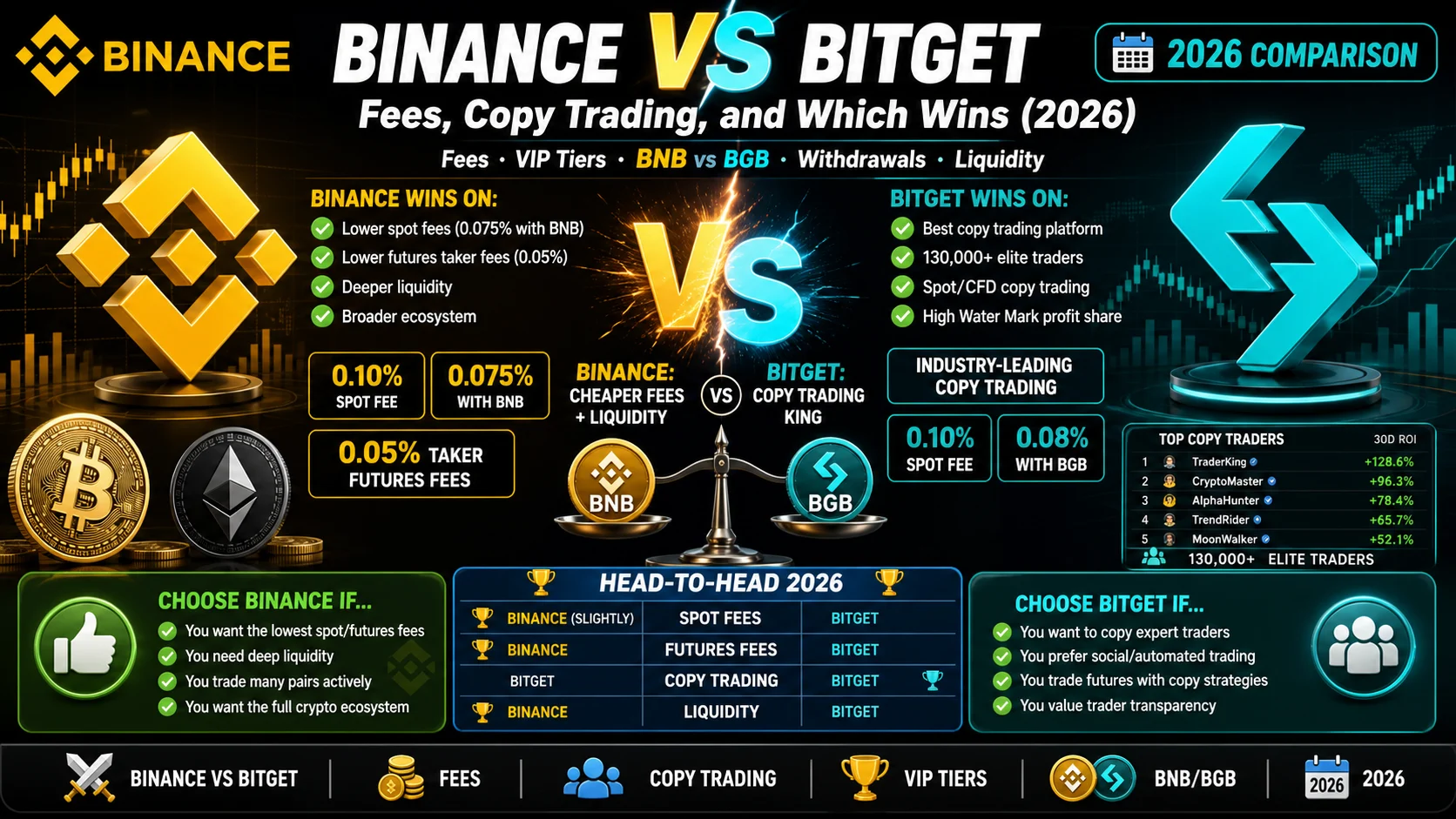
Binance vs Bitget (2026): Fees, Copy Trading, and Which Wins
Binance is cheaper for spot and futures; Bitget wins on copy trading. Compare 2026 fees, VIP tiers, BGB vs BNB discounts, withdrawals, and liquidity.
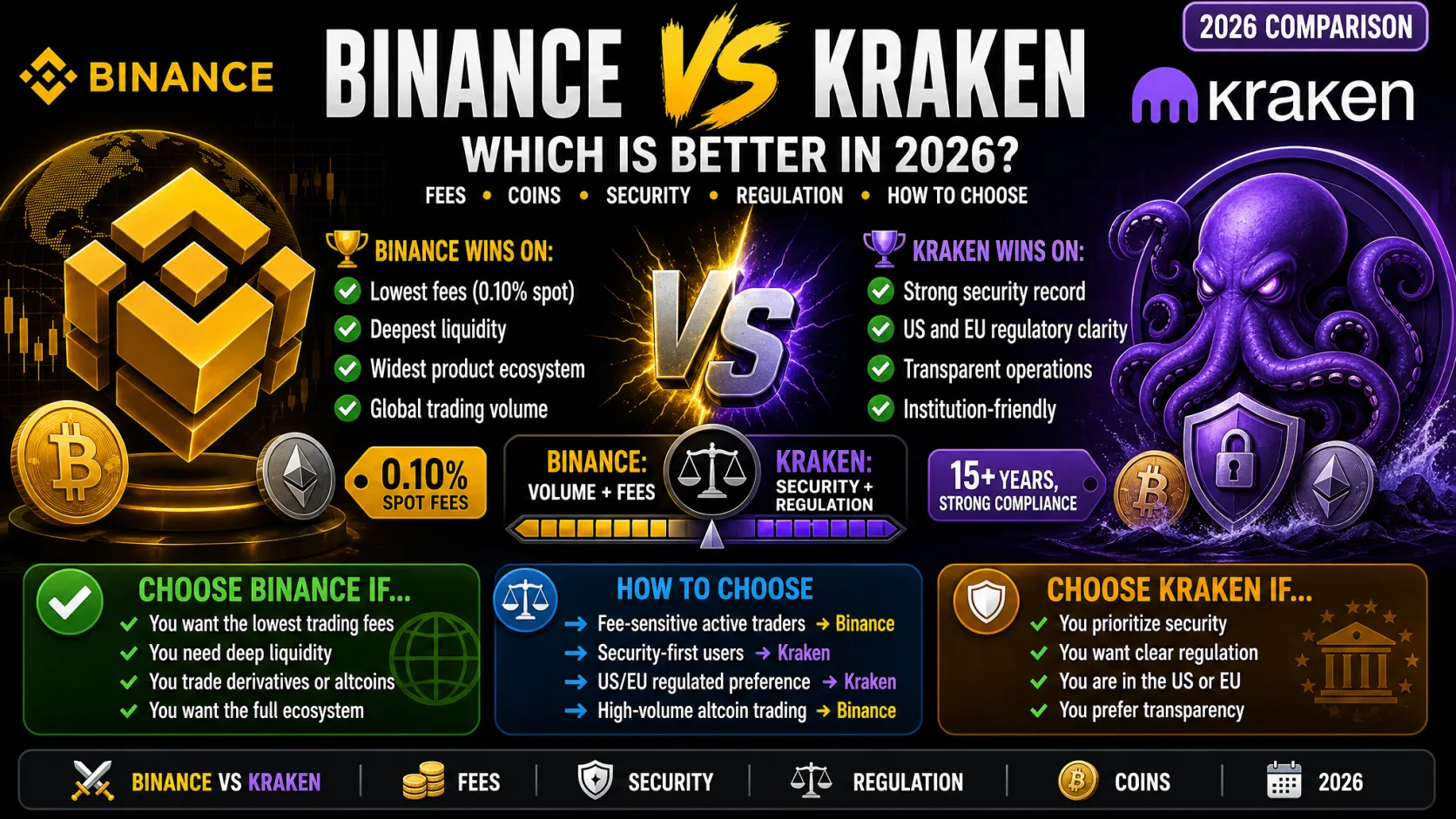
Binance vs Kraken: Which Is Better in 2026?
Binance charges 0.10% spot (0.075% with BNB). Kraken's entry tier is 0.40%/0.80% after its July 2026 rework. Fees, access, safety, and how to choose.
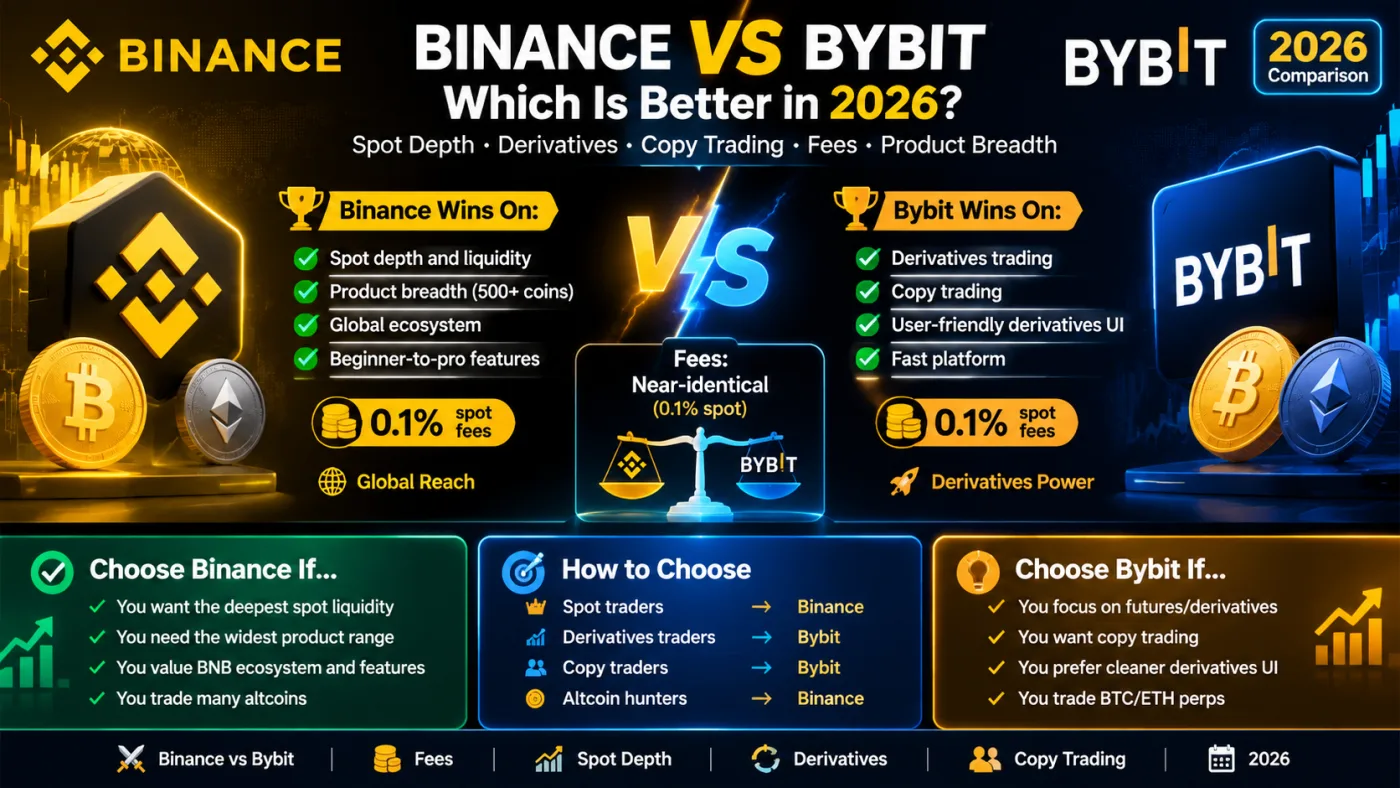
Binance vs Bybit: Which Is Better in 2026?
Binance wins on spot depth and product breadth; Bybit wins on derivatives and copy trading. Fees are near-identical (0.1% spot). Here's how to choose.