
Binance vs Kraken: Which Is Better in 2026?
Binance charges 0.10% spot (0.075% with BNB). Kraken's entry tier is 0.40%/0.80% after its July 2026 rework. Fees, access, safety, and how to choose.
 Lucas Almeida 5 min read
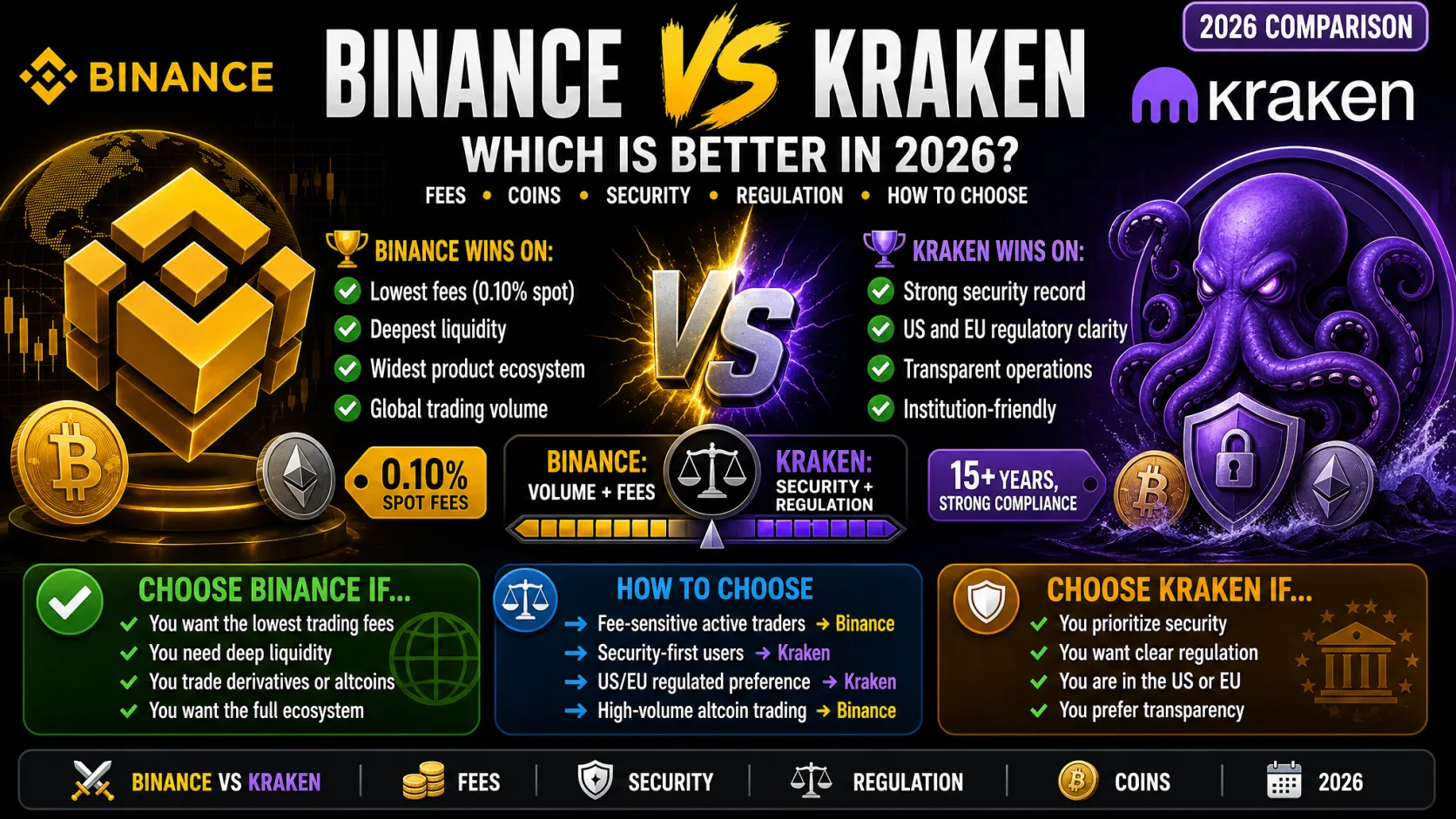
Key takeaways
- Binance is far cheaper at the entry tier: 0.10% spot, or 0.075% with BNB. Kraken's current Tier 1 is 0.40% maker / 0.80% taker — four to eight times more on a simple trade.
- Kraken wins on regulated access. It serves the US (except Maine and New York), the UK and the EU/EEA under MiCA, while Binance blocks US users and paused new UK and EEA onboarding.
- Kraken's fee schedule changed in July 2026. Guides quoting 0.25% maker / 0.40% taker are describing the old table, not the rate a new account pays today.
- Kraken's app is not its cheap venue: instant buys cost 1% plus an undisclosed spread. Use Kraken Pro or Desktop, where the tier table applies.
- Binance covered the largest theft in crypto history — about $6.3 billion on 29 October 2026 — within four days and at its own expense, but doing so halved its SAFU reserve to roughly $580 million.
- For a beginner buying BTC or ETH monthly in a country that supports Binance, Binance is the cheaper default. For a US, UK or EU user who cannot open Binance, Kraken is the stronger regulated option.
Binance and Kraken are both large, established exchanges, but they are built for different constraints. Binance is the cheaper and broader platform: 0.10% spot fees, 0.075% with BNB, 500+ coins and the deepest order books. Kraken is the more regulated platform: it serves the US, UK and EU/EEA, publishes proof of reserves and holds a long list of licences. The catch is price. Kraken’s current entry tier is 0.40% maker / 0.80% taker, so a simple $1,000 taker trade costs $8.00 there versus $1.00 on Binance.
That gap decides most comparisons. If Binance is legally available where you live and you trade spot, Binance is usually the better value. If you are in the US, UK or EU and cannot open a Binance account, Kraken is the stronger regulated option — as long as you use Kraken Pro, not the app’s 1% instant-buy screen.
⚠️ The most important thing first: if Binance is available in your country, don’t tap Sign Up directly in the app — you’ll miss the new-user rewards and the fee rebate. Register through an invite link or enter the referral code BN2688 so the 20% trading-fee rebate is attached to your account. It cannot be added later.
Binance vs Kraken at a glance
Here is the whole comparison in one table. The sections below explain each row and the exceptions behind it.
| Binance | Kraken | |
|---|---|---|
| Founded | 2017 | 2011 |
| Spot fee (entry) | 0.10% maker / 0.10% taker | 0.40% maker / 0.80% taker |
| Spot fee with token discount | 0.075% with BNB (25% off) | No token discount |
| Futures fee (Pro) | 0.02% maker / 0.05% taker | 0.02% maker / 0.05% taker |
| App instant-buy fee | Spread built into the Convert quote | 1% plus spread (1.5% custom) |
| Listed crypto | 500+ coins | 500+ crypto assets; 11,000+ US stocks and ETFs |
| US access | Blocked; Binance.US is separate | Available except Maine and New York |
| UK access | No new retail sign-ups since October 2023 | FCA-registered, with product restrictions |
| EU/EEA access | New onboarding paused from July 2026 | MiCA passport across 30 EEA countries |
| Custody record | 2019 and 2026 hacks both absorbed by Binance; SAFU now ~$580M after covering $6.3B | No major platform-wide hack; PoR since 2014 |
| Best for | Low-cost spot trading and product breadth | Regulated access, USD banking and transparency |
What are the trading fees on each exchange?
Binance is dramatically cheaper at the entry tier, and the gap is widest for anyone who places simple market orders. Binance charges a flat 0.10% maker and 0.10% taker on regular spot trades. Paying fees with BNB cuts that by 25%, to 0.075%. There is no minimum volume requirement to get either rate.
Kraken’s current schedule is different, and this is where most 2026 comparison articles are out of date. Kraken reworked its spot tiers in July 2026. The live schedule now starts at 0.40% maker / 0.80% taker for Tier 1, roughly double the old entry-level taker rate that many reviews still quote.
Kraken’s tiers do improve quickly if you trade or hold a lot:
| Kraken tier | 30-day spot volume | Assets on platform | Maker / taker |
|---|---|---|---|
| Tier 1 | $0+ | — | 0.40% / 0.80% |
| Tier 3 | $10,000+ | $20,000+ | 0.22% / 0.38% |
| Tier 6 | $100,000+ | $200,000+ | 0.12% / 0.25% |
| Tier 9 | $1,000,000+ | $1,000,000+ | 0.06% / 0.18% |
| Tier 12 | $10,000,000+ | $10,000,000+ | 0.00% / 0.10% |
Kraken sets your tier by whichever measure is most favourable: 30-day spot volume, 30-day futures volume, or the USD value of assets you hold on the platform. That last route is unusual. A user who holds $20,000 on Kraken can reach Tier 3 even with almost no trading volume — a detail most fee guides miss.
Two other Kraken fees matter more for beginners than the tier table:
- Instant buys and recurring buys cost 1%, plus a spread that Kraken does not disclose in the fee schedule. Custom orders cost 1.5%. Converting a small balance below the minimum order size costs a fixed 3%.
- Kraken+ members pay 0% on the first $10,000 of monthly buy, sell or convert volume in major fiat currencies. The spread still applies, and the subscription does not cover Kraken Pro spot, futures or API trading.
Futures are the one place the two exchanges tie: Kraken Pro charges 0.02% maker / 0.05% taker at Tier 1, exactly matching Binance’s USDS-M futures rate. Kraken’s app-based “Perps” product is a different deal at 0.25% to open and 0.25% to close, which is expensive for anything but a rare position.
How much does a $1,000 trade actually cost?
On the cheapest venue at each exchange, Binance costs $1.00 per $1,000 taker trade and Kraken costs $8.00 — an eight-fold difference that shrinks only at high volume. Here is the arithmetic at two common trade sizes, using published taker rates and excluding spreads.
| Trade size | Binance (0.10%) | Binance + BNB (0.075%) | Binance + BNB + 20% rebate | Kraken Tier 1 (0.80%) | Kraken Tier 3 (0.38%) |
|---|---|---|---|---|---|
| $1,000 | $1.00 | $0.75 | $0.60 | $8.00 | $3.80 |
| $10,000 | $10.00 | $7.50 | $6.00 | $80.00 | $38.00 |
| $100,000 | $100.00 | $75.00 | $60.00 | $800.00 | $380.00 |
The rebate column is specific to this site’s Binance referral arrangement: 20% of the trading fee comes back, so the effective spot cost is 0.08%, or 0.06% if you also pay with BNB. On $1,000 that is 60 cents versus Kraken’s $8.00.
Kraken closes part of the gap if you qualify for a higher tier. At $10,000 of 30-day volume, the taker rate falls to 0.38%, which is $3.80 per $1,000. At $100,000 of volume or $200,000 on platform, it falls to 0.25%. But a beginner making one or two $1,000 buys a month never gets there.
Over a year, the difference is easier to see. A user buying $1,000 of BTC a month pays about $12 in Binance spot fees, $9 with BNB, or $7.20 with BNB plus the rebate. The same user on Kraken’s Tier 1 pays about $96 if they use Kraken Pro, or $120 plus spread if they use the app’s 1% instant buy.
That does not make Kraken a bad exchange. It makes Kraken an expensive place to trade small amounts frequently, and a reasonable place to hold, bank and trade larger balances under a regulated roof.
Which exchange can you actually use?
Kraken is available in far more regulated Western markets, while Binance is available in more of Asia, Latin America, Africa and the Middle East. Availability is the row that overrides every fee comparison, because an exchange you cannot legally open is not an option.
Here is the November 2026 picture, checked against each exchange’s own disclosures:
| Market | Binance | Kraken |
|---|---|---|
| United States | Blocked; Binance.US is a separate platform | Available except Maine and New York |
| United Kingdom | No new retail sign-ups since October 2023 | FCA-registered; no derivatives, 24-hour cooling-off |
| EU / EEA | New-user onboarding paused from 1 July 2026 | MiCA authorisation, passported across 30 EEA countries |
| Canada | Exited | Available under OSC/provincial registration |
| Australia | Available | Available; derivatives for wholesale clients only |
| Asia, Latin America, Africa, Middle East | Broad coverage | Broad coverage, with country restrictions |
| Sanctioned jurisdictions | Blocked | Blocked |
Kraken’s regulatory stack is the strongest part of its case. It holds 100+ licences and registrations across 30+ countries, including a US FinCEN registration, money-transmitter licences in 46 jurisdictions, a Wyoming SPDI bank charter, a Federal Reserve limited-purpose master account, FCA registration in the UK, and MiCA authorisations in Ireland. That is why it can offer USD banking, US stocks and ETFs, and a regulated derivatives venue in markets where Binance has withdrawn.
Binance’s position is the mirror image. It is the largest exchange in the world, with 500+ coins and the deepest liquidity, but it has no US access, no new UK retail onboarding, and no new EEA onboarding since July 2026 after failing to secure a MiCA licence. It also paid a $4.3 billion settlement with US authorities in 2023.
The practical rule is simple:
- In the US: Kraken is available in 48 states; Binance is not. Compare Kraken with Coinbase and Gemini, not with Binance.
- In the UK or EU/EEA: Kraken is available; Binance is closed to new users. Kraken is the practical choice between these two.
- In Asia, Latin America, Africa or the Middle East: Binance is likely available and much cheaper. Check your local rules first.
- Anywhere: do not use a VPN or a borrowed identity to get around a block. Both exchanges prohibit it, and a frozen account can take your funds with it.
How do registration and KYC compare?
Both exchanges require identity verification before you can deposit or trade, but Kraken asks for more documents and Binance usually completes verification faster. Neither offers a meaningful unverified trading mode.
| Binance | Kraken | |
|---|---|---|
| KYC requirement | Government ID plus face verification | Government ID plus proof of address |
| Typical review time | Minutes to a few hours | Under 30 minutes automated; about 45 minutes if manual |
| Standard cash limits | Tiered by region and verification level | Up to $100,000/day and $500,000 per 30 days |
| Higher limits | Available with additional verification | Case-by-case through an account specialist |
| Unverified access | No trading or deposits | No deposits, trading or withdrawals |
The practical difference is the proof of address. Kraken’s standard verification asks for a document less than three months old — a bank statement or utility bill — while Binance’s basic verification is usually ID plus a face scan. If you are opening a Kraken account, have that document ready before you start; a rejected address document is the most common reason a Kraken application sits in review.
Kraken’s standard verified limits are $100,000 per day and $500,000 per 30 days for cash funding, with higher limits available through its account-specialist route. Binance’s limits depend on your region and verification tier, so the number shown in your account is the only one that matters.
One more operational note: both exchanges have periods when verification queues run long. Kraken’s support pages have carried a banner asking users not to submit duplicate applications, and Binance’s support is its most common complaint. Submit once, use a clear photo, and wait rather than opening a second ticket.
How do they compare on security?
Both are among the safer custodial exchanges, but Kraken’s record is cleaner and Binance’s 2026 test was more brutal. Neither is risk-free, and neither eliminates the need for your own account security.
Kraken has never suffered a major platform-wide hack. It pioneered proof of reserves in 2014 and still publishes Merkle-tree attestations that users can verify — the 30 June 2026 snapshot showed BTC at 102.9% and ETH at 100.5% of client balances. Around 95% of deposits are held in cold storage, and the company holds ISO 27001 and SOC 2 Type 2 certifications. Its US banking charter and Fed master account are unusual for a crypto exchange and give it a regulated fiat rail that most rivals lack. Its one 2024 incident was a bug exploit where CertiK took about $3 million from Kraken’s own treasury — client funds were unaffected and it was patched within 47 minutes.
Binance has now had two major breaches, and it paid for both itself. In May 2019 it lost 7,000 BTC (about $40 million) from a hot wallet and repaid users from SAFU. On 29 October 2026 roughly $6.3 billion left hot wallets across about ten chains — by far the largest theft in crypto history, attributed by TRM Labs, Chainalysis and Elliptic to North Korea’s TraderTraitor group. Binance set aside $6.34 billion of its own money, reported about 90% of losses covered within two days and about 95% within four, and phased withdrawals back on from 1 November. Users were not charged the loss.
The cost is the part most comparisons skip. Covering the hack drew SAFU down from about 15,000 BTC to about 7,500 BTC — roughly $580 million, half its former size — and Binance has committed to rebuilding it to about $1 billion without publishing a deadline. It also publishes quarterly proof of reserves, now zk-SNARK verifiable, so the 31 October snapshot can be checked by users directly. The blemish is regulatory: the $4.3 billion US settlement in 2023 over anti-money-laundering and sanctions failures, plus the loss of EU and UK access in 2026.
The honest summary: Kraken is safer on regulatory standing and has a cleaner breach record; Binance has larger reserves, deeper operational capacity, and just demonstrated it can absorb a ten-figure loss in under a week — at the price of half its insurance fund. For a beginner, the bigger risk is usually not the exchange’s balance sheet but a reused password, a phishing link or a skipped two-factor setup. Whichever platform you use, enable an authenticator app, set a withdrawal whitelist, and move long-term holdings to a wallet you control. Our guides to account security and private keys cover the basics.
What products and features does each offer?
Binance has the broader trading menu; Kraken has the more regulated menu, including US stocks and a proper banking rail. The right choice depends on whether you want more products or more regulated ones.
Binance offers spot, margin, USDS-M futures, options, P2P trading, Earn, staking, Launchpad and Launchpool token sales, auto-invest, a crypto card, and more than 500 coins. Its liquidity is the deepest in the industry, which matters for large orders and for altcoins with thin books elsewhere. For a beginner, the most useful parts are Spot, Convert, Earn and P2P; the derivatives menu is where beginners lose money.
Kraken offers spot, margin up to 20x, futures and perpetuals, staking on 20+ assets, OTC trading, Kraken Pro and Desktop, a self-custodial Kraken Wallet, and 11,000+ US stocks and ETFs for eligible US clients, plus tokenised xStocks. It has no native exchange token, so there is no BNB-style discount and no Launchpool equivalent. Its staking product charges a 20% commission on flexible staking rewards for assets without an on-chain unbonding period.
The trade-off is easy to state. Binance gives you more coins, more products and lower fees. Kraken gives you fewer speculative listings but a more regulated place to hold and move dollars, pounds or euros, plus access to traditional stocks in the US. If you want a simple BTC-and-ETH account with a bank rail, Kraken’s product set is sufficient. If you want Launchpool, P2P and the long tail of altcoins, Binance is the only one of the two that offers them.
Is Kraken or Binance better for beginners?
Binance is better for a beginner in a country where it works — but only if you avoid the two traps that catch new users on each platform. That is a narrower claim than it sounds, so here is the first month on each one, step by step.
Opening the account. Both require photo ID and a liveness check, and both usually clear within hours. Kraken is the more predictable of the two, because it does not have Binance’s regional on-off switches. If you are in the US, UK or EU, that difference decides the question before fees are even mentioned — you cannot open the global Binance account at all.
Making the first purchase. This is where the beginner path on each exchange diverges sharply, and where most “which is cheaper” articles mislead.
- On Kraken, the friendly path is the app’s buy button. It costs 1% plus a spread Kraken does not disclose, or 1.5% for custom orders. That is more expensive than the 0.80% taker rate on Kraken Pro — the simple interface is the premium product. A beginner who never leaves the app pays roughly ten to fifteen times Binance’s rate.
- On Binance, the friendly path is Convert, which has no separate commission but prices the spread into the quote. The cheaper path is the Spot market at 0.10%, or 0.075% with BNB. The trap is different: Binance’s interface offers futures, Earn, Launchpool, P2P and margin on the same screen, and new users wander into leveraged products they do not understand. Use the simplified mode for the first month.
Understanding what you actually paid. Neither platform makes this obvious. Kraken’s spread is invisible by design — you see one price and cannot tell what the market price was. Binance’s fee is explicit, but the rebate arrives later as USDC, which makes people think their code failed. Our Binance referral code guide explains why the money shows up separately.
Finding help when something goes wrong. Kraken offers 24/7 human support, which matters more to a first-time buyer than a fee table. Binance’s support is ticket-based and strains under load — its most common complaint. If you are the kind of person who wants a person on the line at 2am, that is a real, non-financial reason to pay Kraken’s fees.
The verdict for a first-time buyer: if Binance is available to you, register through an invite link so the fee rebate attaches, buy on Spot rather than with a card, and stay out of the derivatives tab. If it is not available — US, UK, EU — use Kraken but install Kraken Pro rather than the standard app, because that single choice is worth roughly 1% on every purchase you make.
Binance vs Kraken: which should you choose?
Choose Binance if it is legally available where you live and you want the lowest cost on spot trades; choose Kraken if you are in the US, UK or EU and need a regulated platform you can actually open. Do not pick Kraken for its fee table and do not pick Binance for its regulatory reach.
Choose Binance if:
- You live in a country where binance.com accepts new users.
- You mostly buy BTC, ETH or major altcoins on spot.
- You want the lowest fees and will hold a little BNB to get the 25% discount.
- You want Launchpool, P2P, Earn and the widest coin selection.
- You are comfortable with a busier interface and a heavier regulatory history.
Choose Kraken if:
- You live in the US (except Maine or New York), the UK or the EU/EEA.
- You need USD, GBP or EUR banking and a regulated fiat rail.
- You value proof-of-reserves transparency and a long clean custody record.
- You want US stocks and ETFs alongside crypto.
- You trade larger amounts or hold assets on the platform, so Kraken’s tier discounts actually apply.
Choose neither if:
- You are in Maine or New York, where Kraken is unavailable and Binance is blocked. Use a US-regulated alternative such as Coinbase or Gemini.
- You are in a sanctioned jurisdiction, where both are closed.
- You want to trade derivatives in the UK, where Kraken’s retail derivatives are restricted and Binance is not accepting new users.
One final decision rule on cost. If you trade less than $10,000 a month, Kraken’s Tier 1 rate is so much higher than Binance’s that the fee difference will exceed any convenience benefit — unless Kraken is the only one you can legally use. If you trade more than $100,000 a month, Kraken’s Tier 6 rate of 0.12%/0.25% starts to look reasonable, but Binance’s 0.10% is still cheaper before its own VIP discounts. Cost alone never makes Kraken the cheaper exchange; access and regulation are its case.
💡 Don't have a Binance account yet? Sign up now — 20% fee rebate on spot and futures — enter the referral code BN2688.
What should you watch out for?
- Kraken’s app is the expensive door. The 1% instant-buy fee plus spread can cost more than 10 times Kraken Pro’s Tier 1 maker fee. If you are going to use Kraken, learn Kraken Pro or Desktop before your first trade.
- Kraken’s fee table changed in July 2026. Any review quoting 0.25% maker / 0.40% taker is using the old schedule. Check the live fee page, not a review.
- Binance’s BNB discount is not free money. You have to hold BNB, which can fall in price. The 25% saving is worth it for active traders, less so for someone who buys once a year.
- The referral rebate is locked at sign-up. Binance does not let you add a referral code after registration in normal cases. Register through the link the first time — see the Binance referral code guide for the exceptions.
- Availability can change with a single announcement. Binance’s EEA exit in July 2026 is the clearest example. If you are in a regulated market, check the exchange’s own country page before you deposit.
- Both are custodial. An exchange balance is a claim on the exchange, not a wallet you control. Keep trading funds on the exchange and long-term savings in self-custody.
The bottom line
Binance and Kraken are not close on price: Binance charges 0.10% spot (0.075% with BNB), while Kraken’s current entry tier is 0.40% maker / 0.80% taker. On a $1,000 taker trade that is $1.00 versus $8.00, and the gap persists until you reach Kraken’s higher volume or asset tiers.
Kraken’s advantage is not fees — it is access and regulatory standing. It serves the US outside Maine and New York, the UK under FCA registration, and the EU/EEA under MiCA, while Binance blocks US users and has paused new UK and EEA onboarding. If you are in one of those markets, Kraken may be the only one of the two you can legally use, and its proof-of-reserves record and banking rails are genuine strengths.
For a beginner in a country where Binance is available, the cheaper path is Binance Spot with the BNB discount and the referral rebate, using the registration guide so the code is applied before the first deposit. For a US, UK or EU user who cannot open Binance, use Kraken Pro rather than the 1% instant-buy screen — and compare it with Coinbase and Bybit before committing.
Fees, availability, security and regulatory details were checked on 4 November 2026 against Kraken’s published fee schedule, Kraken’s fee-tier change notice, Kraken’s regulatory and proof-of-reserves pages, Binance’s fee page, and Binance’s security-incident recovery updates of 30 October to 2 November 2026. Exchange terms change without notice — confirm the current numbers in your own account before trading.
One warning worth carrying into any other comparison you read: as of early November 2026, several widely cited pages still quote Kraken at 0.25% maker / 0.40% taker, and some at 0.16% / 0.26%. Those are the pre-9 July 2026 tiers. Kraken’s own comparison page conflicts with its own fee schedule on this point. The live schedule is the one that applies to a new account.
Sources checked: Kraken fee schedule · Kraken regulatory page · Kraken proof of reserves · Binance fee page · Binance proof of reserves
Don't have a Binance account yet?Sign up nowenter the referral codeBN2688
Frequently asked questions
Is Kraken cheaper than Binance?
Why do some sites say Kraken charges 0.25% and 0.40%?
Is Binance available in the United States?
Is Kraken available in the UK and EU?
Which exchange is safer, Binance or Kraken?
Which is better for beginners?
Can I use both Binance and Kraken?
Does this article earn a commission from Kraken?
Editor-in-Chief & Lead Researcher
Editor of MyCryptoStart. Independent researcher of cryptocurrency exchanges, focused on fees, security, KYC, and onboarding — publishes step-by-step guides in plain English for beginners.
View author page →Some links on this page are affiliate links: we may earn a commission at no extra cost to you. This content is educational and is not financial, investment, or legal advice. Affiliate disclosure · Disclaimer.
Continue reading
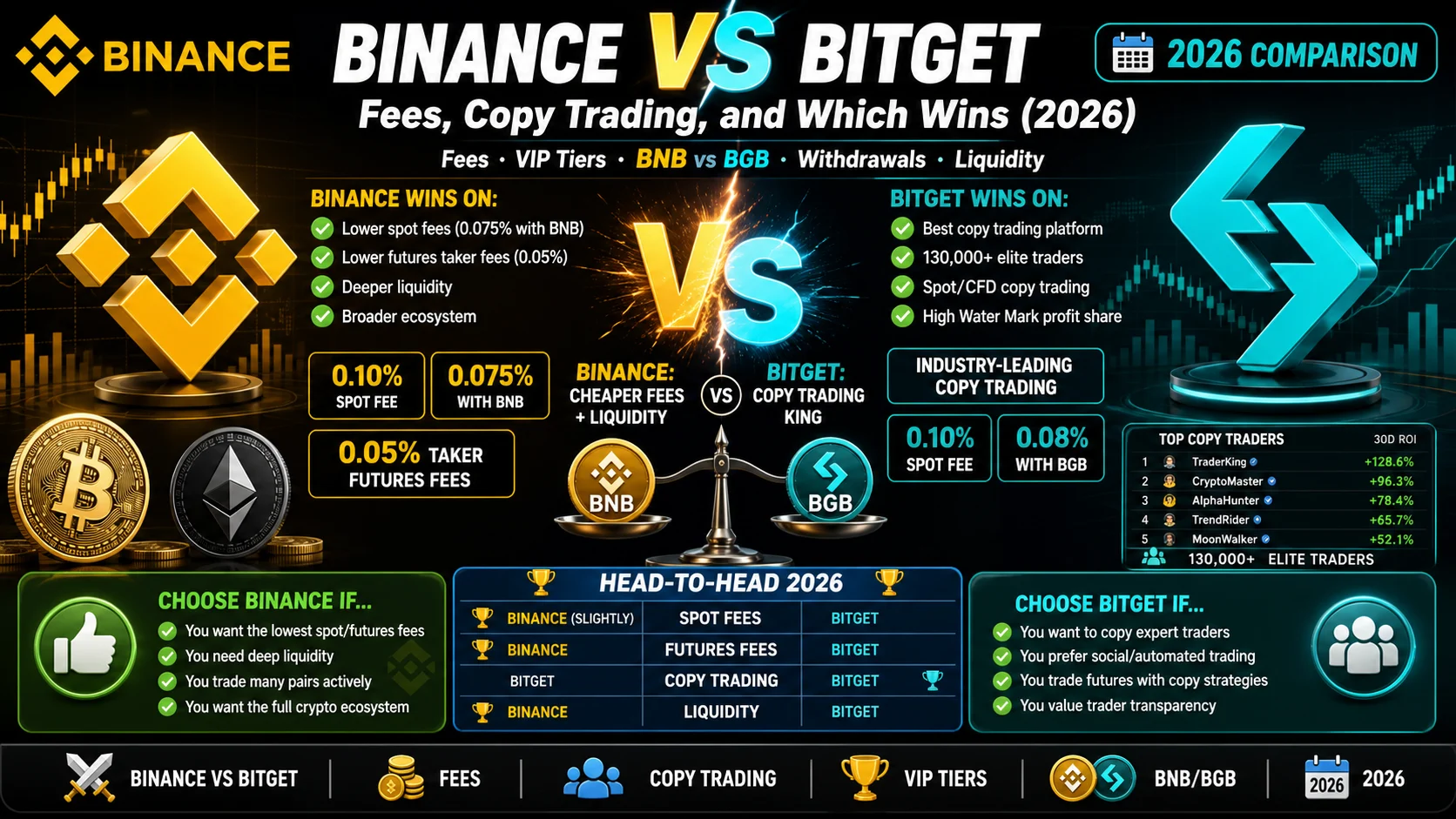
Binance vs Bitget (2026): Fees, Copy Trading, and Which Wins
Binance is cheaper for spot and futures; Bitget wins on copy trading. Compare 2026 fees, VIP tiers, BGB vs BNB discounts, withdrawals, and liquidity.
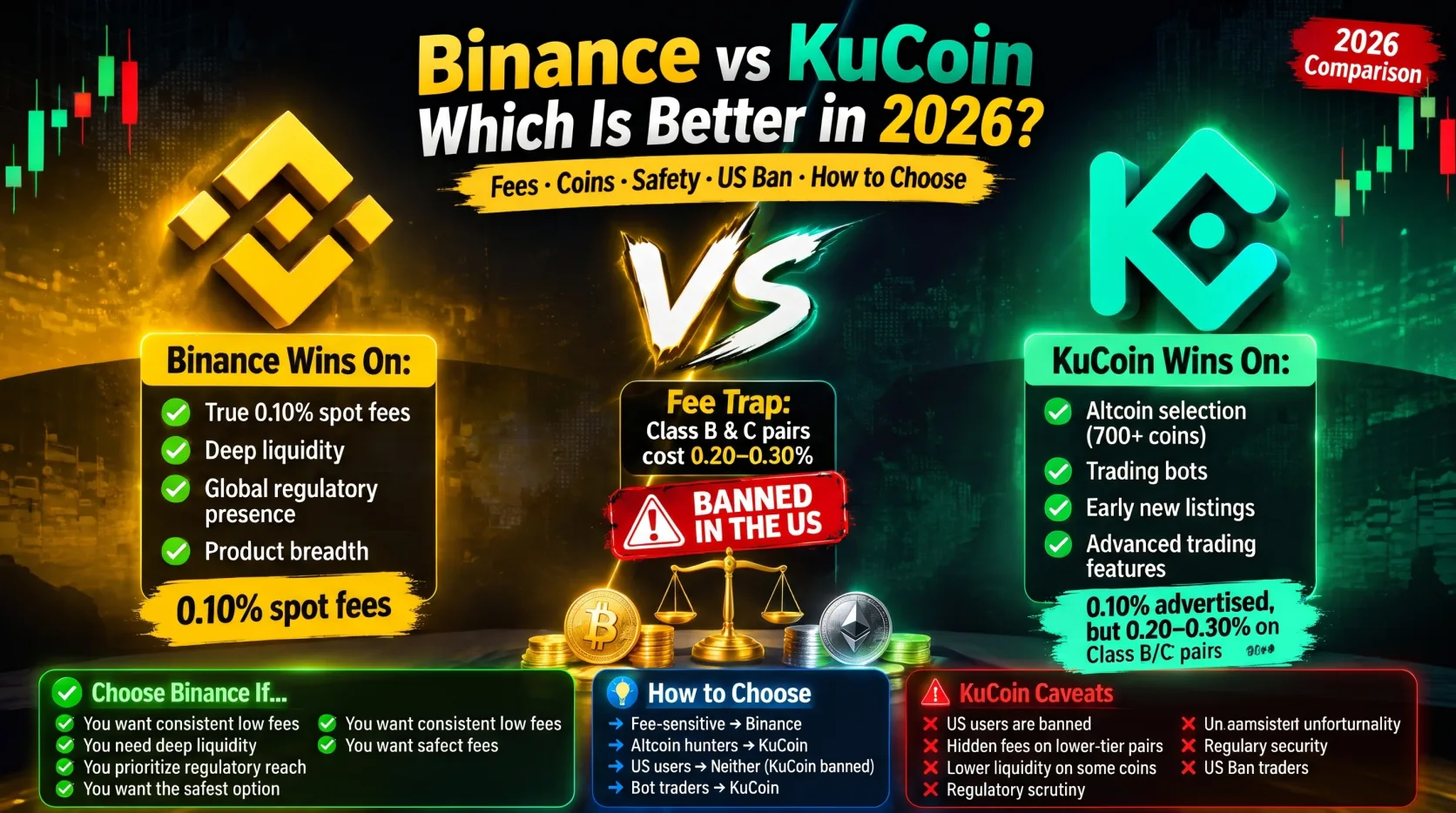
Binance vs KuCoin: Which Is Better in 2026?
Both advertise 0.10% spot, but KuCoin's Class B and C pairs cost 0.20–0.30% and it is banned in the US. Fees, coins, safety, and how to choose.
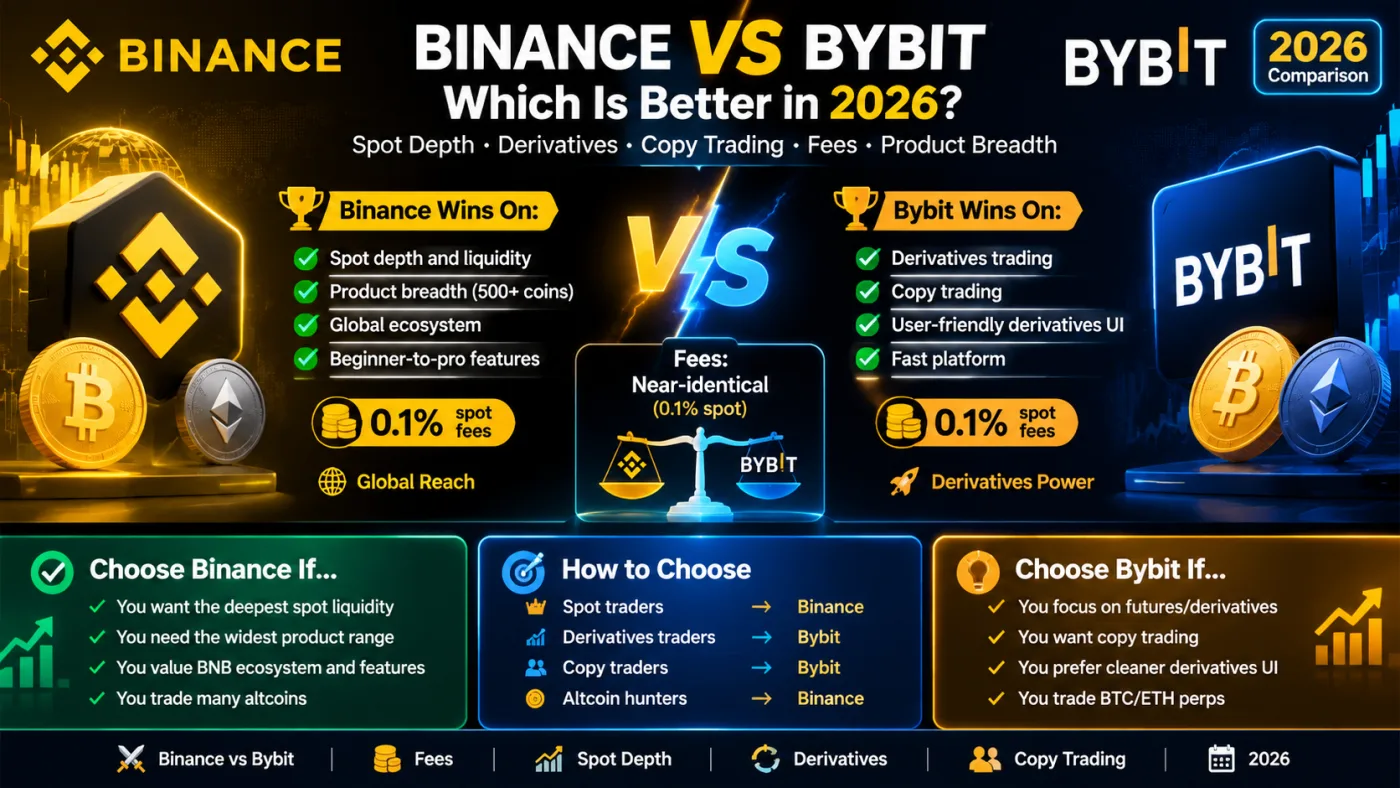
Binance vs Bybit: Which Is Better in 2026?
Binance wins on spot depth and product breadth; Bybit wins on derivatives and copy trading. Fees are near-identical (0.1% spot). Here's how to choose.