
Binance Review: Fees, Safety & Verdict (2026)
An honest Binance review for beginners: fees from 0.1%, 500+ coins, and how it handled the $6.3B October 2026 hack — plus the regulatory caveats before you sign up.
 Lucas Almeida 5 min read
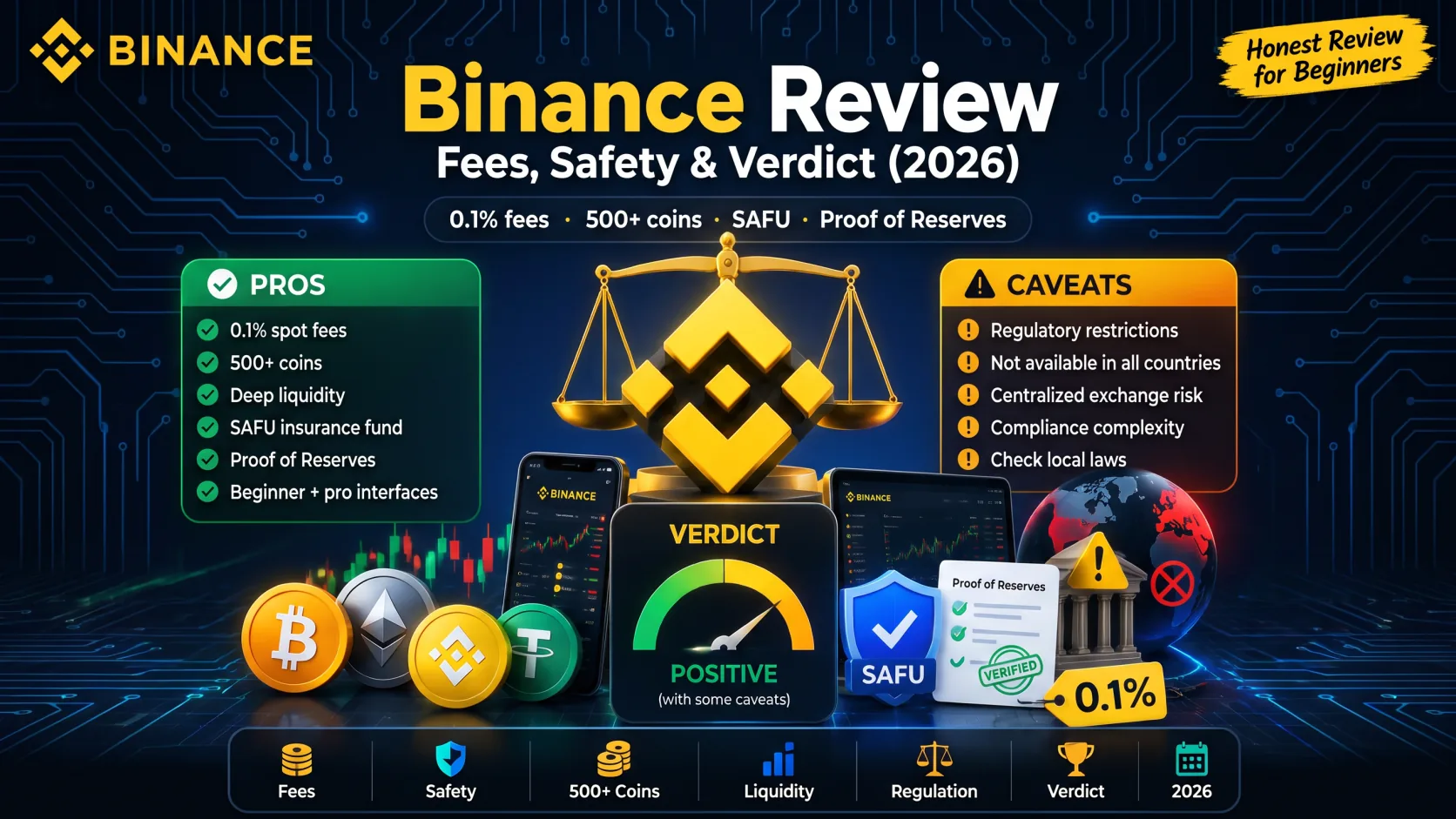
Key takeaways
- Binance is the world's largest crypto exchange: 300 million+ registered users (announced December 2025), 500+ listed coins, and spot fees from 0.1% — or 0.075% if you pay with BNB (all checked October 2026).
- Its custody record is the strongest part of the story — and it was tested in October 2026. When about $6.3 billion left hot wallets, Binance covered roughly 90% within two days and 95% within four from its own funds, rather than passing the loss to users.
- The real caveats are regulatory, not technical. US residents are routed to the separate Binance.US, and Binance holds no EU MiCA licence as of October 2026, so availability depends on where you live.
- Ignore the Trustpilot score — Trustpilot itself disabled Binance's TrustScore in 2024 over fake-review concerns. Judge the exchange on its custody record and your own account security instead.
- Verdict: for beginners in supported countries who want low fees and the widest coin selection, Binance is the default pick. Secure your account with an authenticator 2FA and withdrawal whitelist from day one.
Binance is the world’s largest crypto exchange, and for most beginners in supported countries it is still the best all-round starting point. The reasons are concrete: spot fees from 0.1% (0.075% with BNB) that undercut nearly every major rival, 500+ listed coins, liquidity deep enough that small orders fill instantly at fair prices, and a custody operation that absorbed the largest theft in crypto history in four days at its own expense.
It also has real weaknesses you should know before registering: US residents cannot use the global platform (they are routed to the smaller Binance.US), it held no EU MiCA licence as of October 2026, its $4.3 billion US compliance settlement in 2023 is part of its history, and customer support is its weakest day-to-day feature.
So the honest review verdict is this: if Binance is available where you live and you want low fees plus the widest coin menu from day one, it should be at the top of your shortlist — with your account security configured properly before your first deposit. This review walks through the numbers behind that verdict, all checked in October 2026.
⚠️ The most important thing first: don’t tap Sign Up directly in the app — you’ll miss the new-user rewards. The welcome benefits only apply when you register through an invite link or enter the referral code BN2688. Remember this.
Binance at a glance
| Founded | 2017 (founder Changpeng “CZ” Zhao; CEO Richard Teng since late 2023) |
| Registered users | 300 million+ — the first exchange to cross the mark, announced 31 December 2025; roughly 323 million cited by mid-2026 |
| Cryptos listed | 500+ coins across 1,500+ trading pairs |
| Cumulative product volume | $34 trillion since launch (company figure, end-2025) |
| Spot fee | 0.1% maker/taker — 0.075% paying with BNB |
| Futures fee (USDS-M) | 0.02% maker / 0.05% taker |
| Regulatory status | Licensed in parts of the Middle East; contested in the US and EU (details below) |
Two context points make those numbers meaningful. First, scale is a safety feature: with ~1 in 27 people on the planet holding an account, Binance has the deepest order books in the industry, which means better prices and no trouble cashing out even in volatile markets. Second, the user growth — 100 million new accounts in the 18 months to end-2025 — happened after the 2023 US settlement, which tells you the regulatory noise has not slowed actual adoption.
Pros and cons
| Pros | Cons |
|---|---|
| Spot fees from 0.1% (0.075% with BNB) — the lowest of any major exchange | Not available to US residents; Binance.US is a separate, smaller platform |
| Deepest liquidity in the industry — fast fills, tight spreads | No EU MiCA licence as of October 2026; EU onboarding under regulatory review |
| 500+ coins, from bitcoin to new listings | $4.3B US settlement (2023) and a compliance history you should know about |
| Full product range: Earn, staking, P2P, Launchpad, auto-invest, futures | Customer support is slow; account-lock complaints are its most common gripe |
| Strong custody record: a $6.3B October 2026 hack covered in days without charging users | The advanced interface can overwhelm total beginners (use the simple mode) |
| Polished mobile app with a proper beginner mode | Trustpilot rating is unreliable in both directions (more below) |
Binance fees: the main reason people pick it
Fees are where Binance built its lead, and it still holds it (checked October 2026 on Binance’s fee page):
| Fee type | Rate |
|---|---|
| Spot trading (regular user) | 0.1% maker / 0.1% taker |
| Spot with BNB discount | 0.075% (25% off when paying fees in BNB) |
| USDS-M futures | 0.02% maker / 0.05% taker |
| Crypto deposits | Free (network fees apply on withdrawals) |
| Fiat deposits | Varies by method and region — card purchases cost more than bank options |
In practice: a $1,000 spot trade costs $1.00, or $0.75 with the BNB discount enabled. That sounds small, but it compounds — a beginner who trades weekly pays noticeably less here than on the 0.4–0.6% instant-buy interfaces of some rivals. The BNB discount is on by default once you hold a little BNB; you can toggle it in account settings.
Three things worth knowing beyond the headline rates:
- The referral rebate. New users who sign up through a referral link can get part of their trading fees rebated — up to 20% on spot under Binance’s co-inviter program, depending on what the referrer shares. The code costs nothing and can only reduce your fees; our Binance referral code guide explains the mechanics.
- Futures are cheap but dangerous for beginners. The 0.02%/0.05% rates are excellent, but leverage is where new traders lose money. Ignore futures entirely for your first months.
- Card purchases cost extra. Buying with a debit/credit card adds a processing fee (and often a spread). Cheaper paths are a bank deposit or P2P — our Binance deposit guide compares them.
We break the full schedule down in Binance fees explained.
How safe is Binance?
The short version: Binance’s technical safety record is the strongest among large global exchanges, while its regulatory position is the weakest part of the story. Both matter, so here is each in brief — our Is Binance Safe? guide covers this in depth.
The custody record is genuinely good — and it was stress-tested. In May 2019 attackers took 7,000 BTC (about $41 million) from a hot wallet, and every affected user was repaid in full from the emergency fund. In October 2026 roughly $6.3 billion left hot wallets across about ten chains: Binance set aside $6.34 billion of company money, reported about 90% of losses covered within two days and about 95% within four, and said it would absorb the impact rather than pass it to users. The large majority of assets sit in offline cold storage. The honest caveat is what it cost: SAFU was drawn down from about 15,000 BTC to about 7,500 BTC (roughly $580 million), and Binance has committed to rebuilding it to about $1 billion without publishing a deadline.
You can verify it. Binance publishes Proof of Reserves quarterly — a cryptographic snapshot showing it holds at least as much of each major asset as customers are owed (recent snapshots: BTC ~100.16%, BNB ~100.51%). It is not a full audit, but it is far more transparency than most exchanges offer.
The regulatory history is the honest minus. In November 2023 Binance paid approximately $4.3 billion in a US settlement over anti-money-laundering and sanctions failures; founder CZ pleaded guilty and stepped down, and a five-year compliance monitor is still in place. That history is why some banks and regulators treat Binance coolly even as its security engineering stays strong.
Where is Binance available? (The caveat that decides for many people)
This is the section that most changes a beginner’s decision, so check it before anything else:
- United States. Residents cannot use the global Binance.com. They are routed to Binance.US — a separate company with fewer coins, thinner liquidity, and different fees. Everything in this review applies to the global platform.
- European Union. As of October 2026 Binance holds no MiCA licence. It was expected to stop onboarding new EU users from 1 July 2026, and an ESMA-led inquiry opened in October 2026 is examining accounts opened through a narrow “reverse solicitation” exemption. If you are in the EU, verify the current status for your country first — our Binance vs Coinbase comparison is worth reading as the regulated alternative.
- Elsewhere. Binance operates across most of Asia, Latin America, Africa, and the Middle East — in some jurisdictions (like Abu Dhabi/Dubai) under full local licences. Availability is not binary in all countries; features such as derivatives or P2P can vary within the same country.
The practical rule: your experience and your protections depend on your jurisdiction. Where Binance is licensed, you have real recourse. Where it is not, you are relying on its own good behavior — which has held up on custody, but is a real consideration.
Coins and products: what you can actually do there
The 500+ coin menu covers everything from BTC and ETH to the long tail of new listings, and the product suite is the widest in the industry:
- Spot trading — simple mode for beginners, full charting when you grow into it. Our step-by-step buying guide walks the first purchase.
- Binance Earn — flexible and locked savings, staking, and dual-asset products that pay yield on coins you already hold. Reviewed in Binance Earn explained.
- P2P trading — buy directly from other users with local payment methods (bank transfer, wallets) at zero trading fee. See Binance P2P for how to avoid the scams specific to it.
- Launchpad and Launchpool — early access to new token sales, usually by staking BNB.
- Auto-Invest — recurring buys, i.e. dollar-cost averaging on autopilot; our DCA guide explains the strategy.
- Futures and margin — leverage products we recommend beginners skip for at least their first year.
For a first week, you need none of the exotic products: deposit, buy spot, and turn on account security before anything else.
Getting started: onboarding and KYC
Signing up takes minutes; verification (KYC) is the step that matters. You will need a government ID and a liveness selfie, and approval is typically fast — often minutes to a few hours, occasionally up to a few days when volume spikes. Our Binance KYC guide covers the exact document requirements and the common reasons verification gets stuck.
The order we recommend for a brand-new account:
- Create the account — with a referral code if you want the fee rebate, since it cannot be added later.
- Complete KYC immediately, before depositing anything.
- Turn on authenticator-app 2FA and the withdrawal whitelist.
- Deposit via the cheapest method available in your country (3 ways compared).
- Make your first spot purchase (walkthrough).
One habit to carry from day one: only ever reach Binance by typing the address yourself. Phishing sites that mimic the login page are the number-one way beginners actually lose accounts — not exchange hacks.
Customer support and reviews: read them correctly
Binance’s weakest everyday feature is support. Wait times for ticket responses can stretch into days during volatile markets, and the most common complaint pattern is account locks triggered by security reviews — frustrating when it happens, though it is the same trade-off every large exchange makes for fraud screening.
About Trustpilot specifically: Binance’s score there sits very low, but Trustpilot itself disabled Binance’s TrustScore in September 2024 after detecting fake review activity — with most of the then ~4,500 reviews being 1-star and patterns of manipulation found on both sides. App-store ratings, meanwhile, run around 4.5/5, and independent review sites typically land at 3.8–4.4/5. The lesson is not “Binance has great or terrible reviews” — it is that review-platform scores for big exchanges measure support frustration more than fund safety. Judge the exchange on the custody record and your own security setup, not the star average.
Who should (and shouldn’t) use Binance
| If you are… | Binance is… |
|---|---|
| A beginner in a supported country wanting low fees and lots of coins | The default choice — start here |
| A US resident | Not available — evaluate Binance.US alternatives instead |
| An EU resident | Uncertain — verify the current MiCA status for your country first |
| A cost-conscious small trader | Excellent — fees and the P2P/eGIFT options suit small amounts |
| Planning to hold large amounts long-term | A fine on-ramp, but move long-term holdings to a wallet you control |
| Someone who wants white-glove support | The wrong fit — every big exchange is weak here, Binance more than most |
The closest mainstream alternative for US and EU users is Coinbase — a more heavily regulated, beginner-polished choice at higher fees; our Binance vs Coinbase comparison covers the differences. If you are choosing between the two anyway, it is reasonable to open with one and add the other later — accounts are free.
💡 Don't have a Binance account yet? Sign up now — 20% fee rebate on spot and futures — enter the referral code BN2688.
The bottom line
Binance earns its position as the default exchange for beginners in supported countries: spot fees from 0.1% (0.075% with BNB), 500+ coins, the deepest liquidity in the industry, and a custody operation that covered the largest theft in crypto history — about $6.3 billion in October 2026 — within four days and at its own expense. Its real weaknesses are outside the trading engine: no US availability, an unresolved EU licensing question as of late 2026, a $4.3 billion compliance settlement in its past, a SAFU reserve that is now roughly half its former size, and support that strains under load.
If that trade-off works for where you live, the sensible path is: register with a referral code (it cannot be retrofitted later, and it can only lower your fees), finish KYC, switch on 2FA and the withdrawal whitelist, and fund the account through the cheapest deposit method in your country. Do that, and you are on the same footing as the exchanges’ most security-conscious users — with the lowest fees in the mainstream to boot.
Don't have a Binance account yet?Sign up nowenter the referral codeBN2688
Frequently asked questions
Is Binance a good exchange for beginners?
How much does Binance charge in fees?
Is Binance safe to use in 2026?
Is Binance available in my country?
Does Binance have a sign-up bonus?
What are the best Binance alternatives?
Editor-in-Chief & Lead Researcher
Editor of MyCryptoStart. Independent researcher of cryptocurrency exchanges, focused on fees, security, KYC, and onboarding — publishes step-by-step guides in plain English for beginners.
View author page →Some links on this page are affiliate links: we may earn a commission at no extra cost to you. This content is educational and is not financial, investment, or legal advice. Affiliate disclosure · Disclaimer.
Continue reading
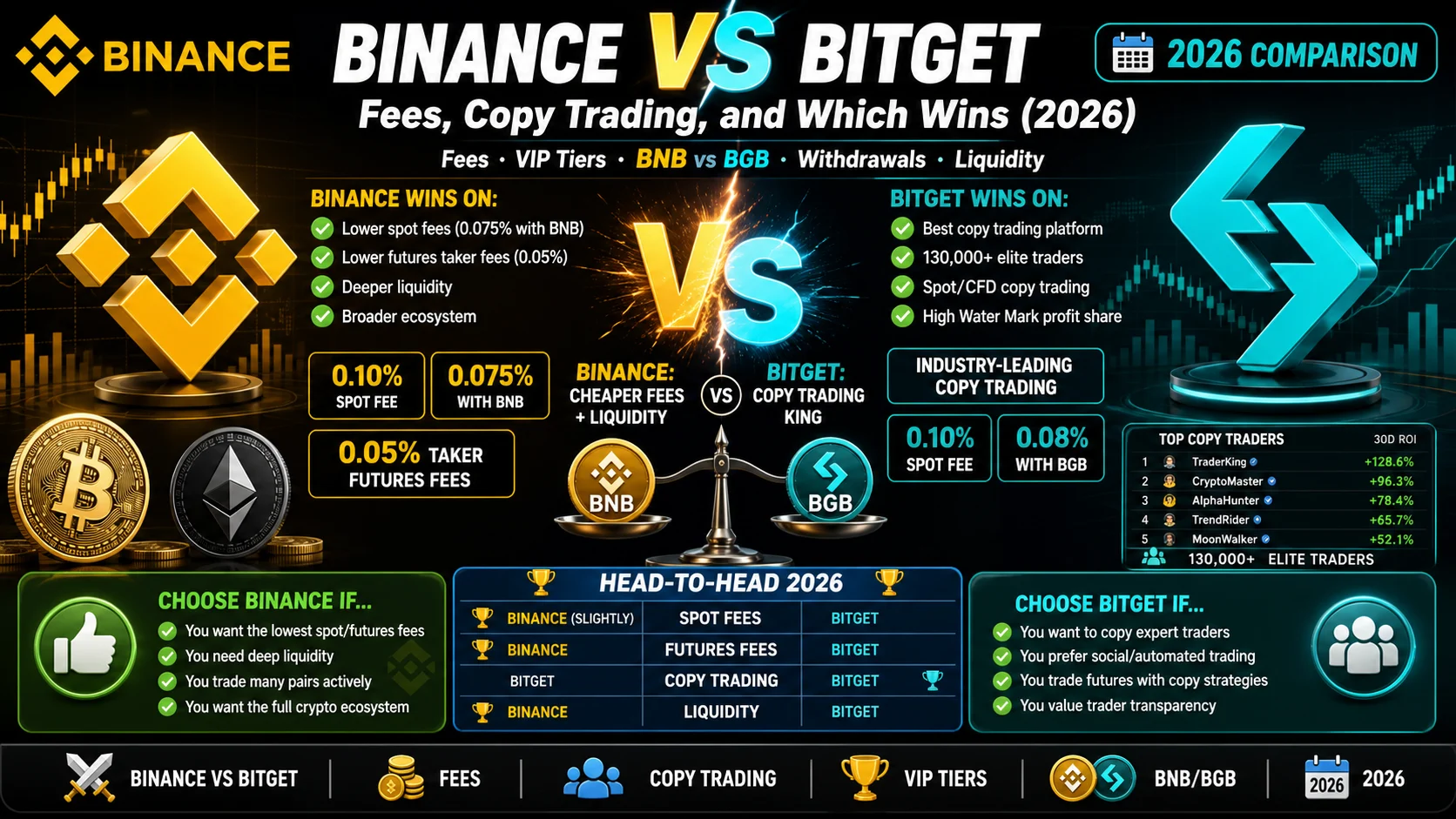
Binance vs Bitget (2026): Fees, Copy Trading, and Which Wins
Binance is cheaper for spot and futures; Bitget wins on copy trading. Compare 2026 fees, VIP tiers, BGB vs BNB discounts, withdrawals, and liquidity.
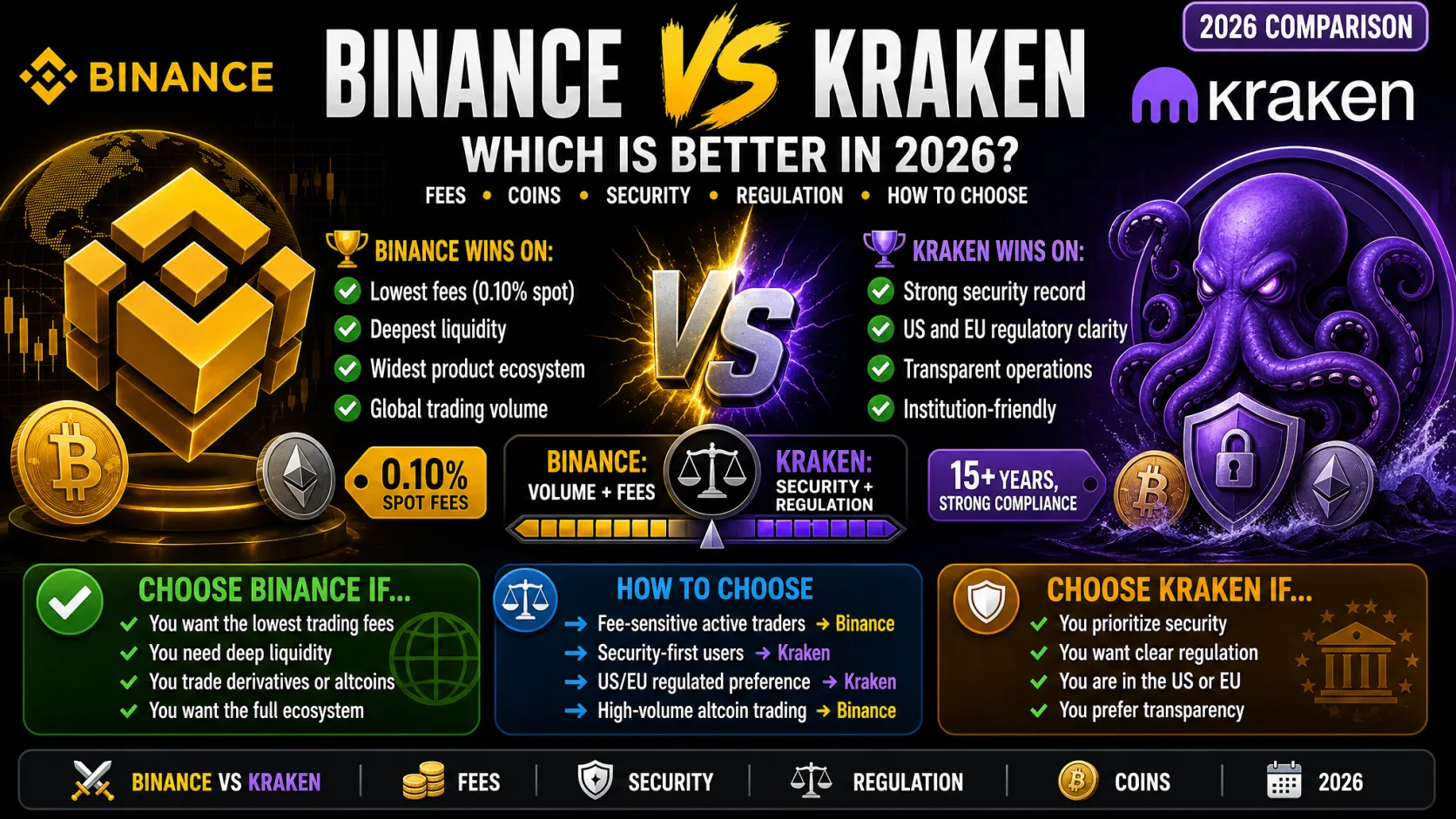
Binance vs Kraken: Which Is Better in 2026?
Binance charges 0.10% spot (0.075% with BNB). Kraken's entry tier is 0.40%/0.80% after its July 2026 rework. Fees, access, safety, and how to choose.
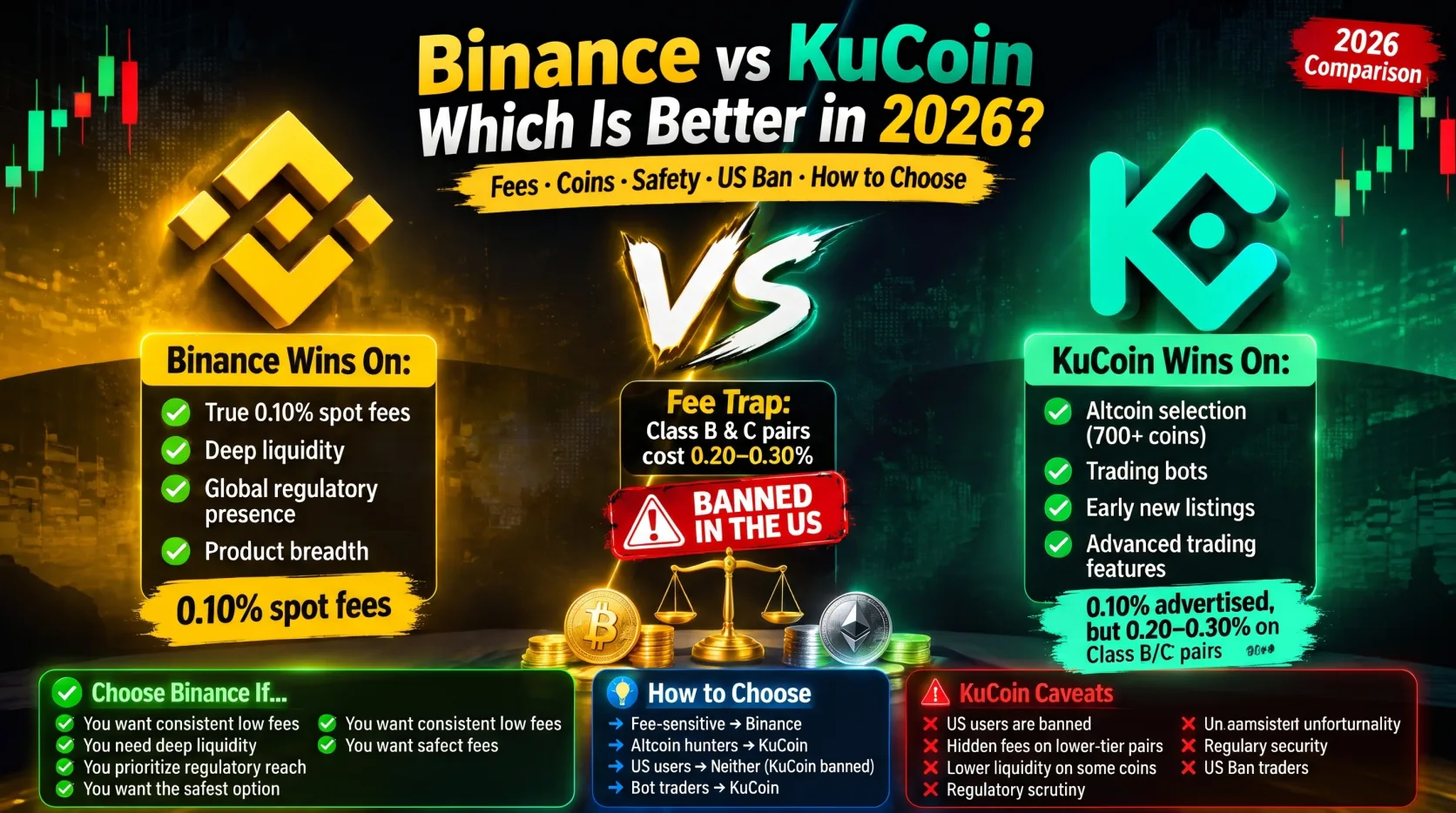
Binance vs KuCoin: Which Is Better in 2026?
Both advertise 0.10% spot, but KuCoin's Class B and C pairs cost 0.20–0.30% and it is banned in the US. Fees, coins, safety, and how to choose.