
OKX Review 2026: Fees, Safety & Verdict
Honest 2026 OKX review: 0.08% global spot maker fees, monthly proof of reserves, MiCA and US licences — plus the $504M DOJ history and who should avoid it.
 Lucas Almeida 5 min read
Key takeaways
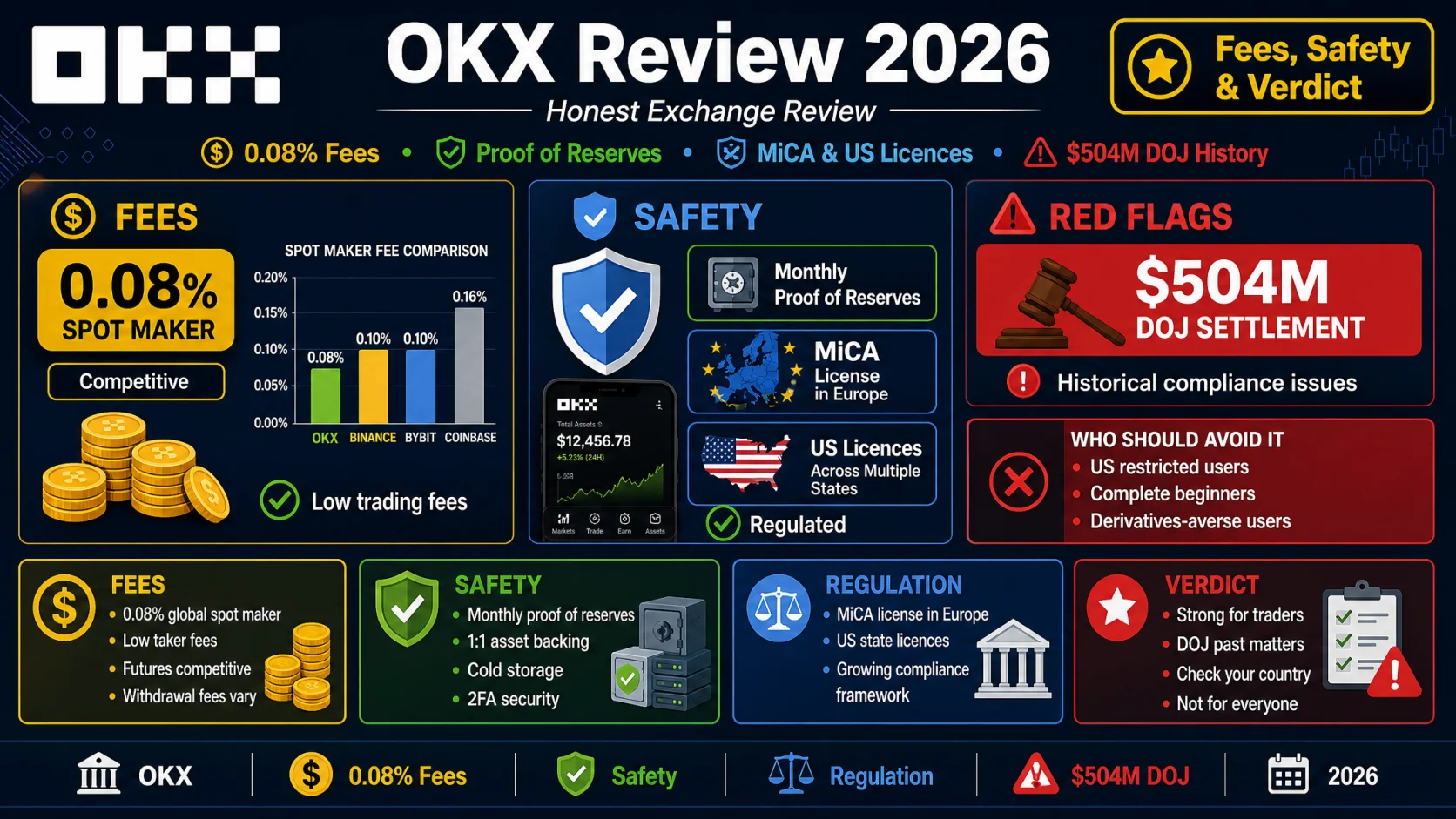
- OKX is the strongest all-round alternative to Binance for traders outside the US: 0.08% maker / 0.10% taker spot fees, deep derivatives, and a built-in self-custody Web3 wallet.
- Its transparency is genuinely top-tier: 49 consecutive monthly proof-of-reserves reports, the November 2026 edition covering $33.87B across 21 assets at BTC 108%, ETH 101% and USDT 106%.
- Fees depend on which of three schedules your account is on. Global accounts pay 0.08%/0.10% spot; EEA accounts without derivatives and US OKX accounts pay 0.20%/0.35%.
- OKB no longer reduces trading fees. OKX's official FAQ (updated September 2026) says holding OKB gives no fee discount and does not count toward VIP tiers — old '25% off with OKB' guides are wrong.
- The biggest caveats are regulatory and regional: a $504M US DOJ settlement in February 2025, a compliance consultant through February 2027, and no access to the global platform for US, Canadian or Hong Kong residents.
- Verdict: pick OKX if you want maker-fee trading, derivatives and a Web3 wallet in one app. Pick Binance if you want the deepest spot books, the cheapest spot fees with BNB, or the largest library of beginner guides.
OKX is the strongest all-round alternative to Binance for traders outside the United States, and the better pick if you trade with limit orders or want a built-in Web3 wallet. Its global spot fee is 0.08% maker / 0.10% taker — cheaper than Binance’s base rate on the maker side — perpetual fees match Binance at 0.02%/0.05%, and it has published 49 consecutive monthly proof-of-reserves reports. The trade-offs are real: a $504 million US DOJ settlement in 2025, a compliance consultant through February 2027, and three different fee schedules depending on where your account is registered.
This review separates those threads. It covers what OKX actually costs in each region, how its safety record compares with Binance and Bybit, which countries can use which version, and a decision rule for choosing between OKX and Binance.
Data check (25 November 2026): fees come from OKX’s official fee pages, reserves from the November 2026 proof-of-reserves report, licensing from OKX’s US licence page and the Malta MiCA announcement, and the US penalty from the DOJ press release. Rates and availability change; confirm on the live page before a large transfer.
⚠️ Before you register: an OKX invite code can only be applied to a brand-new account through the registration link. It cannot be added to an existing account later. If you want the new-user fee benefit, start from the link rather than the bare app.
OKX at a glance
| Founded | 2017 as OKEx; renamed OKX in 2021 |
| Operating entity | Aux Cayes Fintech Co. Ltd., registered in Seychelles |
| Global users | 120 million+ (OKX figure, November 2026) |
| Platform assets | $33 billion+; reserve ratio 103% |
| Spot fee (global Regular) | 0.08% maker / 0.10% taker |
| Perpetual fee (global Regular) | 0.02% maker / 0.05% taker |
| Spot fee (EEA without derivatives / US) | 0.20% maker / 0.35% taker |
| Token fee discount | None — OKB does not reduce fees |
| Licences | MiCA via Malta (EEA); FinCEN-registered US entity; AFSL in Australia |
| Regulatory history | ~$504M US DOJ settlement, February 2025 |
The scale matters for a practical reason: OKX is consistently one of the deepest spot venues after Binance, so a retail order fills at a fair price and a position can be exited without moving the book. The $33 billion+ in platform assets and 103% reserve ratio are company-reported figures, but they are backed by a monthly cryptographic attestation you can check yourself (more on that below).
Pros and cons
| Pros | Cons |
|---|---|
| 0.08% maker fee on global spot — undercuts Binance’s 0.10% base | Taker fee is the same 0.10%, so market orders gain nothing |
| Perpetual fees match Binance at 0.02%/0.05% | No token discount: OKB does not cut fees (official FAQ, September 2026) |
| 49 straight monthly proof-of-reserves reports; zk-verifiable | Proof of reserves is a snapshot, not a full audit or a guarantee |
| MiCA-licensed EEA entity; FinCEN-registered US entity | $504M US DOJ settlement and compliance consultant through February 2027 |
| Excellent built-in Web3 wallet, DEX aggregator and NFT support | US, Canadian and Hong Kong residents cannot use the global platform |
| Unified account, portfolio margin, options and trading bots | EEA and US accounts pay 0.20%/0.35% — 2.5–3.5× the global rate |
| OKX Shield reimbursement of up to $100K–$500K for account takeovers | Shield is discretionary, not insurance, and requires six settings |
What is OKX, and who owns it?
OKX is a Seychelles-registered crypto exchange founded in 2017 as OKEx, renamed in 2021, and now a combined exchange, Web3 wallet and payments platform. Its operating entity is Aux Cayes Fintech Co. Ltd. OKX reports 120 million+ users, $33 billion+ in platform assets and a 103% reserve ratio as of November 2026.
The corporate story changed materially in 2026. On 5 March 2026, Intercontinental Exchange (ICE) — the parent of the New York Stock Exchange — took a minority stake in OKX at a $25 billion valuation, reportedly about $200 million, and gained a board seat (Bloomberg, The Block). The commercial plan is for OKX users to access ICE’s US futures and tokenized NYSE equities in the second half of 2026, subject to regulatory approval.
That deal is the main reason to take OKX more seriously than a generic offshore exchange: it ties a large crypto venue to the infrastructure of a major US exchange group. It does not erase the compliance history below, and the tokenized-equity plan is not live yet.
OKX fees: which of the three schedules are you on?
OKX does not have one fee schedule — it has three, and quoting the global rate to a US or EEA reader is the most common mistake in OKX reviews. Your account’s entity decides which table applies.
| Fee type | Global Regular | EEA without derivatives | US (OKX INC.) |
|---|---|---|---|
| Spot | 0.08% maker / 0.10% taker | 0.20% / 0.35% | 0.20% / 0.35% |
| Perpetual futures | 0.02% / 0.05% | Not available | Not available |
| Options | 0.02% / 0.03% | Not available | Not available |
| Crypto deposit | Free | Free | Free |
| Withdrawal | Network fee only | Network fee only | Network fee only |
Three practical conclusions follow.
- Global accounts have a genuine maker edge. At 0.08%, a $10,000 limit order costs $8 versus $10 on Binance’s base tier. If you post liquidity rather than take it, OKX is cheaper.
- Market orders are a tie. Both charge 0.10% at the base tier, and Binance’s 25% BNB discount takes its spot rate to 0.075% — cheaper than OKX for takers who hold BNB.
- The regional gap is bigger than the brand gap. An EEA account without derivatives or a US account pays 0.20%/0.35%, which is 2.5–3.5× the global rate. Check which schedule your account is on before comparing OKX with anyone.
The OKB discount is dead. OKX’s official Trading Fee Rules FAQ, updated 9 September 2026, states that holding OKB does not reduce trading fees and does not count toward VIP tier upgrades. Do not buy OKB expecting a 20–25% discount; that rule belongs to older campaigns. The legitimate ways to pay less are a higher VIP tier (based on 30-day volume or assets), a maker rebate at the top tiers, or a new-user invite-code benefit shown at registration.
Fees checked on OKX’s fee page on 25 November 2026. For a like-for-like comparison with the other major venue, see our Binance fees guide.
How safe is OKX?
On custody transparency, OKX is in the top tier of major exchanges; on regulatory history, it has a real scar. Both are part of an honest answer.
The reserve reporting is unusually strong. OKX has published a proof-of-reserves report every month since November 2022. The 49th report, released in November 2026, covered $33.87 billion across 21 assets, with BTC at 108%, ETH at 101% and USDT at 106% (OKX Proof of Reserves). The attestation uses zk-STARK cryptography and Merkle trees, so a user can verify inclusion without revealing their balance. Auditors named in OKX’s materials include Hacken and SlowMist. The company also reports SOC 1 Type II, SOC 2 Type II, ISO/IEC 27001 and CSA STAR Level 1 certifications.
There has been no major exchange-level theft of customer funds. OKX’s record is different from Binance’s (a $6.3 billion hot-wallet incident in October 2026) and Bybit’s ($1.5 billion in February 2025). Its biggest operational test was different: in October 2020, OKEx froze withdrawals for about five weeks after a private-key holder — founder Star Xu — was detained in a Chinese investigation; withdrawals reopened on 26 November 2020 with reserves intact (CoinDesk). That is a custody-concentration lesson, not a hack, and it is the main reason not to treat any exchange’s cold-storage claims as risk-free.
Smaller incidents belong in the record too. In December 2023 an attacker used a leaked proxy-admin key to drain token approvals from a deprecated OKX DEX contract; third-party analysts put the loss around $2.7 million, while OKX said about $370,000, and OKX pledged full reimbursement (The Block). In June 2024 attackers used forged judicial documents and deepfakes to take over individual accounts in a campaign reported at roughly $2 million; OKX compensated affected users and tightened verification (GetBlock). Those are product- and account-level failures, not a breach of the exchange’s main cold wallets — but they are why “never hacked” should be read as a marketing line, not a risk assessment.
The regulatory scar is the US case. On 24 February 2025, Aux Cayes Fintech pleaded guilty in the Southern District of New York to one count of operating an unlicensed money transmitting business. The company agreed to a $420.3 million forfeiture plus an $84.4 million fine — about $504 million total — and retained an external compliance consultant through February 2027. The conduct ran from about 2018 to early 2024 and involved serving US customers despite a stated policy against it (DOJ press release). There was no money-laundering charge, no monitor, and no individual prosecution, but the case is why OKX now operates in the US through a separate, licensed entity.
On the positive side of regulation, the EEA entity is licensed. OKX Europe Limited obtained a MiCA licence from Malta’s MFSA on 27 January 2025, which it can passport across the EEA (OKX). Malta’s FIAU later fined the EU arm about €1.05 million in April 2025, a reminder that licensing brings supervision, not immunity.
OKX Shield adds a reimbursement layer for account takeovers. Launched in Europe in September 2026 and extended to US users in October 2026, it covers up to $100,000 for regular users and up to $500,000 at higher VIP tiers. It is explicitly not insurance: it must be activated manually, requires six security settings (including a passkey and large-withdrawal protection), excludes user-authorized scams and trading losses, and allows one approved claim per person (OKX Shield FAQ).
The balanced reading: OKX’s technical and reserve transparency is excellent; its compliance history is mixed but now structured through licensed entities. Neither fact removes custodial risk. Use authenticator or passkey 2FA, a withdrawal whitelist and an anti-phishing code from day one — our account security guide covers the setup.
Is OKX available in your country?
Availability is the first question, because it overrides every fee comparison. OKX runs a global platform, a separate US entity, and a MiCA-licensed European entity — and it is fully restricted in several major markets.
- United States. The global platform is closed to US residents. US users must use OKX INC. (OKX US), a FinCEN-registered money services business with NMLS ID 1767779 and state money-transmitter licences. It offers spot and OTC/convert in most states, but not New York, Puerto Rico, American Samoa, Guam, the Northern Mariana Islands or the US Virgin Islands (OKX US licences). Derivatives are not available to US users as of November 2026.
- European Economic Area. OKX Europe Limited is MiCA-licensed in Malta and passportable across the EEA. Accounts without derivatives access sit on the 0.20%/0.35% spot schedule.
- Fully restricted markets. OKX’s official risk and compliance disclosure (updated 14 November 2026) names Canada, Hong Kong, India, Japan, Malaysia, Nepal, Uzbekistan, Iran, North Korea, Syria, Cuba, Afghanistan and the Crimea/Donetsk/Luhansk regions, plus certain US jurisdictions and territories. The list changes; check the live disclosure before you plan around it.
- Partial restrictions. The UK blocks derivatives, CeFi and P2P but allows spot under FCA promotion rules. Australia restricts derivatives and CeFi services. Brazil and South Korea restrict derivatives and P2P. The pattern: the spot venue may be open while the high-risk products are not.
Do not falsify your country of residence to get around a restriction. OKX’s 2025 US case was built partly on exactly that behaviour — IP bans that VPNs defeated and staff advising users to misstate their location. Mismatched identity information creates problems at withdrawal review and account freezing, and it violates the platform’s terms.
What can you actually do on OKX?
OKX is a full-stack venue: spot, derivatives, a unified account, trading bots, copy trading and a self-custody Web3 wallet in one app. The breadth is the product’s main selling point — and its main risk for beginners.
- Spot trading. Hundreds of tokens with a Lite interface for beginners and a full Pro terminal with charting, order types and API access. Our beginner trading guide covers the order types worth learning first.
- Derivatives. USDT- and USDC-margined perpetuals, delivery futures and options, with a unified account and portfolio margin for experienced traders. Treat this as off-limits until you understand liquidation.
- Web3 wallet. A built-in self-custody wallet that connects to DEXs, bridges, NFT markets and multiple chains. It is the most integrated wallet among the big centralized exchanges — but the keys are yours, so the seed-phrase rules apply.
- Copy trading and bots. Follow lead traders, or run grid, DCA and futures bots. Copy trading is a tool, not a shortcut; past performance does not transfer.
- Earn and P2P. Flexible and fixed savings, staking and dual-investment products, plus peer-to-peer trading with local payment methods.
- OKX Pay and OKX Card. Payment products in supported regions, tied to the MiCA/PI licensing in Europe.
For a first month, ignore derivatives, bots and copy trading. Deposit, buy spot, set up security, and learn how the unified account displays balances before adding complexity.
OKX vs Binance: which should you choose?
Choose OKX for maker-fee trading, derivatives and a built-in Web3 wallet; choose Binance for the cheapest spot fees with BNB, the deepest order books and the largest beginner library. The two are close enough that your trading style should decide, not brand loyalty.
| OKX | Binance | |
|---|---|---|
| Spot fee (base) | 0.08% / 0.10% | 0.10% / 0.10% |
| Spot fee with token | No OKB discount | 0.075% with BNB |
| Perpetual futures | 0.02% / 0.05% | 0.02% / 0.05% |
| Spot liquidity | Deep — top tier globally | Deepest |
| Web3 wallet | Best-in-class, built in | Separate, less integrated |
| Licensing | MiCA (EEA); US entity; $504M DOJ case | No MiCA as of Oct 2026; $4.3B US settlement (2023) |
| Custody stress test | 2020 withdrawal freeze, reserves intact | $6.3B hack (Oct 2026), covered in days |
| Beginner experience | Feature-dense but has a Lite mode | More tutorials; simpler lite mode |
On raw cost, a global OKX maker pays 0.08% versus Binance’s 0.10%, while a Binance taker with BNB pays 0.075% versus OKX’s 0.10%. On $10,000 of spot volume, that is $8 versus $10 for makers, and $7.50 versus $10 for BNB-holding takers. Neither gap is large; both compound for active traders.
On safety, both have real incidents in their history. Binance absorbed a $6.3 billion theft in October 2026 without charging users, but its SAFU reserve fell from about 15,000 BTC to about 7,500 BTC with no published refill deadline. OKX has not suffered a comparable theft, but it paid a $504 million US penalty and must operate through licensed entities. Our Binance review and Is Binance Safe? guide cover the other side in detail.
The decision rule:
- Pick OKX if you mostly post limit orders, trade perpetuals or options, want a single app with a serious Web3 wallet, or need a MiCA-licensed venue in the EEA.
- Pick Binance if you buy and hold spot, want the deepest books for large orders, hold BNB for the 0.075% rate, or want the widest choice of coins and beginner guides.
- Use both if you are an active trader: OKX for maker/derivatives and Web3, Binance for spot liquidity and fiat on-ramps. The only cost is securing two accounts.
How do you open an OKX account?
Registration takes minutes; verification and the first deposit are the steps that need care. The order that avoids the common mistakes:
- Start from the invite link, not the bare app. The invite code is applied by the link and cannot be added to an existing account later.
- Use your real country of residence. A mismatch is the fastest route to a frozen withdrawal review.
- Complete KYC immediately. You need a government ID and a liveness check. Most verifications finish in minutes to a few hours; peak periods can stretch to one to three business days.
- Turn on security before depositing. Enable passkey or authenticator 2FA, set an anti-phishing code, and add a withdrawal address whitelist. SMS-only 2FA is the weakest option.
- Deposit through the cheapest rail. Bank transfer and P2P are usually cheaper than a card; card purchases add a processing fee and a spread.
- Buy spot first. Skip leverage, copy trading and bots until you can explain liquidation and funding rates.
- Consider OKX Shield if eligible. It requires six settings and manual activation; it is a reimbursement program, not insurance.
If you are in the US, use OKX US and expect the 0.20%/0.35% fee schedule and a narrower product set. If you are in Canada, Hong Kong or another fully restricted market, OKX is not a practical option — our Binance alternatives comparison covers regulated venues instead.
💡 Don't have an OKX account yet? Sign up now — use invite code 60895497.
Who should and shouldn’t use OKX?
| If you are… | OKX is… |
|---|---|
| A global trader who posts limit orders | A strong pick — 0.08% maker beats Binance’s base rate |
| A derivatives trader outside the US | A strong pick — perp fees match Binance and the unified account is excellent |
| Someone who wants a built-in Web3 wallet | The best mainstream option — the wallet is genuinely integrated |
| An EEA trader who needs MiCA | A good fit — the Malta entity is licensed and passportable |
| A US resident | Only through OKX US — spot/OTC, higher fees, no derivatives |
| A Canadian or Hong Kong resident | Not available — use a regulated local venue |
| A total beginner who wants the simplest app | Workable but dense — Binance’s guides and lite mode are easier |
| Someone who wants the absolute cheapest spot fees | Not the winner — Binance with BNB is 0.075% |
| Planning to hold long-term | An on-ramp, not a vault — move long-term holdings to a wallet you control |
The bottom line
OKX is the best all-round alternative to Binance for traders outside the US, and the better choice if you trade with limit orders, need derivatives, or want a serious Web3 wallet inside the same app. Its 0.08% global maker fee, 49 consecutive monthly proof-of-reserves reports and MiCA-licensed European entity are real strengths. Its weaknesses are equally real: no token fee discount, 0.20%/0.35% fees for EEA and US accounts, a $504 million US DOJ settlement, and no access for US, Canadian or Hong Kong residents to the global platform.
If that trade-off fits you, register through the invite link (the code cannot be added later), complete KYC, set up passkey 2FA and a withdrawal whitelist, and start with spot. If you mainly buy and hold BTC or ETH, compare the total cost against Binance first — with BNB, its 0.075% spot rate is still the cheapest mainstream option.
Don't have an OKX account yet?Sign up nowuse invite code60895497
Frequently asked questions
Is OKX safe to use in 2026?
What are OKX's trading fees?
Does holding OKB reduce OKX trading fees?
Can US residents use OKX?
OKX vs Binance: which is better?
Is OKX regulated?
Does OKX have a sign-up bonus or referral code?
What is OKX Shield?
Editor-in-Chief & Lead Researcher
Editor of MyCryptoStart. Independent researcher of cryptocurrency exchanges, focused on fees, security, KYC, and onboarding — publishes step-by-step guides in plain English for beginners.
View author page →Some links on this page are affiliate links: we may earn a commission at no extra cost to you. This content is educational and is not financial, investment, or legal advice. Affiliate disclosure · Disclaimer.
Continue reading
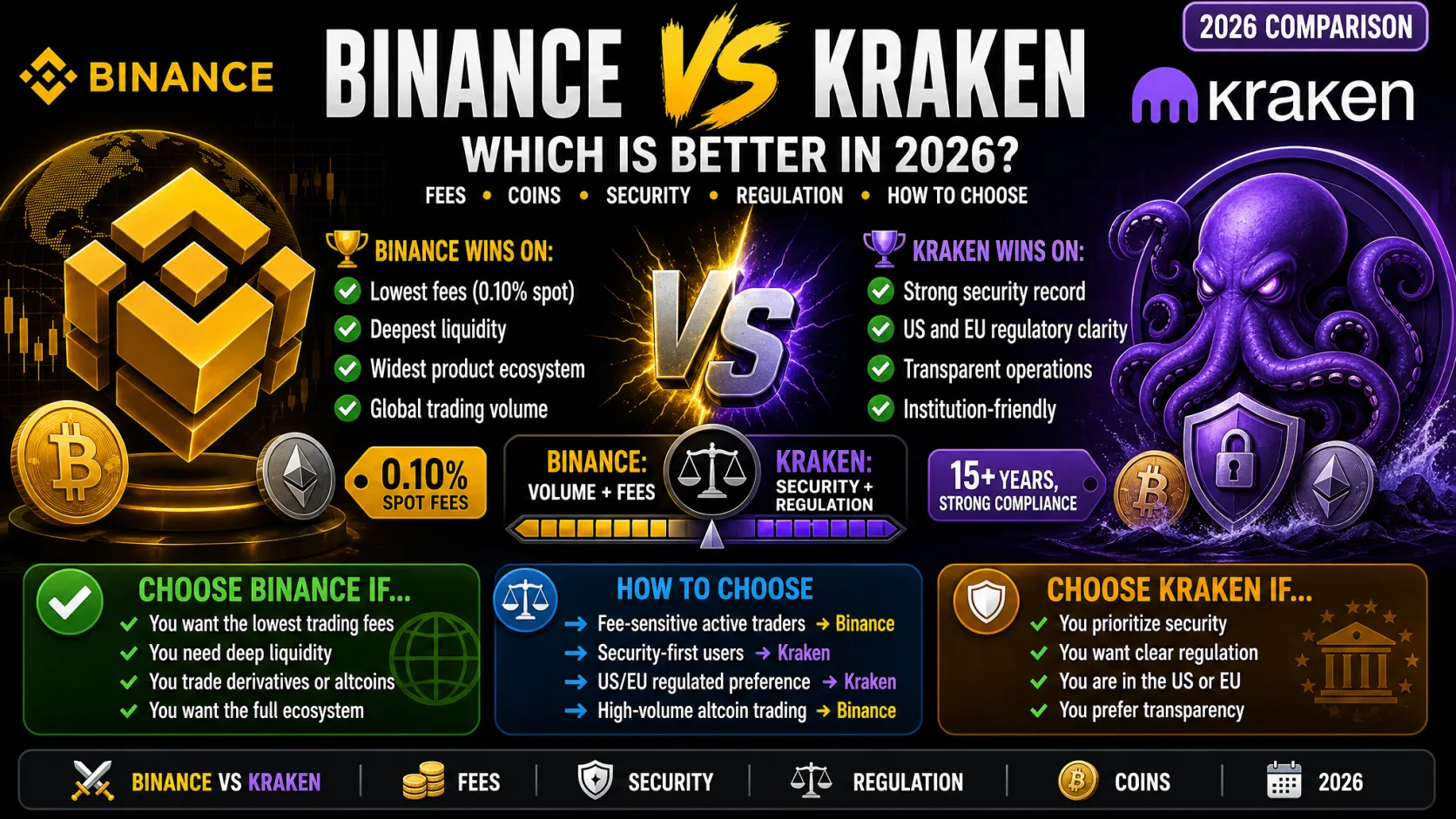
Binance vs Kraken: Which Is Better in 2026?
Binance charges 0.10% spot (0.075% with BNB). Kraken's entry tier is 0.40%/0.80% after its July 2026 rework. Fees, access, safety, and how to choose.
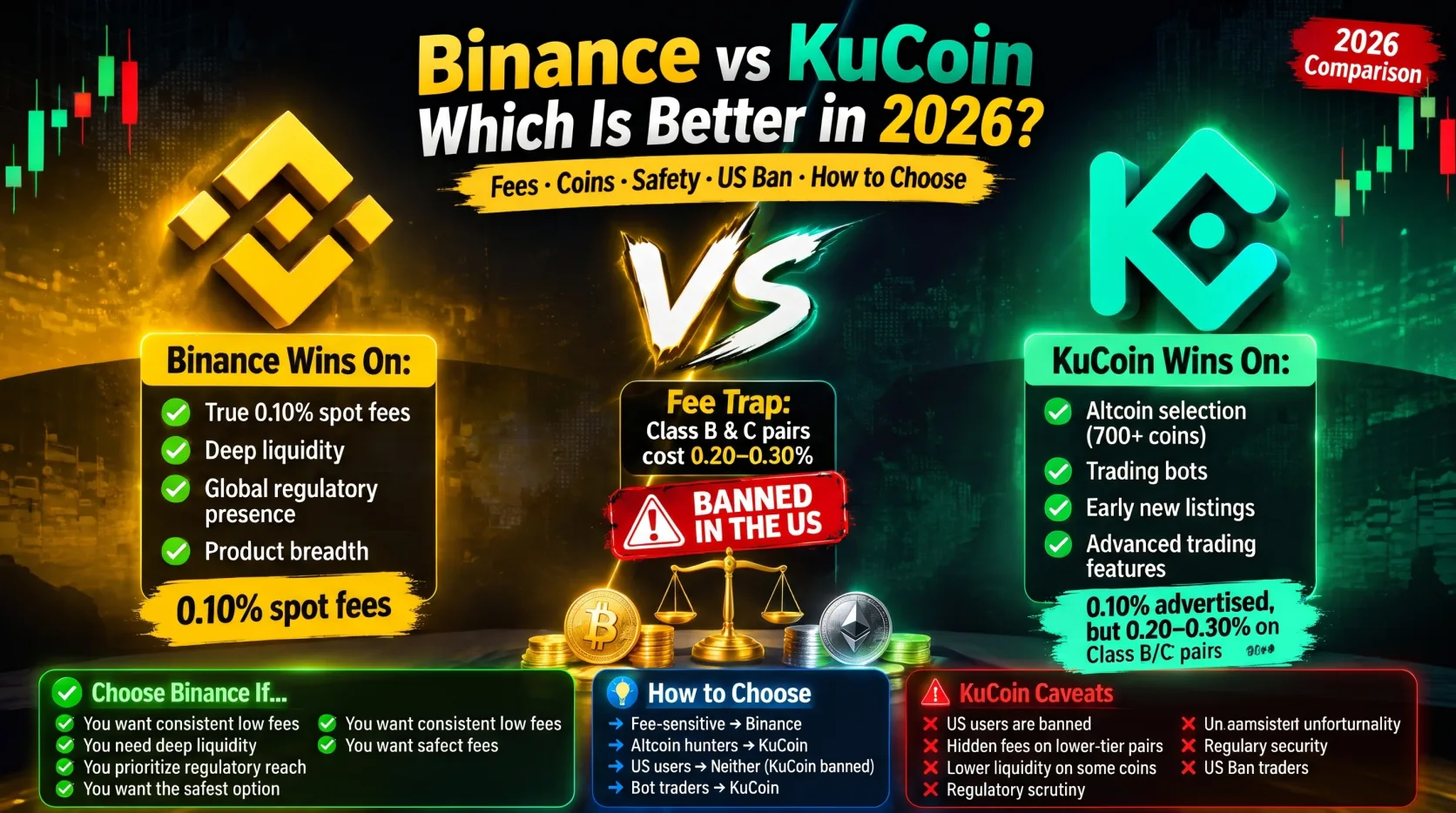
Binance vs KuCoin: Which Is Better in 2026?
Both advertise 0.10% spot, but KuCoin's Class B and C pairs cost 0.20–0.30% and it is banned in the US. Fees, coins, safety, and how to choose.
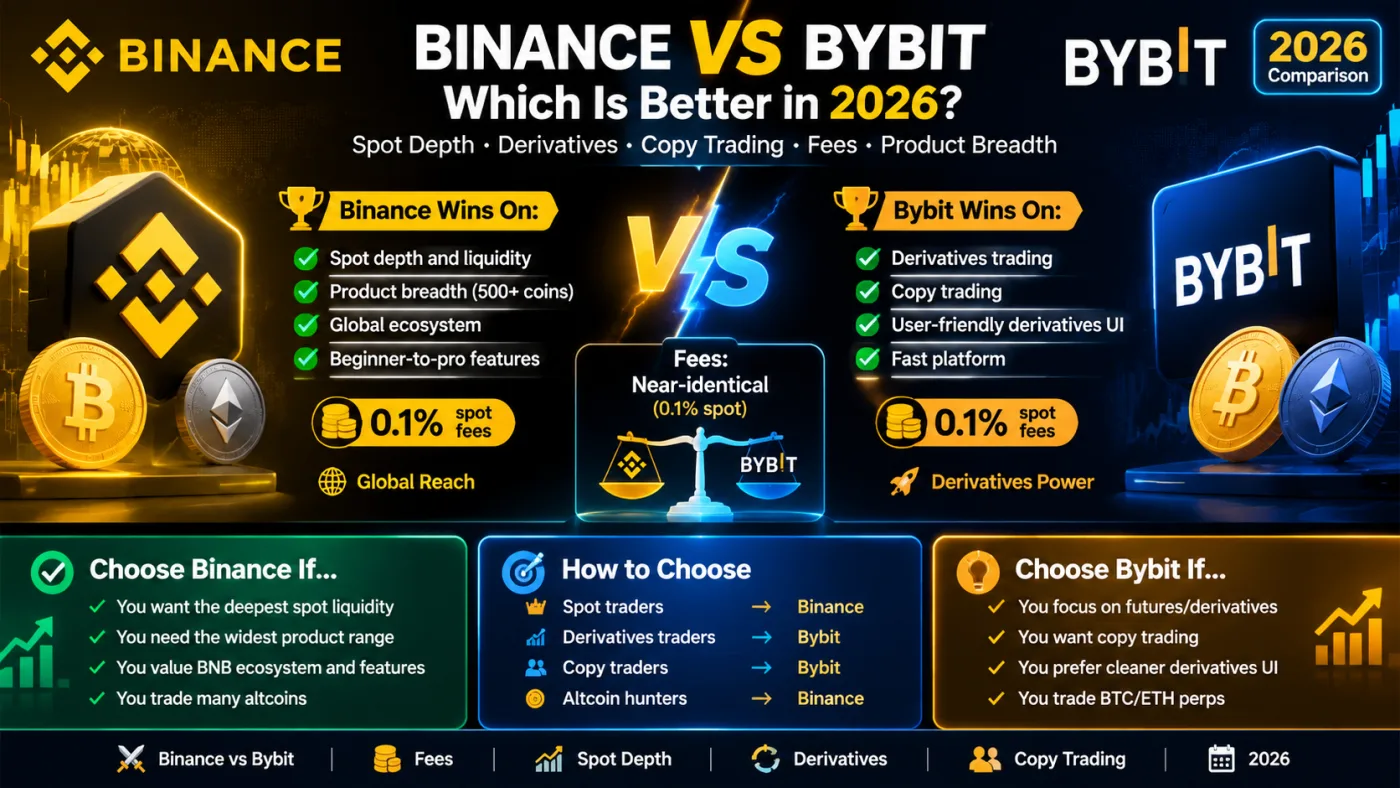
Binance vs Bybit: Which Is Better in 2026?
Binance wins on spot depth and product breadth; Bybit wins on derivatives and copy trading. Fees are near-identical (0.1% spot). Here's how to choose.