
Binance vs Bybit: Which Is Better in 2026?
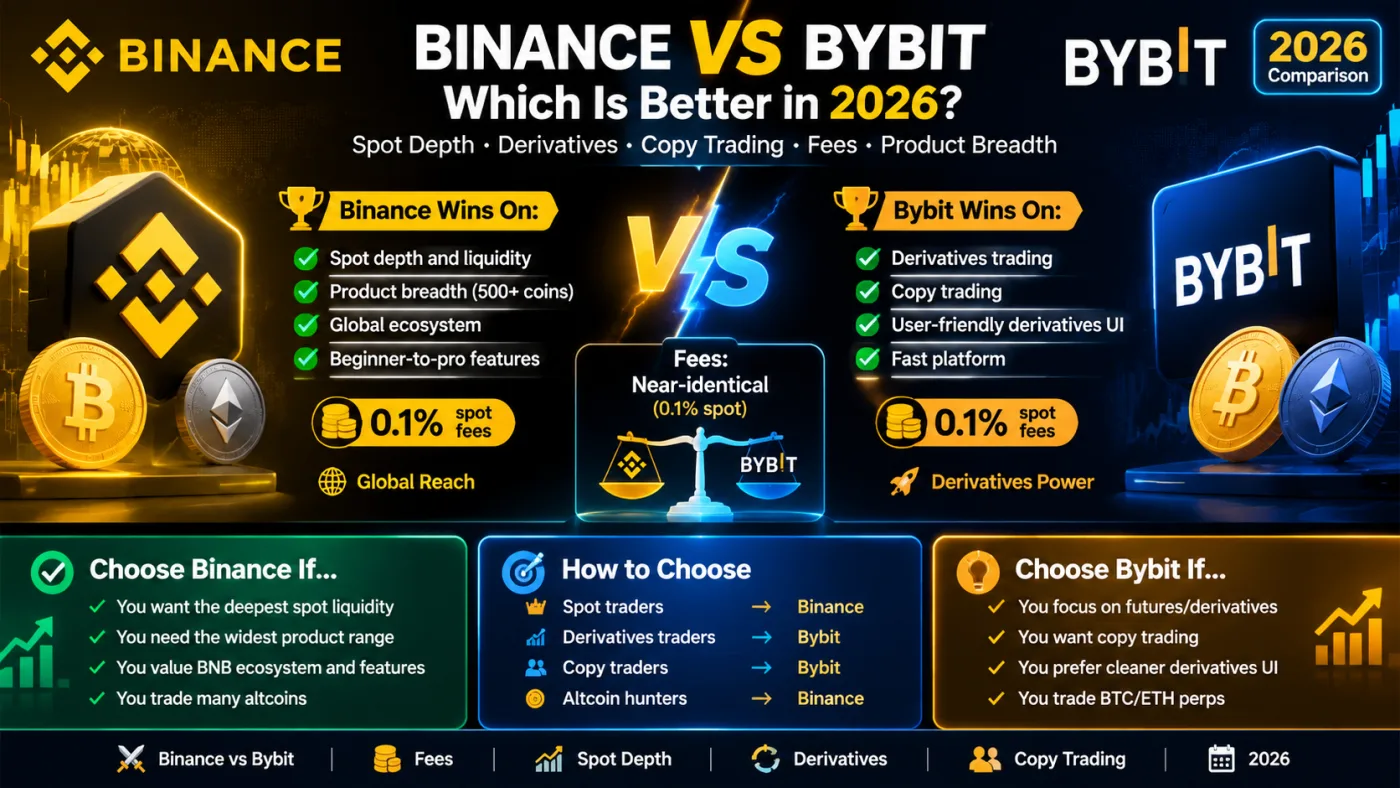
Binance wins on spot depth and product breadth; Bybit wins on derivatives and copy trading. Fees are near-identical (0.1% spot). Here's how to choose.
 Lucas Almeida 5 min read
Key takeaways
- There is no universal winner: fees are near-identical (0.10% spot on both), so the choice comes down to what you trade and where you live.
- Binance wins on spot liquidity, product breadth, the BNB ecosystem, and fiat on-ramps; Bybit wins on altcoin perpetuals, copy trading, and a cleaner trader-focused interface.
- Binance's 25% BNB discount is the main spot edge (0.10% → 0.075%); Bybit's MNT discount tops out around 20%.
- Both are safe by the record that matters: Bybit survived what was then the largest crypto theft ever (~$1.5B, Feb 2025) and restored 1:1 reserves within ~72 hours; Binance absorbed a larger one ($6.3B, Oct 2026) in about four days.
- For beginners buying BTC/ETH on spot, Binance is usually the better first exchange; for derivatives and copy trading, Bybit is the specialist.
Binance and Bybit are two of the largest crypto exchanges in the world, but they are built for different traders — and the honest answer to “which is better” is “better at what?” Binance wins on spot liquidity, product breadth, the BNB ecosystem, and fiat on-ramps; Bybit wins on derivatives, altcoin perpetuals, and copy trading. On raw fees the two are nearly identical (0.10% spot on both), so the decision comes down to what you trade and where you live.
This guide walks through the differences that actually matter — fees, availability, KYC, security, and products — and ends with a decision rule you can apply to your own situation.
⚠️ The most important thing first: don’t tap Sign Up directly in the app — you’ll miss the new-user rewards. The welcome benefits only apply when you register through an invite link or enter the referral code BN2688. Remember this.
Binance vs Bybit at a glance
Here is the whole comparison compressed into one table. The sections that follow explain each row.
| Binance | Bybit | |
|---|---|---|
| Spot fee (base) | 0.10% maker / 0.10% taker | 0.10% maker / 0.10% taker |
| Perpetual futures fee | 0.02% maker / 0.05% taker | 0.02% maker / 0.055% taker |
| Fee discount | 25% off spot with BNB | Up to ~20% with MNT |
| Fiat-pair fee | Standard spot fee | Higher (0.15% maker / 0.20% taker) |
| Regulatory reach | Closed to US, UK retail; left EEA July 2026 | No US service; broad elsewhere |
| Standout strength | Spot liquidity, product breadth, BNB ecosystem | Derivatives, altcoin perps, copy trading |
| Largest incident | ~$6.3B hot-wallet theft (Oct 2026), covered from own funds | ~$1.5B ETH theft (Feb 2025), fully covered |
| Beginner fit | Powerful but busy | Clean, but derivatives-first |
The rest of this guide unpacks each row so you can see which differences matter for you.
What are the trading fees on each exchange?
Fees are where most people assume there’s a big gap — and there isn’t, at least for crypto pairs.
Spot fees are identical at the base tier: 0.10% maker and 0.10% taker on both exchanges. For perpetual futures, Binance charges 0.02% maker / 0.05% taker while Bybit charges 0.02% maker / 0.055% taker — a half-basis-point difference that only matters at very high volume. Both are dramatically cheaper than the simple buy/sell surfaces on consumer apps, which build a spread into the price.
The real differences are in the discounts and the edges:
| Fee detail | Binance | Bybit |
|---|---|---|
| Spot base | 0.10% / 0.10% | 0.10% / 0.10% |
| Spot with token discount | 0.075% with BNB | ~0.08% with MNT (varies) |
| Perpetual futures | 0.02% / 0.05% | 0.02% / 0.055% |
| Fiat-to-crypto pairs | Standard spot fee | 0.15% maker / 0.20% taker |
| Token discount ceiling | 25% (BNB) | ~20% (MNT) |
Three conclusions fall out of this:
- On spot, it’s a tie unless you hold BNB. Binance’s 25% BNB discount brings spot fees to 0.075%, which is the only meaningful spot edge. Bybit’s MNT discount tops out around 20%.
- Bybit is more expensive for fiat pairs. Its 0.15% maker / 0.20% taker on fiat-to-crypto pairs means Binance is the cheaper on-ramp if you’re buying with a bank card or bank transfer.
- The gap is small enough that fees shouldn’t drive your decision. A $1,000 spot trade costs about $1.00 on either exchange. The 0.075% BNB rate makes it about $0.75. Where you live and what you trade matter far more than a few basis points.
See our Binance fees guide for the full Binance breakdown, and confirm Bybit’s current rates on its fee page before a large trade — the direction of the gap is stable, but exact numbers shift.
Which exchange can you actually use?
This is the first question to answer, because it overrides everything else. If one exchange is not licensed in your country, the comparison ends there.
Availability moves as regulators do, so treat this as a snapshot (checked October 2026) and confirm on each exchange’s official site:
| Market | Binance | Bybit |
|---|---|---|
| United States | Global platform closed; Binance.US is separate and reduced | Not available |
| United Kingdom | Not open to new retail customers | Restricted |
| European Economic Area | Global services suspended July 2026 (MiCA) | Available in much of the EEA |
| Asia, Latin America, Africa, Middle East | Broad coverage | Broad coverage |
The pattern is consistent: Binance has pulled back from regulated Western markets, while Bybit has kept a broad international footprint outside the US. Neither serves US residents. If you’re in the EEA, Bybit may now be one of the few major exchanges you can still use, while Binance’s exit leaves a gap. If both are available where you are, the rest of this guide matters — and our Binance availability guide covers the country list in detail.
How do registration and KYC compare?
Both are now mandatory-KYC platforms, and the sign-up experience is broadly similar — the difference is what you’re signing up for.
| Binance | Bybit | |
|---|---|---|
| Sign-up requirement | Email or phone number | Email or phone number |
| KYC model | ID upload plus face check; tiered limits | ID upload plus face check; tiered limits |
| Beginner onboarding | Busy dashboard, many menus | Cleaner, more trader-focused layout |
| Demo account | Limited | No-ID demo trading available |
The practical takeaway: Bybit’s interface is genuinely cleaner and it offers a no-ID demo account for practicing derivatives — which is why it attracts traders. Binance’s dashboard is more powerful but assumes you know what everything is. Neither lets you meaningfully trade without verification anymore; unverified accounts are effectively withdraw-only. For the full Binance step-by-step, see how to create a Binance account.
How do they compare on security?
Both are large platforms with real security programs, and — importantly — neither has lost user funds in a major incident. The difference is in the specific test each has faced.
Bybit faced the biggest one of its time: in February 2025 it suffered what was then the largest crypto theft ever, about $1.5 billion in ETH stolen by the North Korean Lazarus Group. Bybit’s response became the industry benchmark — it covered every loss, kept withdrawals open, and restored 1:1 reserves within roughly 72 hours. It publishes proof-of-reserves monthly and maintains an insurance fund reported at $300M–$700M.
Binance lost about $40M in a 2019 hot-wallet exploit (covered by its SAFU fund), then roughly $6.3 billion on 29 October 2026 — the largest theft on record. It covered about 90% of that within two days and 95% within four from SAFU, its futures insurance fund and corporate treasury, so users were not charged the loss, though SAFU fell from about 15,000 BTC to about 7,500 BTC (roughly $580 million) with no published refill deadline. It also paid a $4.3 billion settlement with US authorities in 2023 — a regulatory matter, not a custodial one — and publishes proof-of-reserves quarterly, now zk-verifiable.
The honest framing: both are solid, and both passed real stress tests — Bybit in 2025, Binance in 2026. Binance’s 2026 incident was more than four times larger and its reimbursement was just as fast; Bybit’s was the first to show that a major exchange could absorb a ten-figure loss at all. Neither is risk-free, and exchange safety is only half the story — your own login is the other half. Use a unique password, turn on two-factor authentication, and move long-term holdings to a wallet you control. Our guides to private keys and common crypto scams cover both halves.
What products and features does each offer?
The two platforms are built for different people, and it shows in what they include.
Binance is the breadth leader: roughly 500+ listed coins, the deepest spot order books in crypto, and the widest product range — spot, margin, futures, options, P2P, a staking and Earn hub, and Launchpad/Launchpool token sales. It also has the strongest fiat rails (including instant SEPA in Europe before its EEA exit) and the deepest BTC/ETH liquidity for large orders.
Bybit is the derivatives specialist: the deepest altcoin perpetual liquidity (roughly a quarter of Binance’s total perp depth), faster new token listings, a superior copy-trading platform, and a cleaner, more trader-focused interface. Its customer support also responds faster (~2 minutes versus Binance’s 8–15 minutes), and it offers a no-ID demo account for practicing.
The beginner’s version: Binance is the biggest supermarket — everything is there, including things that can hurt you. Bybit is a derivatives trading desk with a cleaner UI. If you want to earn on your coins on Binance, see our Binance Earn guide. If you’re new to the whole space, start with how to use Binance.
Binance vs Bybit: which should you choose?
Rather than a fake “winner,” here is a decision rule you can run yourself.
Choose Binance if any of these apply:
- You mostly buy and hold BTC, ETH, or major coins on spot.
- You want the widest coin selection and products (Earn, Launchpool, P2P, options).
- You hold (or are happy to hold) BNB to unlock the 25% spot fee discount.
- You’re buying with fiat and want the cheaper on-ramp.
- You’re a beginner who wants the deepest, most liquid market for large orders.
Choose Bybit if any of these apply:
- You trade derivatives — especially altcoin perpetuals.
- You want to use copy trading to follow other traders.
- You value a cleaner, less overwhelming interface.
- You want a no-ID demo account to practice before risking real money.
The fee gap in real numbers. On $1,000 of spot trading, both charge about $1.00 — with BNB, Binance drops to about $0.75. On $10,000 of perpetual futures, Binance’s taker fee is about $5.00 versus Bybit’s $5.50. The differences are real but small; they should rarely be the deciding factor.
A lot of people use both: Binance for spot majors and fiat on-ramps, Bybit for altcoin perps and copy trading. The only real cost of both is that you now have two accounts to keep secure.
What should you watch out for?
- Availability changes with little notice. Binance’s EEA exit landed in July 2026, and Bybit’s US and UK restrictions shift too. Treat every availability and fee figure in this guide as a snapshot, and confirm your country’s status before you register.
- Bybit’s fiat pairs cost more. If you buy crypto with a card or bank transfer, check the fiat-pair fee (0.15% maker / 0.20% taker) — you may be better off buying a stablecoin on Binance and transferring it.
- Derivatives are how beginners lose money, not how they get rich. Bybit’s strength is leveraged trading, which most newcomers should avoid entirely until they understand liquidation. Start with spot — see our trading beginner guide.
- “Which is better” pages are often affiliate pitches. Many comparison articles rank whichever exchange pays them more. This article is honest about the trade-offs. Note that Bybit is not one of our referral partners, so there is no Bybit link to bias this comparison.
- Security is on you, not just the exchange. The biggest risk for most beginners is a reused password, a phishing link, or a skipped two-factor setup — not the exchange’s reserves.
The bottom line
Binance and Bybit are both excellent, and the honest answer to “which is better” is “better at different things.” Binance wins on spot liquidity, product breadth, the BNB ecosystem, and fiat on-ramps; Bybit wins on derivatives, altcoin perpetuals, and copy trading. On fees they’re a near-tie, so for most people the choice comes down to where they live and what they actually trade.
For beginners buying BTC/ETH on spot, Binance is usually the better first exchange — start with how to create a Binance account and see our Binance fees guide and how to use Binance for what comes next. If you’re already a derivatives trader or want copy trading, Bybit is the specialist worth a look.
💡 Don't have a Binance account yet? Sign up now — 20% fee rebate on spot and futures — enter the referral code BN2688.
Don't have a Binance account yet?Sign up nowenter the referral codeBN2688
Frequently asked questions
Which is better, Binance or Bybit?
Is Binance cheaper than Bybit?
Is Bybit safe after the 2025 hack?
Is Binance or Bybit better for futures?
Which is better for beginners?
Is Bybit available in the US?
Can I use both Binance and Bybit?
Which exchange has lower fees?
Editor-in-Chief & Lead Researcher
Editor of MyCryptoStart. Independent researcher of cryptocurrency exchanges, focused on fees, security, KYC, and onboarding — publishes step-by-step guides in plain English for beginners.
View author page →Some links on this page are affiliate links: we may earn a commission at no extra cost to you. This content is educational and is not financial, investment, or legal advice. Affiliate disclosure · Disclaimer.
Continue reading
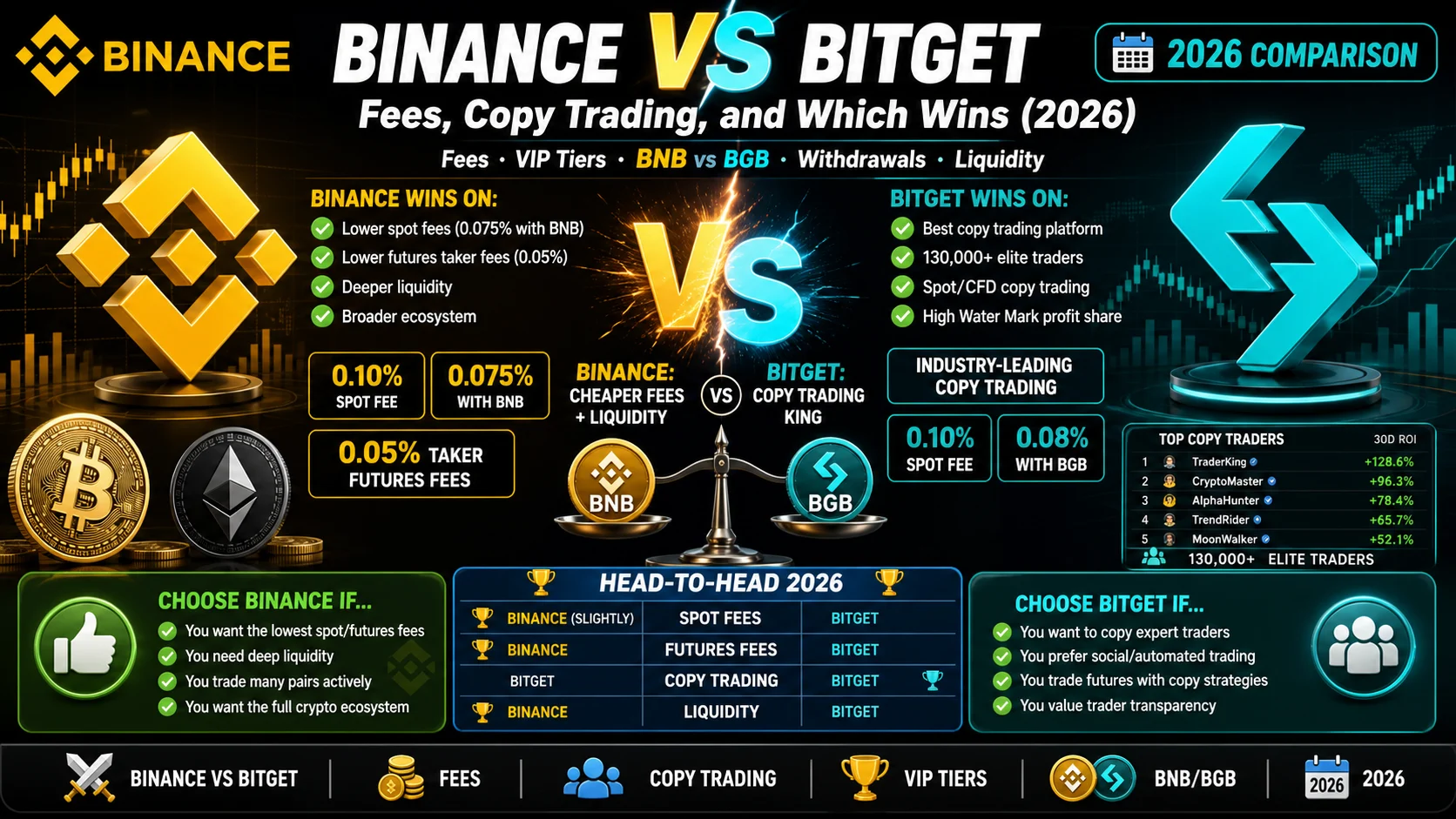
Binance vs Bitget (2026): Fees, Copy Trading, and Which Wins
Binance is cheaper for spot and futures; Bitget wins on copy trading. Compare 2026 fees, VIP tiers, BGB vs BNB discounts, withdrawals, and liquidity.
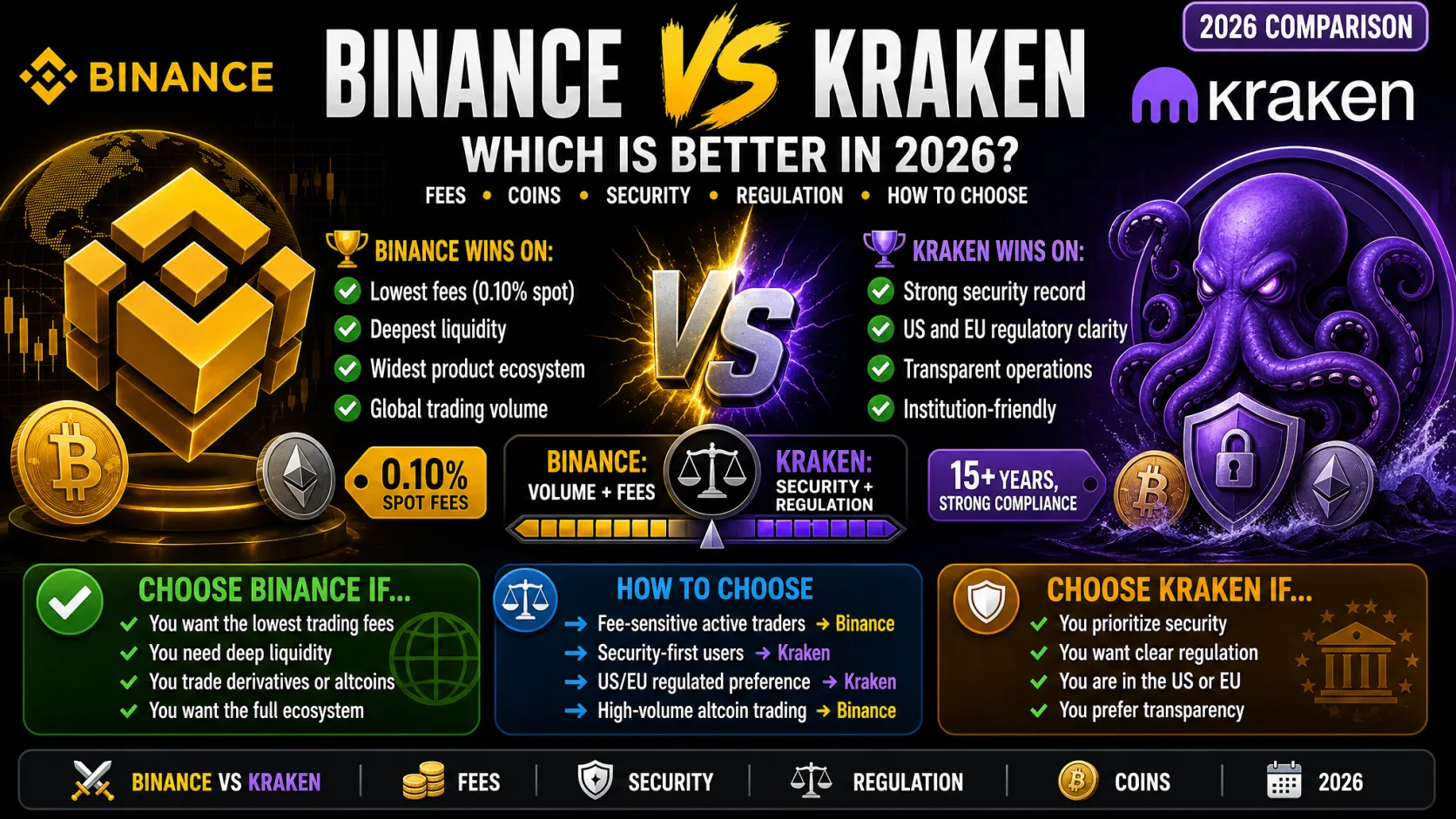
Binance vs Kraken: Which Is Better in 2026?
Binance charges 0.10% spot (0.075% with BNB). Kraken's entry tier is 0.40%/0.80% after its July 2026 rework. Fees, access, safety, and how to choose.
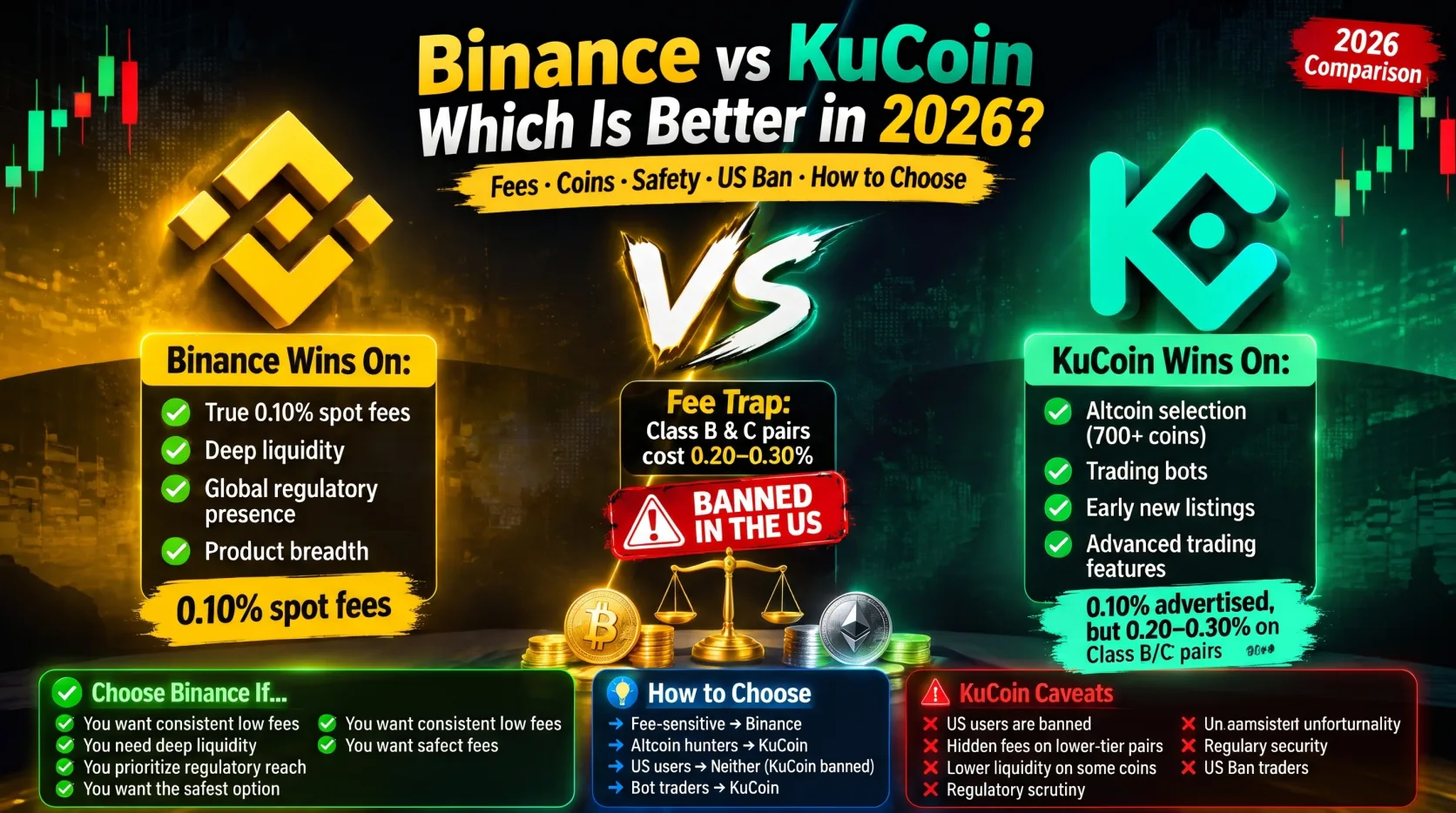
Binance vs KuCoin: Which Is Better in 2026?
Both advertise 0.10% spot, but KuCoin's Class B and C pairs cost 0.20–0.30% and it is banned in the US. Fees, coins, safety, and how to choose.