Best Crypto Exchanges (2026): Tested, Ranked, Priced
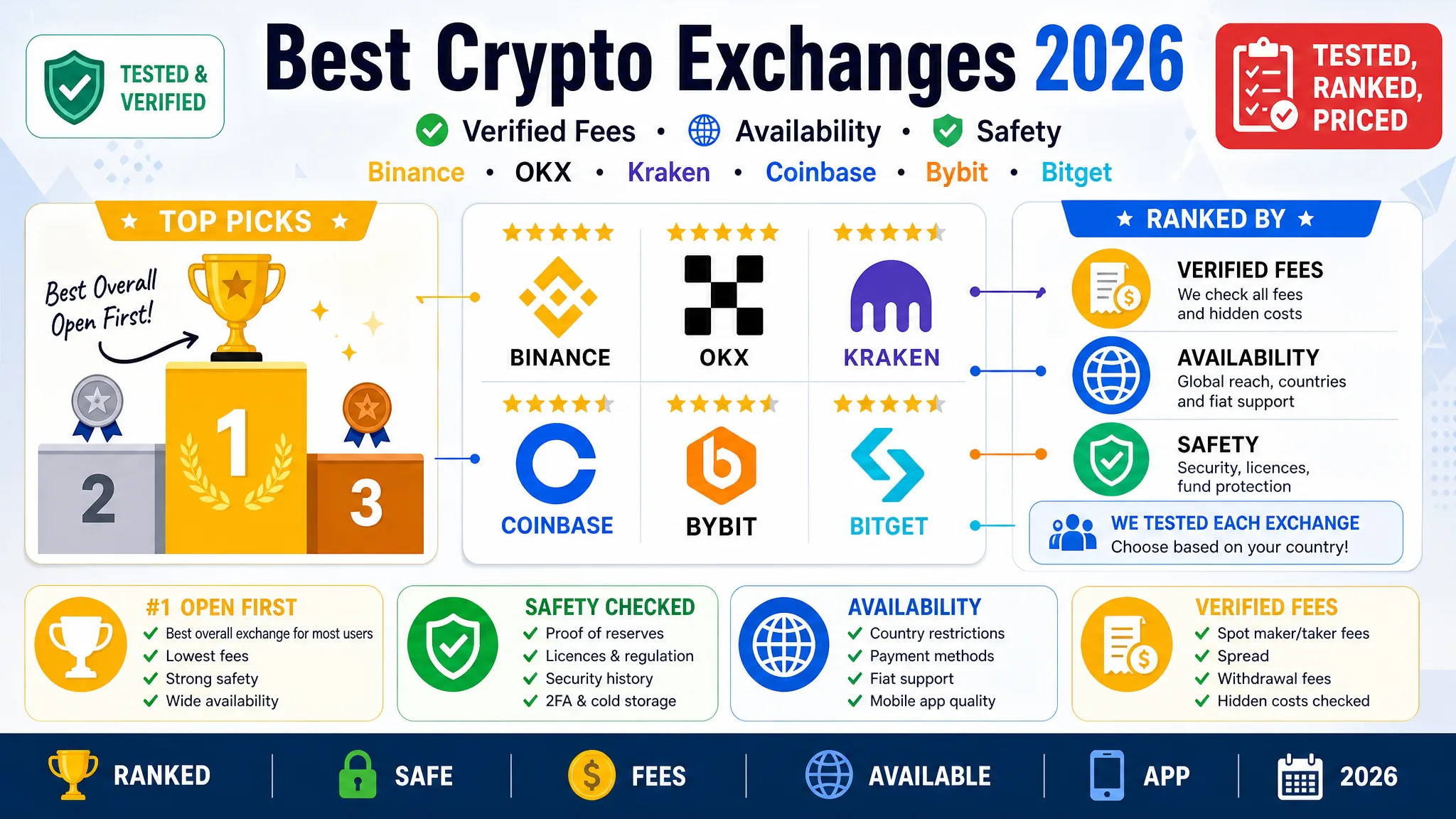
We ranked the best crypto exchanges for 2026 by verified fees, availability and safety: Binance, OKX, Kraken, Coinbase, Bybit and Bitget — and which to open first.
 Lucas Almeida 5 min read
Key takeaways
- Best overall where it is available: Binance — 0.10% spot, 0.075% with BNB, and about 0.06% after a 20% fee rebate, with 500+ coins and the deepest order books.
- Best in the EU/EEA: OKX — a Malta MiCA licence and 0.08% maker fees, though EEA accounts pay 0.20%/0.35% and get no derivatives.
- Best in the US: Kraken for regulated access (0.40%/0.80% at Tier 1) or Coinbase for simplicity (0.50%/0.90% on Advanced).
- The same $10,000 taker trade costs $6 on Binance with BNB and our rebate, $10 on OKX, $80 on Kraken and $90 on Coinbase Advanced — a 15x spread that no referral code can close.
- Availability decides before fees: Binance blocks US users and paused new EEA and UK onboarding; OKX's global platform is closed to the US, Canada and Hong Kong.
The best crypto exchange in 2026 is not one platform — it is the best platform you can legally open an account on, at a fee you can live with. For most people outside the US, UK and EEA, that is Binance. In the EEA it is OKX. In the US it is Kraken for safety or Coinbase for simplicity. Everything else in this guide explains why, with the fees and restrictions we verified.
Most “best exchange” lists rank by marketing budget. This one ranks by four things you can check yourself: all-in trading cost, whether the platform serves your country, how it handled a real custody failure, and whether the product set fits what you actually do. Every figure below was read from the exchange’s own fee schedule, availability page or proof-of-reserves page between 24 and 28 November 2026.
Disclosure: this site earns a commission if you open a Binance or OKX account through our links. Kraken, Coinbase, Bybit and Bitget are not partners. The commission does not decide the order — Binance and OKX happen to be the two cheapest platforms here, and the four non-partner exchanges are still recommended wherever they are the better fit (Kraken in the US, Coinbase for total beginners). Where a non-partner wins, it is listed first for that use case.
⚠️ Before you register anywhere: if you are opening a Binance or OKX account, start from an invite link rather than the bare app. The referral code is applied once, at sign-up, and cannot be added later. For Binance’s global platform use BN2688; for OKX use invite code 60895497.
The short answer
| # | Exchange | Best for | Base spot fee | US users? |
|---|---|---|---|---|
| 1 | Binance | Lowest all-in cost and the widest coin list | 0.10% (0.075% with BNB) | No — Binance.US is separate |
| 2 | OKX | EEA traders, limit orders, derivatives | 0.08% maker / 0.10% taker | OKX US only (0.20%/0.35%) |
| 3 | Kraken | Regulated access in the US, UK and EU | 0.40% maker / 0.80% taker | Yes, except Maine and New York |
| 4 | Coinbase | The simplest US on-ramp | 0.50% / 0.90% on Advanced | Yes, all 50 states |
| 5 | Bybit | Perpetual futures and copy trading | 0.10% | No |
| 6 | Bitget | Copy trading on a smaller budget | 0.10% | No |
If you only read one line: open Binance first if it is available where you live; open OKX instead if you are in the EEA or mostly post limit orders.
What $10,000 actually costs on each exchange
Headline fee percentages hide the real bill. Here is the same $10,000 spot trade priced on every platform, using each exchange’s published entry-tier schedule.
| Exchange | Maker | Taker | Maker cost | Taker cost | With token / rebate |
|---|---|---|---|---|---|
| Binance | 0.10% | 0.10% | $10.00 | $10.00 | $6.00 with BNB + 20% rebate |
| OKX (global) | 0.08% | 0.10% | $8.00 | $10.00 | No token discount since OKB stopped counting |
| Kraken (Tier 1) | 0.40% | 0.80% | $40.00 | $80.00 | Lower only at high 30-day volume |
| Coinbase Advanced (US) | 0.50% | 0.90% | $50.00 | $90.00 | EU/UK accounts pay 0.25%/0.50%; simple buy/sell costs more |
| Bybit | 0.10% | 0.10% | $10.00 | $10.00 | MNT discount applies to spot |
| Bitget | 0.10% | 0.10% | $10.00 | $10.00 | $8.00 with BGB (spot only) |
Three things worth noticing:
- The spread between platforms is far larger than any referral reward. The gap between Binance’s effective 0.06% and Coinbase Advanced’s 0.90% is 15 times the fee — no code, bonus or cashback closes that.
- The “simple buy” button is not the fee table. Coinbase’s simple flow and Kraken’s instant-buy screen add a spread or a flat ~1% on top. If you use either exchange, switch to Advanced or Pro before you trade anything larger than pocket money.
- Token discounts are not equal. Binance’s BNB discount is 25% on spot and 10% on futures; Bitget’s BGB discount is spot-only; OKX’s OKB no longer reduces fees at all (its own FAQ, updated September 2026).
1. Binance — best overall where it is available
Binance is the best first exchange for most of the world because it wins the two things that compound: fees and liquidity. Base spot trading costs 0.10%, the BNB discount takes it to 0.075%, and a 20% referral rebate on top brings the effective rate to about 0.06% — the cheapest mainstream spot rate in this guide. It lists 500+ coins, its BTC/USDT book is the deepest in crypto, and its Earn, Launchpool and P2P products mean you rarely need a second account for ordinary tasks. For the full breakdown, see our Binance review and Is Binance safe?.
It is also the largest exchange by users — 300 million+ registered accounts, announced in December 2025 — which matters for liquidity but not for your safety.
The honest caveats are serious:
- Availability is shrinking in the West. Binance blocks US residents (Binance.US is a separate company), has not accepted new UK retail sign-ups since October 2023, withdrew its MiCA application in June 2026, and stopped onboarding new EU/EEA users on 1 July 2026. Canada and the Netherlands are fully exited. See the full country-by-country list.
- October 2026 was the real stress test. About $6.3 billion left hot wallets on 29 October; Binance covered roughly 90% within two days and 95% within four from SAFU, its futures insurance fund and corporate treasury, so customers were not charged the loss. The cost: SAFU fell from about 15,000 BTC to about 7,500 BTC (~$580M) with no published refill deadline.
- Regulatory history. A $4.3 billion US settlement in 2023 and an independent compliance monitor are part of the record. Proof of reserves is quarterly and now zk-verifiable.
Choose Binance if you are outside the US/UK/EEA, you buy spot, and you want the lowest cost plus the widest selection. Skip it if you are in a restricted market — no fee advantage is worth a frozen account.
💡 Don't have a Binance account yet? Sign up now — 20% fee rebate on spot and futures — enter the referral code BN2688.
2. OKX — best for the EEA and for limit-order traders
OKX is the best exchange in Europe and the better pick if you post limit orders or trade derivatives. Its global schedule charges 0.08% maker / 0.10% taker, making it the only major platform that beats Binance’s base maker rate without a token. Perpetual futures match Binance at 0.02%/0.05%, and the built-in Web3 wallet is genuinely integrated rather than bolted on.
Its licensing is the differentiator in Europe — detailed in our OKX review: OKX Europe Limited holds a MiCA licence from Malta’s MFSA (granted January 2025) and can passport across the EEA. It publishes a monthly proof-of-reserves report — 49 consecutive months as of November 2026, covering $33.87 billion across 21 assets at ratios above 100%.
The catches:
- No token discount. OKB no longer reduces trading fees or counts toward VIP tiers; guides promising “25% off with OKB” are out of date.
- EEA and US accounts pay more. Both sit on a 0.20% maker / 0.35% taker schedule, and EEA accounts get no derivatives.
- Regulatory history. A $504 million US DOJ settlement in February 2025 and a compliance consultant through February 2027.
- Not universal. The global platform is closed to the US, Canada and Hong Kong; US users need OKX US.
Choose OKX if you are in the EEA and need a licensed venue, you mostly use limit orders, or you want derivatives and a serious Web3 wallet in one app.
💡 Don't have an OKX account yet? Sign up now — use invite code 60895497.
3. Kraken — best regulated option for the US, UK and EU
Kraken is the safest regulated place for a US, UK or EU beginner to start — if you accept paying more. Our Binance vs Kraken comparison covers the fee gap in more detail. It serves US residents in every state except Maine and New York, operates in the UK and, in the EU/EEA, under MiCA, has published proof of reserves since 2014, and has never suffered a major platform-wide hack.
The price of that record is the fee schedule. Kraken reworked its spot tiers in July 2026; Tier 1 now starts at 0.40% maker / 0.80% taker, which is 4–8x Binance on a simple trade. On $10,000 that is $40–$80 versus $6–$10. Kraken only becomes competitive at high 30-day volume, and its app’s instant-buy screen adds about 1% on top — use Kraken Pro.
A warning that no ranking site repeats: many 2026 guides still quote Kraken’s old 0.25%/0.40% table. That schedule is gone — and Kraken’s own “Kraken vs Kraken Pro” marketing page still displayed the old numbers when we checked on 28 November 2026. Check the live fee page before you deposit, because third-party reviews lag the change by months.
Choose Kraken if you cannot use Binance or OKX, you value regulatory clarity over cost, or you need USD banking and a long operating record.
4. Coinbase — best for US beginners who want simplicity
Coinbase is the easiest first account in the US and the most expensive way to trade on this list. Our Binance vs Coinbase comparison covers the regulatory side. It is licensed in all 50 states, NASDAQ-listed, and its SEC lawsuit was dismissed in 2025. Onboarding is the cleanest of the six, and the interface assumes you have never bought crypto before.
The cost is real. Coinbase Advanced charges 0.50% maker / 0.90% taker for US accounts at the entry tier (EU/UK accounts pay 0.25%/0.50%, and international accounts 0.09%/0.10% since the September 2026 schedule), and the simple buy/sell screen is more expensive still because of the spread. A $10,000 taker trade costs $90 before spread — 15x the Binance effective rate. Coinbase One can waive some fees for frequent users, but it does not remove the simple-flow spread.
Choose Coinbase if you are in the US, you want the simplest possible start, and you are buying small amounts rather than trading actively. Move to Advanced before your order sizes grow.
5. Bybit — best for derivatives and copy trading
Bybit is a specialist: perpetual futures, altcoin liquidity and copy trading, not a beginner’s first spot account. See Binance vs Bybit for the head-to-head. Spot costs 0.10% (MNT discount applies), perpetuals are 0.02% maker / 0.055% taker, and its copy-trading roster is one of the largest. In February 2025 it absorbed what was then the largest crypto theft ever — about $1.5 billion — covered every loss, kept withdrawals open and restored 1:1 reserves in roughly 72 hours.
It is not available in the US, and its derivatives focus means the interface and leverage prompts are aimed at experienced traders.
Choose Bybit if you already understand leverage and funding rates and want deep altcoin perpetuals. Avoid it as a first exchange.
6. Bitget — best for copy trading on a smaller budget
Bitget is the copy-trading venue with the deepest roster of lead traders — roughly 190,000 — and a fee schedule that is close to Binance’s base rate. Binance vs Bitget has the full fee maths. Spot is 0.10% (0.08% with BGB, spot only); futures are 0.02% maker / 0.06% taker, slightly above Binance’s 0.05%. It publishes Merkle-tree proof of reserves and a protection fund above $300 million.
The trade-offs: its BGB discount does not touch futures, its futures taker fee is higher than Binance’s, and it is restricted in the US, Canada and Singapore. Copy trading also carries a specific risk most beginners miss: you inherit someone else’s leverage and stop-loss decisions, and lead traders commonly take 10%–20% of your profits.
Choose Bitget if copy trading is specifically what you want and you are outside its restricted markets. Otherwise the fee edge belongs to Binance.
Which exchange is available where you live?
Availability is the first filter; fees only matter after it.
| Region | Practical first choice | Notes |
|---|---|---|
| US | Kraken or Coinbase | Binance global blocked; Binance.US is separate and BN2688 does not apply; OKX US is spot/OTC only at 0.20%/0.35% |
| EU / EEA | OKX, Kraken or Coinbase | Binance withdrew its MiCA application and stopped new EEA onboarding on 1 July 2026; OKX EEA fees are 0.20%/0.35% |
| UK | Kraken or Coinbase | Binance has paused new UK sign-ups since October 2023; a return is realistic in 2027 at the earliest |
| Canada | Kraken or a local licensed venue | Binance exited; OKX global is closed |
| Hong Kong | A locally licensed venue | OKX global is closed; check local licensing before depositing |
| Most of Asia, LatAm, Africa, Middle East | Binance, then OKX | Check Binance’s prohibited-country list before you register; sanctions and local rules change |
| Restricted/sanctioned markets | None of the above | Do not attempt workarounds; exchanges freeze accounts and funds on mismatch |
If your country is not clearly supported, the correct move is to stop and check the exchange’s own region list — not to register with a different country. A country mismatch is the single fastest way to get a withdrawal review that takes weeks.
What licences does each exchange actually hold?
Almost no “best exchange” list shows this, yet it is the first thing a regulator would ask. This is the regulatory footing we could verify on 28 November 2026 — not legal advice, and not a substitute for checking your local register.
| Exchange | Regulatory footing | Main restriction |
|---|---|---|
| Binance | $4.3B US settlement (2023) with an independent compliance monitor; withdrew its MiCA application in June 2026 | No global access for US residents; new UK sign-ups paused since Oct 2023; EEA onboarding stopped 1 Jul 2026 |
| OKX | Malta MFSA MiCA licence via OKX Europe (Jan 2025); US state money-transmitter licences via OKX Inc.; $504M DOJ settlement (Feb 2025), compliance consultant to Feb 2027 | Global platform closed to US, Canada and Hong Kong |
| Kraken | Licensed across US states except Maine and New York; MiCA licence via the Central Bank of Ireland (June 2025); serves the UK and EU/EEA | Entry-tier fees among the highest |
| Coinbase | NASDAQ-listed, licensed in all 50 US states, SEC lawsuit dismissed with prejudice in 2025; serves the EEA | Highest US trading fees; simple-flow spread |
| Bybit | MiCA licence via Austria’s FMA (May 2025); serves most markets outside the US through regional entities | US, Canada, Singapore and Hong Kong excluded; derivatives-first platform |
| Bitget | Serves most markets outside the US, Canada and Singapore; no MiCA licence | Higher futures taker fee; copy-trading risk |
Licensing changes faster than any article can track. If a licence is your deciding factor, check the regulator’s public register, not the exchange’s marketing page.
How safe is each exchange?
Safety is a spectrum, and the useful question is “what happened the last time it was tested?” This table uses each exchange’s own disclosures and public enforcement records.
| Exchange | Major incidents | Reserve reporting | Current safeguard |
|---|---|---|---|
| Binance | 2019 hot wallet (~$40M, repaid); $6.3B Oct 2026, ~95% covered in 4 days | Quarterly, zk-verifiable | SAFU ~$580M after the payout, no refill deadline |
| OKX | 2020 withdrawal freeze, reserves intact; no comparable theft | Monthly, 49 consecutive reports | $504M DOJ settlement; compliance consultant to Feb 2027 |
| Kraken | No major platform-wide hack | Since 2014 | Strong licensing footprint |
| Coinbase | No customer-fund theft; SEC case dismissed 2025 | No Merkle PoR; audited 10-K/10-Q (Deloitte) | NASDAQ-listed, audited |
| Bybit | ~$1.5B Feb 2025, fully covered, 1:1 in ~72h | Monthly | Proof of reserves |
| Bitget | No major customer-fund breach reported | Merkle-tree PoR | Protection fund >$300M |
Two conclusions follow. First, “never hacked” is not the right test — the right test is whether customer losses were covered and how fast. Binance and Bybit both passed that test at enormous scale. Second, proof of reserves is a snapshot, not insurance: it shows assets existed at a moment, not that they will be there tomorrow.
Which one should you open first?
Use this decision rule instead of a leaderboard:
- You are outside the US, UK, Canada and EEA, and you buy spot. Open Binance. Use the invite link, take the BNB discount, and keep the account to trading funds.
- You are in the EEA and want a licensed venue. Open OKX (MiCA), accept the 0.20%/0.35% EEA schedule, and skip derivatives if your account does not offer them.
- You are in the US. Open Kraken if regulatory clarity and a clean record matter most; open Coinbase if you want the simplest possible start and are buying small amounts. Use Advanced or Pro, not the simple screen.
- You trade perpetual futures. OKX or Bybit outside restricted regions — but only after you can explain liquidation and funding rates. If you cannot, stay on spot.
- You specifically want copy trading. Bitget, with the understanding that you inherit the lead trader’s risk and share 10%–20% of profits.
- You want both low fees and limit-order execution. Many active traders keep Binance for spot liquidity and OKX for maker orders and Web3. The cost is two accounts to secure.
How to register safely (any of them)
The signup flow is similar everywhere; the mistakes are also similar.
- Start from the official site or an invite link — not a search ad and not a DM. The referral code is applied once and cannot be added later; our Binance registration guide and referral code guide walk through it.
- Use your real country of residence. It must match your ID and proof of address.
- Complete KYC immediately. Government ID plus a liveness check; most finish in minutes, peak periods can take one to three business days.
- Secure the account before depositing. Passkey or authenticator 2FA, an anti-phishing code, and a withdrawal address whitelist. SMS-only 2FA is the weakest option.
- Deposit through a bank transfer or P2P, not a card. Card purchases add a processing fee and a spread that dwarfs the trading fee.
- Make one small spot trade first. Confirm the fee you were charged matches the schedule before you scale up.
- Move long-term holdings to a wallet you control. An exchange is an on-ramp, not a vault.
Mistakes that cost beginners money
- Signing up in the app without a code. The referral rebate cannot be recovered later; a fresh account is the only fix.
- Trading on the simple buy/sell screen. Coinbase and Kraken both charge far more there than on Advanced/Pro.
- Leaving fiat parked in the exchange’s “earn” product without reading the terms. Yield is not the same as a bank deposit.
- Using leverage in week one. Liquidation is the fastest way to turn a small account into zero.
- Trusting a “support agent” who DMs first. No legitimate exchange calls you or asks for your 2FA code, password or seed phrase.
The bottom line
Binance is the best crypto exchange in 2026 for most people who can use it: the lowest effective spot fees, the widest coin list and the deepest liquidity — with real regional restrictions and a halved emergency fund you should know about. OKX is the better choice in the EEA and for limit-order traders. Kraken is the safer regulated pick in the US, UK and EU; Coinbase is the simplest US entry at the highest cost.
Pick by availability first, then by what you trade, then by fee. And whichever you choose, register through the official invite link, complete KYC, turn on authenticator 2FA and a withdrawal whitelist, and keep only what you are actively trading on the exchange.
Sources checked 24–28 November 2026: Binance fee schedule · Binance proof of reserves · OKX fee schedule · OKX proof of reserves · Kraken fee schedule · Coinbase Advanced fees · Bybit fees · Bitget fees.
Don't have a Binance account yet?Sign up nowenter the referral codeBN2688
Frequently asked questions
What is the best crypto exchange in 2026?
Which crypto exchange has the lowest fees?
Is Binance or OKX better for beginners?
What is the best crypto exchange in the US?
What is the best crypto exchange in Europe?
Are these exchanges safe?
Do I need to complete KYC to use these exchanges?
Can I use the same referral code on all of these exchanges?
Editor-in-Chief & Lead Researcher
Editor of MyCryptoStart. Independent researcher of cryptocurrency exchanges, focused on fees, security, KYC, and onboarding — publishes step-by-step guides in plain English for beginners.
View author page →Some links on this page are affiliate links: we may earn a commission at no extra cost to you. This content is educational and is not financial, investment, or legal advice. Affiliate disclosure · Disclaimer.
Continue reading
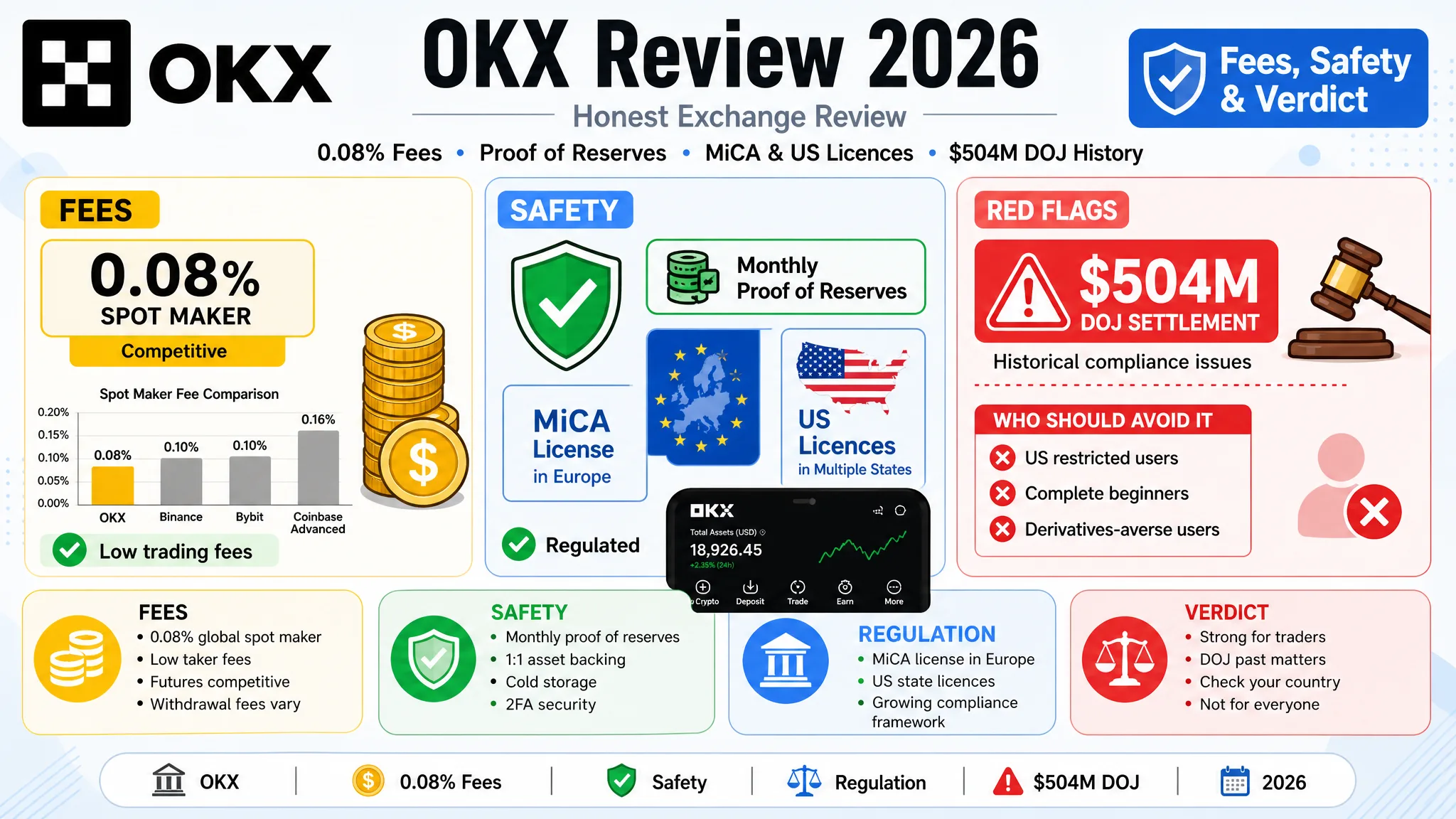
OKX Review 2026: Fees, Safety & Verdict
Honest 2026 OKX review: 0.08% global spot maker fees, monthly proof of reserves, MiCA and US licences — plus the $504M DOJ history and who should avoid it.
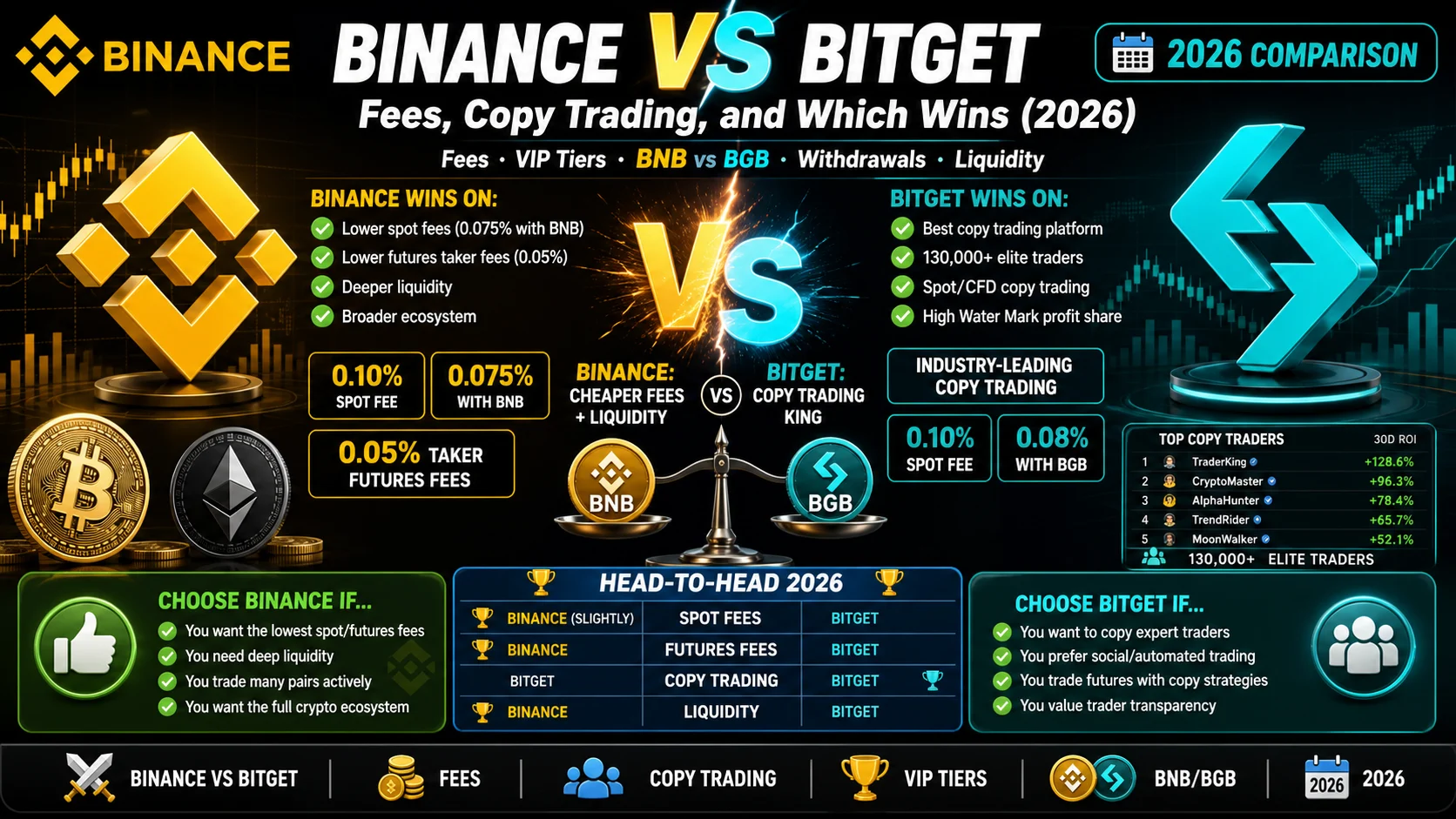
Binance vs Bitget (2026): Fees, Copy Trading, and Which Wins
Binance is cheaper for spot and futures; Bitget wins on copy trading. Compare 2026 fees, VIP tiers, BGB vs BNB discounts, withdrawals, and liquidity.
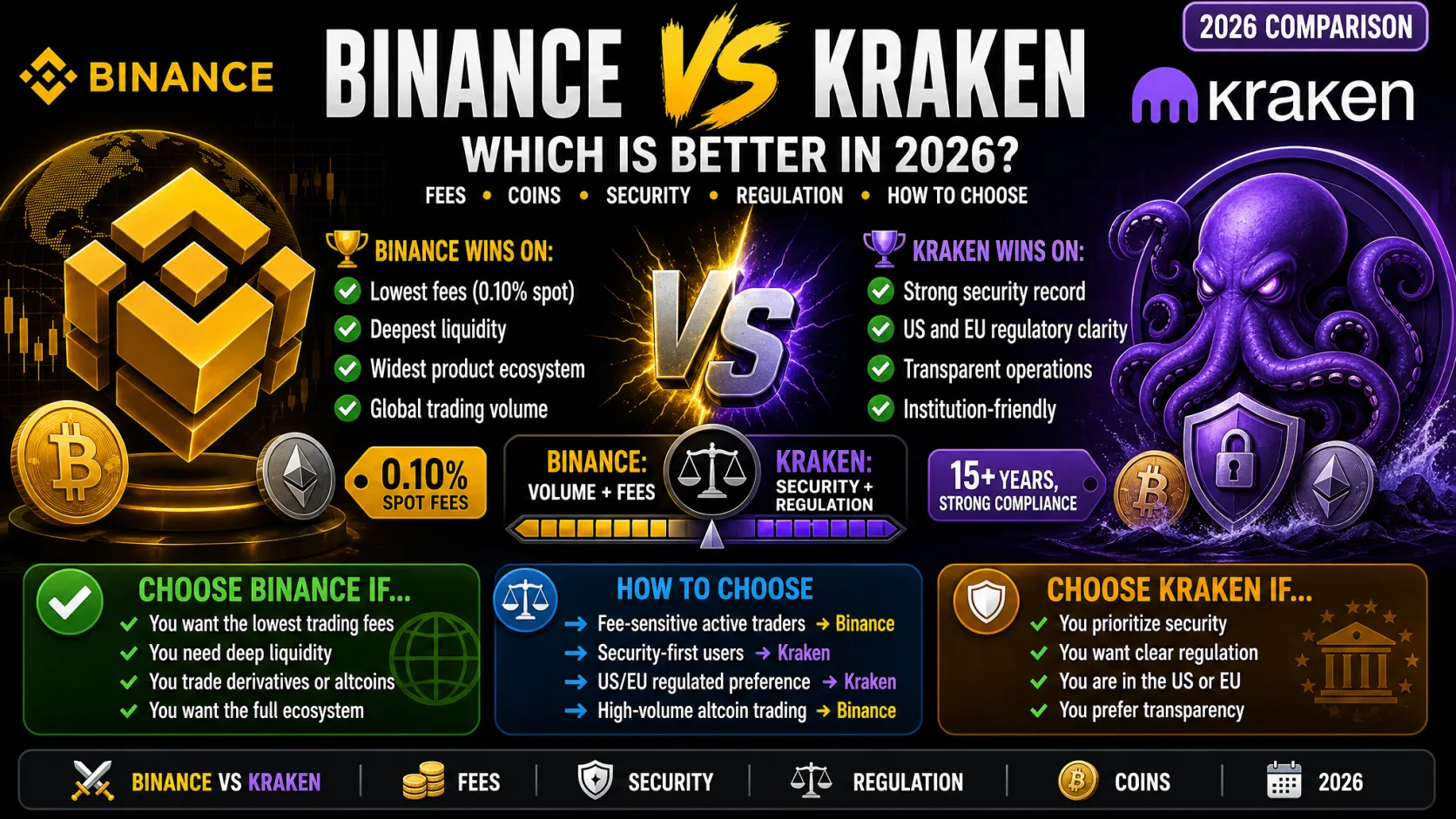
Binance vs Kraken: Which Is Better in 2026?
Binance charges 0.10% spot (0.075% with BNB). Kraken's entry tier is 0.40%/0.80% after its July 2026 rework. Fees, access, safety, and how to choose.