
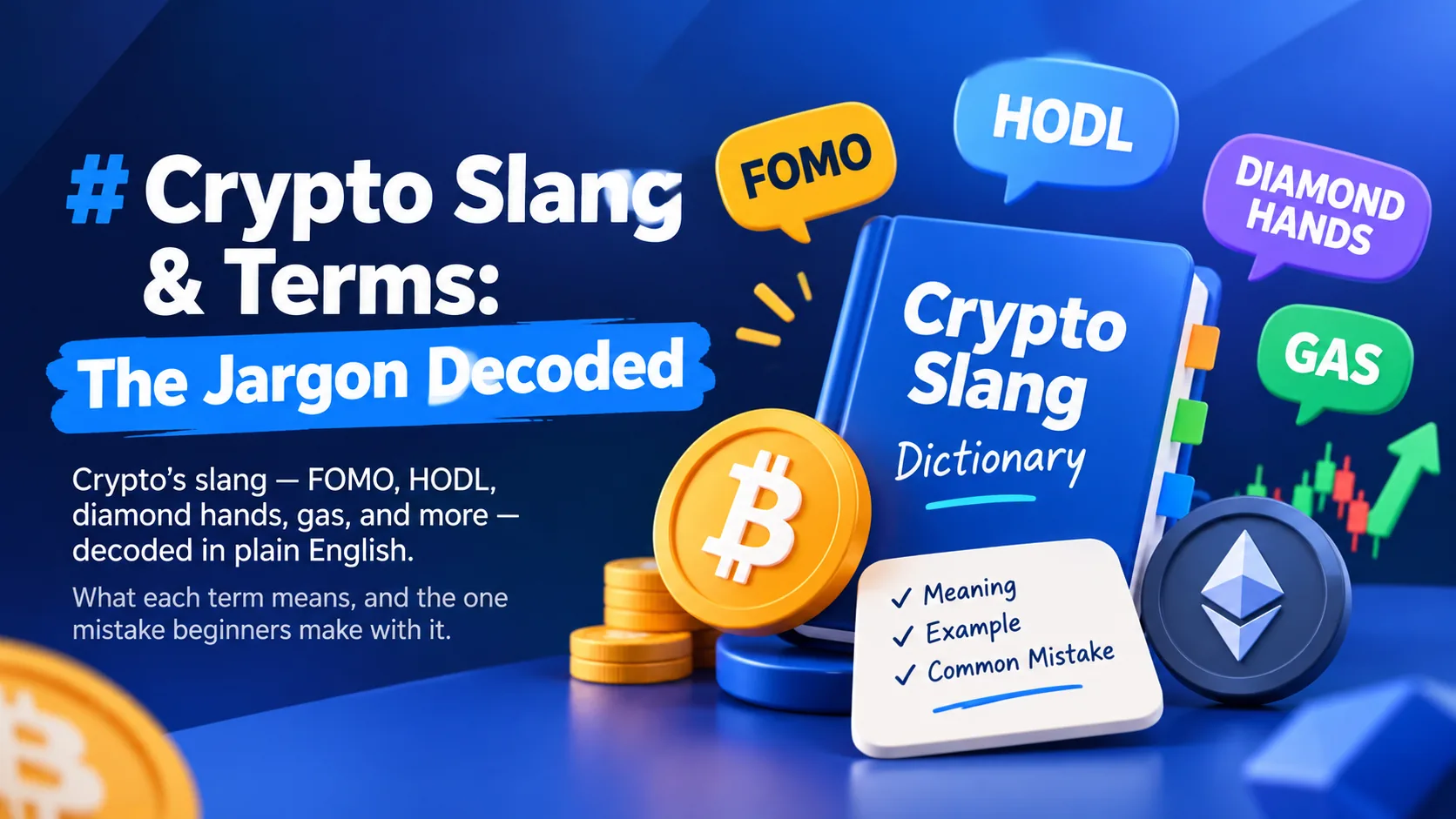
Crypto Slang & Terms: The Jargon Decoded
Crypto's slang — FOMO, HODL, diamond hands, gas, and more — decoded in plain English. What each term means, and the one mistake beginners make with it.
 Lucas Almeida 5 min read
Key takeaways
- Crypto slang splits into two kinds: emotion words (FOMO, FUD, HODL, diamond hands) that describe how people feel and behave, and market words (gas, ATH, whale) that describe how the market itself works.
- FOMO makes you chase a rising price; FUD makes you panic out of a falling one — the same mistake mirrored, and both are beaten by a plan written before you felt anything.
- HODL began as a 2013 typo ('I AM HODLING') and became crypto's word for not panic-selling — a real insight that also gets weaponized to shame legitimate exits.
- Most of the language is sentiment, not signal: a feed full of 'to the moon' tells you attention is spiking, not that you should buy.
- The terms are cheap to learn and expensive to ignore — every one of them names a specific way beginners lose money, and knowing the word is the first step to spotting the mistake.
Crypto has its own language, and most of it is explained badly. Every community, exchange, and group chat trades in words that outsiders can’t follow — FOMO, HODL, diamond hands, “to the moon.” The words matter less than they seem to, but the feelings behind them matter more than most beginners realize, because each one names a specific way that newcomers lose money.
This guide decodes the most common crypto slang in plain English. For each term you’ll get what it means in one sentence, where it came from, and — most useful — the mistake it usually hides. None of these words are required to buy and hold your first crypto. But being able to read them is what stops you from being the person they’re aimed at.
The quick table
| Term | What it means | One-sentence translation |
|---|---|---|
| FOMO | Fear of missing out | Buying high because the price is climbing and you’re afraid of being left behind |
| FUD | Fear, uncertainty, doubt | Negative news or rumors that scare people into selling |
| HODL | “Hold” (a 2013 typo) | Holding long-term instead of panic-selling |
| Diamond hands | Unshakeable conviction | Holding through a crash as a badge of honor |
| Paper hands | Weak grip | Selling at the first sign of red |
| Moon | A vertical rally | “To the moon” = the price rocketing up |
| Rekt | “Wrecked” | Taking a severe loss, often from leverage or a scam |
| Whale | A large holder | Someone big enough to move the price with one trade |
| Gas | Transaction fee | What you pay to have a blockchain process your transaction |
| DYOR | Do your own research | Check the primary source before you buy |
| Rug pull | A developer exit scam | The team takes the money and disappears |
| ATH | All-time high | The highest price an asset has ever reached |
The emotion words: FOMO and FUD
The two words you’ll hear most often are a matched pair, and they’re the same mistake pointed in opposite directions.
FOMO — fear of missing out — is what makes you buy at the top. When a coin is climbing and every feed is full of screenshots of other people’s gains, the urge to get in stops being a decision and becomes a reflex. The problem is structural, not personal: FOMO is loudest at the exact moment an asset is most crowded, the sellers are most eager to take profit, and the remaining upside is thinnest. Buying then is buying from the people who bought early and are now distributing into your enthusiasm.
FUD — fear, uncertainty, and doubt — is what makes you sell at the bottom. It’s negative information, real or manufactured, that spreads panic about a coin or the market. The word is used both ways, and that’s the trap: sometimes FUD is genuine (a real exploit, a real regulatory filing), and sometimes it’s a coordinated effort to shake out holders so someone can buy cheaper. The tell is never the tone of the news — it’s the source. A regulator’s filing exists whether or not you believe it; an anonymous screenshot exists only if you do.
The two words are defeated by the same habit: a plan written before you felt anything. Decide your entry, your size, and your exit while you’re calm, and neither the fear of missing out nor the fear of losing can force your hand. This is exactly what dollar-cost averaging mechanizes — a fixed buy on a fixed schedule, whether you feel euphoric or terrified.
The holding words: HODL, diamond hands, paper hands
The next cluster is about the single most common decision in crypto — whether to hold or sell — and the community has strong, loaded words for both answers.
HODL is the philosophy of not panic-selling. It began as a typo: in December 2013, after Bitcoin fell from about $1,240 to under $500 in weeks, a Bitcointalk user named GameKyuubi posted a drunken defense of not selling, titled “I AM HODLING.” The community kept the misspelling, and “hold on for dear life” became the backronym. The kernel is true — panic-selling the bottom is how most beginners turn a dip into a permanent loss — and Bitcoin going on to recover and multiply is what cemented the word.
Diamond hands is HODL’s aggressive, performative descendant — holding through deep red as an identity, announced to an audience (💎🙌). Paper hands is the insult for the opposite — the trader who folds at the first red candle (🧻🤲). The pair is a small morality play about investing, and like most morality plays, it oversimplifies on purpose.
Here’s the part the chants leave out: the distinction only means something when the decision was made on purpose. A sell made because your thesis broke, or your size was wrong, or your pre-set exit was hit is a decision — even if the price later went up. A hold made because “we don’t sell” is not conviction, it’s refusing to look. The people most eager to call you paper hands are often the ones who need you to keep holding while they find their exit.
The up-and-down words: moon and rekt
If the holding words describe how people behave, the next pair describes how the chart moves — and they come in sequence.
To the moon means a vertical, parabolic rally. It’s the default caption for any coin that’s pumping, and it’s deliberately absurd — a target so high it’s not a forecast, it’s a mood. The thing to know is that a vertical chart can’t stay vertical forever, and it attracts the most FOMO buyers at the exact moment the early holders are most tempted to take profit. By the time the whole feed is chanting “to the moon,” the biggest leg of the move has often already happened.
Rekt is the flip side — “wrecked,” taking a severe loss. A leveraged position liquidated in one candle, a token that crashed, a buy at the top that never recovered. The word is used as a verb, an adjective, and a self-deprecating confession (“I got rekt”), which is exactly what makes it a useful warning: every rekt post is a data point about what not to do, and it’s almost always the same short list — too much leverage, no stop-loss, bought the top.
The two words are a matched set for a reason: every moon post eventually produces rekt posts, often from the same people, on the same coin. The moon posts are the buy signal for latecomers; the rekt posts are the receipt.
The market’s other players: whales
Not everyone in the market is a beginner. Whales are the holders big enough to move a price with a single trade — a few percent of a thin altcoin’s supply, or a few thousand Bitcoin. They matter to you for two reasons. First, a single large sell from a whale can push a thin order book down faster than any news, so knowing whether an asset has concentrated holders is basic due diligence. Second, whale activity is visible on public blockchains before it shows up in price, which is why “whale watching” is its own hobby.
The honest version of whale watching is humble about what it can know. A large transfer to an exchange is often read as “they’re going to sell” — and sometimes it is, but it can also be collateral or a wallet reshuffle. A large accumulation is often read as “they’re bullish” — and sometimes it is, but it can also be a whale preparing to distribute to the people copying them. A whale’s trade tells you what they did, not why, and never what you should do. Their moves are information, not instructions.
The safety words: DYOR and rug pull
Two words sit on the line between the market and its scams, and together they’re the cheapest insurance a beginner can buy.
DYOR — do your own research — is the reminder that no one will protect you from a bad tip but yourself. In crypto there’s no broker with a duty of care, no regulator who’ll make you whole, and a constant flow of people whose income depends on you buying what they hold. That’s why “should I buy this?” has exactly one honest answer. But the phrase has been hollowed out by misuse: “this is not financial advice, DYOR” has become the disclaimer that lets an influencer recommend a coin, pocket the engagement, and take zero responsibility when it dumps. Real DYOR means reading the primary source — the docs, the token’s distribution, the team — not the YouTube summary of it.
A rug pull is what happens when you skip that research. It’s a scam where a token’s creators hype it up, attract buyers, and then drain the money and disappear — “pulling the rug” out from under investors. There are two shapes: the fast liquidity rug (the developers withdraw the trading pool and vanish) and the slow rug (they dump their own token supply over time). The reassuring part is that a rug pull is predictable — concentrated holders, unlocked liquidity, no audit, and an anonymous team are all checkable before you buy, and our scam guide walks the full checklist.
The structure words: gas and ATH
Finally, two words that aren’t slang about feelings at all — they describe how the market’s plumbing works, and they’re the ones beginners trip on silently.
Gas is the fee for having a transaction processed on a blockchain. On Ethereum it’s paid in ETH and quoted in “gwei,” and it swings with congestion — the same transfer that costs cents on a quiet Sunday can cost dollars during a busy launch. The mistake beginners make is treating the fee as small because the amount they’re moving is small: gas prices network space, not dollar value, so a $40 transfer and a $40,000 transfer cost the same. The fix is the network you choose — moving stablecoins over a cheap network like Solana or an Ethereum layer-2 turns a $15 fee into under $0.10.
ATH — all-time high — is the highest price an asset has ever reached. It’s a milestone, not a signal: “never been higher” is a fact about the past, not a promise about the future. It carries outsized psychological weight because at an ATH every single holder is in profit, which is exactly the condition that produces selling — the early buyers are looking at a number that has never been higher and thinking about taking it. And there’s no historical trading above the ATH to catch a fall. Buying at an ATH because it’s the ATH is the FOMO pattern wearing a milestone’s clothes.
💡 Don't have a Binance account yet? Sign up now — 20% fee rebate on spot and futures — enter the referral code BN2688.
How to actually use the jargon
You don’t need to use any of these words to succeed — plenty of long-term holders have never typed “diamond hands.” You need to be able to read them, because the language is how the market communicates, and how it manipulates.
The single most useful skill is telling sentiment from signal. A feed full of “to the moon” tells you attention is spiking — that’s a fact. But attention is not a reason to buy; it’s the reason everyone else is buying. A chorus of “paper hands” aimed at anyone who sells tells you holders are nervous — that’s also a fact, and usually a sign the smart money is already thinning out. When you can read a word for what it’s doing (pressure, encouragement, panic) rather than what it says, you stop being the person it’s aimed at.
And the boring part, repeated once because it’s the whole game: every one of these words names a mistake, and the fix is always the same — a plan written before you felt anything. A position size you can hold, an entry you can justify without looking at the chart, and an exit decided in advance. That one habit beats FOMO, FUD, paper hands, and the moon chant at once.
If you’re new here, the right order is: start with what cryptocurrency actually is, see how Bitcoin and Ethereum work, and — before you put a single dollar down — make sure you understand private keys and can spot the scams that will be waiting for you the moment you do.
Don't have a Binance account yet?Sign up nowenter the referral codeBN2688
Frequently asked questions
What's the difference between FOMO and FUD?
Where did HODL come from?
What does 'gas' mean in crypto?
What are diamond hands vs. paper hands?
What does it mean when people say 'DYOR'?
Why does the jargon matter if I just want to buy and hold?
Editor-in-Chief & Lead Researcher
Editor of MyCryptoStart. Independent researcher of cryptocurrency exchanges, focused on fees, security, KYC, and onboarding — publishes step-by-step guides in plain English for beginners.
View author page →Some links on this page are affiliate links: we may earn a commission at no extra cost to you. This content is educational and is not financial, investment, or legal advice. Affiliate disclosure · Disclaimer.
Continue reading

Should You Invest in Bitcoin? (2026 Guide)
Bitcoin can be a small, high-risk slice of a portfolio — but only with money you can afford to lose. Learn how to size a position and the real risks.
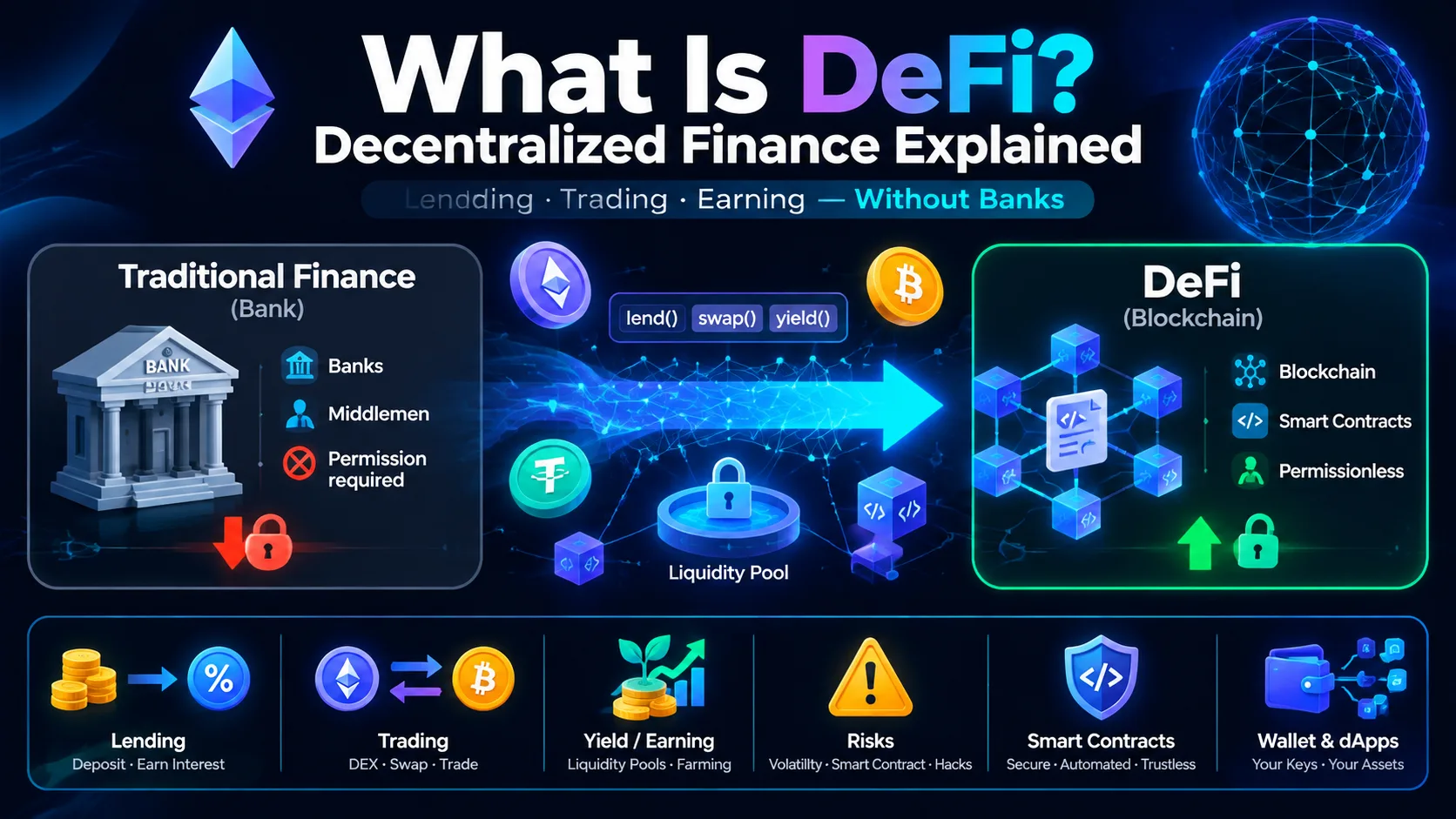
What Is DeFi? Decentralized Finance Explained
DeFi is financial services — lending, trading, and earning — rebuilt on blockchains instead of banks. Learn how it works and the risks.

What Is Ethereum? Smart Contracts Explained
Ethereum is a decentralized computing platform powered by smart contracts. Learn how it works, what ETH and gas fees are, and how it differs from Bitcoin.