
What Is Binance Alpha? Early-Stage Tokens Explained (2026)
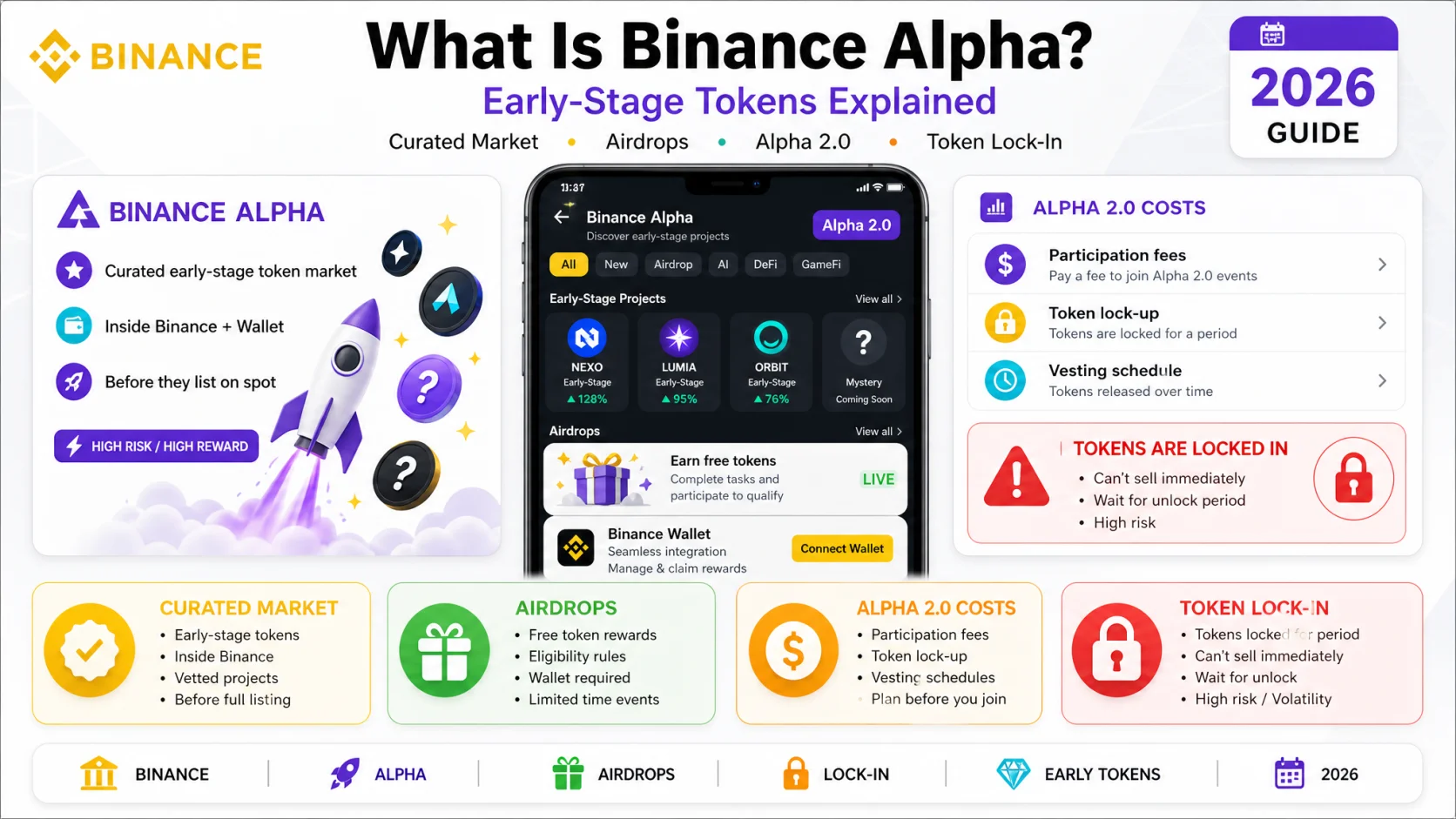
Binance Alpha is a curated early-stage token market inside Binance and its Wallet. How airdrops work, what Alpha 2.0 costs, and why tokens are locked in.
 Lucas Almeida 5 min read
Key takeaways
- Binance Alpha is a curated market for early-stage tokens, launched on 17 December 2024 inside Binance Wallet. It is a discovery pool, not a promise of a Spot listing.
- Alpha 2.0, introduced in March 2025, lets verified Binance users trade the same tokens with their Spot or Funding balance. Purchases settle into a separate Alpha account.
- On Alpha 2.0 you cannot withdraw or transfer a token to Spot or another wallet until that token lists on Binance Spot. Until then, the only exit is selling inside Alpha.
- By October 2025, 221 tokens had gone through Alpha airdrops, TGEs or Booster campaigns; Binance says 105 later reached Futures and 38 reached Spot.
- Alpha airdrops usually cost 15 Alpha Points and pay in the new token. Binance's own best-case figures use all-time highs; a typical claim in 2026 has been worth tens of dollars.
Binance Alpha is a curated market for early-stage crypto tokens, launched by Binance on 17 December 2024 as a pre-listing showcase inside Binance Wallet. It is not a smaller version of Binance Spot, and it does not guarantee a listing: by Binance’s own count, only 38 of the 221 tokens that went through Alpha by October 2025 had reached Spot. The draw is airdrops, but the tokens are high-risk, and on Alpha 2.0 they cannot be withdrawn at all until they list on Spot.
This guide explains what Alpha actually is, how the airdrop and TGE mechanics work, what trading costs, and the exit problem that most “free airdrop” videos skip.
What is Binance Alpha?
Binance Alpha is a pre-listing token pool: a curated set of early-stage projects that Binance surfaces before — and sometimes instead of — a Spot listing. Binance launched it on 17 December 2024 inside Binance Wallet, with tokens released in batches over 24-hour showcase periods.
Binance’s own description is careful: Alpha is an educational and discovery initiative, and a featured token “may be considered” for a future Binance listing. Considered is not listed. The company has repeated that qualifier in every product update since.
The product has changed shape twice:
- December 2024 — Alpha inside Binance Wallet. Users swapped tokens through the self-custody wallet, paying network gas and DEX fees.
- March 2025 — Alpha 2.0 inside the exchange. Binance integrated Alpha into the main app so verified users could trade the same tokens using their Spot or Funding balance, without creating a wallet or moving assets on-chain.
- February 2026 — tokenized stocks arrive. Binance used Alpha to list 10 tokenized US stocks, ETFs and commodity products through Ondo Finance, including exposure to Apple, Google, Tesla, Nvidia and the QQQ ETF. Those products are not available to US users.
So “Alpha” now means two things: the token list, and the two venues where you can trade it.
What does Binance get from Alpha?
Alpha solves a trust problem and an activity problem at the same time. Before Alpha, the gap between “a project is trending” and “Binance lists it” was opaque. Alpha gives Binance a public shortlist, gives projects a marketing venue, and gives users a reason to trade.
The numbers show how the funnel works. In an October 2025 retrospective, Binance said 221 tokens had gone through Alpha airdrops, TGEs or Booster campaigns. Of those:
| Outcome by October 2025 | Tokens | Share |
|---|---|---|
| Later appeared on Binance Futures | 105 | 48% |
| Later appeared on Binance Spot | 38 | 17% |
| Still Alpha-only at that point | At least 78 | — |
The Futures and Spot groups may overlap, so the shares do not add up to a clean 100%. The point is the shape of the funnel: most Alpha tokens had not reached Spot, and a Futures listing — which is not the same as a Spot listing — was the more common step up.
That is the honest way to read Alpha: it is a venture-style market with a listing lottery attached, not a preview of tomorrow’s Spot market.
Alpha vs Alpha 2.0 vs Spot: what is the difference?
The token list is similar; the custody and exit rules are not. The original Alpha route is a self-custody wallet, Alpha 2.0 is an account inside the exchange, and Spot is the regulated listing market.
| Binance Alpha (Wallet) | Alpha 2.0 (exchange) | Binance Spot | |
|---|---|---|---|
| Where to find it | Binance Wallet → Alpha | Markets → Alpha | Spot |
| What you trade | On-chain pools across several chains | The Alpha token list, using exchange balances | Listed spot pairs |
| What you pay with | Chain assets through a swap | USDT and USDC only | Any listed pair |
| Custody | Your own wallet | Alpha account inside Binance | Spot wallet |
| Exit route | Swap or transfer on-chain | Sell inside Alpha; withdrawal only after a Spot listing | Sell or withdraw |
| Visible fees | Network gas and DEX fees | Gas on instant orders; 0.01%–0.15% on limit orders | 0.1%, or 0.075% with BNB |
Three practical differences matter more than the table suggests:
- Alpha 2.0 is not a wallet. The assets are held by Binance in a separate Alpha account. Your Spot balance and Alpha balance are different pools, and moving between them is restricted.
- Alpha 2.0 only accepts USDT and USDC. You cannot fund a trade with BNB, BTC or another token; convert first.
- The Wallet route is self-custody. That means gas, network selection and key security are your problem. It also means the tokens are actually yours, which is the opposite of the Alpha 2.0 lock-in.
Binance still labels Alpha 2.0 a beta product with availability that varies by country. In Brazil, for example, Binance paused Alpha 2.0 for local users on 27 October 2026 while it applied for a central-bank licence, alongside loans, margin and Launchpool.
How do Alpha airdrops and TGEs work?
Alpha events are the reward layer: projects distribute tokens to users who hold enough Alpha Points, and the points are the entry ticket. There are four formats, and they behave very differently.
| Event type | What you get | What it costs | Main catch |
|---|---|---|---|
| Airdrop | Free tokens from a project | Usually 15 Alpha Points | First-come or two-phase; token may be illiquid |
| TGE | Tokens at a fixed or bonding-curve price | Subscription capital, sometimes points | Allocation is not guaranteed |
| Pre-TGE | Early tokens at a fixed price | Capital; points for some sales | Tokens are locked until a set date |
| Booster | Rewards for on-chain quests | No points, but usually at least 61 points held | Rewards vest in phases |
Airdrops use a two-phase distribution, introduced on 19 June 2025. Phase 1 opens to users at or above a threshold — say 250 points — for a limited window. Phase 2 lowers the threshold and opens the remaining pool first-come, first-served. Each user can claim once per event, and eligibility is fixed by the points you held when the event started, not when you click.
The November 2026 ZEST round is a clean example. On 19 November 2026, Binance Alpha opened a second-round Zest Protocol (ZEST) airdrop at 250 points for 280 ZEST per user. Claiming cost 15 points, had to be confirmed within 24 hours, and the threshold dropped by 5 points every 5 minutes if the pool was not exhausted.
Two numbers keep the reward in perspective:
- The headline is not the payout. Binance’s October 2025 retrospective put the best airdrop, STBL, at $2,412 per user at its all-time high — but $501 at the first-day close. The best TGE, MYX, was reported at about $9,035 per user at its peak. These are the top of the distribution, not the median.
- The hypothetical total assumed every event. Binance estimated $11,881 from all eligible airdrops plus $2,892 from TGEs for a user who joined every single event. Reaching the thresholds for all of them is not free — see the Alpha Points guide for the volume math.
Most claims in 2026 have been worth tens of dollars, and the points needed to qualify can cost more than the reward if you manufacture the volume with round trips.
How do Alpha Points decide who qualifies?
Alpha Points are a rolling 15-day activity score, not a loyalty balance. Each day at 23:59:59 UTC, Binance snapshots two components and adds them to a 15-day total:
- Balance points: 1 point a day for $100–$1,000 of eligible holdings, 2 for $1,000–$10,000, 3 for $10,000–$100,000, and 4 above $100,000. The maximum from holdings is 60 points across a full window.
- Volume points: purchases on Alpha or in the keyless Wallet, on a logarithmic scale. $2 of daily buying earns 1 point, $4 earns 2, $8 earns 3, and every doubling adds one more — $1,024 earns 10 and $32,768 earns 15.
Each day’s points expire 15 days later, so the score falls if you stop trading. Since 22 October 2025, volume and task points do not count on a day when balance points are zero, which effectively requires at least $100 of eligible assets. Only master accounts earn; imported or exported wallets do not count.
The scoring detail that matters for Alpha specifically: new Alpha tokens carry a 30-day trading multiplier — 4x volume points for purchases on BNB Chain and 2x for other chains. That is why Alpha activity clusters around BNB Chain launches. The full rules and the real cost of farming are in the Binance Alpha Points guide.
What does it cost to trade on Alpha 2.0?
Alpha 2.0 does not use the standard 0.1% Spot fee schedule. Binance’s Alpha 2.0 FAQ sets two regimes:
| Order type | Fee | Charged in |
|---|---|---|
| Instant / market order | On-chain gas only | The gas asset |
| Limit order | 0.01%–0.15%, depending on the network | The asset you receive |
A $1,000 limit buy at the 0.1% end costs $1, and the round trip costs $2 plus gas — cheaper than Spot on paper. But the fee is not the whole cost. The quote also contains the DEX price, price impact and slippage, and on a thinly traded launch those can be several times the fee. If the executable price is 1% away from the mid price, a round trip loses about $10 on $1,000, or five times the visible fee.
Three mechanics catch beginners:
- Quotes refresh every 15 seconds. If the minimum received amount moves before execution, the order simply fails. A failed order is not a loss, but repeated failures during a fast move are a warning.
- Only USDT and USDC are accepted. Binance’s Alpha 2.0 documentation lists only the two stablecoins as funding assets, so other balances must be converted first, which adds a Spot trade.
- The alpha price is not the future Spot price. If the token later lists on Spot, the two markets can trade at different prices and liquidity. Do not assume an arbitrage.
Why can’t you withdraw Alpha tokens?
This is the most important limitation in the product: Alpha 2.0 holdings cannot be withdrawn or transferred — including to your own Spot wallet — until the token is listed on Binance Spot. Binance states the restriction directly in its Alpha 2.0 documentation: withdrawals and transfers are unavailable “unless the corresponding token is listed on Binance Spot.”
That has three consequences:
- Your exit is other buyers inside Alpha. You can sell, but the price is whatever the Alpha order book or DEX route will pay. When an airdrop lands and thousands of recipients sell at once, that price can fall sharply.
- Airdrops are paid in an asset you may not be able to move. A $40 claim is only worth $40 if you can sell it near the quoted price.
- It changes position sizing. Money in Alpha is not liquid savings. Treat it like a private-market position with an unknown lock-up, not like a Spot balance you can withdraw on a bad day.
The Wallet route has the opposite trade-off: the tokens are in your own wallet and can be moved, but you are responsible for gas, the correct network and your recovery phrase. Sending an Alpha token to a Spot deposit address that does not support it can lose the funds.
Which risks matter most?
The biggest risk is not volatility; it is buying an illiquid token with no guaranteed exit. Volatility you can size for. A one-way door you cannot.
| Risk | What it looks like | Practical response |
|---|---|---|
| No listing guarantee | 38 of 221 tokens reached Spot by October 2025 | Buy only tokens you would hold without a listing |
| Exit liquidity | Airdrop recipients sell into the same thin pool | Check volume and holder concentration before buying |
| Locked assets | Alpha 2.0 balance cannot be withdrawn | Size it as illiquid, not as savings |
| Reward inflation | Thresholds and payouts change per event | Never farm points on autopilot |
| Region changes | US excluded; EU suspended; Brazil paused Alpha 2.0 | Confirm access before depositing |
| Wallet key risk | The Wallet route is self-custody | Back up the phrase offline; verify the network |
There is also a subtler risk: the airdrop itself is marketing. A project distributes tokens to create holders and volume. If you would not buy the token with your own money at the quoted price, claiming it and holding it is the same decision with extra steps.
Is Binance Alpha available in your country?
Alpha follows Binance.com’s country rules, and those rules changed materially in 2026.
- United States: unavailable. Binance.com does not serve US residents, and Binance.US does not offer Binance Alpha. See the Binance availability list.
- EU/EEA: Binance suspended services to EU/EEA users on 1 July 2026 after failing to secure a MiCA licence, so Alpha is not available there either.
- Brazil: Alpha 2.0 was paused for local users on 27 October 2026 as Binance applied for a Brazilian licence. Spot trading continued.
- Other markets: access depends on Binance’s current product list and your verification status. Alpha 2.0 is still labelled a beta product, and Binance can change the country list without notice.
Using a VPN to reach a restricted product is a bad trade: it can trigger a withdrawal review or an account freeze at exactly the moment you need to move funds.
Who is Binance Alpha actually for?
Alpha suits users who already understand on-chain trading and want small, high-risk exposure to early tokens. It is a poor fit for anyone treating it as a savings product or a guaranteed airdrop farm.
| If you are… | Alpha fit | Better first step |
|---|---|---|
| A beginner who wants to learn | Small position, after Spot | Binance beginner guide |
| A long-term DCA investor | Poor — illiquid and volatile | Auto-Invest |
| An active BNB Chain trader | Reasonable — the multiplier rewards it | Start with one position you would hold |
| Chasing airdrops with round trips | Usually negative after spread | Read the points cost math first |
| In the US, EU or Brazil | Unavailable | Use a supported product |
A simple rule: never put more into Alpha than you would put into a single early-stage startup bet, and never count an unclaimed airdrop as income.
How do you start on Binance Alpha?
The safe first route is Alpha 2.0 with a small USDT balance, a limit order and a quote you have checked line by line. The screens change between app versions; the sequence does not.
- Create and verify a Binance account. Alpha requires identity verification. Register through the Binance registration guide so the referral code is applied before your first deposit.
- Update the app and open Markets → Alpha. If the tab is missing, your app is out of date or the product is not available in your region.
- Fund with USDT or USDC. Alpha 2.0 does not accept other assets. Keep the amount small enough that a total loss would not change your month.
- Check the quote, not just the price. Confirm the token contract, the network, the minimum received amount and the price impact. If the gap between the quoted and expected amount looks wrong, stop.
- Use a limit order for the first trade. It exposes the fee (0.01%–0.15%) instead of relying on an instant order, and it prevents a fill far from the price you saw.
- Decide the exit before you buy. Know whether you are selling inside Alpha, holding for a possible listing, or claiming a related airdrop. Remember that Alpha 2.0 holdings cannot be withdrawn until a Spot listing.
💡 Don't have a Binance account yet? Sign up now — 20% fee rebate on spot and futures — enter the referral code BN2688.
If you only want the airdrops, you still need points, and points come from balance and purchase volume. Before chasing a 250-point event, compare the reward with the cost of the volume required — the Alpha Points guide works through that comparison with current thresholds.
The bottom line
Binance Alpha is a real product with a real use: it gives early-stage tokens a liquid-ish venue and gives Binance users a structured way to speculate on them. It is also the most misrepresented part of Binance in beginner content.
The parts worth remembering:
- Alpha is not Spot. Only 38 of 221 tokens had reached Spot by October 2025, and there is no guarantee any token will.
- Alpha 2.0 tokens are locked in. No withdrawal or transfer until a Spot listing, so the exit is selling inside Alpha.
- The fees are small; the spread is not. Check the quote and the price impact, not just the headline fee.
- Airdrops are a lottery ticket, not a salary. A claim usually costs 15 points, and the typical payout in 2026 has been tens of dollars.
If you want exposure to early tokens, size it like venture capital and use a limit order. If you want a savings product, Alpha is the wrong tab — Spot, Auto-Invest or a hardware wallet is the safer path.
Facts in this guide were checked on 21 November 2026. The Alpha launch and product description come from Binance’s 17 December 2024 announcement; Alpha 2.0 custody, withdrawal and fee rules from the Alpha 2.0 FAQ; points rules, the 15-day window and the 22 October 2025 balance requirement from the Alpha Points FAQ; the 221-token funnel and reward examples from Binance’s October 2025 retrospective; the ZEST claim terms from BlockBeats, 19 November 2026; the Ondo tokenized-stock listings from CoinDesk, 24 February 2026; and the Brazil restrictions from DeFi Planet, October 2026. Product rules and country access change without notice — confirm the current terms in the app before trading.
Don't have a Binance account yet?Sign up nowenter the referral codeBN2688
Frequently asked questions
Is Binance Alpha the same as Binance Spot?
Do you need a Binance Wallet to use Binance Alpha?
Can you withdraw tokens bought on Binance Alpha?
How much does it cost to claim a Binance Alpha airdrop?
Is Binance Alpha available in the US?
Can you lose money on Binance Alpha?
Editor-in-Chief & Lead Researcher
Editor of MyCryptoStart. Independent researcher of cryptocurrency exchanges, focused on fees, security, KYC, and onboarding — publishes step-by-step guides in plain English for beginners.
View author page →Some links on this page are affiliate links: we may earn a commission at no extra cost to you. This content is educational and is not financial, investment, or legal advice. Affiliate disclosure · Disclaimer.
Continue reading
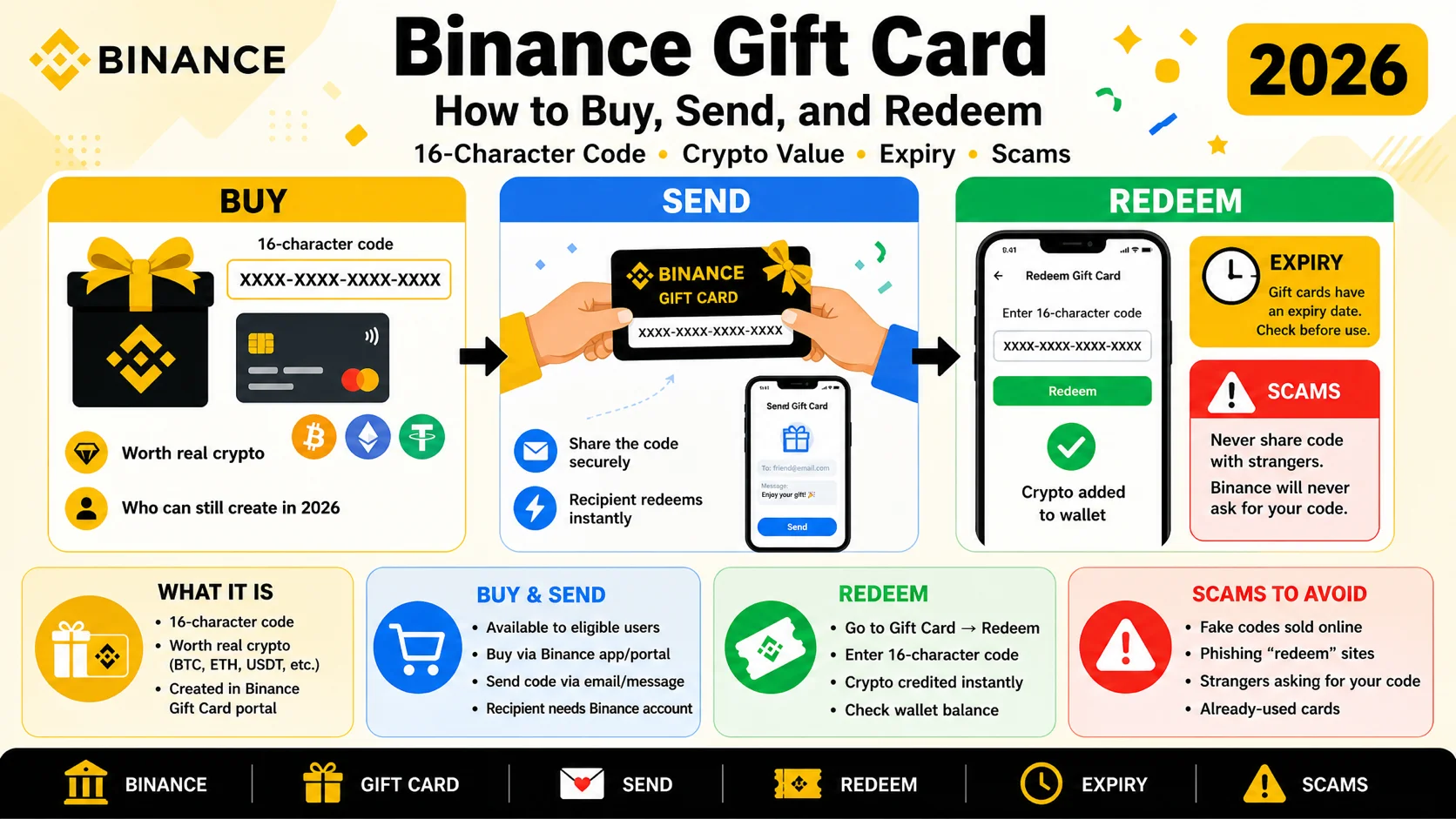
Binance Gift Card: How to Buy, Send, and Redeem (2026)
A Binance Gift Card is a 16-character code worth real crypto. Who can still create one in 2026, where to buy, how to redeem, when it expires, and the scams to avoid.
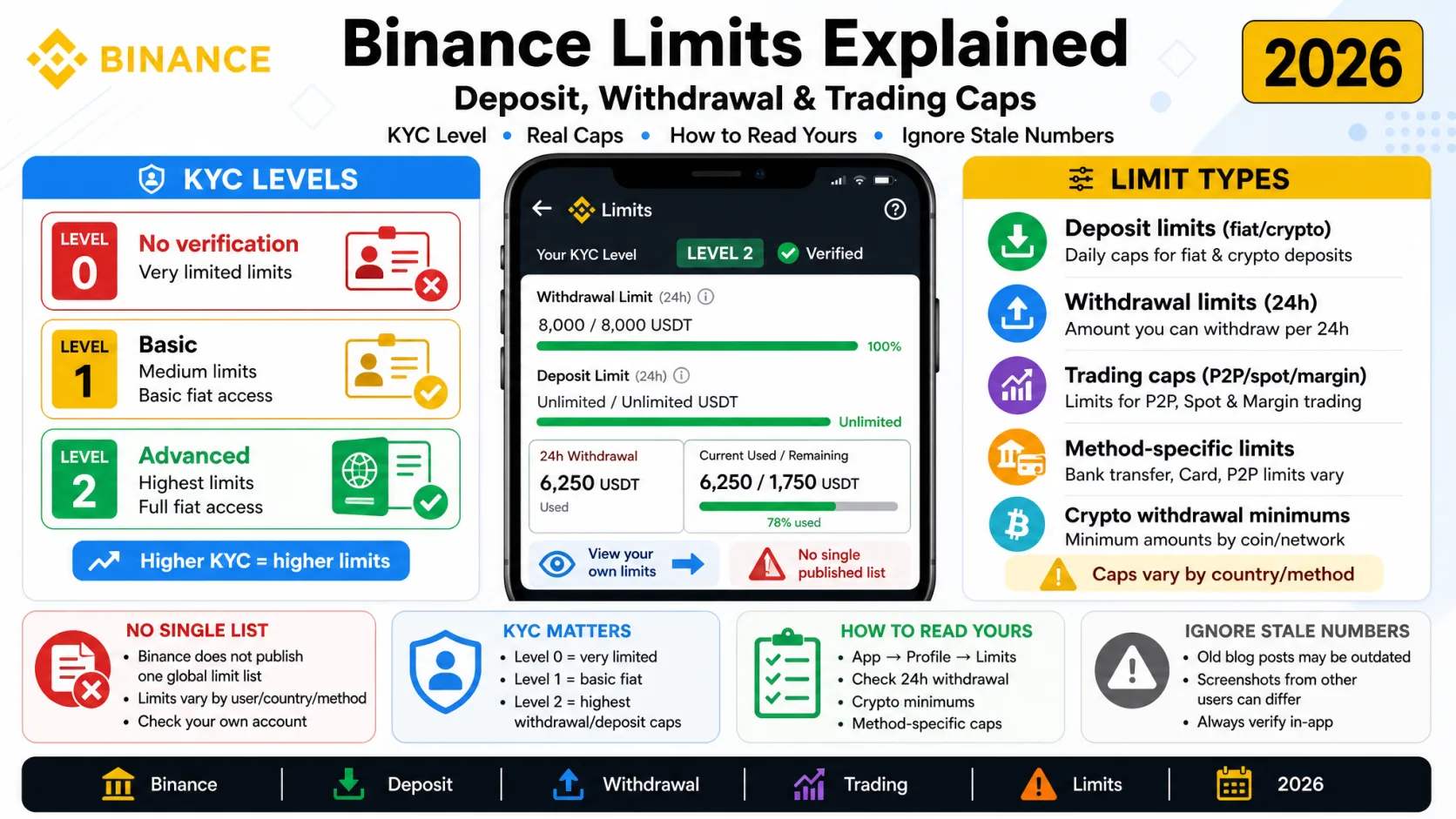
Binance Limits Explained: Deposit, Withdrawal, and Trading Caps (2026)
Binance publishes no single limit list. The real withdrawal, deposit and trading caps by KYC level, how to read your own, and the stale numbers to ignore.
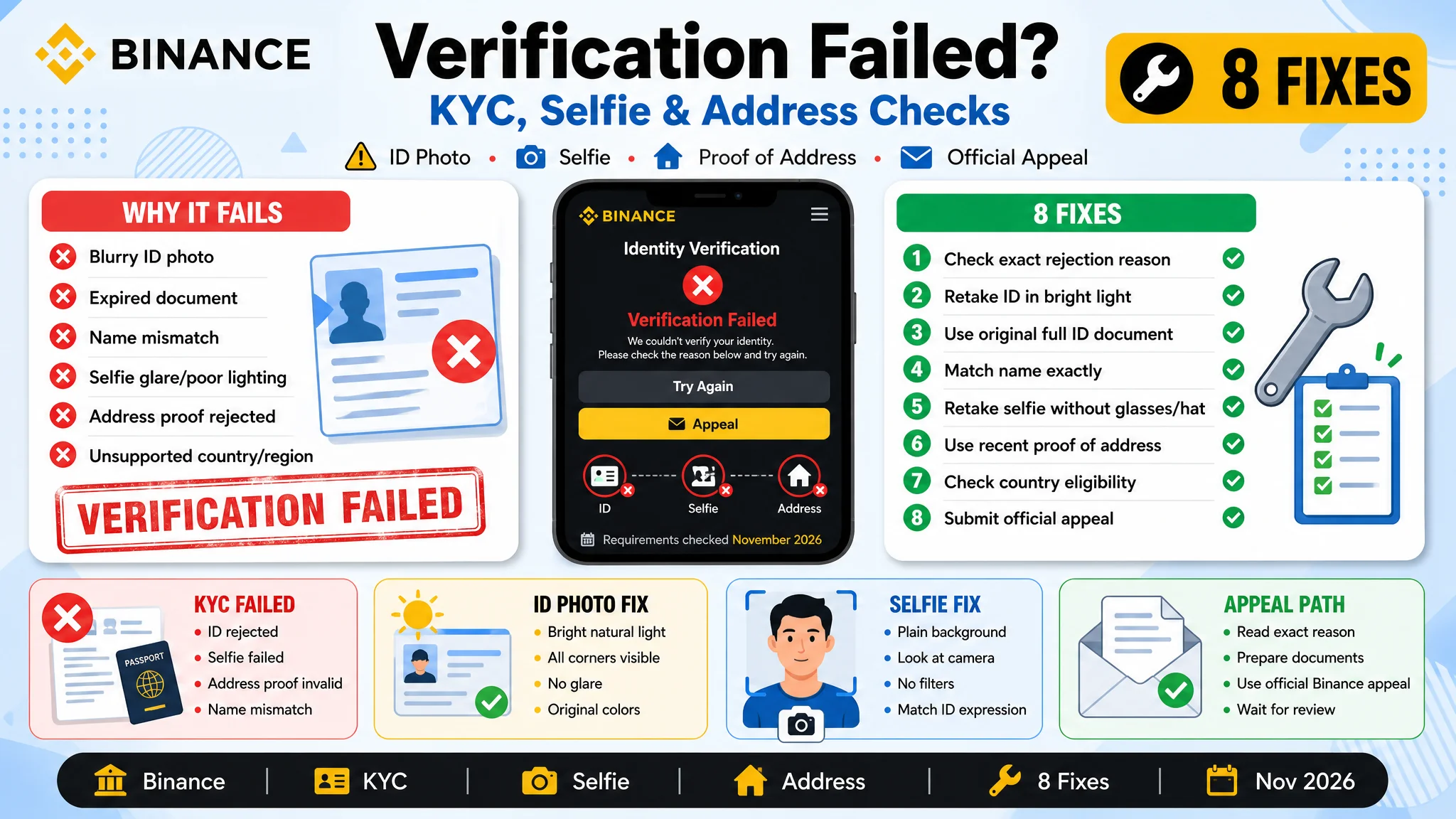
Binance Verification Failed? 8 Fixes for KYC, Selfie, and Address Checks (2026)
Binance verification failed? Find the exact rejection, fix the ID photo, selfie or address proof, and use the official appeal path. Requirements checked November 2026.