
Binance Limits Explained: Deposit, Withdrawal, and Trading Caps (2026)
Binance publishes no single limit list. The real withdrawal, deposit and trading caps by KYC level, how to read your own, and the stale numbers to ignore.
 Lucas Almeida 5 min read
Key takeaways
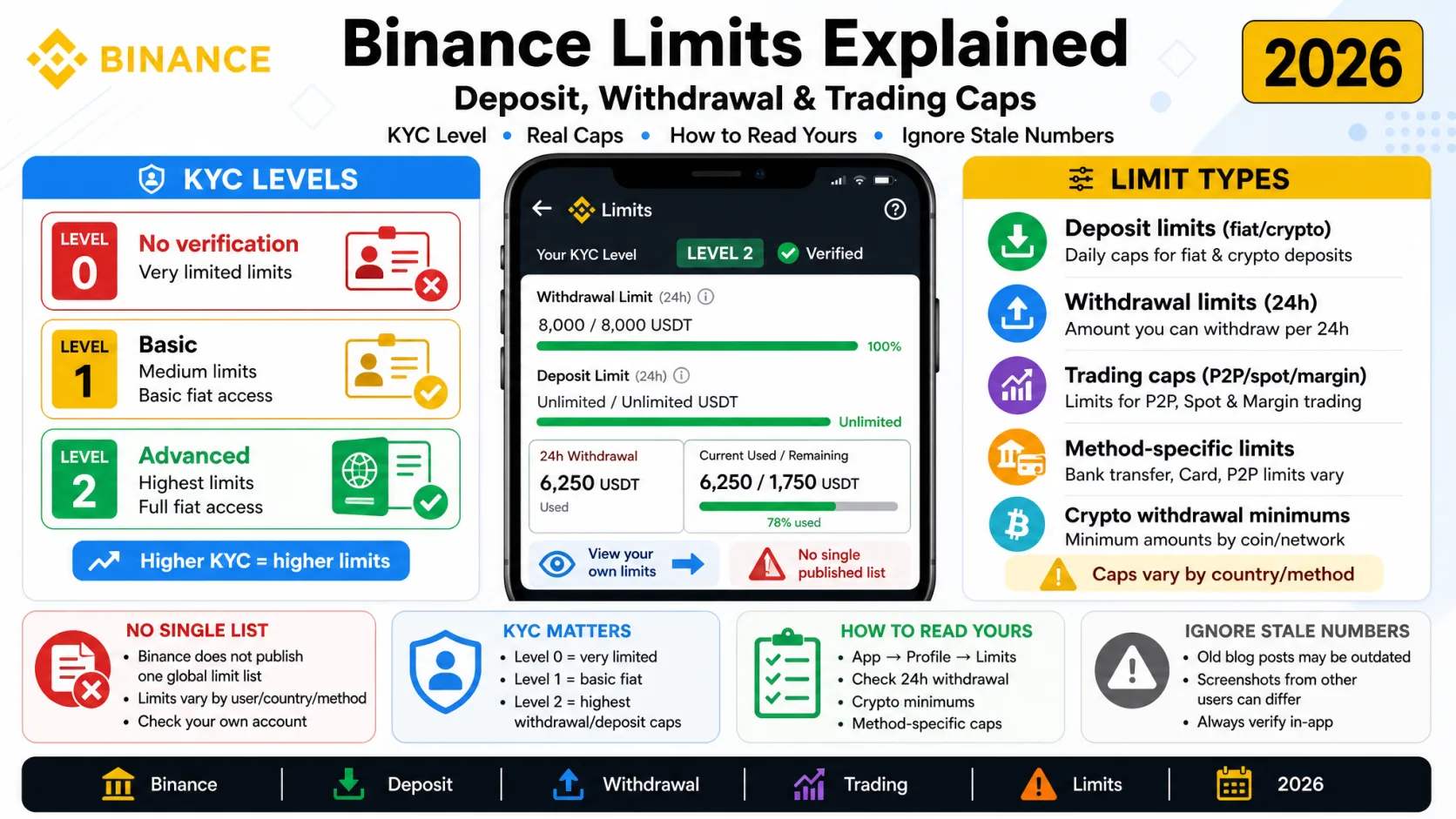
- Binance has no single 'account limit'. Five separate systems apply: verification gating, fiat monthly ceilings, crypto withdrawal caps, per-pair order rules, and futures rate and position limits.
- Crypto withdrawal limits are account- and country-specific and shown on Account → Identification. Binance deliberately publishes no global number, so any blog quoting one is guessing or recycling a 2021 figure.
- The one set of published ceilings is fiat: Binance's Mexico help page (10 February 2025) lists US$5,000 monthly deposits and US$10,000 monthly withdrawals for Verified, rising to US$15,000 and US$30,000 for Verified Plus.
- Trading limits are per pair and measurable. On 26 November 2026, 501 of Binance's 531 USDT spot pairs required a 5 USDT minimum order, 30 required 1 USDT, and every pair capped open orders at 200.
- Withdrawals can be capped even after KYC by face verification, fewer than three 2FA methods, logins from multiple IPs, or a 24–48 hour security lock after a password or whitelist change.
Binance has no single “account limit”. Five separate systems apply: verification gating, fiat monthly ceilings, crypto withdrawal caps, per-pair order rules, and futures rate and position limits. The withdrawal cap that most people are searching for is not published globally — it appears on Account → Identification and changes with your country and verification level.
The numbers that are published are narrower than most guides admit. Binance’s Mexico help page, published 10 February 2025, lists fiat ceilings of US$5,000 in monthly deposits and US$10,000 in monthly withdrawals for Verified, rising to US$15,000 and US$30,000 for Verified Plus. On the trading side, we pulled Binance’s public spot rules on 26 November 2026: of 531 USDT spot pairs, 501 required a 5 USDT minimum order and 30 required 1 USDT, and every pair capped open orders at 200.
⚠️ The most important thing first: don’t tap Sign Up directly in the app — you’ll miss the new-user rewards and the fee rebate. Register through an invite link or enter the referral code BN2688 so the 20% trading-fee rebate is attached to your account. It cannot be added later.
What limits does Binance actually apply?
Binance splits limits into five systems that move independently, which is why a single “Binance limit” answer is always wrong. Each system has its own gate, its own display location, and its own fix.
| Limit system | What it controls | Where to see it | Published figure? |
|---|---|---|---|
| Verification gating | Whether you can deposit, trade or withdraw at all | Account → Identification | Yes: Verified / Verified Plus |
| Fiat monthly ceilings | Bank deposits and withdrawals per month | Fiat deposit/withdraw screen; help page | Yes, by region |
| Crypto withdrawal caps | Per-request and 24-hour crypto outflows | Identification page; withdrawal screen | No global number |
| Spot order rules | Minimum order value, maximum order size, open-order count | Order form; public exchange rules | Yes, per pair |
| Futures rate and position limits | Orders per minute, maximum position size | Futures trading parameters; position page | Yes, by tier |
The practical consequence: raising one limit does not raise the others. A Verified Plus upgrade lifts fiat ceilings but does nothing for the 200-open-order cap on a spot pair, and enabling a third 2FA method can lift a withdrawal restriction without changing your KYC level at all.
What are Binance’s withdrawal limits?
Crypto withdrawal limits are account- and country-specific and shown on Account → Identification; Binance publishes no global figure. The 24-hour cap is denominated in a USD equivalent and applies across assets, with the remaining allowance displayed above the amount field when you withdraw.
Two rules frame everything else. First, since Binance’s June 2026 policy update, new users must complete Verified status before they can deposit or trade, and older unverified accounts are restricted to withdrawal-only mode. Second, the Verified Plus tier exists precisely to raise limits: it adds a proof-of-address check and unlocks higher fiat and account ceilings.
| Verification level | What it requires | What it unlocks |
|---|---|---|
| Unverified (legacy accounts) | Nothing | Withdraw-only: withdraw, cancel orders, close positions, redeem Earn |
| Verified | Government ID, both sides, plus a live face scan | Depositing, spot and futures trading, standard withdrawal limits |
| Verified Plus | Verified plus proof of address under 3 months old | Higher fiat and withdrawal ceilings, region-specific payment channels |
| Enterprise | Corporate documents and KYB | Per-entity limits set by Binance |
For fiat, the published ceilings are the clearest numbers Binance gives. The table below is from Binance’s Mexico support page, last published 10 February 2025; Binance states that limits are reviewed continuously and that other regions can differ.
| Monthly fiat limit | Verified | Verified Plus |
|---|---|---|
| Fiat deposits | US$5,000 | US$15,000 |
| Fiat withdrawals | US$10,000 | US$30,000 |
Withdrawal friction is not only about KYC. Binance’s own verification FAQ lists conditions that cap or suspend withdrawals independently of your tier, and each one is fixable.
| Trigger | What happens | Fix |
|---|---|---|
| Face verification not completed | Withdrawal amount is limited | Complete the face scan under Identification |
| Fewer than three 2FA methods | Withdrawal blocked | Enable three, e.g. passkey, authenticator app, SMS |
| Logins from multiple IPs | Withdrawals temporarily suspended as suspicious | Contact support to verify identity |
| Password or 2FA reset | 24–48 hour automatic lock | Wait; it cannot be lifted early |
| Whitelist toggled or address added | New address and disabled whitelist restrict withdrawals | Confirm by email; expect a 24-hour hold |
| Incomplete verification details | Withdrawals temporarily suspended | Supply the documents support asks for |
On top of these sit per-network minimums, which are a floor rather than a cap. Each coin and network sets a minimum withdrawal and a network fee, and both change periodically — our withdrawal fee comparison tracks the current schedule, and the withdrawal walkthrough covers the process step by step.
What are Binance’s deposit limits?
Crypto deposits have no published account-wide maximum on most coins, while fiat deposits are capped monthly by verification tier. For crypto, the constraint is the opposite of a cap: each coin and network sets a minimum, and deposits below the displayed threshold may not be credited.
That per-coin minimum is shown on the deposit screen before you send, and it can be fractions of a cent for stablecoins on cheap networks. Some networks also publish a maximum, usually for operational reasons rather than risk. Binance charges no deposit fee for crypto; the only cost is the sending-side network fee.
Fiat is where real ceilings exist. The same Mexico page gives US$5,000 per month for Verified accounts and US$15,000 for Verified Plus, and those figures are region-specific. Card purchases and P2P trades add another layer on top: card limits come from the payment provider, while P2P limits are set by each merchant in their ad. Our guide to Binance deposit methods and the minimum deposit rules cover those routes in detail.
What are Binance’s trading limits?
Spot trading limits are per pair: a minimum order value, a maximum order size, and a cap on how many orders you can keep open. Unlike withdrawal limits, these are published in Binance’s public trading rules and can be measured directly.
We queried Binance’s spot exchange rules on 26 November 2026 and counted the constraints across every live market. The results give a concrete picture of what the platform actually enforces.
| Spot constraint | Measured value (26 Nov 2026) | Notes |
|---|---|---|
| Live trading pairs | 1,381 | Across all quote currencies |
| USDT pairs | 531 | The main market for beginners |
| Pairs with a 5 USDT minimum order | 501 | 94% of USDT pairs |
| Pairs with a 1 USDT minimum order | 30 | Mostly smaller-cap and meme pairs |
| Open orders per pair | 200 | Applied to all 1,381 pairs |
| Open algo orders per pair | 5 | Stop-loss and similar orders |
| BTCUSDT maximum market order | 122.86 BTC | Dynamic, moves with liquidity |
| BTCUSDT maximum limit order | 9,000 BTC | Static per pair |
| ETHUSDT maximum market order | 4,365 ETH | Dynamic, moves with liquidity |
| ETHUSDT maximum limit order | 9,000 ETH | Static per pair |
The maximum market order size is the number most people miss. It is dynamic — Binance recalculates it from current liquidity — so a market order that worked last week can be rejected today with a “max market order” error. Limit orders use a separate, static ceiling that is far higher. The fix for a rejected large market order is to split it or use a limit order, not to panic.
Futures adds a second layer of limits that has nothing to do with how much money you have.
| Futures limit (updated 30 June 2026) | Default value |
|---|---|
| Orders per minute, per account | 1,200 |
| Messages per minute, per IP | 2,400 |
| USDⓈ-M orders per 10 seconds | 300 |
| BTCUSDT max market order | 120 BTC |
| BTCUSDT max limit order | 1,000 BTC |
| ETHUSDT max market order | 2,000 ETH |
| ETHUSDT max limit order | 10,000 ETH |
High-volume traders can raise the rate limits through volume tiers: 30-day futures volume of 600 million USDT lifts orders to 6,000 per minute, and 25 billion USDT lifts them to 18,000 per minute. Position sizes are raised separately through Binance’s position limit adjustment page, which is where VIP status actually matters. Spot API users face their own ceilings: 6,000 request weight per minute, 100 orders per 10 seconds, and 200,000 orders per day.
Why do Binance limit numbers on blogs disagree?
Most published Binance limit numbers are stale, belong to a different Binance entity, or were never official. Three failures explain almost every conflicting figure you will find.
The first is age. The widely repeated 0.06 BTC per day for unverified accounts and 100 BTC per day for verified accounts both come from Binance’s July 2021 rules and have been retired. Binance replaced them with country-specific limits displayed in the account, so a 2021 number is not a conservative estimate — it is simply wrong.
The second is entity confusion. Binance.com, Binance.US, Binance Japan and Binance TH are separate operations with separate KYC tiers and separate dollar limits. A US help-centre figure does not apply to a global account, and a global figure does not apply to Binance.US.
The third is asset drift. Withdrawal limits, minimums and fees are recalculated per coin and network, sometimes within weeks. Any table that does not state a check date should be treated as historical.
| Claim you will see | Status | What to use instead |
|---|---|---|
| 0.06 BTC/day unverified | Retired (July 2021) | Unverified accounts are withdraw-only |
| 100 BTC/day verified | Retired (July 2021) | Your Identification page |
| “Binance daily limit is $8M” | Unverified | Identification page |
| US$5,000 / US$15,000 fiat deposits | Published, regional | Mexico help page, 10 Feb 2025 |
| 5 USDT minimum order | Current, measurable | Spot exchange rules |
How can I check my own Binance limits?
Your own account is the authoritative source, and four screens show every limit that applies to you. Checking them takes about two minutes and avoids relying on any third-party table.
- Account → Identification. This shows your verification level and your current 24-hour crypto withdrawal limit. If the page offers Verified Plus, your region supports the upgrade.
- Wallet → Withdraw. Enter a coin and network and the screen shows the per-request maximum, the remaining 24-hour allowance, the network minimum and the fee before you confirm.
- Wallet → Deposit. Choose the coin and network to see the deposit minimum and maximum that apply to that route.
- The order form. The minimum order value appears when you type an amount, and Binance rejects an oversized market order with a specific maximum-order error.
For futures, the trading parameters page lists the maximum market and limit order size per contract, and the position limit page shows your current position ceiling. If you use the API, the exchange rules endpoint returns every per-pair filter, including the 200-order cap and the dynamic market maximum.
How can I raise a Binance limit?
There are three legitimate routes — upgrade verification, complete security requirements, or request a manual increase — and each fixes a different type of limit. Matching the route to the limit is the part most guides skip.
| Goal | Legitimate route | Realistic timeline |
|---|---|---|
| Higher fiat deposit/withdrawal ceilings | Upgrade to Verified Plus with a proof of address under 3 months old | Review usually within 48 hours, often faster |
| Remove a face-verification cap | Complete the face scan under Identification | Minutes |
| Remove a 2FA withdrawal block | Enable at least three 2FA methods | Minutes |
| Lift a security lock | Wait out the 24–48 hour timer | 1–2 days |
| Raise futures position or rate limits | Position limit adjustment page or VIP portal | Same day to a few days |
| Raise a crypto withdrawal cap above your tier | Contact Binance support with source-of-funds documents | Days, case by case |
Three shortcuts do not work and can make things worse. A VPN does not change your account’s country or limits, and using one to misrepresent location can freeze the account. Opening a second account to get a fresh limit violates Binance’s terms and risks both accounts. Buying a “verified account” is a scam that hands your funds to a stranger. Splitting a large withdrawal into many small ones to stay under a threshold is also the pattern compliance teams flag, so plan large moves in advance and ask support instead.
The proof-of-address requirement for Verified Plus is stricter than most people expect: the document must be under three months old, show your full address including postal code, match the name on your ID, and be an original PDF or photo rather than a screenshot. Mobile phone bills are rejected; landline bills, bank statements, utility bills, tax notices and residence certificates are accepted. Our KYC guide covers the verification flow, and the verification failure fixes cover rejections.
What happens if I hit a limit?
Hitting a limit is a wait, not an error — the 24-hour crypto allowance resets at 00:00 UTC, and fiat ceilings reset monthly. The right response depends on which ceiling you hit.
If it is the 24-hour crypto cap, the remaining allowance returns at the UTC reset; withdrawing on a different network does not create a separate allowance, because the cap is measured in USD equivalent across assets. If it is a fiat monthly ceiling, the reset is calendar-based and the only faster route is a Verified Plus upgrade or a different payment rail. If it is a per-order maximum, split the order or switch from market to limit. If it is an open-order cap, cancel stale orders — the 200 limit counts orders, not value.
Planning matters more than tactics for large transfers. Check the withdrawal screen a day before you need the money, confirm that your 2FA methods and face verification are current, and avoid changing your password in the same week as a large withdrawal. For the cost side of moving funds, see our Binance fees guide; for the account-opening sequence, start with Binance registration and the referral code guide.
The bottom line
Binance limits are five systems, not one number: verification gating, fiat monthly ceilings, crypto withdrawal caps, per-pair order rules, and futures rate and position limits. The only figures worth quoting are the ones with a date and a source — Binance’s own help pages for fiat ceilings, and the public trading rules for order minimums and maximums. For everything else, your Identification page is the answer.
If you have not registered yet, do it through the referral code so the 20% fee rebate is attached from the start; it cannot be added after the fact.
💡 Don't have a Binance account yet? Sign up now — 20% fee rebate on spot and futures — enter the referral code BN2688.
Don't have a Binance account yet?Sign up nowenter the referral codeBN2688
Frequently asked questions
What is the Binance withdrawal limit?
What is the Binance deposit limit?
Is 100 BTC a day still the Binance withdrawal limit?
Why is my Binance withdrawal limited even after KYC?
What is the minimum order on Binance?
Can I increase my Binance limits?
Does VIP level increase my Binance withdrawal limit?
Are Binance.US limits the same as Binance.com?
Editor-in-Chief & Lead Researcher
Editor of MyCryptoStart. Independent researcher of cryptocurrency exchanges, focused on fees, security, KYC, and onboarding — publishes step-by-step guides in plain English for beginners.
View author page →Some links on this page are affiliate links: we may earn a commission at no extra cost to you. This content is educational and is not financial, investment, or legal advice. Affiliate disclosure · Disclaimer.
Continue reading
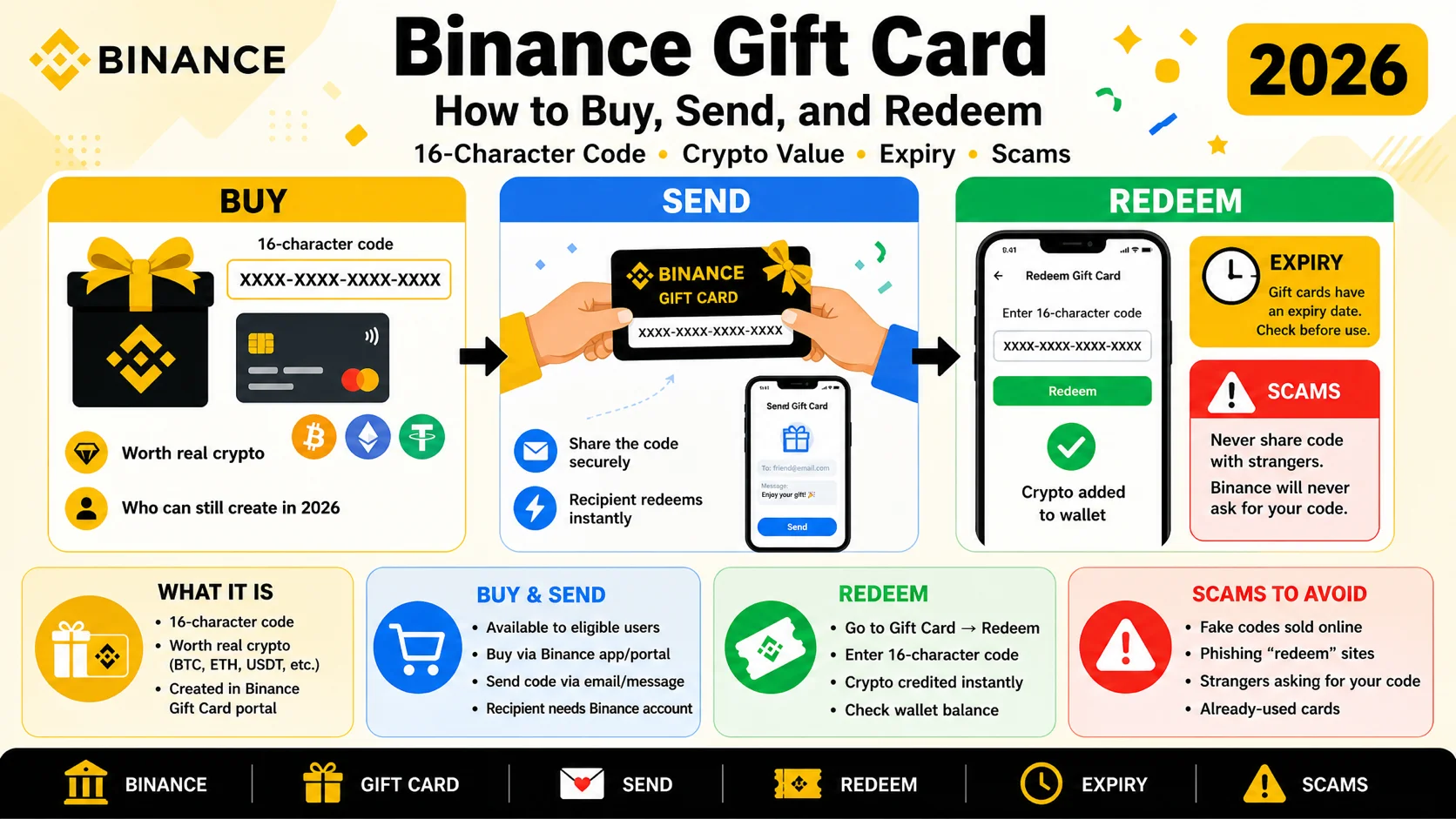
Binance Gift Card: How to Buy, Send, and Redeem (2026)
A Binance Gift Card is a 16-character code worth real crypto. Who can still create one in 2026, where to buy, how to redeem, when it expires, and the scams to avoid.
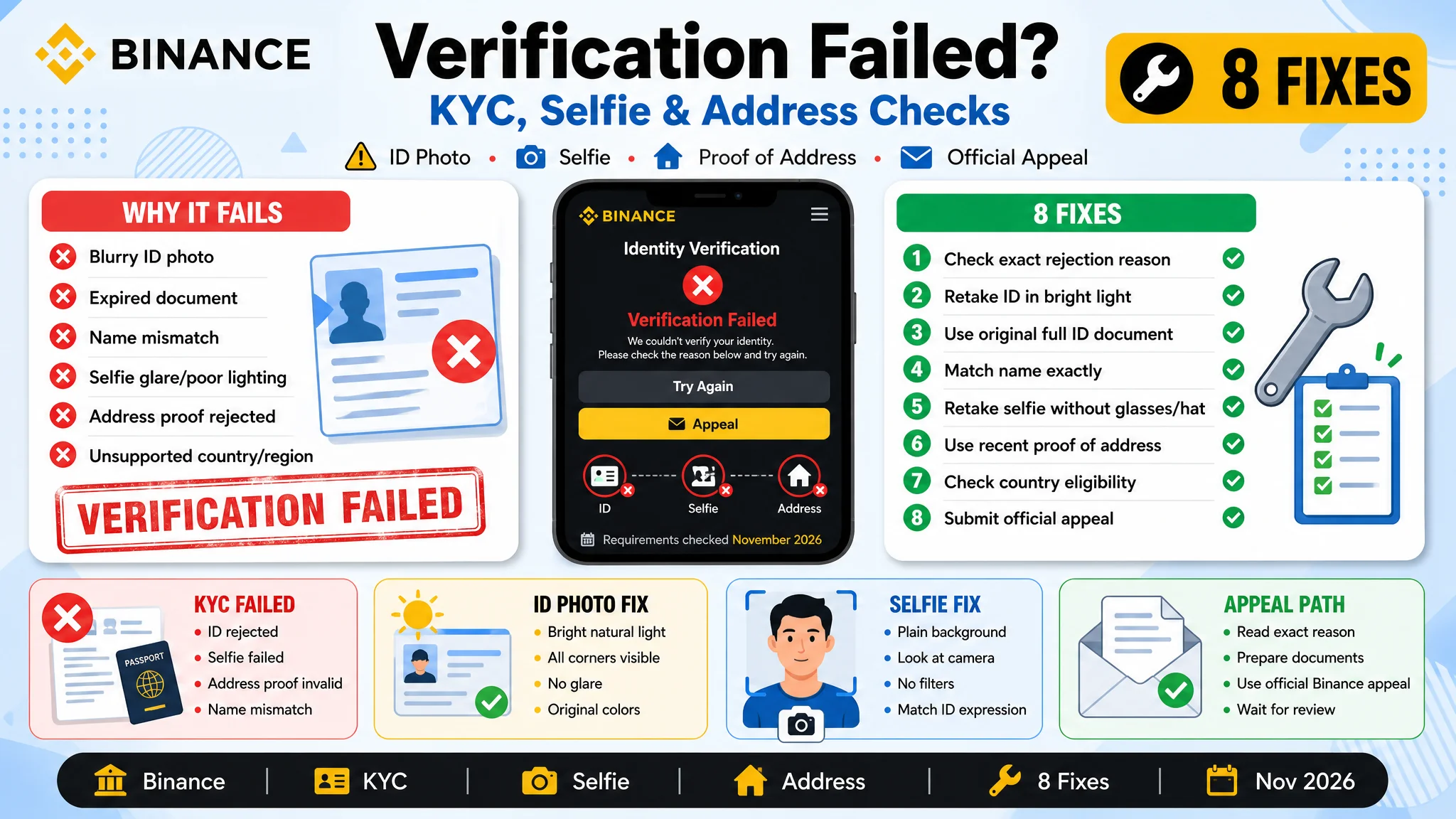
Binance Verification Failed? 8 Fixes for KYC, Selfie, and Address Checks (2026)
Binance verification failed? Find the exact rejection, fix the ID photo, selfie or address proof, and use the official appeal path. Requirements checked November 2026.

Binance Learn & Earn: How It Works and How to Claim Rewards (2026)
Binance Learn & Earn pays small crypto vouchers for passing short quizzes. Here is how it works, where rewards go, why campaigns disappear, and the 14-day redemption trap.