
How to Stake Crypto and Earn Yield (2026)
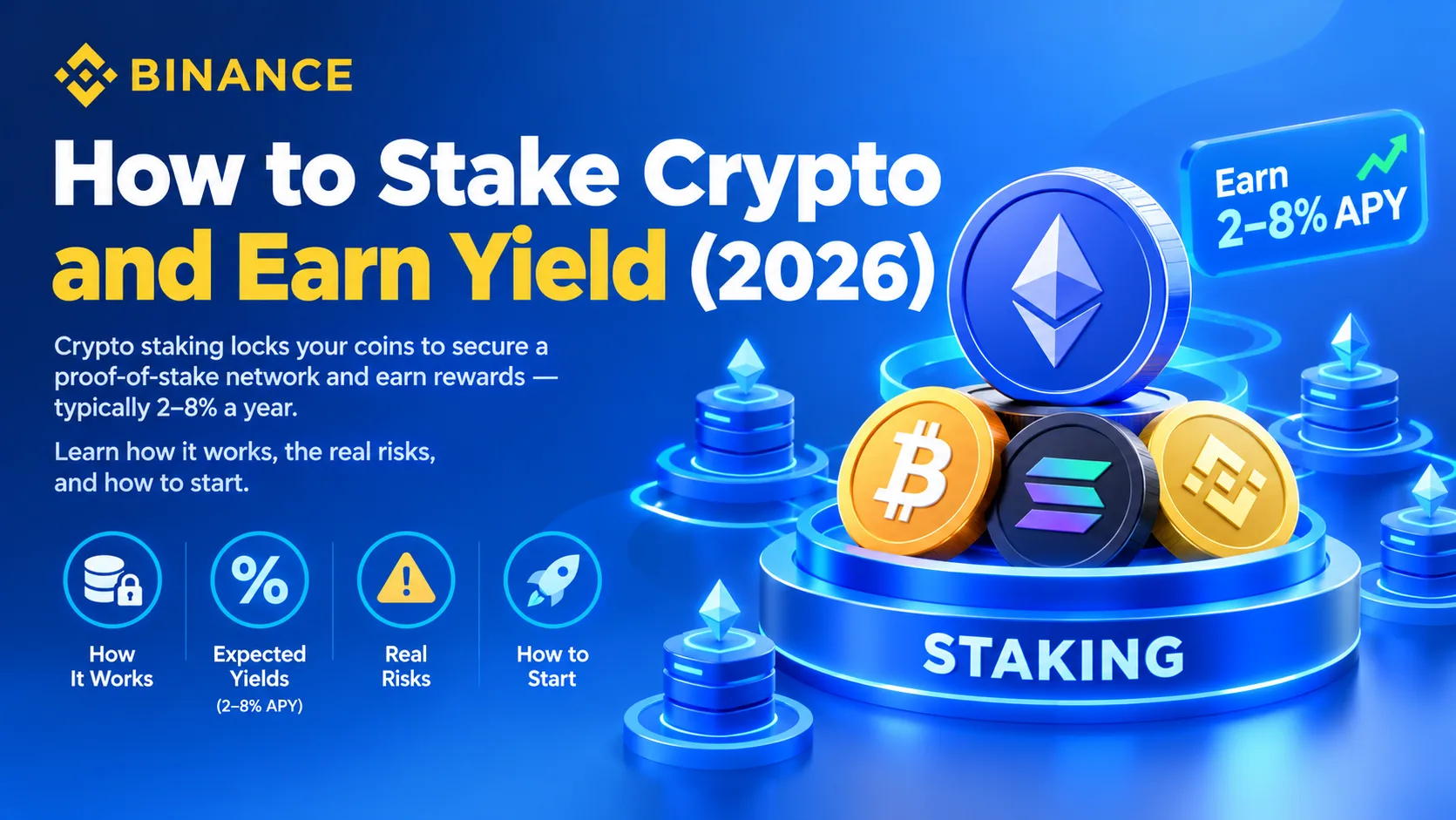
Crypto staking locks your coins to secure a proof-of-stake network and earn rewards — typically 2–8% a year. Learn how it works, the real risks, and how to start.
 Lucas Almeida 5 min read
Key takeaways
- Staking locks your crypto to help secure a proof-of-stake blockchain, and pays you new coins as a reward — typically 2–8% a year (Ethereum ~2.5%, Solana ~3–6%).
- The yield is real but variable: rates float with network activity, and the biggest risk is price volatility, not the reward math — a 20% price drop wipes out a 10% yield.
- On-chain staking carries slashing risk (losing part of your stake for downtime or misbehavior) and an unbonding period during which you cannot sell.
- The simplest path for beginners is exchange staking — Binance Simple Earn — a few clicks, no validator to run, but you trust the platform.
- Liquid staking (stETH, rETH) gives you a tradable token so you are not locked, at the cost of added smart-contract and de-peg risk.
Staking means locking your cryptocurrency to help secure a proof-of-stake network, and earning new coins as a reward for doing so. Real-world yields cluster in a 2–8% band — as of October 2026, Ethereum’s base rate was about 2.5% and Solana roughly 3–6%. The one caveat that matters more than any number: rewards are paid in the staked coin, so a price drop can erase the yield faster than it accrues.
This guide explains what staking actually is, how the rewards work, the risks that most summaries skip, and how to start staking in a few clicks on an exchange.
What Is Crypto Staking?
Staking is how a proof-of-stake (PoS) blockchain stays secure without mining. Instead of spending electricity to solve puzzles the way Bitcoin’s proof-of-work does, a PoS network asks participants to lock up coins as a security deposit. The people who run the network — called validators — put their own coins at stake, and if they behave honestly they earn rewards; if they misbehave or go offline, they can lose some of that stake.
The insight is economic: a validator who has $X of their own money on the line is incentivized to act honestly, because the value of the coins they are securing rises only if the network stays trustworthy. When you “stake” your coins, you are joining that system — either running a validator yourself, or delegating your coins to one and taking a share of its rewards.
The most useful analogy is a rental security deposit: you put value down as a guarantee of good behavior, and you get it back (plus a reward for your trouble) once the agreement ends. The difference is that on a blockchain, the “agreement” is enforced by code, not a landlord.
If you are new to how these networks work, start with what Ethereum is and what DeFi is, since staking is the engine underneath most of decentralized finance.
How Does Staking Work?
The mechanics are the same across chains, with the numbers changing per network. You lock coins, they are assigned to a validator, and you earn newly issued coins plus a share of transaction fees, proportional to your stake.
The reward comes from two sources:
- New coin issuance. The network mints new coins to pay validators, which is the “base” reward.
- Transaction fees (and on some chains, MEV). Validators also collect fees from the activity they help process.
Your return is expressed as an APR (annual percentage rate) or APY (which accounts for compounding). Because issuance and fees both vary with how many people are staking and how much activity the chain has, the rate floats — a figure you see today is a snapshot, not a promise.
The numbers you will actually see in late 2026, from current sources:
| Asset | Typical staking yield (Oct 2026) | Notes |
|---|---|---|
| Ethereum (ETH) | ~2.5% base; ~3–4% solo with MEV | ~43.9M ETH staked, about 35% of supply (ethereum.org) |
| Solana (SOL) | ~3–6% | Faster unbonding (a few days) |
| Cosmos (ATOM) | up to ~13% advertised | Higher yield, higher inflation |
| USDT / USDC (stablecoin “earn”) | ~1.7–3.5% | Lending, not on-chain staking |
A crucial distinction to keep straight: many exchange “earn” products are lending, not staking. When you deposit USDT into a “flexible savings” product, you are lending to a platform or borrower — you earn interest and take credit risk, but there is no validator, no slashing, and no unbonding queue. Only coins on a proof-of-stake network (ETH, SOL, ATOM, and many others) can be staked in the technical sense.
What Can You Actually Earn?
The honest answer is a few percent a year on major coins — not the double-digit rates marketing sometimes implies. Here are current, sourced figures for Ethereum specifically:
- Base protocol APR: ~2.5%, per Ethereum’s official staking page in October 2026, with about 43.9 million ETH (roughly 35% of all ETH) already staked.
- Solo staking (running your own validator with 32 ETH): roughly 3–4% all-in, because you also capture transaction fees and, if configured, MEV — but this requires a dedicated computer online ~24/7 and real technical effort.
- Liquid staking (Lido’s stETH, Rocket Pool’s rETH): about 2.2–2.9% after platform fees. As of early October 2026, Lido’s stETH was yielding roughly 2.19% and Rocket Pool’s rETH 2.17%.
- Exchange staking (Coinbase, Kraken, and similar): about 1.8–2.9%, because the exchange takes a cut — Coinbase, for example, keeps roughly 25% of rewards, leaving around 1.8% net.
The two exchanges this site covers work the same way, with rates that change weekly:
- Binance Simple Earn listed ETH flexible rates around 1–2.5% and USDT flexible around 2.5–4.5% in 2026, with locked terms paying more for longer commitments (roughly 2% for 30 days up to ~3.5% for 120 days on ETH). Locked-product rates reset weekly, and redeeming early forfeits accrued interest.
The pattern to internalize: the more convenient and flexible the product, the lower the yield. Exchange staking is the easiest and pays the least; solo staking is the hardest and pays the most. Everything in between is a trade-off between effort, liquidity, and return.
The Risks You Need to Know First
Staking is often pitched as “free money,” which is misleading. Before you lock anything, these are the four risks that actually matter:
- Price volatility is the biggest one. Rewards are paid in the staked coin, so if that coin falls, your total position loses value even as the “yield” number ticks up. A 20% price drop wipes out a 10% yield — and it can happen in a single day in crypto. This, not slashing, is how most stakers lose money.
- Slashing can reduce your principal. On-chain staking has a penalty called slashing: if a validator double-signs or stays offline for too long, the network destroys part of its stake. When you delegate to a validator, that penalty propagates to you, so a sloppy validator can cost you real coins — not just missed rewards.
- Unbonding locks you out of selling. When you unstake, you usually cannot touch your coins until an unbonding period passes — about 2–4 days on Solana, 7–21 days on Cosmos, 28 days on Polkadot, and a variable queue on Ethereum that lengthens when many people exit at once. In a crash, a natively staked holder may be unable to sell while the price falls.
- Liquid staking adds smart-contract risk. Liquid staking (stETH, rETH, JitoSOL) fixes the lock-up by giving you a tradable receipt token, but that token is built on third-party smart contracts. It can be exploited, and in a panic it can trade at a discount to the underlying coin — exactly when you most want to sell. A receipt token is tradable, not necessarily redeemable 1:1 on demand.
Two more things that get missed:
- Taxes. In most jurisdictions, staking rewards are treated as taxable income at the time you receive them, on top of any capital gains when you later sell. The rules are country-specific — read our crypto taxes guide for the detail.
- “Earn” is not always staking. A platform product that pays a fixed rate on stablecoins is usually lending, and it carries the platform’s credit risk rather than the network’s slashing rules. Understand which one you are buying.
None of these make staking bad — they make it a risk-bearing activity with a modest, variable return, not a savings account.
Ways to Stake: Choosing Your Method
You have three realistic options, and they differ in minimums, liquidity, and trust assumptions:
| Method | Minimum | Liquidity | Yield (Oct 2026) | Risk profile |
|---|---|---|---|---|
| Exchange staking (Binance) | ~$1–$10 | Flexible or short lock | ETH ~1–2.5%, SOL ~3–6% | You trust the platform; lowest effort |
| Liquid staking (Lido / Rocket Pool) | Tiny (buy the token) | Tradable anytime | ETH ~2.2–2.9% | Smart-contract + de-peg risk |
| Solo staking | 32 ETH (Ethereum) | Locked until you exit | ~3–4% with MEV | Technical effort + slashing |
For a beginner, the decision rule is simple: start with exchange staking. It takes minutes, has no minimum of consequence, and the platform handles the validator and the security. Liquid staking is the next step up if you want to stay liquid, and solo staking is only worth it if you already hold 32+ ETH and enjoy running infrastructure.
How to Stake Crypto Step by Step
Here is the beginner path on the two exchanges this site covers. The steps are nearly identical on both.
Step 1: Choose an asset to stake
Start with a major proof-of-stake coin you already hold — Ethereum or Solana are the standard choices — rather than chasing the highest advertised APY on an obscure coin. Higher yields almost always mean higher inflation or higher risk, and staking a coin that falls hard is a losing trade even at a high APR.
If you do not own any yet, buy a small amount first — see how to buy crypto. Only stake money you can afford to leave locked for months.
Step 2: Choose a method
For your first stake, exchange staking is the right call. It is a few taps, has no real minimum, and the platform runs the validator and manages the security. Liquid staking and solo staking are worth revisiting later, once you understand the lock-up trade-off.
Step 3: Fund your account
Deposit the coins you plan to stake into your exchange account. The deposit flow is in how to deposit into Binance. Keep the amount small — a figure whose total loss would not change your life.
Step 4: Subscribe to a staking product
On Binance, open the Earn section and choose Simple Earn — pick Flexible to redeem any time, or Locked for a higher rate on a fixed term. Select the coin and product. Before you confirm:
- Read the live APR on the screen — it changes, and it is what you are actually getting.
- Note the reset schedule. Locked products reset their rate weekly, so the number you saw last week is not today’s.
- Confirm the early-redemption rule. Most locked products forfeit accrued rewards if you redeem before the term ends.
Step 5: Know your exit rules and track rewards
Before you commit, find the unstake / redeem button and the unbonding period — on-chain staking can take days to free your coins, and flexible products still have processing time. Then, once rewards start accruing, keep records: staking rewards are usually taxable income, and you will need a total when you report (see the crypto taxes guide).
💡 Don't have a Binance account yet? Sign up now — 20% fee rebate on spot and futures — enter the referral code BN2688.
If you have not opened an account yet, start with how to create a Binance account. And before you stake real money, make sure you actually understand the asset you are locking — read our Ethereum guide and Solana guide first.
Common Problems and Fixes
- The APR dropped after I subscribed. Rates float with network activity and reset weekly on locked products. This is normal, not an error — the fix is to accept the variable rate or switch to a flexible product.
- I cannot withdraw my coins. You are almost certainly inside an unbonding or lock-up period. Check the product’s terms; flexible products free up faster, while locked and on-chain products have fixed waits.
- My locked product “lost” its rewards. You redeemed early, which forfeits accrued interest on most locked products. Confirm the early-redemption rule before subscribing, not after.
- The “staking” product is actually lending. If the coin is a stablecoin or the rate is fixed, you are lending, not staking — the risks (platform credit) are different. Read the product description to know which one you hold.
- Rewards are smaller than the headline number. The advertised rate may be gross, before the platform’s cut. Exchanges keep a share — Coinbase, for instance, takes ~25% of Ethereum rewards — so your net is lower than the top-line APR.
The Bottom Line
Staking is a legitimate way to earn a modest, variable yield — roughly 2–8% a year on major coins — in exchange for helping secure a proof-of-stake network. It is not free money: the rate floats, slashing and lock-up periods are real, and price volatility can erase the yield. But for coins you already plan to hold long term, staking is one of the few ways to make them work while you wait.
The sensible way to start is to stake a small amount of Ethereum or Solana through exchange staking — Binance Simple Earn — read the live APR and exit terms before you confirm, and keep records for tax. Start small, understand the lock-up, and let the reward be a bonus, not the reason you bought the coin.
The information in this article is for education only and is not financial advice. Staking involves risk, including loss of principal, and the yields cited here are current snapshots that can change at any time.
Don't have a Binance account yet?Sign up nowenter the referral codeBN2688
Frequently asked questions
What is crypto staking?
How much can I earn from staking crypto?
Is staking crypto safe? What are the risks?
What is the difference between staking and crypto lending or savings?
Can I withdraw my staked crypto at any time?
How do I start staking crypto?
Editor-in-Chief & Lead Researcher
Editor of MyCryptoStart. Independent researcher of cryptocurrency exchanges, focused on fees, security, KYC, and onboarding — publishes step-by-step guides in plain English for beginners.
View author page →Some links on this page are affiliate links: we may earn a commission at no extra cost to you. This content is educational and is not financial, investment, or legal advice. Affiliate disclosure · Disclaimer.
Continue reading
Dollar-Cost Averaging (DCA) in Crypto (2026)
Dollar-cost averaging buys a fixed dollar amount of crypto on a set schedule. Learn how DCA works, what backtests show, and when lump sum wins.

Crypto Taxes Explained: Rates & Rules (2026)
Selling, swapping, or spending crypto is a taxable event; buying and holding is not. How US crypto taxes work in 2026: rates, rules, and how to file.
Bitcoin Halving Explained: What It Means (2026)
The halving cuts Bitcoin's mining reward in half every four years, slowing new supply. Learn how it works and why it does not guarantee a price rise.