
What Are Crypto Gas Fees? (2026 Guide)
A gas fee is what you pay to have a transaction processed on a blockchain. Learn how gas is calculated in gwei, why it spikes, and how to pay less.
 Lucas Almeida 5 min read
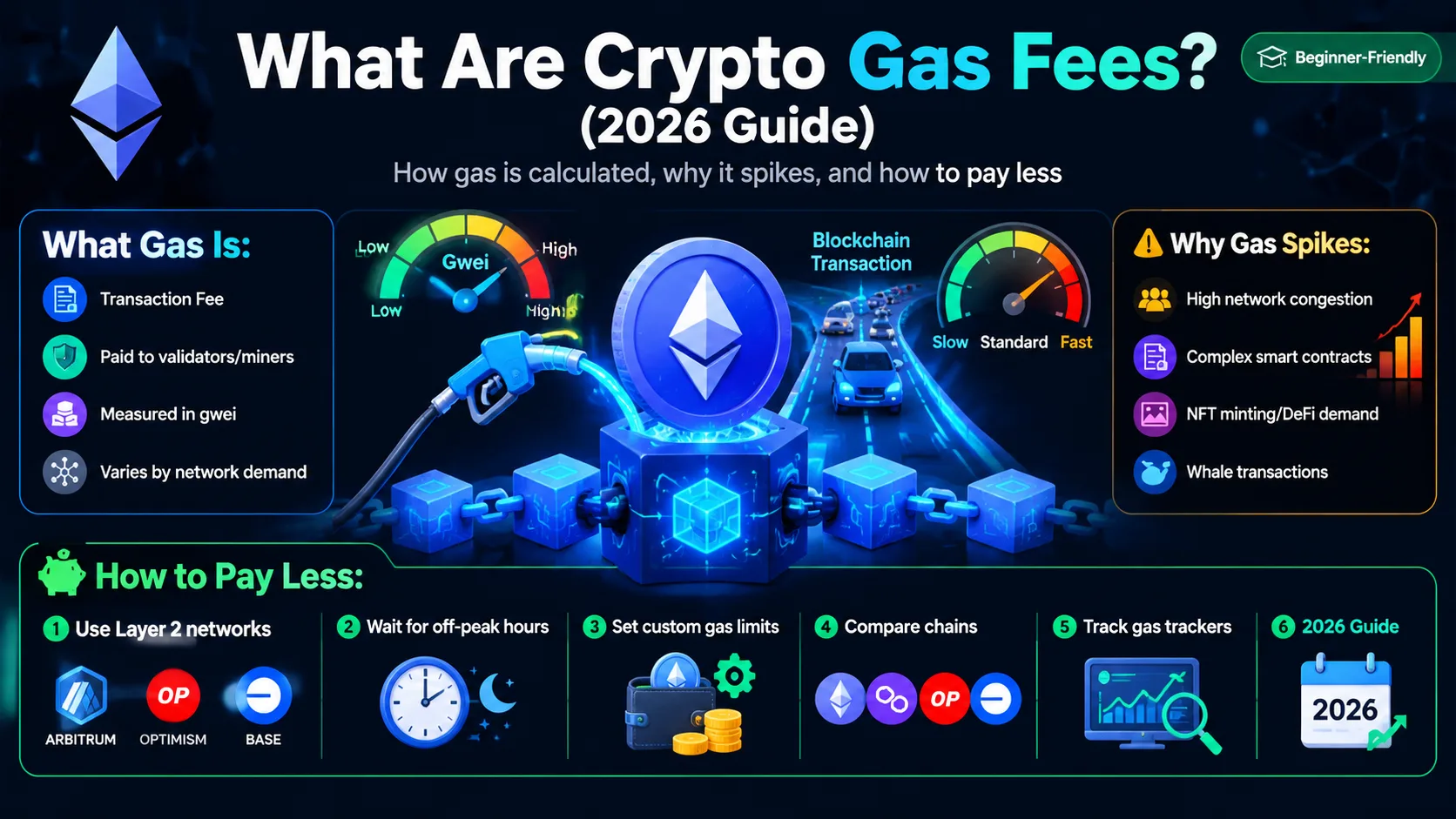
Key takeaways
- A gas fee is the payment that compensates a blockchain's validators for processing your transaction — on Ethereum it is paid in ETH and quoted in gwei (one billionth of an ETH).
- The formula is simple: fee = gas used × price per unit. A plain ETH transfer always uses 21,000 gas; swaps use far more, which is why they cost more.
- Fees move with network congestion, not with the dollar size of your transfer — sending $50 and $50,000 of ETH costs the same.
- Failed transactions still burn gas, and lowering the gas limit is the classic beginner mistake — lower the price, never the limit.
- Layer-2 networks like Arbitrum and Base, or cheaper chains like Solana, cut the same transaction from dollars to cents — typically 90–99% cheaper.
A gas fee is the transaction fee you pay to have an operation processed and permanently recorded on a blockchain. On Ethereum, the fee is paid in ETH, the unit of work is called “gas,” and its price is quoted in gwei — one billionth of an ETH. Fees range from fractions of a cent to tens of dollars depending on the network, the operation, and how busy the chain is at that moment.
This guide explains what gas fees are, the exact formula behind them, why they swing so violently, and — most usefully — the concrete levers that cut your costs by 90% or more. It ends with the one beginner mistake that costs people real money: confusing the gas limit with the gas price.
What Is a Gas Fee?
A gas fee is the price you pay for the computational work of your transaction. Blockchains are run by thousands of independent computers (validators or miners) that process and secure every operation; the fee is what compensates them for that work. Ethereum’s own documentation puts it plainly: “Gas refers to the unit that measures the amount of computational effort required to execute specific operations on the Ethereum network.”
The fee serves two purposes at once. The first is economic — without fees, there is no incentive to run the hardware that keeps the network secure. The second is defensive — writing data permanently onto a shared ledger is expensive, so charging for every computation stops the network from drowning in junk and infinite loops. “Gas” is simply Ethereum’s name for that metered work; other chains use the same idea under different names (a “transaction fee” on Bitcoin, a “compute unit” on Solana).
One distinction matters more than any other: a gas fee prices network space, not dollar value. Sending $50 of ETH and $50,000 of ETH costs the same, because both are the same-sized transaction. This is why, on a congested day, a fee can exceed a small transfer you are trying to make — a common source of beginner confusion.
How Are Gas Fees Calculated?
Since the EIP-1559 upgrade (the London hard fork in August 2021), an Ethereum fee has two moving parts. The formula is:
Total fee = gas used × (base fee + priority fee)
- Gas used is the fixed amount of work each operation needs. A plain ETH transfer always consumes exactly 21,000 gas. A token approval uses roughly 46,000, an ERC-20 transfer around 65,000, and a swap on a decentralized exchange around 150,000–180,000 gas. The more complex the operation, the more gas it burns.
- Base fee is set automatically by the protocol based on network demand, and is then burned (removed from supply forever). You cannot set it — it is the reserve price for the next block.
- Priority fee (tip) is an optional extra you add to convince validators to include your transaction ahead of others. It goes to the validator.
Here is the math in a worked example. Say the base fee is 10 gwei and you add a 2 gwei tip, and you are sending plain ETH:
21,000 gas × (10 + 2) gwei = 252,000 gwei = 0.000252 ETH
At an example price of $3,000 per ETH, that is about $0.76. Swap the same day to a busy period where the base fee hits 60 gwei, and the identical 21,000-gas transfer costs 0.00126 ETH — about $3.78 — ten times as much for the exact same operation. Gemini’s explainer walks through the same arithmetic; the takeaway is that the quantity of work is fixed and the price is what moves.
Gas Limit vs Gas Price: The Mistake That Costs Beginners
The most common and most expensive beginner error is confusing the gas limit with the gas price. They are different controls, and lowering the wrong one loses money.
- Gas price is how much you pay per unit of gas. This is what you can safely lower when you are not in a hurry — choosing a lower price tier just means your transaction waits a little longer for a validator to pick it up.
- Gas limit is the maximum gas you allow your transaction to use. You should never cut it to “save” money. If your transaction needs more gas than the limit you set, it runs out of gas, fails, and still charges you for the gas consumed — and the money spent is gone.
The honest advice from Etherscan’s gas guidance and the wallet providers is the same: keep the limit at the wallet’s recommended value, and reduce the price only if you can wait. A transaction that fails because you shaved the limit is paying for nothing. Most modern wallets also simulate a transaction before sending, so you get a warning if it is likely to revert — a free check worth paying attention to.
Why Do Gas Fees Change So Much?
Gas fees swing because they are an auction for a fixed amount of block space. Every block has a finite gas capacity, and validators fill it with the transactions that pay the most. When many people want in at once, the base fee climbs to clear the queue; when demand drops, it falls back down.
Under EIP-1559, this adjustment is automatic and predictable: if the previous block was more than 50% full, the base fee rises by up to 12.5%; if it was less than 50% full, it falls by up to 12.5%. The result is a fee level that breathes with usage in real time, without anyone needing to manually price the network.
That is why fees follow the market’s temperature with only a few minutes of lag. In quiet stretches, a basic transfer sits at a few cents. When a narrative heats up — a hot token launch, an NFT mint, a meme season — the auction tightens and the same transfer drifts into the dollars. At the mania peaks, fees have historically risen high enough to price small traders out of Ethereum mainnet entirely, which is exactly when activity migrates to layer-2 networks and cheaper chains.
The practical reading of a fee chart: expensive gas is a thermometer, not just a cost. A spike means congestion, and congestion means a burst of attention and volatility in whatever is being traded. When you see it, the sensible moves are the unglamorous ones — delay non-urgent transfers, and route activity to a layer 2.
How Much Do Gas Fees Actually Cost?
The honest answer is “it depends on when, where, and what.” Structural figures are stable, but the dollar number moves constantly. Two layers of reality:
First, the fixed work cost of each operation does not change. An ETH transfer is always 21,000 gas; a swap is always many times that. Second, the price per unit is what swings — and it has fallen dramatically through Ethereum’s 2024–2025 upgrades. Zelcore’s 2026 breakdown traces the drop: the Dencun upgrade (March 2024) introduced “blobs,” a separate cheap data channel for layer-2 networks; Pectra (May 2025) raised blob throughput; and Fusaka (December 2025) raised the mainnet gas limit again.
By mid-2026, standard Ethereum gas was around 0.5 gwei, down from roughly 25 gwei in early 2024. At that level the typical costs were roughly:
| Operation | Gas used | Example cost (mid-2026) |
|---|---|---|
| ETH transfer | 21,000 | ~$0.02–0.05 |
| ERC-20 transfer | ~65,000 | ~$0.05–0.08 |
| Token swap | ~150,000–180,000 | ~$0.20–1.00 |
The far bigger lever is which network you use. Coinpaprika’s 2026 comparison puts a simple transfer at roughly $0.01–0.04 on Arbitrum and under $0.02 on Base, versus a few cents to over a dollar on Ethereum mainnet. Layer-2 networks batch thousands of transactions and settle them back to Ethereum in one compressed bundle, which is why they run 90–99% cheaper while inheriting Ethereum’s security.
The rule of thumb that survives all the volatility: a swap on Ethereum mainnet costs dollars to tens of dollars at peak; the same swap on a layer 2 costs pennies. If your fee quote looks like a real amount of money, you are probably on the wrong network for that transaction.
Do Failed Transactions Still Cost Gas?
Yes — and this surprises almost every beginner the first time. A failed or reverted transaction still consumes gas, because validators did the computational work of attempting it before the operation hit its error. A failed swap on a complex contract can burn a meaningful amount of gas for nothing.
This is precisely why the gas-limit mistake is so costly: you can set a limit too low, watch the transaction fail, and still be charged for the gas consumed up to that point. The prevention is free — let the wallet’s simulator flag a likely revert, and if a transaction is not urgent, wait for a quieter window rather than rushing it through at peak prices. For a deeper look at the broader safety rules that sit around this, our wallet security guide covers the full picture.
Gas Fees vs Exchange Fees: What Is the Difference?
People routinely confuse the on-chain gas fee with the withdrawal fee an exchange charges, and they are different things.
- A gas fee goes to the blockchain’s validators. It applies to every on-chain action — sending crypto between wallets, swapping on a DeFi protocol, or minting an NFT — and you pay it directly, in the network’s native coin.
- An exchange withdrawal fee is what a platform like Binance charges when you move funds out. It is set by the exchange, is fixed per coin and per network rather than a percentage of the amount, and part of it reimburses the network fee the exchange pays on your behalf.
The practical consequence: on a small withdrawal, the exchange’s fixed fee matters far more than any gas price. Choosing the right withdrawal network — say, sending USDT over a layer-2 or Tron instead of Ethereum mainnet — turns a multi-dollar fee into a fraction of a cent. Our Binance withdrawal guide and exchange fee breakdown walk through picking that network correctly, including the step everyone skips: confirming the receiving side supports the exact network before you send.
How to Pay Less in Gas Fees
Cutting your gas costs is mostly a matter of choosing when and where, not paying more cleverly. The levers, in order of impact:
- Use a layer 2 or a cheaper chain. Routing the transaction to Arbitrum, Base, Optimism, or Solana is the single biggest saving — 90% or more. The trade-off is that you need to hold a little of that network’s token to pay its (much smaller) fee.
- Pick a quiet moment. Etherscan’s Gas Tracker shows the live rate and a heatmap of the day. Gas is typically lowest on weekends and in the 0:00–6:00 UTC window, and often 25–40% cheaper than peak hours. Non-urgent transfers can simply wait.
- Choose the standard fee tier, not fast. Wallets offer slow/standard/fast options. Unless the transaction is time-sensitive, standard is usually enough and can save half or more.
- Never lower the gas limit. Reduce the price if you are patient; leave the limit at the wallet’s recommendation. A transaction that runs out of gas fails and still costs you.
- Batch and combine when you can. Approving a token, then swapping it, is two transactions; some flows let you combine them into fewer contract interactions. Each removed step is a removed fee.
- Pick the cheapest withdrawal network on exchanges. When moving funds off an exchange, choose the lowest-fee network the receiving side supports — this is where the fixed withdrawal fee, not the live gas price, dominates.
- Check the fee before you commit. Wallets show the estimated fee before you sign. If it looks high, that is the network telling you it is congested — the fix is to wait or switch networks, not to force the transaction through.
💡 Don't have a Binance account yet? Sign up now — 20% fee rebate on spot and futures — enter the referral code BN2688.
Before any of this matters, you need crypto to move in the first place. If you have not opened an account yet, start with our step-by-step guide to buying crypto, which covers the first purchase on a regulated exchange — and when you withdraw, remember to pick the cheap network. If you want the fuller picture of what you are paying for on Ethereum, our Ethereum guide explains gas, smart contracts, and why the network works the way it does.
The Bottom Line
A gas fee is the transaction fee that keeps a blockchain running — it compensates the validators who process your operation, and it meters the network against spam. The formula is gas used times price per unit; the quantity is fixed by the operation, and the price is an auction that rises with congestion and falls with calm. The two mistakes that cost beginners the most are confusing the gas limit with the gas price, and paying mainnet prices for a transaction that belongs on a layer 2.
The practical summary: check the live fee, move in a quiet window, and route everything you can through a layer-2 network or a cheaper chain. Do that, and a transaction that would have cost dollars comes in at cents — not because you got smarter about the network, but because you stopped overpaying for its busiest lane.
The information in this article is for education only and is not financial advice. Gas prices and exchange fees change frequently; always check the current figures in your wallet or on the network’s tracker before sending.
Don't have a Binance account yet?Sign up nowenter the referral codeBN2688
Frequently asked questions
What is a gas fee in crypto?
How is an Ethereum gas fee calculated?
Why do gas fees change so much?
Do I pay a gas fee if my transaction fails?
How do I pay less in gas fees?
What is the difference between a gas fee and an exchange withdrawal fee?
Editor-in-Chief & Lead Researcher
Editor of MyCryptoStart. Independent researcher of cryptocurrency exchanges, focused on fees, security, KYC, and onboarding — publishes step-by-step guides in plain English for beginners.
View author page →Some links on this page are affiliate links: we may earn a commission at no extra cost to you. This content is educational and is not financial, investment, or legal advice. Affiliate disclosure · Disclaimer.
Continue reading
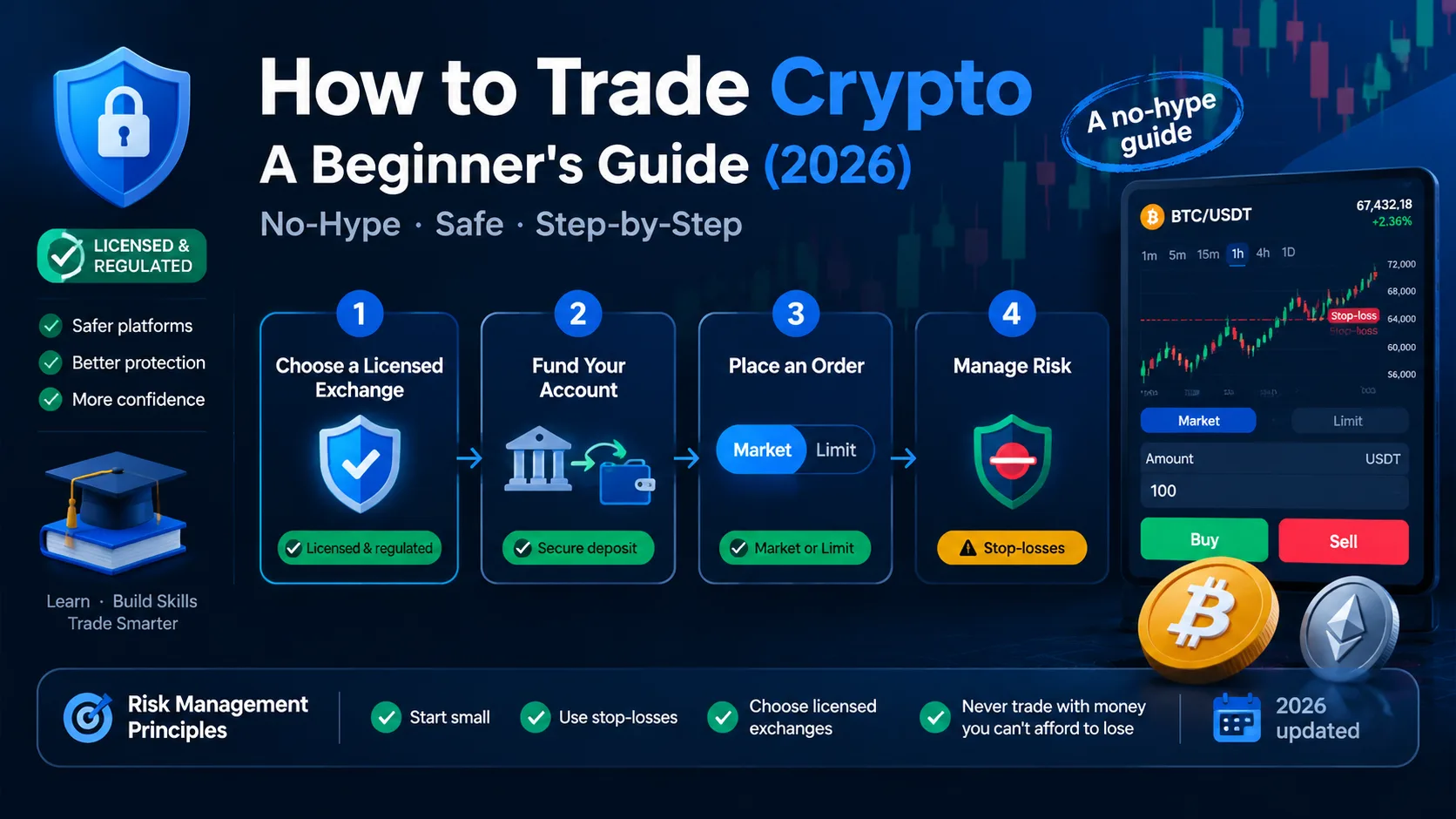
How to Trade Crypto: A Beginner's Guide (2026)
How to trade crypto safely: choose a licensed exchange, fund your account, place a market or limit order, and manage risk with stop-losses. A no-hype guide.
Crypto Slang & Terms: The Jargon Decoded
Crypto's slang — FOMO, HODL, diamond hands, gas, and more — decoded in plain English. What each term means, and the one mistake beginners make with it.

How to Use Binance: A Beginner's Guide (2026)
Learn how to use Binance step by step: create an account, verify your identity, deposit funds, make your first trade, and withdraw — safely.