
Crypto vs Stocks: Which Should You Choose in 2026?
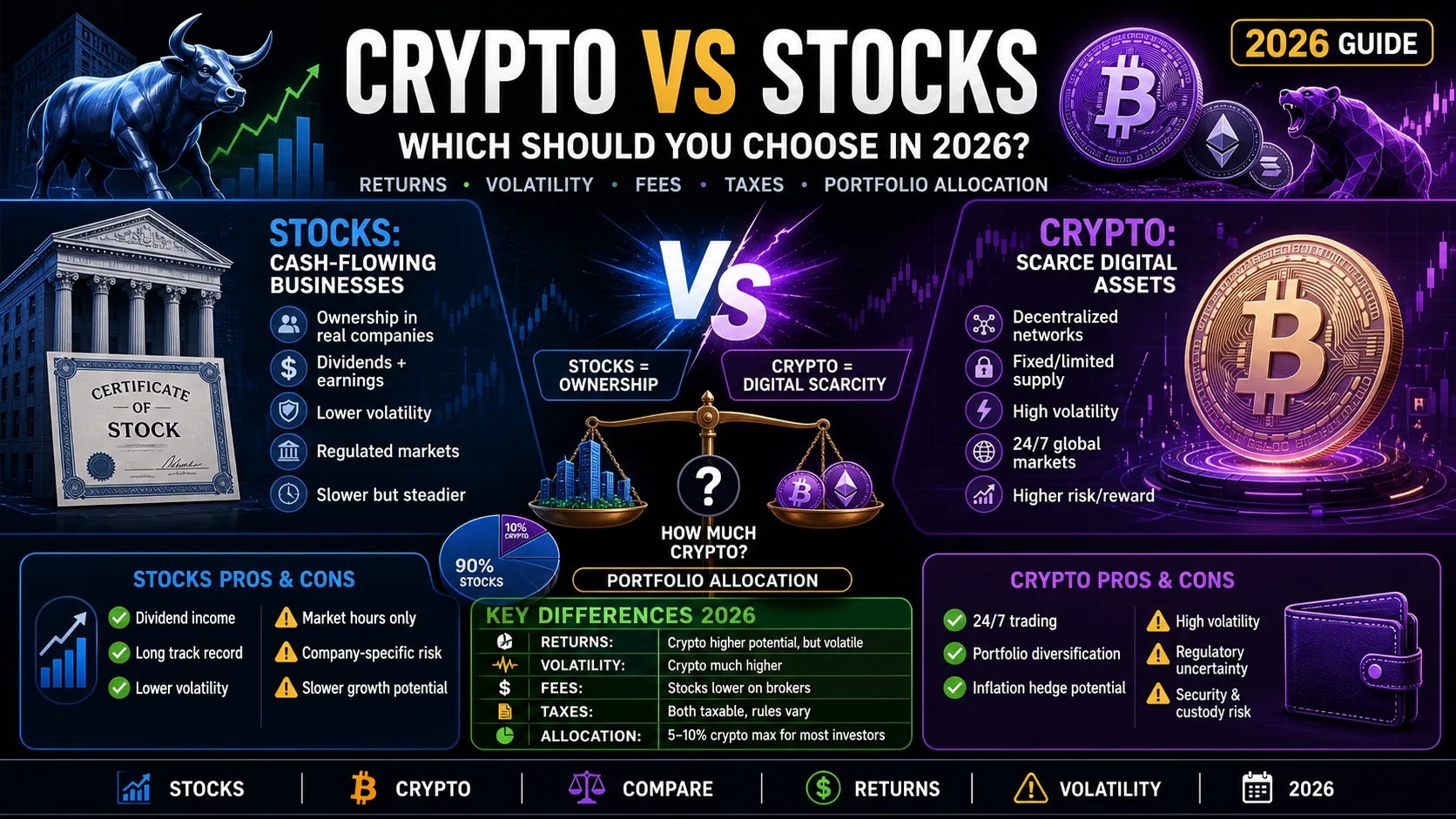
Stocks are cash-flowing businesses; crypto is a scarce digital asset. Compare returns, volatility, fees, taxes, and how much crypto belongs in a portfolio.
 Lucas Almeida 5 min read
Key takeaways
- Stocks are ownership in businesses that earn revenue and often pay dividends; crypto tokens are scarce digital assets with no cash flow, so the two are priced by completely different forces.
- Over the 12 months to November 11, 2026, the S&P 500 returned +9.8% with 13.7% annualized volatility, while Bitcoin returned -28.4% with 43.9% volatility and a 53% drawdown from its October 2025 peak.
- For most beginners, diversified stock index funds should be the core of the portfolio and crypto a small satellite — BlackRock's research suggests 1–2% for a measured Bitcoin allocation.
- At roughly 44% annualized volatility, a 5% crypto position can still move a $10,000 portfolio by several percent in a bad month; position size, not price prediction, is what you control.
- Crypto only makes sense with money you can leave untouched for years, after an emergency fund, and with Bitcoin or Ethereum rather than speculative altcoins.
For most beginners the answer is not “crypto or stocks” — it is stocks first, crypto second, and only in a size you can lose. A diversified stock portfolio owns businesses that earn money and pay dividends; Bitcoin owns scarcity, trades 24/7, and just spent a year proving how violent that can be, falling 53% from its October 2025 peak before recovering part of the loss. Build the stock core first, then add crypto as a small satellite — usually 1–5% of what you invest.
What is the difference between crypto and stocks?
A stock is a share of a business; a crypto token is a scarce digital asset, and that difference explains almost everything else. When you buy a stock, you own a fraction of a company’s future earnings, its assets, and sometimes a vote. When you buy Bitcoin, you own a fixed amount of a digital asset whose price depends on supply, demand, and what the next buyer will pay.
| Stocks | Crypto | |
|---|---|---|
| What you own | Equity in a company | A digital asset or token |
| Cash flow | Earnings, often dividends | None from the asset itself |
| How it is valued | Earnings, cash flow, growth, multiples | Supply, demand, adoption, narrative |
| Trading hours | Exchange hours (9:30–16:00 ET in the US) | 24/7, every day |
| Settlement | T+1 in the US since May 2024 | Seconds to minutes on-chain |
| Custody | Brokerage account | Exchange account or your own wallet |
| Income | Dividends and buybacks | Staking yield on some assets |
| Regulation | Long-established securities law | Still developing in most countries |
That table hides one important nuance: not every token is the same. Ethereum is used to pay for computation and can be staked, and stablecoins are designed to track a currency. But none of them gives you a legal claim on a company’s profits. A share of Microsoft and a bitcoin are not two versions of the same investment; they are different asset classes that happen to trade on screens.
Which has performed better, crypto or stocks?
Over the past decade stocks delivered strong, steady gains; over the past two years they beat Bitcoin outright — a reminder that crypto’s famous returns depend heavily on the starting date. The numbers below are computed from daily closes through November 11, 2026.
| Metric | S&P 500 | Bitcoin |
|---|---|---|
| 12-month return | +9.8% | -28.4% |
| 2-year return | +25.3% | -16.8% |
| 3-year return | +70.3% | +97.7% |
| 2026 year to date | +9.9% | -15.8% |
| Annualized volatility, past 12 months | 13.7% | 43.9% |
| Worst drawdown, same 3-year window | -18.9% (2025) | -53.0% (Oct 2025–Jun 2026) |
| Income paid | Dividends, roughly 1–2% a year | None |
Bitcoin’s three-year return is higher — +97.7% against +70.3% for the S&P 500 — but it came with a 53% drawdown along the way. That is the trade: more upside, a much wilder ride.
The S&P 500 figures are price-only, so they understate total return by the dividend yield. Over the very long run — 1926 through 2025 — the S&P 500 has returned about 10% a year including dividends, or roughly 7% after inflation, according to long-run market studies such as Motley Fool’s historical return data.
Bitcoin’s record is stranger. It has been one of the best-performing assets of the past decade and one of the worst in several individual years. The 12 months to November 2026 were firmly in the second category: Bitcoin hit a daily closing peak near $124,700 on October 6, 2025, fell to $58,625 on June 30, 2026 — a 53% decline — and traded around $73,700 on November 11, 2026. That is the full picture, and any comparison that shows only the upside is marketing.
There is also a valuation caveat on the stock side. The past decade’s 13.3% annualized price return is well above the long-run average, helped by rising profit margins and a large expansion in valuation multiples. Starting valuations matter: buying when prices are already high tends to produce lower forward returns, which is why long-run planning should use something closer to 6–7% real, not 13%.
How risky is crypto compared with stocks?
Bitcoin is roughly three times as volatile as the S&P 500 right now, and its drawdowns are in a different league. At 43.9% annualized volatility, Bitcoin’s daily swings are large enough that a 10% move in a week is unremarkable; the S&P 500’s 13.7% volatility produces nothing like that.
That 43.9% is actually low by Bitcoin’s standards. Its 10-year average is around 64%, and Grayscale Research noted in October 2026 that Bitcoin’s realized volatility had fallen to about 43% — below many individual S&P 500 stocks — as liquidity deepened and spot ETFs brought in institutional money (Bitcoin Magazine). Lower average volatility is not the same as lower tail risk: Bitcoin still fell more than 50% inside eight months.
The practical way to see the risk is to convert it into dollars. Here is what a 53% Bitcoin drawdown does to a $10,000 portfolio at different position sizes:
| Bitcoin weight | Amount in Bitcoin | Loss if Bitcoin falls 53% | Portfolio loss |
|---|---|---|---|
| 0% | $0 | $0 | 0% |
| 1% | $100 | -$53 | -0.5% |
| 5% | $500 | -$265 | -2.7% |
| 10% | $1,000 | -$530 | -5.3% |
| 20% | $2,000 | -$1,060 | -10.6% |
| 50% | $5,000 | -$2,650 | -26.5% |
That table is the entire argument for small position sizes. You cannot control whether Bitcoin falls 53% again; you can control whether that event costs you 2.7% or 26.5% of your portfolio.
What do fees and costs look like?
Stock index investing is usually cheaper per year, while crypto is cheaper per trade — but crypto’s 24/7 access makes it easy to trade far more often, which flips the math. A typical low-cost S&P 500 ETF charges 0.03–0.20% a year and most major brokers charge $0 commission. Binance’s standard spot fee is 0.1% per trade, reduced by 25% when you pay in BNB.
| Cost | Stock index ETF | Crypto on Binance |
|---|---|---|
| Trading commission | $0 at major brokers | 0.1% standard spot fee |
| Ongoing fee | 0.03–0.20% expense ratio | No account fee |
| Spread | Usually pennies | Varies by pair and liquidity |
| Withdrawal cost | None for cash | Network fee, varies by chain |
| Tax-advantaged account | Often available | Usually not available |
Run the numbers on a $5,000 purchase:
- Stock ETF: $0 commission, plus about $2.50 a year on a 0.05% expense ratio.
- Bitcoin on Binance: 0.1% = $5.00. Paying the fee in BNB cuts 25%, to $3.75. Registering with invite code BN2688 adds a 20% commission rebate, taking the effective cost to about $3.00, or 0.06%.
💡 Don't have a Binance account yet? Sign up now — 20% fee rebate on spot and futures — enter the referral code BN2688.
That looks cheap, and for a buy-and-hold investor it is. The trap is frequency: 20 round trips a year on $5,000 at 0.06% costs about $60, more than a decade of ETF fees. Crypto’s low per-trade cost rewards patience and punishes restlessness.
How are crypto and stocks taxed differently?
Both are usually taxed on gains, but stocks can often sit inside tax-advantaged retirement accounts while direct crypto usually cannot — and every crypto swap can be a taxable event. In the United States, for example, crypto is treated as property: selling it, swapping Bitcoin for Ethereum, or paying for a coffee with it can all realize a capital gain or loss. Stocks held in a 401(k) or IRA grow tax-deferred until withdrawal.
The details vary by country, but three rules apply almost everywhere:
- Selling at a profit is taxable. That includes crypto-to-crypto swaps, not just cashing out to a bank.
- Income is income. Staking rewards and some airdrops may be taxed as ordinary income when received, then again on later gains.
- Record every purchase. Your cost basis and holding period decide the tax, and exchanges do not always keep usable records for your jurisdiction.
Stocks have an extra advantage that is easy to miss: many countries offer tax-sheltered accounts for listed securities, and those wrappers generally do not accept direct crypto. Our crypto taxes guide covers the reporting basics; for your own situation, use a local tax professional.
What are the practical differences for a beginner?
Stocks are built for long-term ownership through an intermediary; crypto is built for direct ownership with no intermediary — which is both the point and the burden. The differences show up in daily use:
- Hours: stocks trade during exchange hours; crypto never closes. That sounds convenient until you realize it also means you can lose money at 3 a.m. on a Sunday.
- Custody: a brokerage holds your shares and is usually covered by investor-protection schemes if the broker fails (in the US, SIPC covers up to $500,000). An exchange holding your crypto is not covered by SIPC, and if you self-custody, a lost seed phrase means the money is gone.
- Minimums: fractional shares make stock investing possible with $1; crypto also trades in fractions, though Binance’s spot minimum order is typically $5 per pair, as we measured in our minimum deposit guide.
- Income and rights: stocks can pay dividends and give voting rights; Bitcoin pays nothing and gives you no claim on anything except the coin itself.
- Settlement: US stock trades settle next business day; crypto transfers settle in seconds or minutes, but exchanges may hold withdrawals for review.
None of these is automatically better. They are different operating systems for different jobs.
How much crypto should you hold?
For most people the answer is 1–5%, and the research-backed starting point is lower than that: BlackRock’s investment institute suggests 1–2% of a multi-asset portfolio. The reason is risk contribution, not return. Because Bitcoin is so volatile, a small slice contributes a surprisingly large share of total portfolio risk.
| Bitcoin allocation | Share of total portfolio risk it contributes |
|---|---|
| 1% | ~2% |
| 2% | ~5% |
| 4% | ~14% |
That is from BlackRock’s paper Sizing Bitcoin in Portfolios. The takeaway: 2% of Bitcoin is roughly as risky as holding one large tech stock, and doubling to 4% more than doubles the risk it adds.
A simple framework by investor profile:
| Profile | Stock core | Crypto satellite | What it assumes |
|---|---|---|---|
| Debt or no emergency fund | 0% crypto | 0% | Build 3–6 months of cash first |
| Conservative / near retirement | 95–100% | 0–1% | Capital preservation first |
| Balanced beginner | 90–97% | 1–3% | Long horizon, can tolerate a dip |
| Growth-tolerant | 85–95% | 3–5% | Accepts a 50% crypto drawdown |
| Aggressive, long horizon | 80–90% | 5–10% maximum | Can lose the entire crypto slice |
The size is right when a 50% crypto drop would annoy you but not change your plans. If it would force you to sell, delay a house purchase, or lose sleep, it is too big — regardless of how bullish you feel.
Which should you choose?
Choose stocks as your core and crypto as an optional satellite; the only people who should choose crypto alone are those who can afford to lose the entire amount. The decision is rule-based:
- If you have credit-card debt or less than three months of expenses saved: choose neither. Pay the debt and build cash first.
- If you need the money within three years: choose stocks and cash-like instruments, not crypto. Crypto’s drawdowns can take years to recover.
- If you want income and ownership: choose stocks. Dividends and earnings are the point.
- If you want asymmetric upside and can stomach a 50% loss: add a small crypto position, sized by the table above.
- If you have no interest in managing keys: a spot Bitcoin ETF inside a brokerage account is the lower-effort route.
- If you want 24/7 access and true self-custody: buy directly on an exchange, then move long-term holdings to a hardware wallet.
The honest summary: stocks are the default, crypto is the exception. Anyone who tells you crypto should replace a diversified portfolio is asking you to take a risk they are not taking for you.
How do you start with each?
Starting with stocks takes one brokerage account; starting with crypto takes an exchange account, identity verification, and a storage plan. Both can be automated in an afternoon.
For stocks:
- Open a brokerage account with a regulated, low-cost provider.
- Buy a broad, low-cost index fund — an S&P 500 or global equity ETF — rather than individual stocks.
- Set up an automatic monthly contribution so the decision is made once, not every month.
For crypto:
- Register on a major exchange through an invite link — on Binance, confirm the code BN2688 appears before creating the account, because a referral cannot reliably be added later.
- Complete identity verification (KYC) with an original ID or passport.
- Deposit a small amount and buy Bitcoin or Ethereum, not an altcoin you heard about yesterday.
- If you plan to buy regularly, use Convert Recurring, Binance’s automated DCA feature.
- Move long-term holdings to a hardware wallet and learn how seed phrases work before you need them.
Our step-by-step crypto buying guide covers the first purchase, and the dollar-cost averaging guide explains why a schedule beats trying to time the entry.
What mistakes should you avoid?
The biggest mistake is comparing Bitcoin’s best years with the stock market’s average years — then sizing the position as if the best years will repeat immediately. Other common errors:
- Recency bias. Bitcoin’s 2013–2021 run was extraordinary; its 2025–2026 stretch was not. Both are part of the same asset.
- Comparing a single coin to an index. Bitcoin is one asset; the S&P 500 is 500 companies. A fair comparison is a single stock, not the index.
- Oversizing after a rally. The time people feel most confident is usually the time the position is most expensive.
- Using leverage. Borrowing to buy crypto turns a 20% dip into a wipeout.
- Buying altcoins as lottery tickets. One 2026 DWF Labs study found that more than 80% of 2025 token launches were trading below their issue price; most tokens are not “the next Bitcoin.”
- Ignoring taxes and records. Every swap creates a taxable event and a new cost basis in many countries.
- Trading because the market is open. Crypto’s 24/7 schedule is a feature for owners and a trap for gamblers.
The bottom line
Stocks and crypto are not rivals fighting for one slot in your portfolio. Stocks are the income-producing core; crypto is a small, volatile satellite that may add upside and will definitely add risk. Build the core first, size the satellite so a 50% drop is survivable, use Bitcoin and Ethereum rather than lottery tickets, and keep records from the first purchase.
If you are ready to add the crypto slice, start with our Bitcoin explainer and Ethereum explainer, then open an account through the Binance registration guide and set up a recurring buy. And if you have not built the stock core yet, do that first — the most reliable way to make money in markets is still to own productive assets for a long time.
Data note: Bitcoin figures were computed from Binance BTCUSDT daily closes on November 11, 2026 (365-day and 1,000-day windows). S&P 500 figures were computed from the FRED SP500 daily series through November 10, 2026 and exclude dividends. Past performance does not predict future returns. This article is educational and is not investment or tax advice.
Don't have a Binance account yet?Sign up nowenter the referral codeBN2688
Frequently asked questions
Is crypto a better investment than stocks?
How much of my portfolio should be in crypto?
Can I invest in both crypto and stocks?
Do you pay tax on crypto the same way as stocks?
Is Bitcoin safer than individual stocks?
Should beginners buy a Bitcoin ETF or buy crypto directly?
Editor-in-Chief & Lead Researcher
Editor of MyCryptoStart. Independent researcher of cryptocurrency exchanges, focused on fees, security, KYC, and onboarding — publishes step-by-step guides in plain English for beginners.
View author page →Some links on this page are affiliate links: we may earn a commission at no extra cost to you. This content is educational and is not financial, investment, or legal advice. Affiliate disclosure · Disclaimer.
Continue reading
How to Stake Crypto and Earn Yield (2026)
Crypto staking locks your coins to secure a proof-of-stake network and earn rewards — typically 2–8% a year. Learn how it works, the real risks, and how to start.
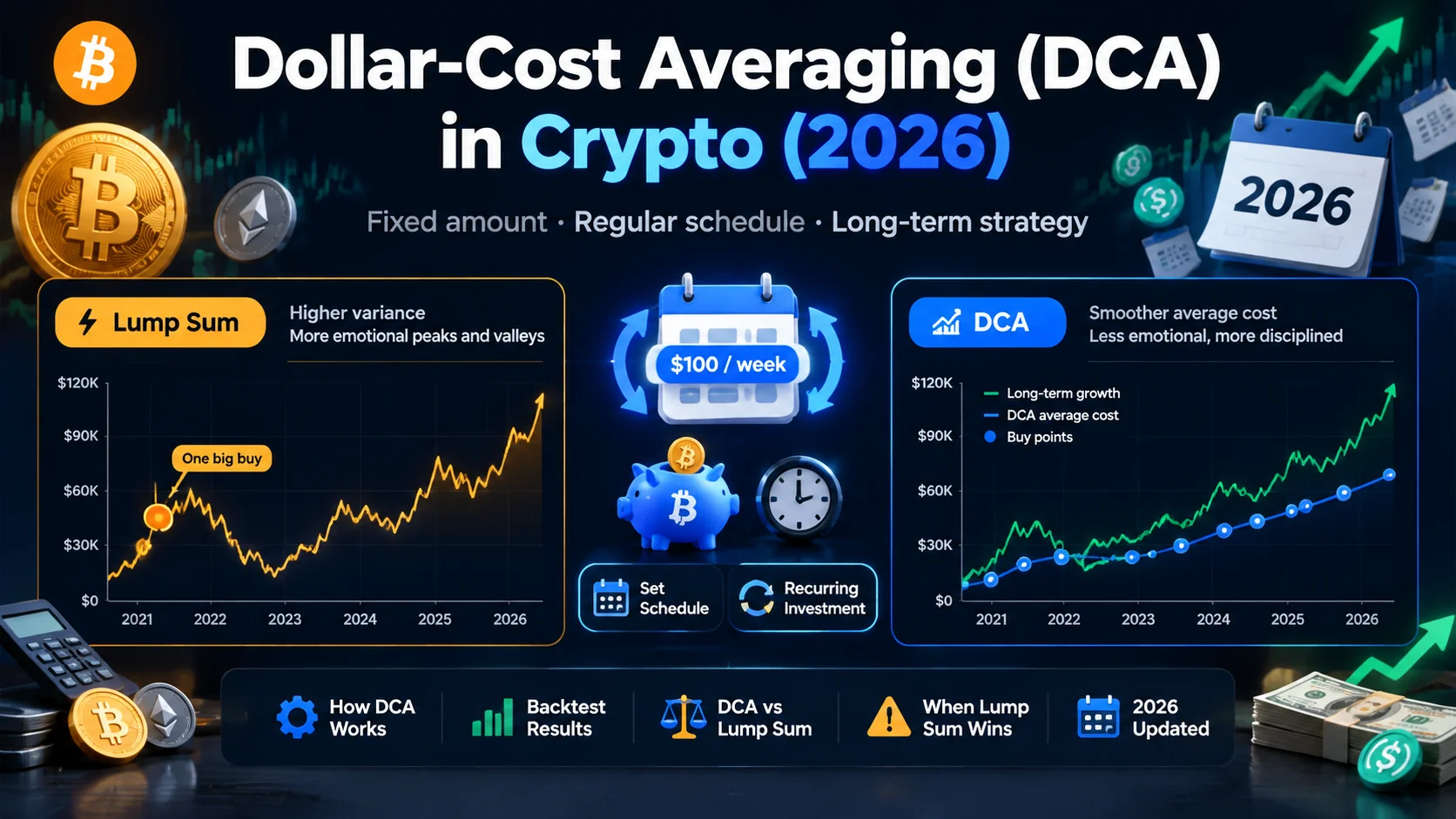
Dollar-Cost Averaging (DCA) in Crypto (2026)
Dollar-cost averaging buys a fixed dollar amount of crypto on a set schedule. Learn how DCA works, what backtests show, and when lump sum wins.

Crypto Taxes Explained: Rates & Rules (2026)
Selling, swapping, or spending crypto is a taxable event; buying and holding is not. How US crypto taxes work in 2026: rates, rules, and how to file.