
What Is a Crypto Airdrop? How It Works (2026)
A crypto airdrop sends free tokens to eligible wallets, usually for past activity. How snapshots, claims, taxes and airdrop scams actually work in 2026.
 Lucas Almeida 5 min read
Key takeaways
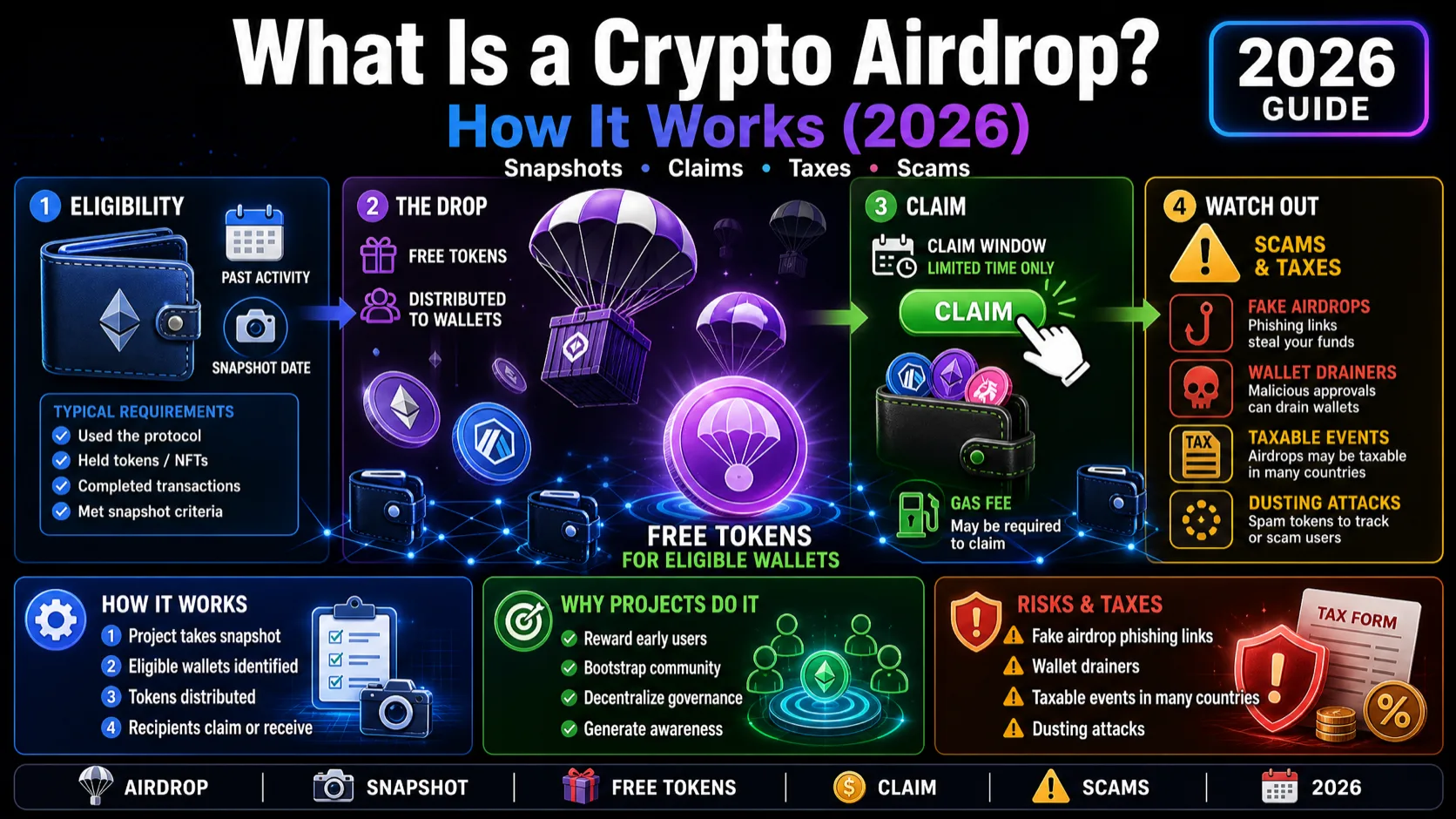
- A crypto airdrop distributes tokens to wallet addresses, usually for free, to reward early users or bootstrap a new network. Most modern airdrops are retroactive: the project snapshots wallets first and announces the rules later.
- The three moving parts are the snapshot, the eligibility formula and the claim window. Miss the snapshot or the claim deadline and you get nothing, no matter how much you used the protocol.
- Airdrops are not free money. Claiming costs gas, farming costs time and capital, and the tokens are taxable income in many countries at their value on the day you receive them.
- Scammers copy every major airdrop. Legitimate projects never ask for your seed phrase, never ask you to send crypto to receive crypto, and never need an unlimited token approval to give you tokens.
- Binance's HODLer Airdrops work differently: you hold BNB in Simple Earn or On-Chain Yields, Binance takes random hourly snapshots and sends tokens to your Spot wallet after the announcement — no claim site involved.
A crypto airdrop is a distribution of free tokens to wallet addresses, usually to reward early users or bootstrap a new network. The tokens are real and sometimes worth thousands of dollars — but the popular image of free money is misleading. Many of the biggest airdrops require you to have used a protocol before a snapshot date you did not know about, and every major drop attracts fake claim sites designed to drain wallets.
This guide explains how airdrops actually work, how to qualify without wasting money, how the tax rules treat free tokens, and how Binance’s own airdrop programs differ from the claim-site model. It is written for someone who has never farmed an airdrop and wants to avoid the two ways beginners lose: paying to claim something worthless, and signing a transaction that empties their wallet.
What Is a Crypto Airdrop?
A crypto airdrop is a project’s distribution of tokens to a group of wallet addresses, often for free and often based on past activity. The purpose is usually marketing and decentralisation: the project gets tokens into the hands of users who might use the network, and early users get a reward for taking the risk before the token existed.
The word covers several different mechanisms:
- Automatic airdrops send tokens directly to eligible wallets. You do nothing and the tokens appear.
- Claim airdrops require you to visit an official page, connect a wallet and sign a transaction, usually paying a network fee.
- Exchange airdrops distribute tokens to users who hold a particular asset on an exchange, such as Binance’s HODLer Airdrops.
- Points and retroactive programs ask users to earn points through activity, then convert those points into tokens at a later date.
The common thread is that the project decides who qualifies. You cannot buy your way into most airdrops, and you cannot rely on a rumour that one is coming.
What Are the Main Types of Airdrops?
The four practical categories are standard, surprise, exchange and targeted airdrops, and each has a different risk profile. Knowing which one you are dealing with tells you whether you need to claim, what it will cost, and how likely it is to be a scam.
| Type | How it works | What you do |
|---|---|---|
| Standard | Announced in advance, with published eligibility rules | Complete the tasks before the deadline |
| Surprise / retroactive | Snapshot happens before the announcement | Nothing — you either used the protocol or you did not |
| Exchange | Exchange distributes tokens to holders of a qualifying asset | Hold the asset in the right product during the snapshot |
| Targeted | Tokens go to a specific group, such as NFT holders or testnet users | Meet the narrow criterion, then claim |
Retroactive drops are the most common model among DeFi protocols because they reward real usage rather than mercenary farming. Uniswap’s September 2020 launch is the template: 400 UNI to each of 251,534 historical addresses that had called the v1 or v2 contracts before the 1 September 2020 snapshot, with no claim deadline. That design — snapshot first, announce second — is now the norm.
How Does an Airdrop Work?
A retroactive airdrop has three moving parts: a snapshot, an eligibility formula and a claim window. Each one can disqualify you independently.
- Snapshot. The project records the state of wallets at a specific block or date. Sometimes the date is announced in advance; often it is revealed only after the fact to prevent gaming.
- Eligibility formula. The project scores wallets on activity: transaction volume, number of months active, liquidity provided, assets held, or points earned. It also filters out sybil wallets — many wallets controlled by one person — using clustering and behavioural analysis.
- Claim window. Eligible wallets visit the official claim page and sign a transaction. The window is often 30–90 days; unclaimed tokens usually return to the project or treasury after it closes.
Distribution can be automatic or claim-based. Automatic drops are simpler and safer for users because there is no site to visit. Claim-based drops are cheaper for the project and create a marketing moment, but they also create the perfect opening for phishing sites.
How Do You Qualify for an Airdrop?
The reliable way to qualify is to use a protocol genuinely before anyone announces an airdrop — which means you cannot know in advance whether it will pay. That is uncomfortable, and it is the honest answer.
What tends to work:
- Use new protocols with real money, not test transactions. A wallet that has made ten meaningful swaps over several months scores better than one that has made 200 dust transactions in a week.
- Provide liquidity or hold the native token where the project’s rules reward it. Check whether the program counts only certain pools or assets.
- Complete testnet tasks for projects that run a public testnet. This is free but time-consuming, and many testnets never produce a token.
- Hold qualifying assets on an exchange for exchange-run programs. Binance’s HODLer Airdrops, for example, count BNB in Simple Earn and On-Chain Yields.
- Keep one identity, not fifty wallets. Modern sybil filters cluster wallets by funding source, timing and behaviour. Farming with many wallets often gets the whole cluster excluded.
What does not work: buying a token because an influencer says a snapshot is imminent, paying for a “guaranteed allocation”, or interacting with a contract you do not understand. Those are the entry points for scams.
Are Airdrops Really Free?
The tokens may be free, but claiming and farming are not. The costs are easy to miss because they are paid in gas, time and taxes rather than in a checkout page.
- Gas fees. A claim on Ethereum can cost anywhere from a few dollars to more than $50 during congestion. If your allocation is worth $40, a $15 claim fee eats a large share of it.
- Farming costs. Every interaction with a protocol costs gas. A points program that requires daily transactions can cost more in fees than the eventual allocation.
- Opportunity cost. Capital locked in a farm cannot be used elsewhere, and the token you receive may fall sharply before you can sell it.
- Tax. In the US, the value of the airdrop is generally ordinary income when you receive it. A $10,000 allocation can create a tax bill even if the token later collapses — see the tax section below.
- Scam risk. The most expensive airdrop is the one that drains a wallet you use for everything else.
A simple test before you claim: estimate the allocation’s value, subtract the gas fee and your time, then decide whether the remaining amount is worth the risk of connecting a wallet. If the answer is no, skip it. Missing a small airdrop costs you nothing; signing a malicious approval can cost everything.
How Do You Avoid Airdrop Scams?
Assume every airdrop has a fake version, and verify the claim page from the project’s own channels rather than from a link you were sent. Airdrop phishing is an industrial business: Scam Sniffer recorded $83.85 million stolen from 106,106 wallets by drainer-style phishing in 2025, and the FBI’s IC3 reported $11.366 billion in total crypto-related losses for the same year.
Six rules cover most of the risk:
- Never share your seed phrase or private key. No legitimate airdrop needs it. Anyone who asks has already stolen from you.
- Never send crypto to receive crypto. “Send 1 ETH to verify your wallet” is always a scam.
- Use the official domain, typed yourself. Bookmark the project’s site and check the URL character by character; lookalike domains are the standard trick.
- Read the signature request. A claim should ask you to sign a message or approve a specific token amount. An unlimited approval or a “Permit” for everything is a red flag.
- Use a dedicated wallet. Keep a small, separate wallet for airdrops and new protocols. Never connect the wallet that holds your savings.
- Revoke old approvals. After claiming, review and revoke permissions you no longer need with a tool such as revoke.cash.
If a project DMs you first, it is a scam. Real teams announce through their official blog and verified accounts, and they do not need to slide into your inbox to give away tokens.
Are Airdrops Taxable?
In the US, an airdropped token is generally ordinary income at its fair market value when you can control and dispose of it. The rule comes from IRS Revenue Ruling 2019-24, which treats crypto received from an airdrop or hard fork as income once you have dominion and control — not when you first see it in a wallet you cannot use.
The mechanics matter:
- Income at receipt. If you receive tokens worth $2,000 on the day you can sell them, you report $2,000 of ordinary income. That is true even if you never sell.
- Basis for the later sale. Your cost basis becomes that $2,000. If you later sell for $3,000, you have a $1,000 capital gain; if you sell for $500, you have a $1,500 capital loss.
- Holding period. The clock starts the day after receipt, so the line between short-term and long-term treatment depends on the date you gained control.
- The tax trap. Claim a $50,000 allocation, watch it fall 90%, and you may still owe income tax on the $50,000. Capital losses can offset gains and up to $3,000 of ordinary income per year, but the rest carries forward — it does not erase the original income bill.
Outside the US, the rules differ. Mexico’s SAT treats crypto as a virtual asset and taxes gains as income at progressive rates up to 35%; Brazil exempts monthly crypto sales up to R$35,000 and taxes gains above that at 15–22.5%; Taiwan has no clear standalone crypto-tax framework, and the Ministry of Finance has said profits may fall under property-transaction income. Wherever you live, record the date, the token amount and the price on the day you could first sell. See the crypto taxes guide for the full treatment.
How Do Binance Airdrops Work?
Binance runs two different programs: HODLer Airdrops, which reward users who hold BNB in earn products, and Launchpool, which rewards users who stake tokens for a farming period. Neither requires you to visit a claim site, which removes the phishing risk that dominates external airdrops.
HODLer Airdrops (official FAQ) work like this:
- Eligible balance. You need BNB subscribed to Simple Earn (Flexible or Locked) and/or On-Chain Yields during the snapshot window.
- Random snapshots. Binance takes multiple random hourly snapshots after the announcement, so moving BNB in at the last minute does not guarantee inclusion.
- Minimum and exclusions. You need more than 0.01 BNB at snapshot time; BNB pledged as collateral for Binance Loans is not counted.
- Automatic distribution. Rewards arrive in your Spot wallet retroactively. You do not claim them.
- Eligibility. You must complete KYC and be in an eligible jurisdiction. The announcement names the snapshot dates and the reward pool.
Launchpool is the other model: you subscribe BNB, FDUSD or another supported asset to a pool for a farming period, and the pool distributes the new token over several days. Your principal is returned at the end; the reward is the new token. See the Binance Launchpool guide for the step-by-step.
💡 Don't have a Binance account yet? Sign up now — 20% fee rebate on spot and futures — enter the referral code BN2688.
The practical difference: HODLer Airdrops are passive and require no lock-up beyond keeping BNB in an earn product, while Launchpool requires you to move assets into a specific pool for a set period. Both are exchange programs, not a guarantee that the token will be worth anything after listing.
The Bottom Line
Airdrops are a token-distribution mechanism, not an income strategy. The projects that pay best are usually the ones that rewarded genuine early usage, and the people who capture them are the ones who were already using the protocol — not the ones chasing a rumour after the snapshot.
If you want exposure, use real protocols you understand, keep a separate wallet, treat every claim page as hostile until verified, and record the date and value of anything you receive for tax purposes. If you would rather avoid the claim-site risk entirely, exchange programs such as Binance HODLer Airdrops and Launchpool put the distribution inside an account you already trust — with their own rules and limits.
Tax rules, exchange mechanics and scam figures were checked on 4 November 2026 against IRS Revenue Ruling 2019-24, Binance’s HODLer Airdrops FAQ, Scam Sniffer’s 2025 wallet-drainer report and the FBI IC3 2025 annual report. Airdrop terms and tax rules change; confirm the current rules for your country and the specific program before acting.
Don't have a Binance account yet?Sign up nowenter the referral codeBN2688
Frequently asked questions
What is an airdrop in crypto?
Are crypto airdrops really free?
How do I qualify for an airdrop?
How can I tell if an airdrop is legitimate?
Are airdrops taxable?
Do I need to hold BNB to get Binance airdrops?
Editor-in-Chief & Lead Researcher
Editor of MyCryptoStart. Independent researcher of cryptocurrency exchanges, focused on fees, security, KYC, and onboarding — publishes step-by-step guides in plain English for beginners.
View author page →Some links on this page are affiliate links: we may earn a commission at no extra cost to you. This content is educational and is not financial, investment, or legal advice. Affiliate disclosure · Disclaimer.
Continue reading

Crypto Taxes Explained: Rates & Rules (2026)
Selling, swapping, or spending crypto is a taxable event; buying and holding is not. How US crypto taxes work in 2026: rates, rules, and how to file.
How to Stake Crypto and Earn Yield (2026)
Crypto staking locks your coins to secure a proof-of-stake network and earn rewards — typically 2–8% a year. Learn how it works, the real risks, and how to start.

Dollar-Cost Averaging (DCA) in Crypto (2026)
Dollar-cost averaging buys a fixed dollar amount of crypto on a set schedule. Learn how DCA works, what backtests show, and when lump sum wins.