
Binance Margin Trading for Beginners: Costs (2026)
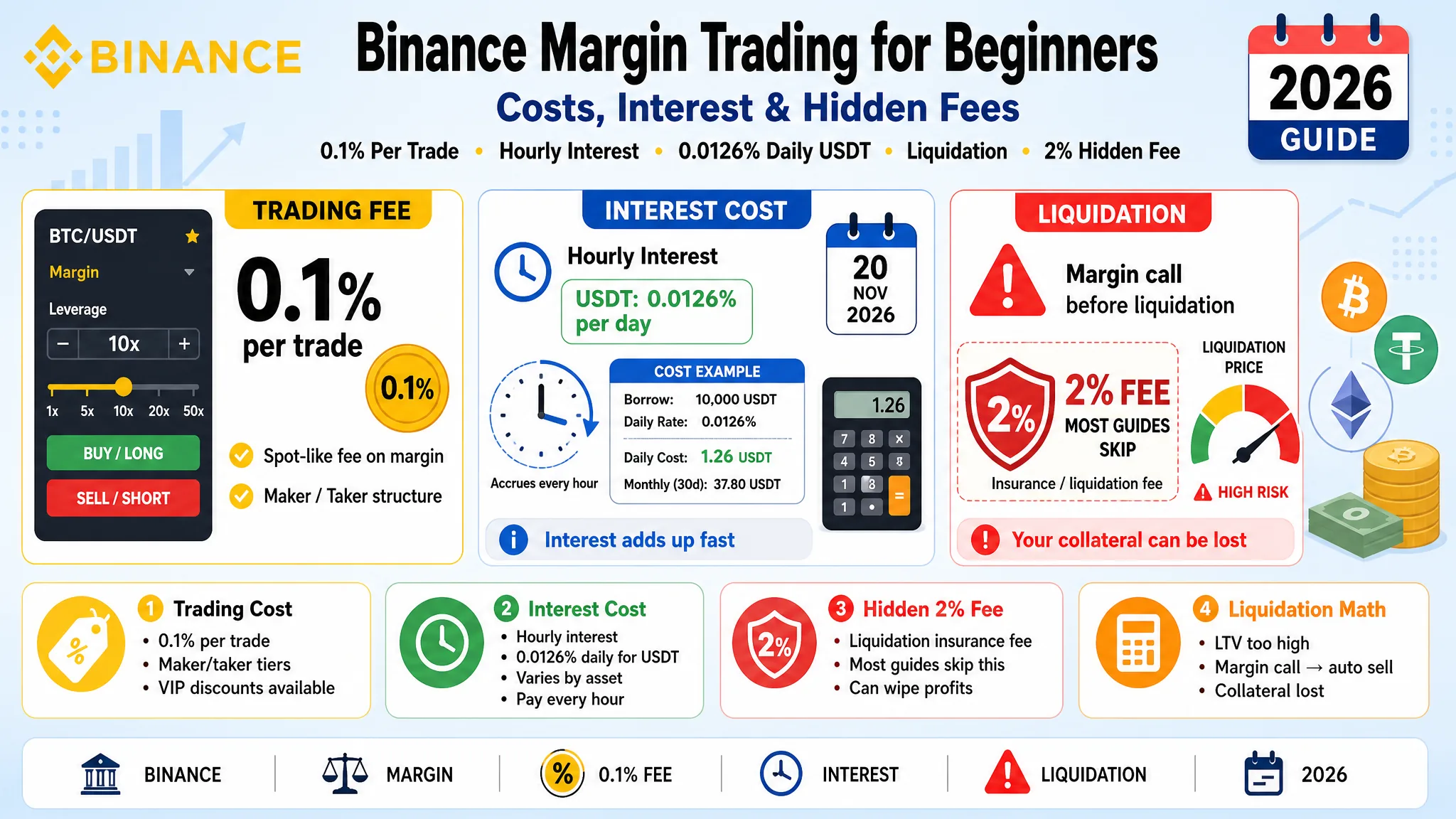
Binance margin charges 0.1% per trade plus hourly interest; USDT cost 0.0126% a day on 20 Nov 2026. Liquidation math and the 2% fee most guides skip.
 Lucas Almeida 5 min read
Key takeaways
- Binance margin trading means borrowing funds against your own collateral to buy more than your balance allows. Cross Margin Classic offers 3x or 5x; Isolated Margin goes up to 10x, with the maximum falling as the borrowed amount grows.
- On 20 November 2026 Binance listed USDT borrowing at 0.0126% per day (4.59% annualized) and BTC at 0.0013% per day. Rates reset every hour, and the median listed asset cost 0.08% per day — six times USDT.
- Trading fees are the spot schedule: 0.1% at VIP 0, or 0.075% with BNB. On a 3x position backed by 1,000 USDT, a taker round trip costs 6 USDT, while interest costs about 0.25 USDT a day.
- Liquidation triggers when the margin level falls to 1.1. For a 1,000 USDT collateral that means roughly a 26.7% drop at 3x, 12% at 5x and 5.5% at 10x, before interest and fees.
- Binance also charges a 2% liquidation fee on the value of the liquidated assets. Most beginner guides mention the liquidation but not the fee, which is deducted from whatever collateral is left.
Binance margin trading lets you borrow funds against your own crypto and trade a position larger than your balance. It is not free leverage: you pay the spot trading fee on the full position, interest on everything you borrow, and a 2% liquidation fee if the position is forcibly closed. On 20 November 2026, borrowing USDT cost 0.0126% per day, while a 3x position backed by 1,000 USDT was liquidated after roughly a 26.7% price fall.
This guide covers what margin trading actually is, what it costs at current rates, where liquidation really sits, and how to open a first position without treating 10x as a target.
What is Binance margin trading?
Binance margin trading is borrowing funds from the exchange against collateral you deposit, then using both to trade spot pairs. The borrowed asset becomes a debt on your margin account, and you repay it with interest. Unlike a futures contract, you are buying the actual coin on the spot market.
Binance offers three margin modes. Two matter for beginners:
| Mode | Maximum leverage | How collateral works | Who it suits |
|---|---|---|---|
| Cross Margin Classic | 3x or 5x | Every asset in the margin wallet backs every position | Users who understand shared risk |
| Isolated Margin | Up to 10x, tiered by pair and size | A fixed amount of collateral per trading pair | A first leveraged trade |
| Portfolio Margin | Eligibility-based | Risk calculated across the whole portfolio | Experienced traders |
Binance phased out Cross Margin Pro on 5 February 2026, so new accounts trade with Cross Margin Classic or Portfolio Margin.
The important difference from spot is not the leverage number. It is that the exchange now has a claim on your collateral. A spot position can fall 50% and you still own the coin. A margin position can be closed by Binance at a price you did not choose, and you lose the collateral behind it.
How much does borrowing cost?
Interest is charged on the borrowed amount, not on your collateral, and the rate changes every hour based on demand. Binance replaced fixed margin rates with a dynamic system: each asset has its own hourly rate, and the rate you see when you borrow can be different an hour later.
I pulled Binance’s public margin interest endpoint on 20 November 2026. It listed 502 borrowable assets:
| Asset | Interest per day | Annualized at that snapshot |
|---|---|---|
| USDT | 0.0126% | 4.59% |
| USDC | 0.0124% | 4.51% |
| ETH | 0.0064% | 2.34% |
| BTC | 0.0013% | 0.48% |
| Median listed asset | 0.0815% | 29.8% |
Two details in that table matter more than the headline rates:
- Borrowing stablecoins to go long is the standard case, and it is the cheap case. At 0.0126% a day, 2,000 USDT of debt costs about 0.25 USDT a day, or 1.76 USDT a week.
- Borrowing an altcoin to short it can be extremely expensive. On the same snapshot, 225 of the 502 assets charged more than 0.1% a day, and the most expensive charged 1.37% a day — roughly 109 times the USDT rate. A short held for a week at that rate pays more than 9% of the borrowed value in interest alone.
Binance charges interest at the top of each hour. Since 30 April 2026, the first charge is prorated by the actual seconds until the next whole hour, so borrowing at 05:50 no longer costs a full hour immediately. After that, each hourly period is charged in full. Paying interest with BNB gives a 5% discount on Cross Margin, but not on Isolated Margin interest.
Two smaller mechanics catch people:
- Interest is added to the debt balance, so the amount owed grows through the position and lowers the margin level even when the price does not move.
- Auto-borrow can create a loan without an explicit borrow step. If the setting is on and your order is larger than your balance, Binance borrows the difference. Check the debt line after every order.
What are the trading fees?
Margin trades use the spot fee schedule, so VIP 0 pays 0.1% maker and 0.1% taker on the full position value. That is five times the taker fee on USDⓈ-M futures, and it is charged on notional rather than on your collateral.
| Fee | VIP 0 | With BNB discount |
|---|---|---|
| Maker | 0.1% | 0.075% |
| Taker | 0.1% | 0.075% |
Paying fees in BNB cuts the spot and margin fee by 25%, and the referral rebate on this site applies to the fee you actually pay. Interest is not rebated and is not reduced by the referral code.
The round trip is what matters. A 3,000 USDT position opened and closed with taker orders costs 6 USDT, which is 0.6% of the 1,000 USDT collateral behind a 3x trade. With BNB it costs 4.50 USDT, or 0.45%. Interest on the 2,000 USDT borrowed costs about 0.25 USDT a day at the 20 November rate.
That creates a simple break-even: fees cost the same as roughly 24 days of interest. For a trade held days or weeks, fees dominate. For a position held for months, interest becomes the bigger cost.
What is the liquidation fee?
Binance charges 2% of the liquidated assets on Cross Margin Classic and Isolated Margin. The 3% rate that applied to Cross Margin Pro is now historical: Binance phased that mode out on 5 February 2026. The fee is taken from the remaining collateral after the position is closed, and it is on top of the loss that triggered the liquidation.
Most beginner guides stop at “you get liquidated.” The fee is the part that changes the arithmetic. If a 3x position with 1,000 USDT of collateral is liquidated at a value of 2,200 USDT, the 2% fee is 44 USDT. You do not lose only the 200 USDT of equity left at the trigger — you lose the equity plus the fee, about 24% of the original collateral.
Binance’s margin liquidation FAQ confirms the 2% rate and that the fee is deducted from the remaining assets in the margin account. The rate is set in clause 5.9 of the Margin Service Terms and can be changed.
How much can you actually lose?
Liquidation happens at a margin level of 1.1 on Cross Margin Classic, and the margin level is collateral value divided by liabilities plus interest. That threshold, not the leverage number alone, decides how far the price can fall.
The formula for a long position, ignoring fees and interest:
Liquidation move ≈ 1 − (1.1 × debt) ÷ position value
Here is what it produces for 1,000 USDT of collateral with no haircut:
| Leverage | Borrowed | Position value | Liquidation after a fall of | 2% liquidation fee |
|---|---|---|---|---|
| 3x | 2,000 USDT | 3,000 USDT | 26.7% | 44 USDT |
| 5x | 4,000 USDT | 5,000 USDT | 12.0% | 88 USDT |
| 10x isolated | 9,000 USDT | 10,000 USDT | 5.5% | 189 USDT |
Three things move those numbers in the wrong direction:
- Interest reduces collateral while the debt stays fixed. A position that is flat for a month is closer to liquidation than it was on day one.
- Trading fees are paid from collateral, so the round-trip fee in the table comes before the price has moved.
- Binance changed the margin level formula on 15 June 2026 to include collateral haircuts. Assets with a collateral ratio below 100% give you less buffer than the raw balance suggests.
The margin call comes first. On 3x cross margin it starts when the level falls to 1.3, and on 5x at 1.16. The gap between margin call and liquidation is narrow on 5x — a 4% zone — which is why adding collateral after the warning is often too late.
Cross vs isolated: which should a beginner use?
Use isolated margin for your first leveraged trade. It limits the loss to the collateral you assign to that pair, which makes the worst case knowable before you enter.
| Isolated Margin | Cross Margin Classic | |
|---|---|---|
| Collateral | Only what you assign to the pair | The whole margin wallet |
| Worst case | The assigned collateral | Every asset in the margin account |
| Leverage | Up to 10x, tiered | 3x or 5x |
| Liquidation price | Fixed for that pair | Moves as the wallet balance changes |
| Good for | A single trade with defined risk | Experienced users managing a portfolio |
Cross margin is not “safer because there is more collateral.” It keeps an individual position alive longer, but it gives one bad trade access to everything. A beginner who has not yet seen interest and fees move the margin level should not hand one position the whole account.
How do you start margin trading on Binance?
The safe first trade is small, isolated, and opened with a limit order after the interest rate and liquidation price have been checked. The screens change between app versions; the sequence does not.
- Check eligibility, enable 2FA, and pass the quiz. Binance requires two-factor authentication and a short margin quiz before the account opens. All answers must be correct.
- Transfer collateral to the margin wallet. Use Wallet → Transfer from Spot. Assets sitting in Spot do not count as margin collateral.
- Choose Isolated Margin for the pair. Assign a fixed amount you are willing to lose entirely, not the whole balance.
- Borrow manually and read the rate. Enter the loan amount yourself instead of relying on auto-borrow, and note that the rate can change hourly.
- Place a limit order. Check the minimum order size, which is 5 USDT for most spot pairs, and keep the margin level well above the liquidation threshold.
- Repay, then transfer out. Close the position, use Repay to clear the debt and interest, then move the remaining collateral back to Spot.
💡 Don't have a Binance account yet? Sign up now — 20% fee rebate on spot and futures — enter the referral code BN2688.
A practical sizing rule: risk no more than 1% of your account to a stop-loss. With 1,000 USDT and a 5% stop, the position should be 200 USDT, not 3,000. At 3x that needs about 67 USDT of collateral, which is why low leverage and sensible position size can coexist.
Margin vs futures: which is cheaper?
For a purely leveraged directional trade, futures is cheaper; margin is for when you need the actual spot asset. The fee schedules and recurring costs are different products, not two prices for the same thing.
| Margin | USDⓈ-M Futures | |
|---|---|---|
| Trading fee (VIP 0) | 0.1% maker / 0.1% taker | 0.02% maker / 0.05% taker |
| Maximum leverage | 5x cross, 10x isolated | Up to 125x on BTC |
| Recurring cost | Interest on the borrowed amount, hourly | Funding on notional, every 1–8 hours |
| Liquidation fee | 2% of liquidated assets | 1.25%–2.5% of notional |
| What you hold | The actual spot coin | A contract with no expiry |
| Best for | Shorting spot, holding spot with moderate leverage | Short-term directional trades |
A one-week 3x trade on 3,000 USDT illustrates the gap. Margin costs about 6 USDT in round-trip fees plus 1.76 USDT of USDT interest, roughly 0.78% of 1,000 USDT of collateral. Futures costs about 3 USDT in taker fees plus funding, which at 0.01% per 8 hours is about 0.63 USDT for the week — roughly 0.36% of the same collateral.
The margin product still has a place: it lets you short a spot pair, borrow a specific coin, or hold the real asset while using it as collateral. If your goal is simply “3x long BTC for a week,” futures does it with lower fees and a known funding schedule. If you have not traded futures before, read the Binance futures guide first; the liquidation mechanics are similar but the fees and funding are not.
What mistakes cost beginners the most?
Most margin losses come from position size and hidden costs, not from being wrong about direction. A correct view with 10x leverage can still be liquidated by a normal move, and a wrong view with small size is survivable.
| Mistake | Why it hurts | Fix |
|---|---|---|
| Using maximum leverage | A 5.5% move liquidates a 10x position | Stay at 2x–3x while learning |
| Letting auto-borrow run | A loan starts without a deliberate decision | Check the debt line after every order |
| Shorting illiquid altcoins | Borrow rates can reach 1%+ per day | Check the asset’s rate before borrowing it |
| Treating cross margin as safer | One trade can consume the whole wallet | Isolated margin until the mechanics are familiar |
| Holding a borrowed position for months | Interest quietly eats the collateral | Compare the daily interest with the trade’s expected gain |
| Forgetting the 2% liquidation fee | The loss is larger than the equity at the trigger | Size the position so liquidation is far beyond the stop |
The behavioural trap is the same as with futures: continuous PnL makes action feel like progress. Margin rewards patience more than activity, because every extra round trip pays 0.2% of notional and every extra day pays interest.
Is Binance margin available in your country?
No for the United States, and availability in Europe changed in 2026. Margin trading is a Binance.com product, and it follows the same country restrictions as the rest of the exchange.
- United States: Binance.com does not serve US residents, and Binance.US does not offer retail margin trading. There is no workaround through the referral code, which only works on Binance.com.
- EU/EEA: Binance suspended services to EU/EEA clients on 1 July 2026, so margin trading is no longer available to new or existing users there.
- United Kingdom: The FCA banned crypto derivatives for retail clients in 2021, and Binance’s UK product set is restricted. Check the app before depositing.
- Everywhere else: Eligibility depends on Binance’s current service list and your verification status. Using a VPN to open a restricted product can freeze the account during withdrawal review.
If you are in an eligible country and do not have an account, register through the Binance registration guide so the referral code is applied before your first deposit, then check the fee schedule before trading.
The bottom line
Binance margin is cheaper to borrow than most people fear and more expensive to lose than most guides admit. USDT cost 0.0126% a day on 20 November 2026, but the round-trip trading fee on a 3x position is 0.6% of collateral, liquidation arrives at a 1.1 margin level rather than at zero equity, and the 2% liquidation fee is charged on the way out.
If you are new, use isolated margin at 2x–3x, size the position so a stop-out costs 1% or less, check the borrow rate on the specific asset, and repay the loan the same day you close the trade. If you want leverage without borrowing a specific coin, futures is usually the cheaper tool — and if you have not traded spot for a few months yet, neither product belongs in your account.
Interest rates, asset counts and the median rate were pulled from Binance’s public margin interest endpoint on 20 November 2026. Leverage limits, margin level thresholds and the liquidation trigger were checked against Binance’s Cross Margin guide and margin level and risk control FAQ; hourly interest and the prorated first charge against the dynamic interest rate FAQ; the 2% liquidation fee against the liquidation FAQ. Fees and BNB discounts were checked against Binance’s spot fee schedule and margin product explainer. Rates and thresholds change without notice — confirm the current figures in the app before borrowing.
Don't have a Binance account yet?Sign up nowenter the referral codeBN2688
Frequently asked questions
How much does it cost to borrow on Binance margin?
What is the minimum amount for Binance margin trading?
What is the difference between cross and isolated margin?
At what price does Binance liquidate a 3x margin position?
Can US residents use Binance margin trading?
Is margin trading cheaper than Binance futures?
Editor-in-Chief & Lead Researcher
Editor of MyCryptoStart. Independent researcher of cryptocurrency exchanges, focused on fees, security, KYC, and onboarding — publishes step-by-step guides in plain English for beginners.
View author page →Some links on this page are affiliate links: we may earn a commission at no extra cost to you. This content is educational and is not financial, investment, or legal advice. Affiliate disclosure · Disclaimer.
Continue reading
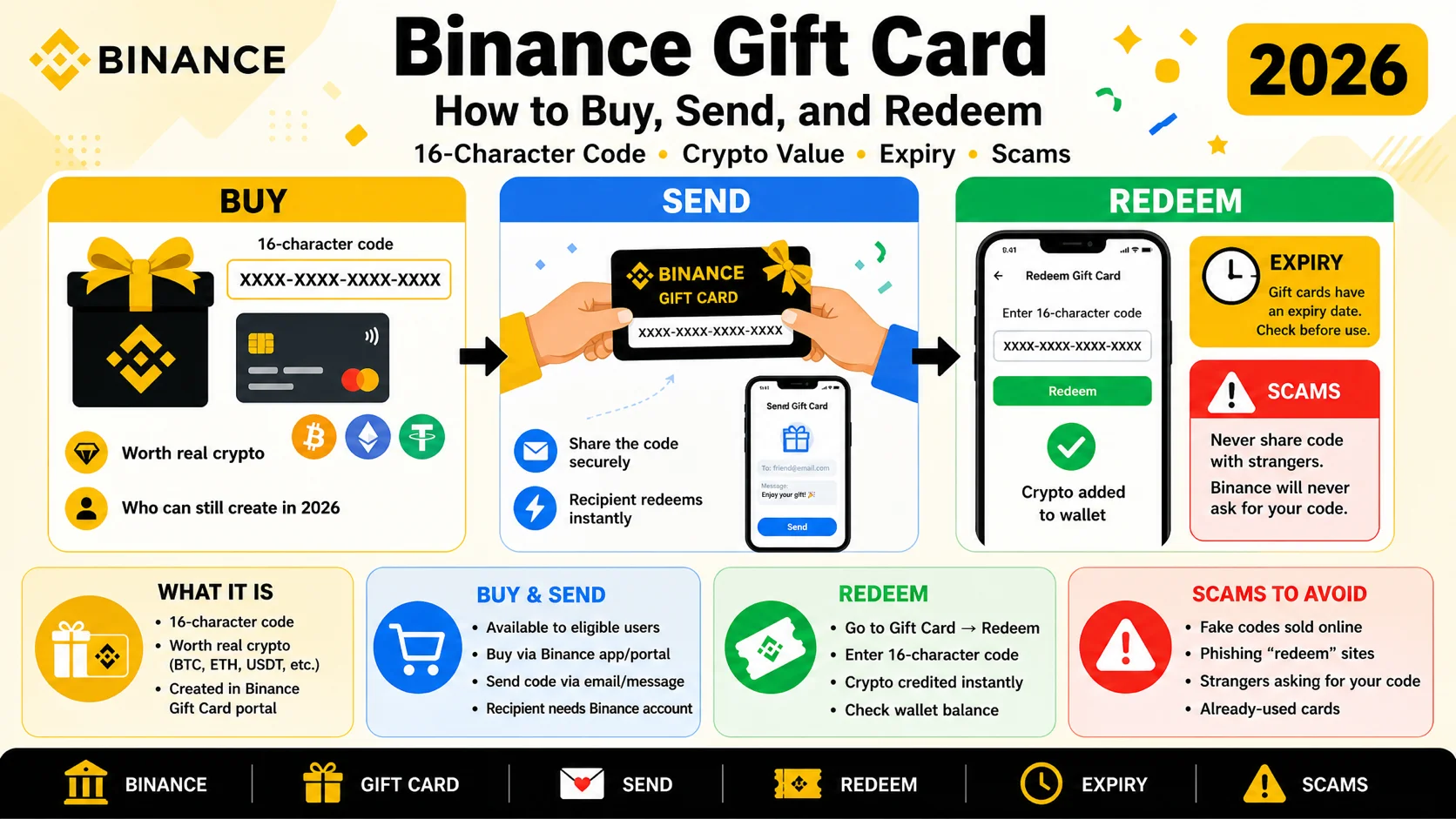
Binance Gift Card: How to Buy, Send, and Redeem (2026)
A Binance Gift Card is a 16-character code worth real crypto. Who can still create one in 2026, where to buy, how to redeem, when it expires, and the scams to avoid.
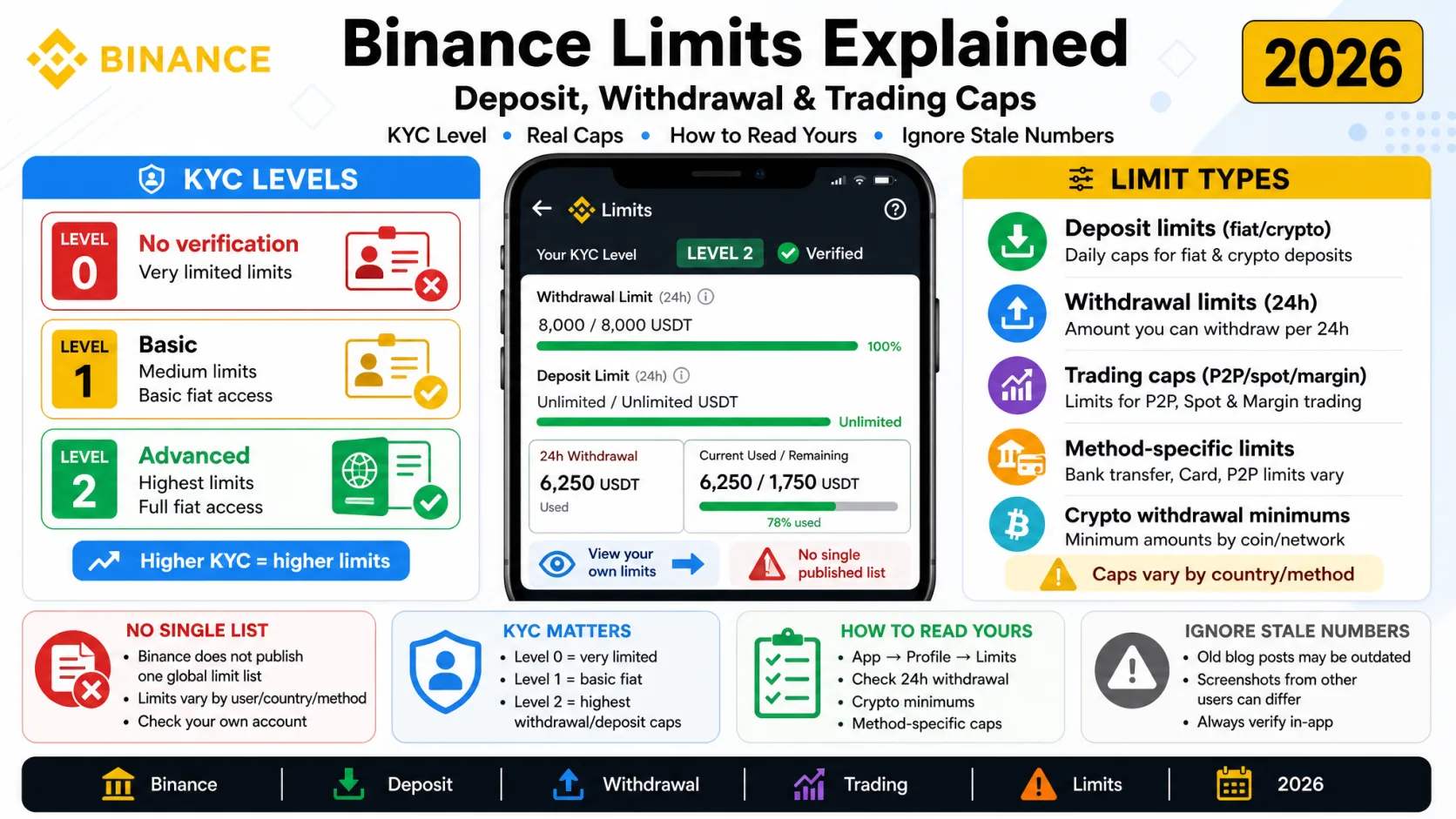
Binance Limits Explained: Deposit, Withdrawal, and Trading Caps (2026)
Binance publishes no single limit list. The real withdrawal, deposit and trading caps by KYC level, how to read your own, and the stale numbers to ignore.
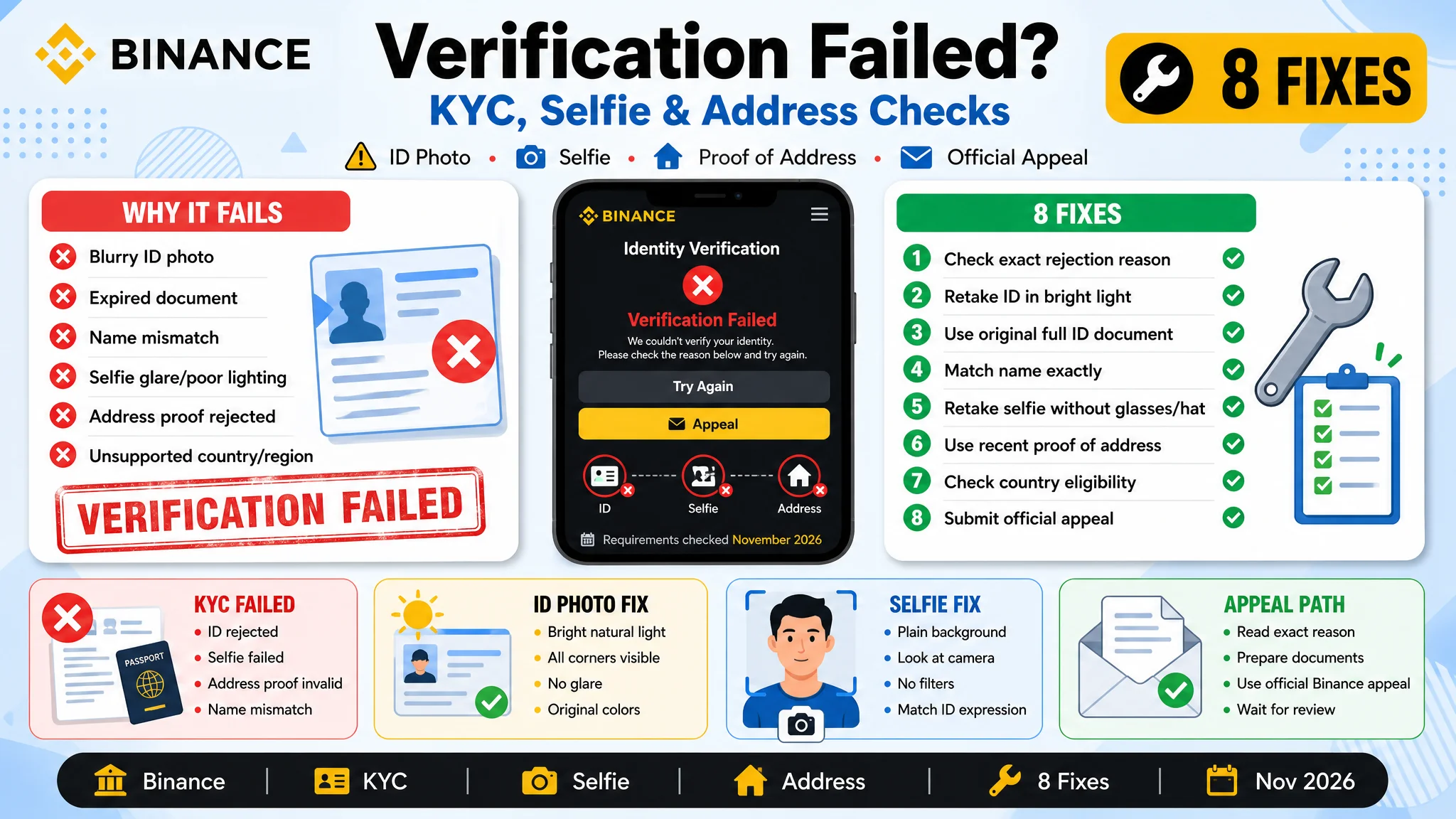
Binance Verification Failed? 8 Fixes for KYC, Selfie, and Address Checks (2026)
Binance verification failed? Find the exact rejection, fix the ID photo, selfie or address proof, and use the official appeal path. Requirements checked November 2026.