
Binance Futures for Beginners: Fees and Liquidation (2026)
Binance futures start at 5 USDT per order, but 10x leverage turns a 3% move into a 30% loss. Real costs, liquidation, and a safe first trade.
 Lucas Almeida 5 min read
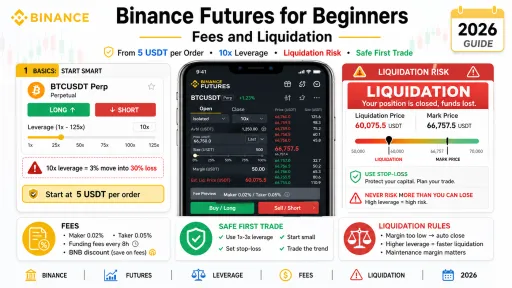
Key takeaways
- A Binance futures contract lets you profit or lose from a price move without owning the coin. Perpetuals never expire, so the position stays open until you close it or it is liquidated.
- On 18 November 2026, 516 of Binance's 522 USDT perpetual contracts accepted a 5 USDT order; BTCUSDT required 50 USDT and ETHUSDT 20 USDT. Those are platform minimums, not a sensible starting size.
- VIP 0 fees are 0.02% maker and 0.05% taker. A 10,000 USDT round trip at taker rates costs about 10 USDT — 1% of the margin behind a 10x position, before funding.
- Funding is charged every 8, 4 or 1 hours depending on the contract; 414 of the 522 USDT perpetuals were on a 4-hour cycle on 18 November 2026. At 10x, a 0.01% rate every 8 hours costs roughly 9% of margin per month.
- Liquidation is measured on mark price, not the last traded price, and Binance charges a liquidation clearance fee on notional value — 1.25% to 2.5% depending on the contract. Leverage above 3–5x is not beginner territory.
Binance futures let you trade a coin’s price with borrowed money instead of buying the coin itself. The platform minimum is small — on 18 November 2026, 516 of Binance’s 522 USDT perpetual contracts accepted a 5 USDT order — but the minimum says nothing about risk. At 10x leverage, a 3% move against you costs about 30% of the margin behind the position, and trading fees, funding and a liquidation clearance fee are charged on top.
This guide explains what a Binance futures contract actually is, what it costs, how liquidation is calculated, and how a beginner can place a first trade without treating the leverage slider as a target.
What are Binance futures?
A Binance futures contract is an agreement to profit or lose from a price move without owning the underlying coin, with gains and losses settled in USDT or crypto. You post margin, choose leverage, and the exchange keeps the contract open until you close it, it is liquidated, or — for quarterly contracts — it expires.
Binance offers two families of contracts, and beginners should understand the difference before touching either:
| Contract type | Margin and settlement | What it means in practice |
|---|---|---|
| USDⓈ-M perpetual (USDT-M) | USDT or USDC margin, PnL in stablecoin | The default for beginners: simple accounting, deep liquidity, no expiry |
| COIN-M perpetual | BTC or another coin as margin, PnL in that coin | Adds coin-price exposure on top of the trade; harder to size |
| Quarterly futures | Stablecoin margin, fixed expiry date | Used for basis trades and hedging; not a beginner product |
A perpetual has no expiry date. Instead of a settlement date, it uses a funding rate paid between longs and shorts every few hours to keep the contract price close to spot. That funding is not a small detail: it is a recurring cost or credit that exists for as long as the position stays open.
Futures also differ from spot in ways that surprise beginners. You never receive the coin, so you cannot stake it, lend it, or receive an airdrop for holding it. A long futures position is not “owning Bitcoin with extra steps”; it is a leveraged bet with an expiration that never comes but a liquidation price that might.
How much money do you need to start?
Binance’s minimum order is 5 USDT of notional value for most USDT perpetuals, 20 USDT for ETHUSDT and a few others, and 50 USDT for BTCUSDT — but a workable starting balance is much larger than the minimum. I pulled Binance’s public futures exchangeInfo endpoint on 18 November 2026: of 522 trading USDT perpetuals, 516 had a 5 USDT minimum notional, five had 20 USDT (ETH, BCH, LTC, ETC and LINK), and BTCUSDT alone had 50 USDT.
That minimum is the exchange’s floor, not a risk plan. Three costs make a tiny position pointless:
- Fees are charged on notional, not margin. A 5 USDT position still pays the same percentage as a 5,000 USDT position, and the spread on a small order can exceed the move you are trying to capture.
- The stop-loss must sit outside normal noise. If your stop is 2% away, a 5 USDT position risks 0.10 USDT — too small to matter, and still large enough to be stopped by a normal wick.
- Liquidation distance shrinks with leverage. At 20x, a 4–5% move can liquidate a position before a sensible stop is hit.
A more realistic learning balance is 100–300 USDT of money you can afford to lose, used with 2x–3x leverage. That is enough to place a position with a real stop, see funding and fees, and still survive being wrong several times. It is not enough to make a living, and anyone who says otherwise is selling something.
💡 Don't have a Binance account yet? Sign up now — 20% fee rebate on spot and futures — enter the referral code BN2688.
What does Binance futures cost?
At VIP 0, USDⓈ-M futures cost 0.02% maker and 0.05% taker, plus funding every few hours and a liquidation clearance fee if the position is forcibly closed. The headline fee looks tiny because it is charged on the full notional value, which leverage multiplies.
Trading fees
| Fee | VIP 0 rate | With BNB discount | Charged on |
|---|---|---|---|
| Maker (limit order that rests in the book) | 0.020% | 0.018% | Notional value |
| Taker (order that fills immediately) | 0.050% | 0.045% | Notional value |
The BNB discount is 10% on USDⓈ-M futures only, and it requires BNB in the futures wallet; if the wallet has no BNB, the fee is deducted in USDT and the discount does not apply. COIN-M futures do not get this discount.
The practical number is the round trip. Open and close a 10,000 USDT position with taker orders and you pay about 10 USDT in fees. Put that next to the margin: at 10x the margin is 1,000 USDT, so the round trip costs 1% of your margin before the price has moved. At 3x the same trade costs about 0.33% of margin. This is why high leverage and frequent trading are a fee strategy, not a profit strategy.
Funding
Funding is a periodic payment between long and short traders, calculated from the premium index and an interest-rate component, and charged every 8, 4 or 1 hours depending on the contract. Binance’s formula after the September 2025 update is:
F = [P + clamp(I − P, 0.05%, −0.05%)] ÷ (8 / N)
Where P is the average premium index, I is the interest rate (0.03% per day by default, or 0.01% per 8-hour interval), and N is the funding interval in hours. The clamp limits how far the interest component can move the rate.
The interval is not always eight hours. Binance’s public fundingInfo endpoint on 18 November 2026 showed 414 of the 522 USDT perpetuals on a 4-hour cycle, 4 on a 1-hour cycle, and 104 on the standard 8-hour cycle. The schedule can change with market conditions, and the app shows a countdown to the next payment.
A worked example makes funding concrete. A 10,000 USDT position with a 0.01% rate per 8-hour interval pays 1 USDT per interval, or about 3 USDT per day. On 1,000 USDT of margin at 10x, that is 0.3% per day, roughly 9% per month, before any price move. Funding can also be negative — shorts paying longs — but it is a cost you must model, not a yield you can count on.
The liquidation clearance fee
This is the fee most beginners have never heard of. When Binance liquidates a position, it charges a liquidation clearance fee calculated on notional value, using a rate that depends on the contract. On 18 November 2026, the same API snapshot showed:
| Liquidation fee rate | Number of USDT perpetuals |
|---|---|
| 1.25% | 12 (including BTCUSDT and ETHUSDT) |
| 1.50% | 351 |
| 2.00% | 152 |
| 2.50% | 7 |
At 10x leverage, a 1.5% fee on notional equals 15% of your margin — charged on top of the loss that triggered the liquidation. The fee is deducted from the position’s remaining assets and appears as “Insurance Clearance” in transaction history. Binance does not charge it when the position is already bankrupt, because there is nothing left to take. Either way, the beginner experience is the same: the margin is gone.
Spread and slippage
Market orders cross the spread, and thin order books make it worse. BTCUSDT and ETHUSDT usually have tight spreads; a newly listed altcoin perpetual can have a spread several times wider. A limit order avoids paying it, but may not fill. For a beginner, the rule is simple: use liquid contracts and limit orders, and treat every basis point as real money.
How do leverage and liquidation actually work?
Leverage lets you control a position larger than your margin; liquidation happens when the position’s margin falls below the maintenance requirement, and Binance measures that against the mark price rather than the last traded price. The mark price is an index-based price designed to stop a single wick on one exchange from triggering a wave of unfair liquidations.
The arithmetic for an isolated long is approximately:
Liquidation price ≈ entry price × (1 − 1 / leverage + maintenance margin rate)
For BTCUSDT, the tier-1 maintenance margin rate is about 0.40%. Ignoring fees and funding, a long entered at 65,000 USDT would have an estimated liquidation price of:
| Leverage | Margin for a 10,000 USDT position | Approximate liquidation price | Adverse move to liquidation |
|---|---|---|---|
| 3x | 3,333 USDT | 43,593 USDT | −32.9% |
| 10x | 1,000 USDT | 58,760 USDT | −9.6% |
| 25x | 400 USDT | 62,660 USDT | −3.6% |
| 50x | 200 USDT | 63,960 USDT | −1.6% |
Fees and funding make the real liquidation price arrive sooner, because they reduce the margin backing the position. The table also shows the trade-off in plain terms: 50x does not multiply your edge, it multiplies the chance that normal volatility ends the trade before your thesis has time to work.
Two more mechanics matter:
- Isolated margin ring-fences the margin assigned to one position. If that position is liquidated, the rest of your futures wallet is untouched.
- Cross margin uses the entire futures wallet as collateral. It can keep a position alive longer, but a single bad trade can consume the whole balance.
If a position goes bankrupt — losses exceed the margin — Binance’s insurance fund covers the shortfall, and the auto-deleveraging (ADL) system may close profitable traders’ positions to balance the book. That is a real counterparty mechanic, not a theoretical footnote.
How do you open your first futures position?
The safe first trade is a small, isolated, low-leverage position on a liquid contract with a stop-loss placed before the entry is confirmed. The exact screens change between app versions, but the sequence does not.
- Complete KYC and activate futures. Verify your identity, open the Futures section, and accept the risk agreement. Check that futures is offered in your country — more on that below.
- Transfer USDT from Spot to the USDⓈ-M wallet. Use the internal Transfer function. This is free and instant. Do not send an on-chain deposit to a futures address; futures funding comes from your Spot wallet.
- Choose BTCUSDT or ETHUSDT perpetual. These books are the deepest and the spreads are the tightest. Avoid a newly listed altcoin for a first trade, even if the chart looks exciting.
- Select isolated margin and 2x–3x leverage. One-way position mode is simpler than hedge mode for a beginner. Read the estimated liquidation price before you continue.
- Place a limit order. Check the minimum notional first: 5 USDT for most pairs, 20 for ETHUSDT, 50 for BTCUSDT. A limit order controls the entry and avoids paying the spread.
- Attach the stop-loss and take-profit. Put the stop where the trade idea is invalidated, not at the liquidation price. If the stop is 5% away and you are willing to risk 10 USDT, the position notional should be 200 USDT, not 2,000.
- Watch funding and the margin ratio, then close. Use a reduce-only order to close, and transfer unused USDT back to Spot. A position left open across several funding intervals is paying rent.
The position-sizing rule in step 6 is the part most guides skip. Risk per trade should be 1% of your account or less. Position notional = risk amount ÷ stop distance. With a 1,000 USDT account, a 10 USDT risk and a 5% stop, the notional is 200 USDT. At 10x that needs 20 USDT of margin — which shows why “use 10x” and “risk 1%” can coexist only when the position is small.
Cross vs isolated: which should a beginner use?
Use isolated margin for every early trade. It caps the damage to the margin you assign to that position, which makes the worst case visible before you enter.
| Isolated margin | Cross margin | |
|---|---|---|
| Collateral | Only the margin assigned to the position | The entire futures wallet |
| Worst case | Lose that position’s margin | Lose the whole futures balance |
| Liquidation price | Fixed for the position | Moves as the wallet balance changes |
| Good for | Learning, single trades, defined risk | Experienced users running hedged portfolios |
Cross margin is not “safer because it has more collateral”. It is safer for the position and more dangerous for the account. A beginner who does not yet know how funding and fees interact with margin should not give one trade access to every dollar in the futures wallet.
What mistakes cause most beginner losses?
Most beginner futures losses come from position size, not from being wrong about direction. A correct view with 50x leverage can still be liquidated by noise; a wrong view with a 1% risk and a stop is a small, survivable loss.
| Mistake | Why it hurts | Fix |
|---|---|---|
| Using maximum leverage | Liquidation distance shrinks to a normal wick | Start at 2x–3x and size by risk, not by the slider |
| No stop-loss | A small loss becomes a margin call | Set the stop before entry, at the invalidation level |
| Ignoring funding | A slow bleed that can exceed the trade’s edge | Check the rate and countdown; avoid holding high-funding positions for days |
| Averaging down | Adds size to a losing idea and moves liquidation closer | Add only if the original thesis is intact and the risk budget allows it |
| Using cross margin with the full balance | One trade can consume every futures dollar | Isolated margin until the mechanics are boring |
| Following signal groups | You inherit the risk without the context | Learn to read the chart and the liquidation price yourself |
| Trading illiquid altcoins | Wide spreads and violent wicks | BTCUSDT or ETHUSDT first |
There is also a behavioural trap specific to futures: because the position is always open and the PnL updates continuously, it feels like action is progress. It is not. The traders who survive are usually the ones who take fewer, smaller trades with a written invalidation level.
Is Binance futures available in your country?
No for the United States, the United Kingdom, the EU/EEA, Canada, the Netherlands and Australia’s derivatives market; eligibility elsewhere depends on Binance’s current service list. This is not a detail you can work around with a VPN — using one to access a restricted product can get an account frozen during withdrawal review.
- United States: Binance.com does not serve US residents, and Binance.US offers spot trading but not perpetual futures.
- United Kingdom: The FCA banned the sale of crypto derivatives to retail consumers in January 2021. Spot may be available; futures are not.
- EU/EEA: Binance suspended services to EU/EEA clients on 1 July 2026 after failing to secure a MiCA licence, leaving withdrawal and position-closing functions open. Trading, deposits and new registrations stopped.
- Canada and the Netherlands: Binance exited both markets in 2023.
- Australia: Binance Australia Derivatives lost its licence in 2023; local derivatives trading ended.
- Sanctioned regions: Cuba, Iran, North Korea, Syria, Crimea and the non-government-controlled areas of Ukraine are excluded.
The referral code on this site works only on binance.com. It does not work on Binance.US, and it cannot be applied retroactively after registration. If you are in an eligible country, register first and complete KYC before depositing.
Should you use Binance futures at all?
For most beginners, no — not until spot trading feels boring and the mechanics of margin, funding and liquidation are clear. Futures is a tool for expressing a view with leverage or hedging an existing position. It is not a yield product, an income stream, or a shortcut to recovering a loss.
A reasonable decision rule:
- Trade spot for at least three to six months first. Buy, hold, sell, withdraw, and watch how fees and spreads behave without leverage.
- Risk no more than 1% of your account per futures trade. If a stop-loss at that size feels too small to be worth it, the account is too small for futures.
- Cap leverage at 3x–5x while learning. The maximum available leverage is a platform limit, not a recommendation.
- Only use money you can lose entirely. Liquidation is a total loss of the position’s margin, and it can happen while you sleep.
- If you cannot explain funding and the liquidation price in one sentence each, do not open the trade.
If you want exposure without those mechanics, spot buying and dollar-cost averaging are the boring alternatives. If you want someone else to manage the positions, copy trading exists — but it adds a profit share of up to 30% on futures and does not remove the risk of losing the margin. Neither product is passive income.
The bottom line
Binance futures are cheap to enter and expensive to learn by accident. The platform minimum is 5 USDT for most contracts, but the real costs are the round-trip fee on notional, funding every 4–8 hours, and a liquidation clearance fee of 1.25%–2.5% of notional if the position is forcibly closed. At 10x, a 3% adverse move costs about 30% of the margin before those fees.
If you are new, start with spot, size every futures trade so a stop-out costs 1% or less, use isolated margin, and keep leverage at 2x–3x. If you have not opened an account yet, use the Binance registration guide so the referral code is applied before your first deposit, then read the Binance fee guide and the copy trading risks before deciding whether leverage belongs in your account at all.
Minimum order sizes, liquidation fee rates and funding intervals were pulled from Binance’s public exchangeInfo and fundingInfo endpoints on 18 November 2026. Fee rates and the BNB discount were checked against Binance’s futures fee schedule and futures fee FAQ; the funding formula against Binance’s funding rate FAQ and the September 2025 formula update; margin tiers against Binance’s leverage and margin page. Regional restrictions were checked against the FCA derivatives ban and reporting on Binance’s EU/EEA suspension. Binance changes fees, limits and availability without notice — confirm the current terms in the app before you trade.
Don't have a Binance account yet?Sign up nowenter the referral codeBN2688
Frequently asked questions
How much do you need to start trading Binance futures?
What are Binance futures fees in 2026?
How does liquidation work on Binance futures?
What is the liquidation clearance fee?
Is funding paid to me or by me?
Can US or UK residents trade Binance futures?
Is Binance futures the same as copy trading?
Editor-in-Chief & Lead Researcher
Editor of MyCryptoStart. Independent researcher of cryptocurrency exchanges, focused on fees, security, KYC, and onboarding — publishes step-by-step guides in plain English for beginners.
View author page →Some links on this page are affiliate links: we may earn a commission at no extra cost to you. This content is educational and is not financial, investment, or legal advice. Affiliate disclosure · Disclaimer.
Continue reading
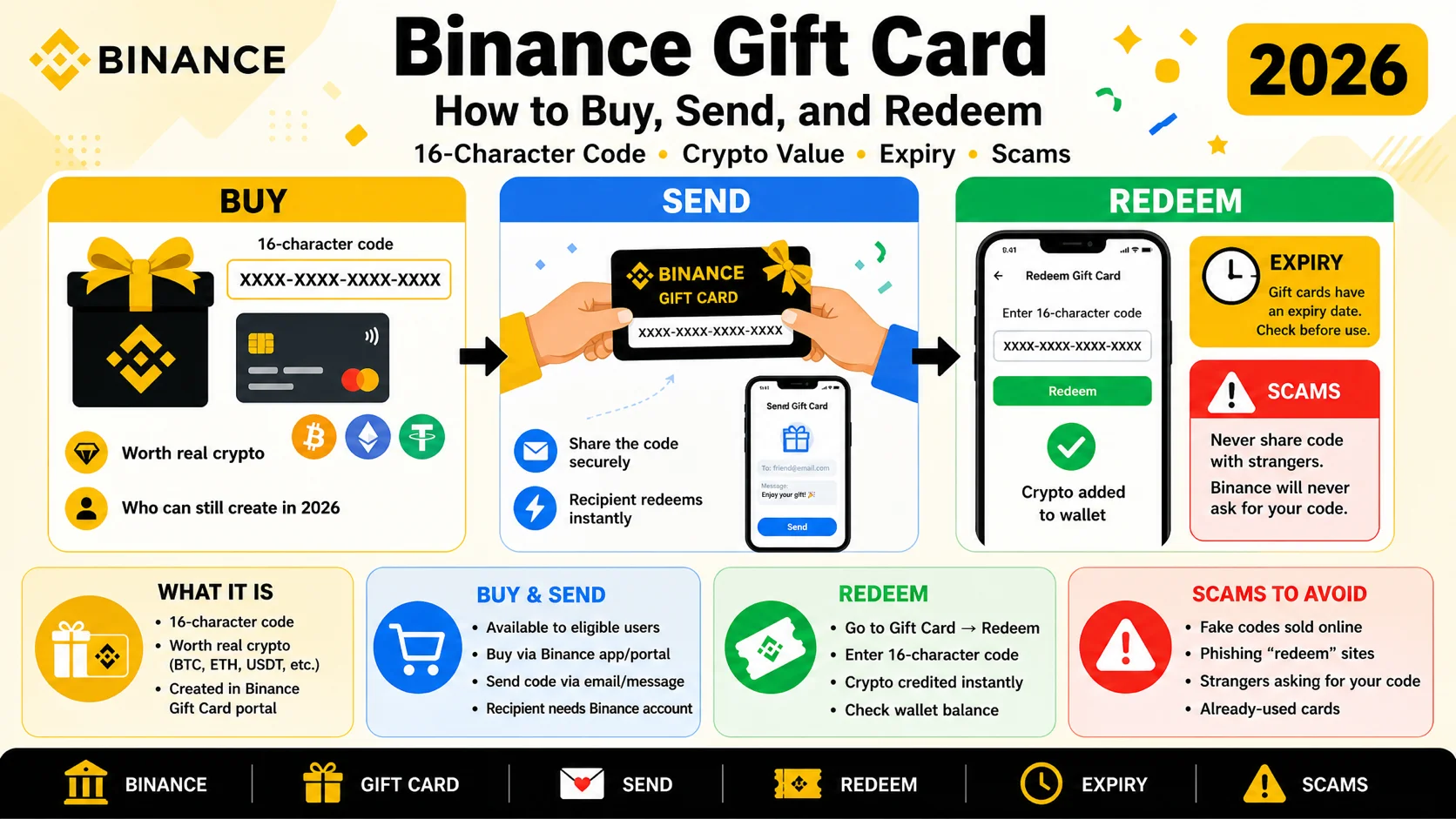
Binance Gift Card: How to Buy, Send, and Redeem (2026)
A Binance Gift Card is a 16-character code worth real crypto. Who can still create one in 2026, where to buy, how to redeem, when it expires, and the scams to avoid.
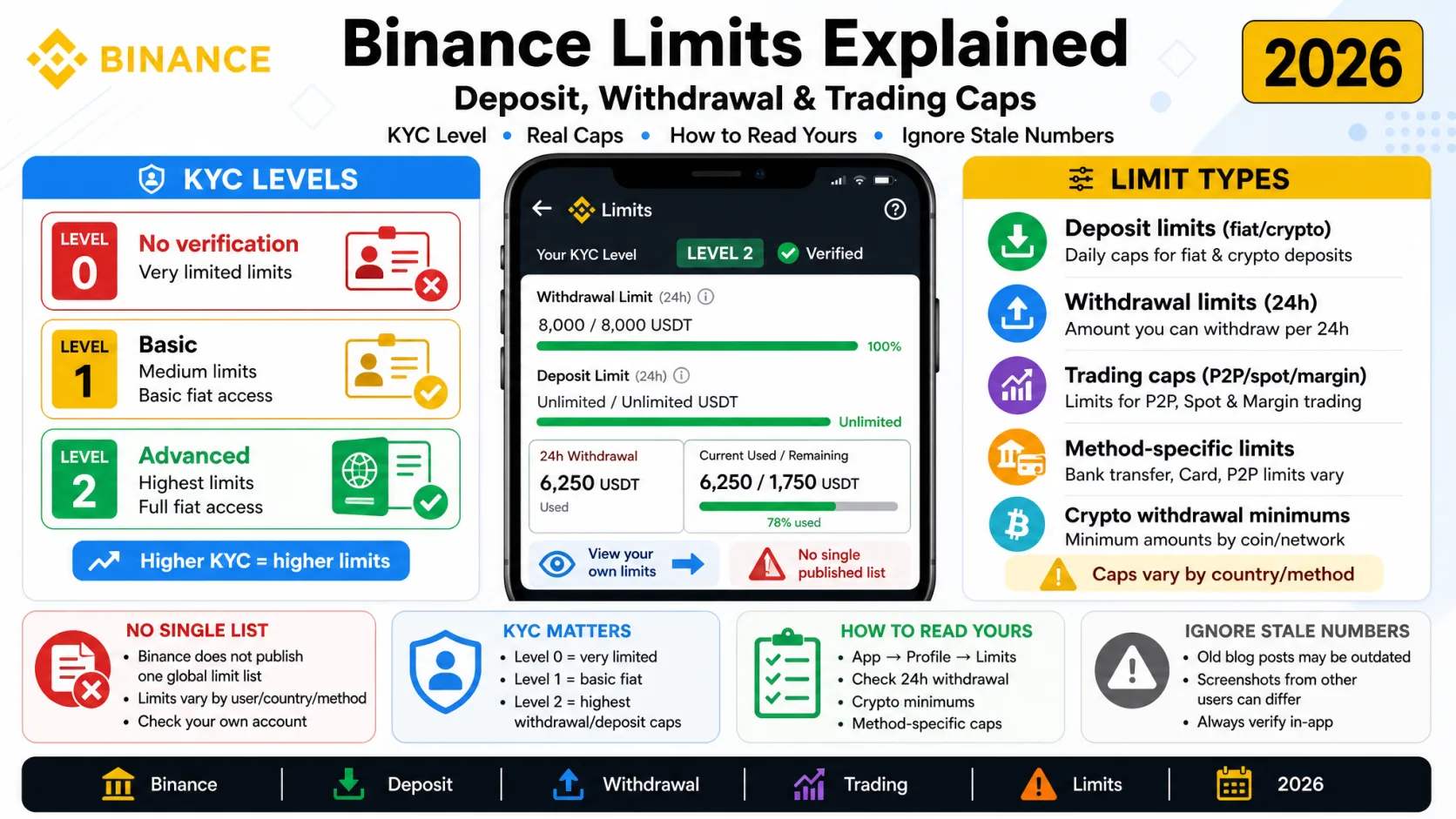
Binance Limits Explained: Deposit, Withdrawal, and Trading Caps (2026)
Binance publishes no single limit list. The real withdrawal, deposit and trading caps by KYC level, how to read your own, and the stale numbers to ignore.
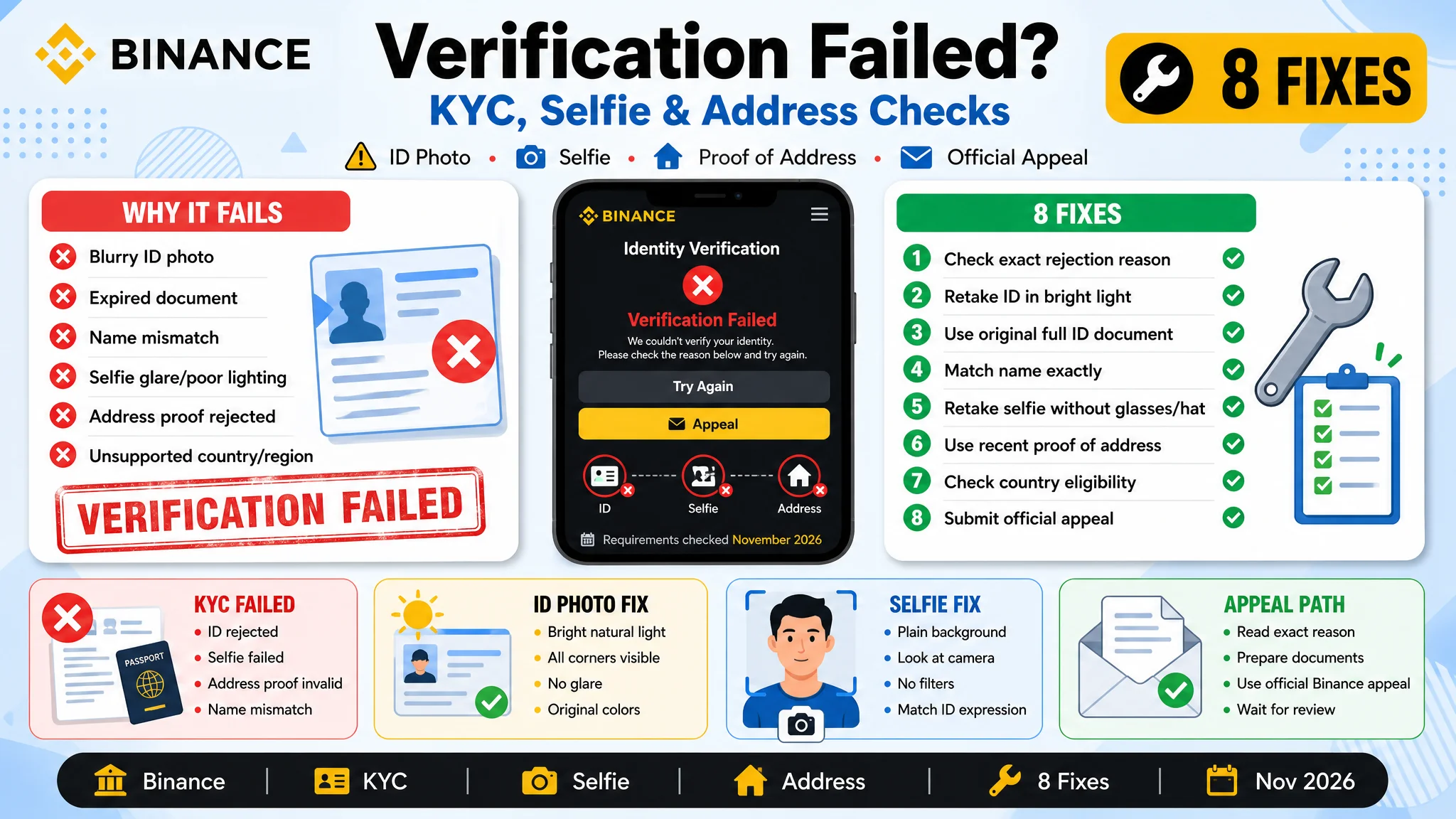
Binance Verification Failed? 8 Fixes for KYC, Selfie, and Address Checks (2026)
Binance verification failed? Find the exact rejection, fix the ID photo, selfie or address proof, and use the official appeal path. Requirements checked November 2026.