
Binance Withdrawal Fees: Every Network Compared (2026)
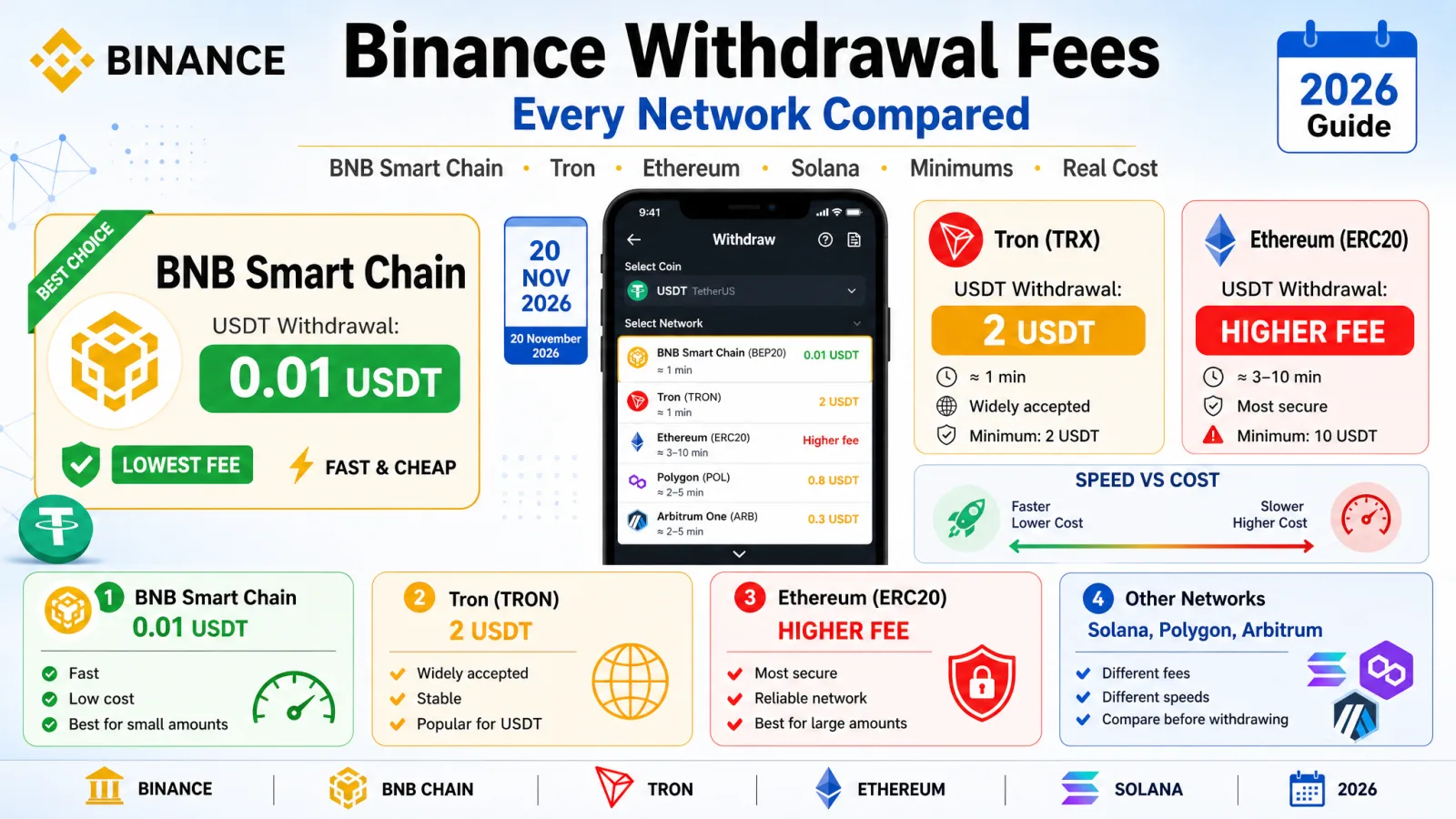
On 20 November 2026 Binance charged 0.01 USDT to withdraw USDT on BNB Smart Chain and 2 USDT on Tron. Every network, minimum, and real cost.
 Lucas Almeida 5 min read
Key takeaways
- On 20 November 2026, the cheapest open USDT withdrawal route on Binance was BNB Smart Chain at 0.01 USDT; Tron cost 2 USDT and Ethereum 0.6 USDT. The same stablecoin cost 200 times more on one network than another.
- Withdrawal fees are flat per transaction and paid in the coin you withdraw, not percentages. A 2 USDT Tron fee is 10% of a 20 USDT transfer but 0.2% of a 1,000 USDT transfer.
- Minimums were 3–5 USDT on USDT networks. The minimum applies to the amount you request, and the fee comes out of it: requesting 5 USDT on Tron leaves 3 USDT for the recipient.
- Binance-to-Binance internal transfers are free and instant. BNB fee discounts and VIP trading tiers do not reduce withdrawal fees.
- Choose the network your recipient supports before comparing fees. ERC20 and BEP20 addresses both start with 0x, and 'BTC on BEP20' is a pegged token, not native Bitcoin.
On 20 November 2026, Binance charged 0.01 USDT to withdraw USDT over BNB Smart Chain and 2 USDT to withdraw the same stablecoin over Tron — a 200-fold difference for an identical asset. Ethereum’s ERC20 rail sat between them at 0.6 USDT, cheaper than Tron. The fee is flat per withdrawal and paid in the coin you send, so its real weight depends on how much you move.
This guide lists every USDT network Binance had open on that date, the minimum for each, what the fee costs at $20, $100 and $1,000, and how to pick a route without losing the transfer to a network mismatch.
All figures come from Binance’s public deposit and withdrawal feed, pulled on 20 November 2026; the feed’s last update timestamp was 19 November 2026, 01:00 UTC. Fees and minimums change without notice, so treat the tables as a dated snapshot and read the withdrawal screen before you confirm.
How much does Binance charge to withdraw USDT?
Binance charged between 0.01 and 2 USDT per USDT withdrawal on 20 November 2026, depending only on the network. Nineteen USDT networks were listed; sixteen were open for withdrawals, and three were paused.
| Network | Fee (USDT) | Minimum (USDT) | Status on 20 Nov 2026 |
|---|---|---|---|
| BNB Smart Chain (BEP20) | 0.01 | 5 | Open |
| Plasma | 0.012 | 5 | Open |
| opBNB | 0.015 | 5 | Open |
| Kaia | 0.02 | 5 | Open |
| Polygon PoS | 0.03 | 3 | Paused |
| Optimism | 0.04 | 3 | Open |
| Avalanche C-Chain | 0.04 | 3 | Paused |
| Celo | 0.05 | 5 | Open |
| Aptos | 0.1 | 3 | Open |
| Asset Hub Polkadot | 0.1 | 5 | Open |
| Scroll | 0.1 | 5 | Paused |
| Tezos | 0.1 | 5 | Open |
| NEAR Protocol | 0.2 | 3 | Open |
| Kava EVM | 0.2 | 5 | Open |
| Arbitrum One | 0.3 | 3 | Open |
| The Open Network (TON) | 0.3 | 3 | Open |
| Ethereum (ERC20) | 0.6 | 5 | Open |
| Solana | 0.7 | 5 | Open |
| Tron (TRC20) | 2 | 5 | Open |
Two details matter more than the ranking. First, a paused network is not a cheap option — Polygon, Avalanche and Scroll were listed at low fees but could not be used at the time of the snapshot. Second, Binance charges the fee in the asset being withdrawn, not in dollars, so a BTC withdrawal is priced in BTC and a USDT withdrawal in USDT.
Deposits are the reverse: Binance does not charge a deposit fee for crypto. Your sending platform may charge its own withdrawal fee, which is why a “free” deposit can still cost money on the other side.
Which network is the cheapest for withdrawing USDT?
BNB Smart Chain was the cheapest open route at 0.01 USDT, followed by Plasma at 0.012 and opBNB at 0.015. The gap between BNB Smart Chain and Tron was 2 USDT per withdrawal, or 200 times.
The cheapest fee is not automatically the right choice. Three checks decide whether a cheap route works:
- Does the recipient support it? A wallet that accepts ERC20 USDT may not accept BEP20, even though both use
0xaddresses. - Is the network open right now? Binance pauses individual networks for maintenance and hot-wallet refills. The fee can look attractive while the route is closed.
- How much are you moving? A 0.01 USDT fee is irrelevant on a 1,000 USDT transfer and still the correct choice on a 20 USDT transfer, where Tron would take 10%.
For most transfers between exchanges, BEP20 is the default cheap rail because the large exchanges and most multi-chain wallets support it. For a self-custody wallet that only supports Ethereum, the 0.6 USDT ERC20 fee is the price of compatibility.
What does the withdrawal fee cost as a percentage?
A flat fee is cheap on large transfers and expensive on small ones. At the 20 November 2026 rates, the same 2 USDT Tron fee ranges from 10% of a 20 USDT withdrawal to 0.2% of a 1,000 USDT withdrawal.
| Amount sent | BEP20 (0.01) | ERC20 (0.6) | Solana (0.7) | TRC20 (2) |
|---|---|---|---|---|
| 20 USDT | 0.05% | 3.0% | 3.5% | 10.0% |
| 100 USDT | 0.01% | 0.6% | 0.7% | 2.0% |
| 1,000 USDT | 0.001% | 0.06% | 0.07% | 0.2% |
The practical rule: below roughly 100 USDT, the network choice dominates your cost; above 1,000 USDT, the fee is small enough that compatibility and arrival time should decide. Splitting one withdrawal into several small withdrawals multiplies a flat fee, which is the opposite of what most people expect.
Why is TRC20 no longer the cheap network?
Because Binance sets a flat price per route, and Tron’s USDT rail is no longer cheap to operate. Tron transfers consume energy, and sending USDT without staking TRX means paying for that energy at market rates. Ethereum’s base fee, by contrast, stayed low for much of 2026, so the ERC20 route undercut Tron in this snapshot.
Binance’s help centre says withdrawal fees cover the network cost paid to miners or validators and “can fluctuate without notice due to factors such as network congestion”. That explains movement over time, but it also means the number on the schedule is Binance’s price for the route, not a live gas estimate. It is recalculated periodically rather than block by block.
The old advice — “always use TRC20 because it is the cheapest” — was reasonable when Ethereum gas was expensive and Tron was subsidised. In November 2026 it is wrong by a factor of more than three on Binance. Anyone repeating it from a 2021 guide is costing you money.
What is the minimum withdrawal on Binance?
USDT minimums were 3 or 5 USDT depending on the network on 20 November 2026. BNB Smart Chain, Ethereum, Tron, Solana, Plasma, opBNB, Kaia, Celo, Tezos, Kava and Asset Hub Polkadot required 5 USDT; Arbitrum, Optimism, TON, Aptos and NEAR required 3.
The minimum applies to the amount you request, not the amount that arrives. On Tron, requesting the 5 USDT minimum with a 2 USDT fee leaves 3 USDT for the recipient. If your balance is below the minimum, Binance will not submit the withdrawal at all.
Small balances have one escape route. Binance’s Small Amount Exchange converts balances worth less than 20 USDT into BNB, BTC, ETH, USDT, USDC, U or BFUSD for a flat 2% fee, once per hour; Alpha tokens cost 10%. The conversion does not guarantee a withdrawal — the converted coin still has to clear its own network minimum.
Does the withdrawal fee come out of my amount or get added on top?
Both are possible, because Binance’s withdrawal screen has two amount modes. In Withdrawal amount mode you enter the total to leave your account and the fee is deducted from it. In Receive amount mode you enter what the recipient should get and the fee is added on top.
Using 100 USDT on Tron with the 2 USDT fee:
| Mode | You enter | Debited from balance | Recipient receives |
|---|---|---|---|
| Withdrawal amount | 100 USDT | 100 USDT | 98 USDT |
| Receive amount | 100 USDT | 102 USDT | 100 USDT |
This is the most common reason a recipient says “you sent less than agreed”. If you are paying an invoice, use Receive amount and enter the invoice figure, or add the fee manually in Withdrawal amount mode. The confirmation screen shows the fee and the estimated received amount before you approve anything.
The mode also changes your balance requirement. In Withdrawal amount mode, a 5 USDT balance can send the 5 USDT minimum on Tron, leaving 3 USDT to arrive. In Receive amount mode, the same transfer needs 7 USDT in the account.
Can you avoid Binance withdrawal fees?
You can avoid the on-chain fee only by not making an on-chain withdrawal. Sending to another Binance account through the internal transfer option is free and instant: choose Binance user, then enter the recipient’s Binance ID, email or phone number. No blockchain transaction is created, and the transfer appears as “Internal” in the history.
Other common beliefs do not hold:
- The BNB discount does not apply. Paying fees in BNB reduces spot trading fees by 25% and USDⓈ-M futures fees by 10%, but the withdrawal schedule is separate.
- VIP tiers do not publish withdrawal discounts. Binance’s fee schedule lists one withdrawal fee per coin and network, not a VIP-tier table. VIP levels change trading fees.
- Deposits are free, but the sender pays. Moving crypto into Binance costs nothing on Binance’s side; the platform you send from charges its own withdrawal fee.
- Batching helps. Because the fee is flat, one 1,000 USDT withdrawal costs less than ten 100 USDT withdrawals.
If the goal is to move funds between two Binance accounts, the internal transfer is the only genuinely free option. If the goal is self-custody, the fee is unavoidable and the only lever is the network.
Which networks are cheapest for BTC, ETH and USDC?
The same logic applies to every asset: compare only the networks both sides support, then take the cheapest. BTC and ETH add a trap that USDT does not — the same ticker on another chain is often a wrapped or pegged token, not the native asset.
| Asset | Network | Fee on 20 Nov 2026 | Approx. USD | Minimum |
|---|---|---|---|---|
| BTC | Bitcoin | 0.00002 BTC | $1.26 | 0.0001 BTC |
| BTC | BNB Smart Chain (BTCB) | 0.00000028 BTC | $0.02 | 0.00000056 BTC |
| BTC | Ethereum (pegged) | 0.0000071 BTC | $0.45 | 0.000014 BTC |
| ETH | Ethereum | 0.00015 ETH | $0.27 | 0.002 ETH |
| ETH | Arbitrum One | 0.00005 ETH | $0.09 | 0.0003 ETH |
| ETH | Base | 0.00005 ETH | $0.09 | 0.002 ETH |
| ETH | zkSync Era | 0.00001 ETH | $0.02 | 0.001 ETH |
| USDC | BNB Smart Chain | 0 USDC | $0.00 | 5 USDC |
| USDC | Aptos | 0.04 USDC | $0.04 | 5 USDC |
| USDC | Base | 0.2 USDC | $0.20 | 5 USDC |
| USDC | Solana | 0.3 USDC | $0.30 | 3 USDC |
| USDC | Ethereum | 1 USDC | $1.00 | 3 USDC |
USD values use BTC at $63,096.28 and ETH at $1,779.31 on 20 November 2026, from Binance’s public product feed. They move with the price; the coin-denominated fee does not.
The trap is in the second and third BTC rows. “BTC on BNB Smart Chain” is BTCB, a Binance-issued token backed by BTC, and “BTC on Ethereum” is a pegged ERC20 version. They track Bitcoin’s price but are not spendable on the Bitcoin network. The same applies to ETH on BNB Smart Chain, which is Binance-Peg ETH. Withdraw them only to a wallet that supports the pegged asset and the chain it lives on.
USDC on BNB Smart Chain was listed at zero fee on the snapshot date. Treat that as a temporary condition, not a rule: fee schedules change, and a zero-fee route can be withdrawn.
How do you choose a withdrawal network without losing funds?
Start at the receiving end, not at Binance’s fee table. The correct order is compatibility, then speed, then fee — the reverse of how the withdrawal screen presents it.
- Read the recipient’s deposit page. Note the exact network name and, where shown, the chain ID. “USDT” alone is not enough.
- Match the network, not the address shape. ERC20, BEP20, Arbitrum and Base all use
0xaddresses. A valid-looking address can still be on the wrong chain. - Check for a memo or tag. Some networks require a destination tag for exchange deposits. Omitting it can strand the funds in the exchange’s omnibus wallet.
- Send a test amount. A 10 USDT test costs one extra fee and proves the route end to end. Do this for every new address, not just large transfers.
- Turn on the withdrawal whitelist and 2FA. These do not affect fees, but they stop a compromised account from sending your balance to an attacker’s address.
Wrong-network transfers are not reliably recoverable. If the destination is a wallet you control, recovery may be possible with the right tools; if it is an exchange, support may help but often will not. The fee you save by picking an incompatible cheap network is trivial next to the amount at risk.
What else can change the fee or block a withdrawal?
Network status, verification level and region can each override the fee table. A route can be open at 0.01 USDT and still fail for reasons unrelated to price.
- Paused networks. On 20 November 2026, Polygon PoS, Avalanche C-Chain and Scroll were listed but closed for USDT withdrawals, with messages about wallet maintenance or hot-wallet refills. Binance also paused ETH withdrawals on Optimism at the same time.
- Verification level. Your daily crypto withdrawal limit is tied to your KYC level and is shown on the Identification page; Binance does not publish one universal number. Complete verification before you need to move funds, not after.
- Region. Binance.com is not available to US residents, who use Binance.US and its separate fee schedule; the BN2688 referral code does not apply there. Binance also suspended services for EU and EEA residents on 1 July 2026.
- Fee changes. Binance updates withdrawal fees without notice. A table from last month, including this one, is a reference point, not a quote.
If a withdrawal is urgent, check the network status before you promise an arrival time. A cheap route that is paused is worse than an expensive route that is open.
The bottom line
Withdrawal fees are the simplest part of Binance’s cost structure once you stop treating them as percentages. On 20 November 2026 the spread ran from 0.01 USDT on BNB Smart Chain to 2 USDT on Tron, and the fee was flat regardless of size. Pick the network your recipient supports, prefer BEP20 when both sides accept it, and use Receive amount mode when someone is expecting an exact figure.
If you do not have an account yet, our Binance registration guide walks through sign-up and KYC, and the referral code guide explains how the fee rebate is applied at registration. For the full cost picture, including trading fees, see Binance fees explained; for the step-by-step withdrawal flow, see how to withdraw from Binance.
Withdrawal fees, minimums, network status and contract types were pulled from Binance’s public getNetworkCoinAll endpoint on 20 November 2026 (feed update 19 November 2026, 01:00 UTC) and cross-checked against the deposit and withdrawal fee page and Binance’s crypto withdrawal fees FAQ. Amount modes follow Binance’s withdrawal guide; free internal transfers follow the internal transfer FAQ; the 20 USDT dust threshold and 2% fee follow the small balance conversion FAQ. BTC and ETH prices are from Binance’s public product feed on the same date. Binance changes fees, minimums and availability without notice — confirm the current numbers on the withdrawal screen before sending.
Don't have a Binance account yet?Sign up nowenter the referral codeBN2688
Frequently asked questions
How much does Binance charge to withdraw USDT?
Which Binance withdrawal network is the cheapest?
Does Binance charge a fee on top of the network fee?
Can you avoid Binance withdrawal fees?
What happens if my balance is below the minimum withdrawal?
Why is TRC20 more expensive than ERC20 in 2026?
Editor-in-Chief & Lead Researcher
Editor of MyCryptoStart. Independent researcher of cryptocurrency exchanges, focused on fees, security, KYC, and onboarding — publishes step-by-step guides in plain English for beginners.
View author page →Some links on this page are affiliate links: we may earn a commission at no extra cost to you. This content is educational and is not financial, investment, or legal advice. Affiliate disclosure · Disclaimer.
Continue reading
Binance Gift Card: How to Buy, Send, and Redeem (2026)
A Binance Gift Card is a 16-character code worth real crypto. Who can still create one in 2026, where to buy, how to redeem, when it expires, and the scams to avoid.
Binance Limits Explained: Deposit, Withdrawal, and Trading Caps (2026)
Binance publishes no single limit list. The real withdrawal, deposit and trading caps by KYC level, how to read your own, and the stale numbers to ignore.
Binance Verification Failed? 8 Fixes for KYC, Selfie, and Address Checks (2026)
Binance verification failed? Find the exact rejection, fix the ID photo, selfie or address proof, and use the official appeal path. Requirements checked November 2026.