
What Is Solana? SOL Explained (2026)
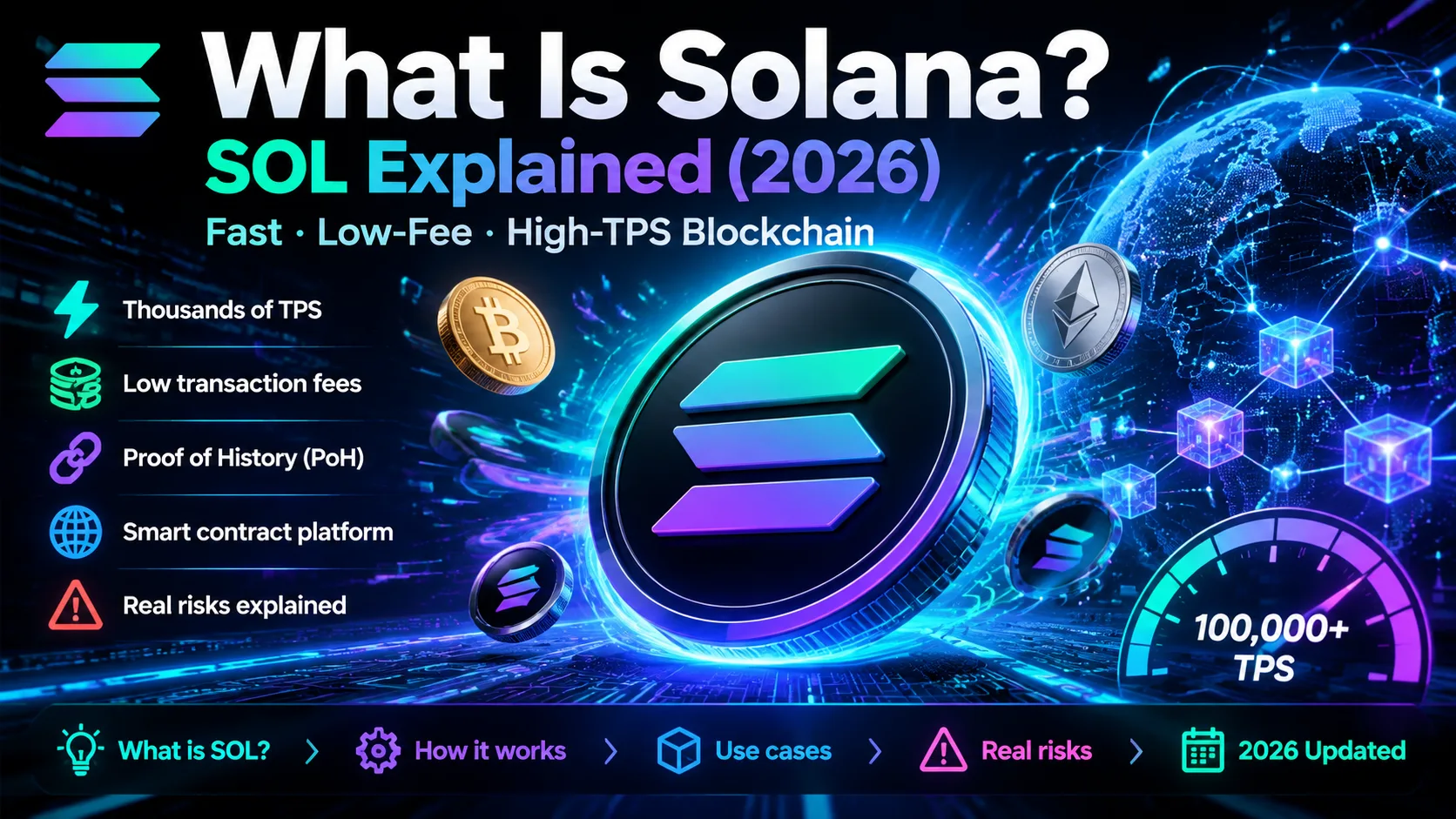
Solana is a fast, low-fee blockchain built to process thousands of transactions per second. Learn what SOL is, how it works, and the real risks.
 Lucas Almeida 5 min read
Key takeaways
- Solana is a Layer 1 blockchain built for speed and low cost — it settles most transactions in under a second for a fraction of a cent, so it is aimed at real applications, not just holding.
- SOL is Solana's native coin, used to pay transaction fees, stake for network rewards (roughly 6–7% APY in 2026), and vote on upgrades.
- Its speed comes from Proof of History — a built-in cryptographic clock — combined with Proof of Stake and parallel transaction processing called Sealevel.
- Solana is a top-10 crypto by market cap and handles far more daily transactions than Ethereum, but Ethereum still holds more institutional capital, security history, and developer depth.
- The honest risks: a history of network outages, validator concentration, regulatory uncertainty, and a meme-coin culture that has burned many beginners.
For a beginner, the short answer is: Solana is a blockchain built for speed and near-zero fees — a network designed to run real apps, not just store value — and SOL is the coin that powers it. While Bitcoin acts like digital gold and Ethereum like a general-purpose computer, Solana aims to be the fast, cheap settlement layer that payments and everyday apps actually need. It settles most transactions in under a second for a fraction of a cent, which is why it has become the busiest blockchain by raw transaction count in 2026.
This guide explains what Solana is, how it manages to be so fast, what SOL is used for, how it compares to Ethereum, and — just as important — what can go wrong. It is education, not investment advice.
What Is Solana?
Solana is a Layer 1 blockchain — a standalone network with its own rules, not something built on top of another chain. The “Layer 1” part matters: it means Solana runs its own security and its own ledger, like Bitcoin or Ethereum do.
The easiest way to place it among the others:
- Bitcoin is digital gold: a scarce asset for storing value, with a deliberately simple design.
- Ethereum is a programmable computer: it introduced smart contracts, the self-executing programs that most crypto apps are built on.
- Solana is the fast, cheap one: it takes the same idea — smart contracts and decentralized apps — and optimizes it for speed and cost.
SOL is Solana’s native coin, the same way ETH is Ethereum’s and BTC is Bitcoin’s. You need a small amount of SOL to do anything on the network: pay a fee, move a token, or interact with an app. This is a core idea we explain in our blockchain guide, and the specifics of what SOL does are covered in the sections below.
One thing to be clear about up front: Solana is an altcoin — the umbrella term for any cryptocurrency other than Bitcoin. That is not a slight; Ethereum, the second-largest crypto, is also an altcoin. It just means Solana competes in a crowded field of “programmable blockchains,” and the reason it stands out is a design bet that speed matters more than anything else.
How Does Solana Work?
The short version: Solana reaches consensus using Proof of Stake — validators lock up SOL to earn the right to process transactions and earn rewards — but it adds two ideas that make it dramatically faster than most rivals: a built-in clock, and parallel transaction processing.
The clock: Proof of History
Most blockchains have a coordination problem: validators spread across the world have to agree not just on what happened, but on when it happened, in what order. On many networks that requires rounds of back-and-forth messaging, which costs time.
Solana’s answer is Proof of History (PoH) — a cryptographic clock built into the chain itself. It works by continuously hashing an input (using SHA-256), where each hash output becomes the input for the next. Because each output depends on the previous one, the sequence is provably ordered — you cannot fake an earlier or later position in it. In effect, the network stamps the order of events before validators process them, so validators spend less time agreeing on timing and more time processing transactions.
You do not need to remember the name. The useful takeaway is one line: Solana bakes a clock into the chain so it does not have to wait around for validators to agree on time.
The security: Proof of Stake
The clock orders events; Proof of Stake secures them. Validators lock up (stake) SOL, and in return they process transactions and earn new SOL as rewards. If a validator behaves dishonestly, the stake can be taken away — an economic incentive to stay honest. This is the same family of mechanism Ethereum moved to in 2022, and it is why Solana uses far less energy than Bitcoin’s mining. We explain the difference between these consensus systems in our blockchain guide.
The throughput: parallel processing
Most blockchains process transactions one after another. Solana’s execution engine, called Sealevel, processes thousands of transactions in parallel across independent accounts — so one transaction on one app does not have to wait in the same queue as another. That parallel design, combined with the clock, is what lets Solana handle the volume it does.
The result, in plain numbers: block times of roughly 400 milliseconds, and transaction fees of roughly $0.00015 to $0.0005 — a small fraction of a cent. For context, Ethereum’s base layer processes in the low tens of transactions per second with fees that can run from a few cents to a few dollars depending on congestion. The trade-off that buys this speed is discussed in the risks section below.
What Is SOL Used For?
SOL is not just a speculative token — it is the working currency of the network, with three core jobs:
- Paying fees. Every transaction on Solana needs a tiny amount of SOL, just like Ethereum needs ETH for gas. Because the fee is a fraction of a cent, it is easy to forget it is there at all.
- Staking. You can lock up SOL to help secure the network and earn rewards in return — roughly 6–7% APY as of early 2026, a number that drifts with network activity and inflation. Staking is the reason many holders keep SOL rather than only trading it; it also carries its own rules, like a cool-down of roughly two to three days (about one epoch) when you unstake.
- Governance. SOL holders participate in votes on technical upgrades and ecosystem funding, giving the community a say in where the network goes.
Beyond those mechanics, Solana’s near-zero fees have made it the home of several real use cases:
- DeFi. Solana hosts a large share of global decentralized-exchange trading, led by apps like Jupiter and Raydium, where users swap tokens without a middleman. The reason traders moved here is simple: on Ethereum, a single swap can cost dollars in gas; on Solana it costs a fraction of a cent.
- Payments and stablecoins. Because fees are negligible, Solana is a natural rail for stablecoins. Visa has processed roughly $3.5 billion in annualized USDC settlement on Solana, and more institutions have announced stablecoin plans on the network in 2026.
- NFTs, gaming, and consumer apps. When an in-game action costs a fraction of a cent, micropayments become practical — a business model that simply does not work on a network that charges dollars per transaction.
- Meme coins. Solana became the primary home of meme-coin trading, largely through launchpads like Pump.fun. This is a double-edged sword: it is a big part of the network’s transaction volume, and also a big part of where beginners lose money. More on that below.
Solana vs Ethereum: What’s the Difference?
Beginners often hear Solana described as an “Ethereum killer.” The more accurate 2026 framing is complementary — two networks making different trade-offs.
| Solana | Ethereum | |
|---|---|---|
| Core priority | Speed and low cost | Security and decentralization |
| Base-layer speed | Under a second, thousands of TPS | ~12 seconds, low tens of TPS |
| Fees | Fraction of a cent | Cents to dollars, variable |
| Scaling approach | One fast layer | Layer 2 networks on top |
| Ecosystem maturity | Younger, growing fast | Older, deeper liquidity |
| Institutional trust | Growing (Firedancer, ETFs) | Established |
The honest summary from 2026 data: Solana wins on raw usage — it processes far more transactions than Ethereum and leads in several measures of daily activity — while Ethereum wins on capital and maturity, with more total value locked, more developers, and a longer security track record. Neither is “better” in the abstract; each is better for different things. Our Ethereum guide goes deeper on the other side of this comparison.
For a beginner, the practical difference you will actually feel is cost and speed: sending or swapping on Solana is near-instant and near-free, while doing the same on Ethereum mainnet can be slow and expensive. That is the experience that draws people to Solana first.
What Are the Real Risks?
Solana’s speed is real, but so are its trade-offs. A balanced view means naming them plainly, the same way we do for Bitcoin’s risks:
- A history of outages. Solana has gone down entirely more than once — most notably a roughly 17-hour outage in September 2021 and several shorter incidents through 2022, caused by bugs and transaction spam. The 2025 launch of Firedancer, a second independent validator client, directly targets this single-point-of-failure risk, and the 2026 Alpenglow upgrade aims for finality of 100–150 milliseconds. The direction is clearly toward reliability, but the history is part of the record.
- Centralization questions. The number of validators fell from thousands to under a thousand through 2025, and a meaningful share of staked SOL sits with a smaller set of large operators. Fewer, larger validators is easier to coordinate — but it runs against the decentralization ethos that blockchains advertise.
- Regulatory uncertainty. A 2022 class-action lawsuit alleged that SOL is an unregistered security. The case is a live example of a broader question hanging over much of crypto: how regulators will classify these assets. That uncertainty is a real risk to factor in.
- Meme-coin culture. Because fees are near zero, Solana is where a lot of speculative meme-coin trading happens, and it is easy to lose money quickly. The mechanics are the same as the classic scam playbook — a token hyped to newcomers, a few early holders dumping on everyone else. Cheap fees remove the friction of trading; they do not remove the risk.
- Volatility. Like all crypto, SOL’s price swings hard. It is a top-10 asset with genuine usage, but that does not make it a safe place for money you will need soon.
None of these are a reason to write Solana off. They are a reason to size any position small and understand what you hold — the same rule that applies to any crypto investment.
How Do You Get Started with Solana?
If you have decided you want to own some SOL, the path is the same as buying any major coin — and it starts with opening an account on a large, regulated exchange.
Step 1 — Choose an exchange. Binance is the largest global exchange and lists SOL. Our exchange comparison helps you choose.
Step 2 — Create and verify your account. You register with an email or phone number, then complete identity verification (KYC) with a photo ID. This is a one-time step required before you can trade or withdraw, and it is the same on every major platform.
Step 3 — Deposit money. Fund your account by bank transfer or card. Bank transfer is usually cheaper for larger amounts; card is faster but often carries a fee.
Step 4 — Buy SOL. Buy the amount you want — you can buy a fraction of a coin, since SOL divides into small units like satoshis do for Bitcoin. Then decide where it lives: you can leave it on the exchange, or withdraw it to a wallet you control.
💡 Don't have a Binance account yet? Sign up now — 20% fee rebate on spot and futures — enter the referral code BN2688.
A first-hand detail worth knowing before you move any SOL off the exchange: the first withdrawal is the moment beginners most often lose funds, because sending to a wrong address is irreversible. The standard practice — send a tiny test amount first, confirm it arrives, then send the rest — costs one extra network fee (on Solana, a fraction of a cent) and saves far more than it costs. Do it every time you use a new address, and read our storage guide before deciding where your coins should sit long-term.
Common Mistakes to Avoid
- Buying a meme coin because “fees are cheap.” Low fees make trading easy; they do not make it profitable. Most meme-coin buyers lose money, and the scam patterns are well documented.
- Leaving meaningful amounts on an exchange. Exchanges are convenient but can fail. Coins you plan to hold long-term belong in a wallet you control — see hot wallet vs cold wallet.
- Treating staking rewards as guaranteed. Staking APY is an estimate that drifts with network conditions, and the underlying SOL price can fall faster than any yield accrues. It is a way to earn on coins you were holding anyway, not a risk-free savings account.
- Buying on a headline. The same rule as Bitcoin applies: a fixed amount on a schedule beats chasing a price that just surged. If you cannot explain in one sentence what Solana is and how you could lose money, you are not ready to size a position in it.
The Bottom Line
Solana is a genuinely fast, cheap blockchain with real usage behind it — payments, DeFi, stablecoins, and a thriving app ecosystem. That is what separates it from a pure speculation token. Its honest trade-offs are a younger ecosystem, a history of outages it is actively fixing, and concentration questions that a beginner should at least know exist.
For someone who has not opened an account yet, the sensible first step is understanding before buying: know what a blockchain is, understand how Ethereum differs, and only then decide whether Solana deserves a small slice of money you can afford to lose entirely. When you are ready, the account-and-buy flow above takes minutes. What takes longer — and what actually protects you — is the hour you spend understanding the thing before you hand over money.
Don't have a Binance account yet?Sign up nowenter the referral codeBN2688
Frequently asked questions
What is Solana in simple terms?
Is Solana the same as Ethereum?
How fast and cheap is Solana really?
Is Solana a good investment for beginners?
How do I buy Solana (SOL)?
What are the main risks of using Solana?
Editor-in-Chief & Lead Researcher
Editor of MyCryptoStart. Independent researcher of cryptocurrency exchanges, focused on fees, security, KYC, and onboarding — publishes step-by-step guides in plain English for beginners.
View author page →Some links on this page are affiliate links: we may earn a commission at no extra cost to you. This content is educational and is not financial, investment, or legal advice. Affiliate disclosure · Disclaimer.
Continue reading

What Is AI Crypto? AI Tokens Explained (2026)
AI crypto combines artificial intelligence and blockchain — GPU networks, data markets, and autonomous agents. Learn how AI tokens work and the real risks.
What Are Layer 2s? Scaling Ethereum Explained
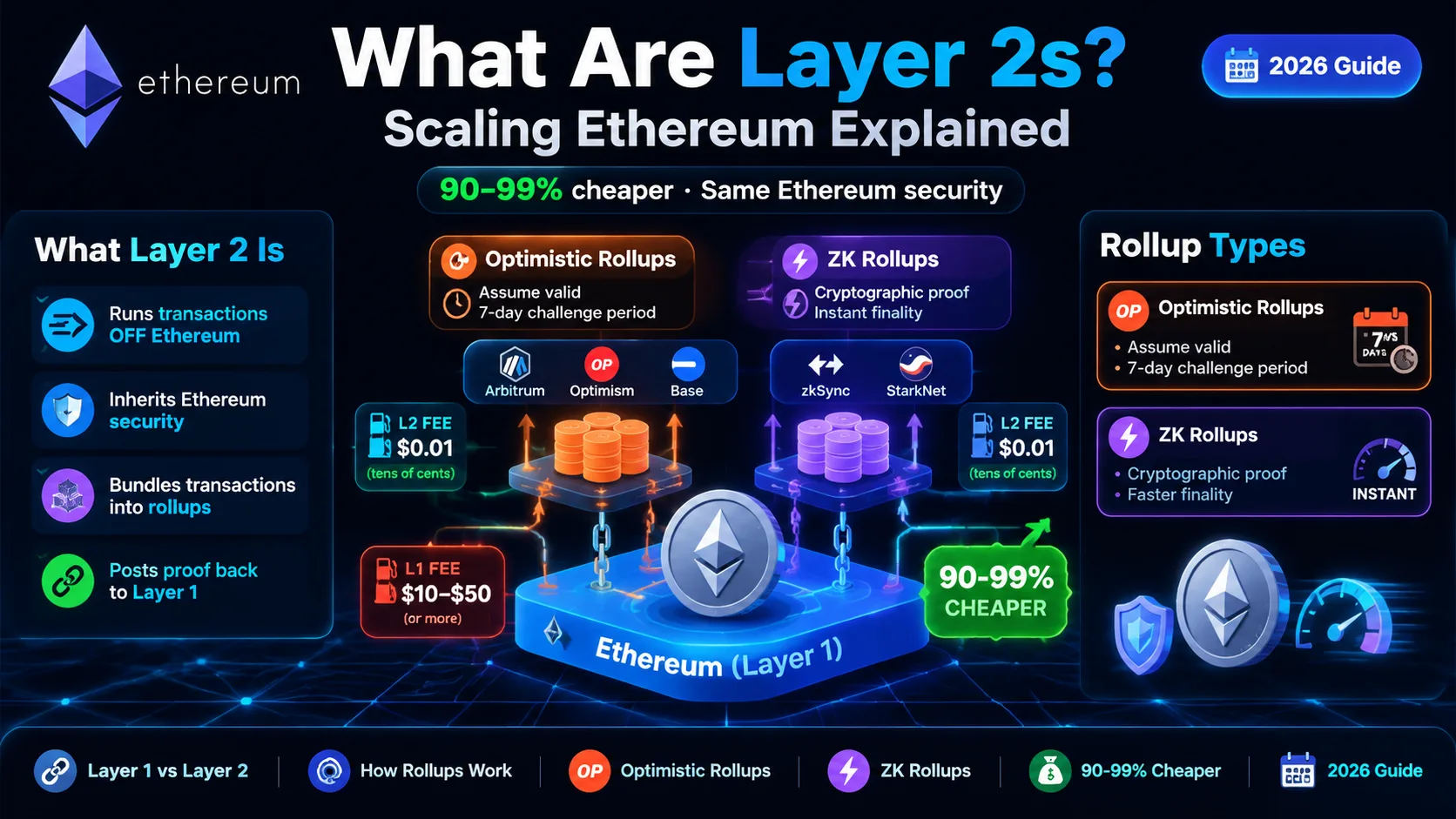
Layer 2s are networks that run transactions off Ethereum but inherit its security — making crypto 90–99% cheaper. Learn how rollups work, optimistic vs ZK, and why withdrawals take 7 days.
What Is XRP? Ripple Explained (2026)
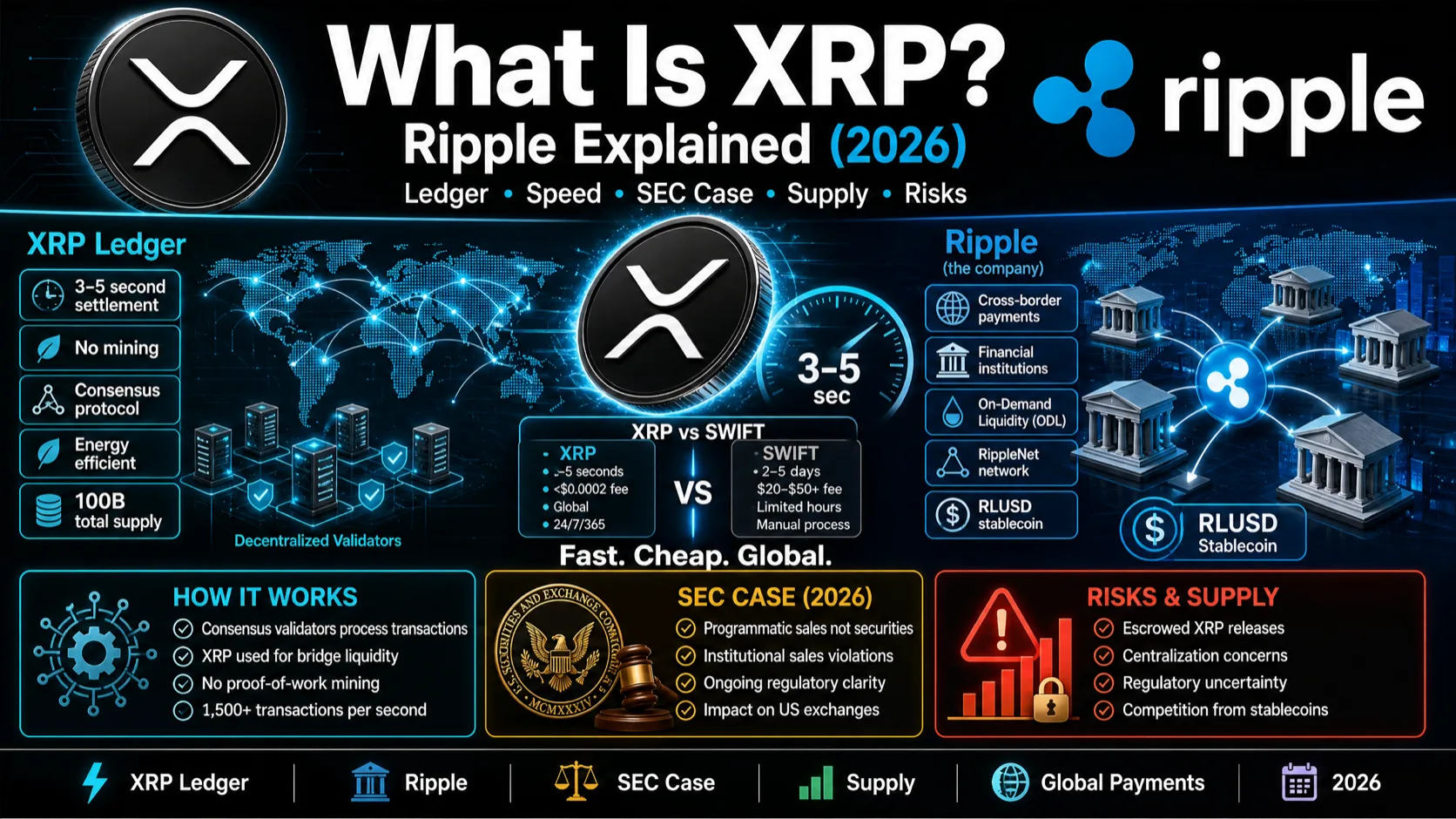
XRP is the native coin of the XRP Ledger, which settles payments in 3–5 seconds without mining. How it works in 2026, the SEC case, supply, and risks.