
What Is XRP? Ripple Explained (2026)
XRP is the native coin of the XRP Ledger, which settles payments in 3–5 seconds without mining. How it works in 2026, the SEC case, supply, and risks.
 Lucas Almeida 5 min read
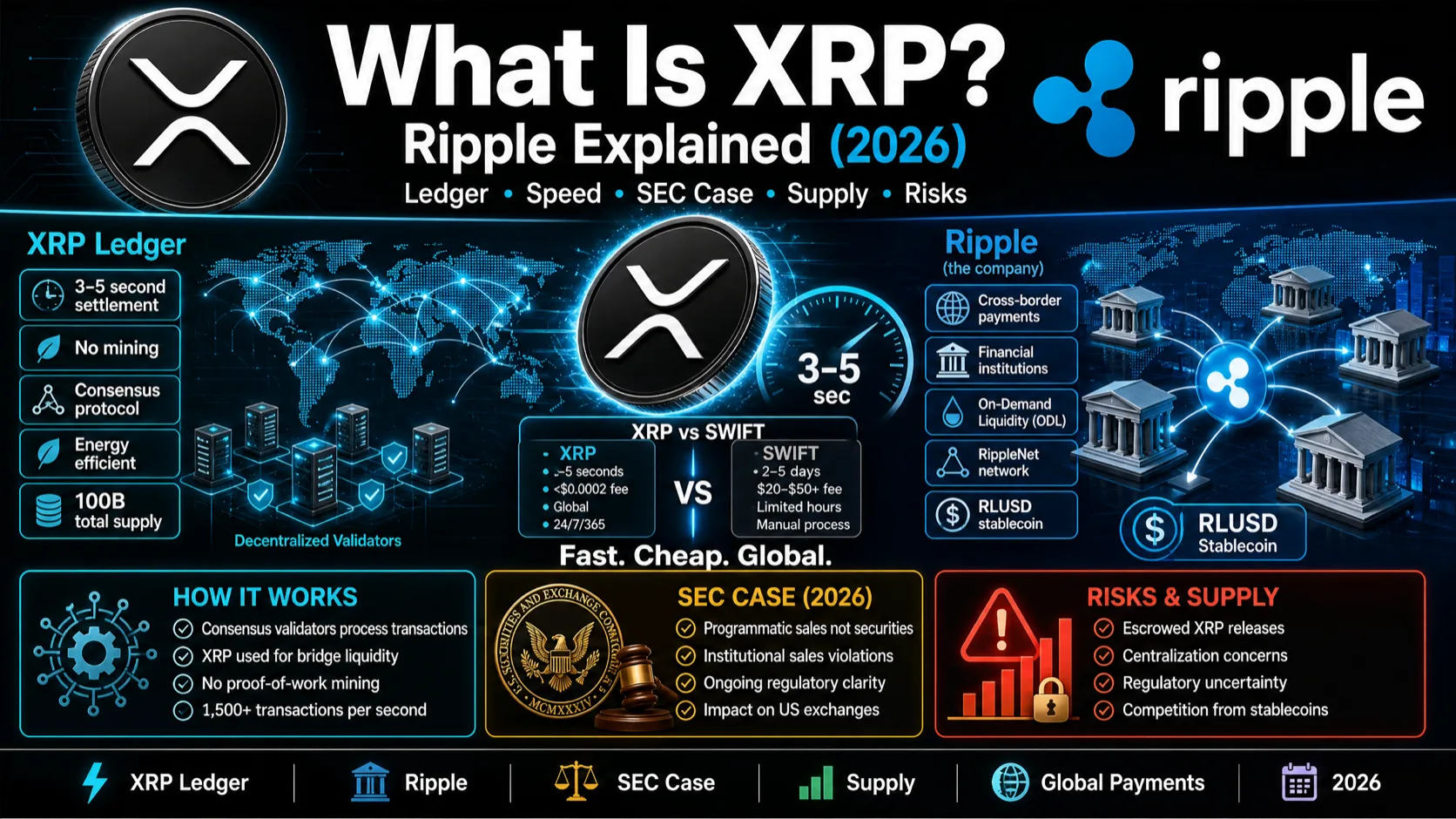
Key takeaways
- XRP is the native asset of the XRP Ledger, a public payments blockchain launched in 2012. It is not a share of Ripple, the company that helped build and still uses the network.
- All 100 billion XRP were created when the ledger launched. There is no mining, and every transaction destroys a tiny amount of XRP as a fee.
- The XRP Ledger uses federated consensus rather than proof of work: a ledger closes every 3–5 seconds, the network is built for about 1,500 transactions per second, and a standard transaction costs 10 drops (0.00001 XRP).
- The SEC sued Ripple in December 2020. A July 2023 ruling held that secondary-market XRP sales were not securities transactions, but institutional sales were; the case closed in August 2025 with a $125 million penalty and an injunction still in place.
- XRP's price is driven mainly by speculation, regulation and ETF flows, not by payment volume — and more than 30 billion XRP are still held in Ripple-controlled escrow, a supply overhang worth understanding before you buy.
XRP is the native cryptocurrency of the XRP Ledger, a public payments blockchain launched in 2012 that settles transactions in 3–5 seconds without mining. It is not a share of Ripple, the company that helped build the network and still uses XRP in its payment products. One XRP traded near $1.25 on 4 November 2026, giving it a market value of roughly $79 billion (CoinGecko) — making it one of the largest crypto assets by market cap.
That short answer hides most of what people actually want to know: why a coin with no mining exists, how the ledger reaches agreement without Bitcoin’s energy-heavy process, what the four-year SEC case actually decided, and why more than 30 billion XRP are still locked in escrow. This guide covers those questions in plain language, including the risks that do not fit in a price chart.
What Is XRP?
XRP is a digital asset used to pay transaction fees and move value on the XRP Ledger. The ledger is a public, open-source blockchain designed mainly for payments: sending value from one account to another quickly and cheaply, including across currencies.
Three design choices separate it from Bitcoin from the start:
- No mining. All 100 billion XRP were created at genesis in 2012. There is no block reward and no competition for hardware.
- A fixed, pre-allocated supply. The founders kept a large share, gave some away, and Ripple later placed most of its holdings into escrow. Bitcoin, by contrast, issues new coins over decades.
- Payments first. The ledger’s built-in features include a decentralised exchange, token issuance and cross-currency payments — not just a store of value.
XRP itself is the asset that pays fees and acts as a bridge in some payment routes. It is not a token issued on top of another chain, and it does not represent a claim on Ripple’s revenue.
Is XRP the Same as Ripple?
No — Ripple is a company, and XRP is an asset on a public blockchain. The confusion is understandable because Ripple owns a large amount of XRP, sells payment software to banks and fintechs, and has been the loudest corporate voice behind the network.
The practical differences matter:
| XRP | Ripple | |
|---|---|---|
| What it is | A digital asset on the XRP Ledger | A private payments technology company |
| What you own | Coins you can transfer or sell | Nothing, unless you are a shareholder |
| Who controls it | The ledger’s validators and users | Its board and investors |
| How it makes money | No cash flow; price is set by the market | Software licences and services |
Ripple uses XRP in On-Demand Liquidity (ODL), a product that lets payment providers fund cross-border transfers with XRP instead of pre-funding bank accounts around the world. That is real usage, but it is a small slice of XRP’s market value. Most XRP trading is speculative, and treating the coin as a proxy for Ripple’s business is a common mistake.
How Does the XRP Ledger Work?
The XRP Ledger reaches agreement through federated consensus: a set of trusted validators vote on which transactions to include, and a new ledger version closes every 3–5 seconds. There is no proof-of-work race and no proof-of-stake slashing mechanism of the kind Ethereum uses.
Here is the flow in plain terms:
- Transactions are broadcast to servers across the network.
- Validators — servers on each participant’s Unique Node List (UNL) — propose and vote on the next ledger version.
- When a supermajority of trusted validators agree, the ledger closes and the transactions become final.
- Failed or conflicting transactions are dropped; the network stops making progress rather than confirming invalid ones.
The performance numbers are the reason payment companies pay attention:
| Metric | XRP Ledger |
|---|---|
| Ledger close time | 3–5 seconds |
| Design throughput | About 1,500 transactions per second |
| Standard transaction cost | 10 drops, or 0.00001 XRP |
| Where the fee goes | Destroyed, not paid to a miner or validator |
| Mining | None |
The fee is deliberately tiny and is destroyed rather than collected. That makes spam expensive in aggregate but keeps ordinary payments cheap — a useful property if you are moving value between exchanges. The trade-off is governance: the validator set is not permissionless in the way Bitcoin’s mining is, and the UNL model concentrates trust in a smaller group of known operators. Supporters call that practical; critics call it a weaker form of decentralisation.
How Is XRP Different From Bitcoin?
XRP is built to move money quickly and cheaply, while Bitcoin is built to be a scarce, heavily decentralised store of value. Both are public blockchains, but almost every design decision follows from that difference.
| XRP | Bitcoin | |
|---|---|---|
| Launch | 2012 | 2009 |
| Maximum supply | 100 billion, all created at launch | 21 million, issued by mining |
| Issuance | None after genesis | Block subsidy halving roughly every four years |
| Consensus | Federated consensus with validator lists | Proof of work |
| Settlement | 3–5 seconds | About 10 minutes per block, often longer for finality |
| Transaction fee | 10 drops (0.00001 XRP), destroyed | Set by block space demand, paid to miners |
| Primary narrative | Cross-border payments and settlement | Digital gold and store of value |
| Governance | Validator list model, more corporate involvement | Mining and node operators, more diffuse |
Neither design is strictly better. Bitcoin’s scarcity and security come with slow, expensive settlement and high energy use. XRP’s speed and low fees come with a more concentrated validator set and a large insider supply. Which matters more depends on whether you want a settlement network or a monetary asset.
What Happened With the SEC Lawsuit?
The SEC sued Ripple in December 2020, alleging that XRP was an unregistered security. The case ended in August 2025 without a clear nationwide rule that XRP is not a security — but with a ruling that secondary-market sales were not securities transactions. The timeline is worth knowing because it still shapes how US platforms treat XRP.
| Date | What happened |
|---|---|
| 22 December 2020 | SEC files suit against Ripple Labs and two executives |
| 13 July 2023 | Judge Analisa Torres rules that programmatic exchange sales and other secondary sales were not securities offerings, but direct institutional sales were unregistered securities offerings |
| 7 August 2024 | Final judgment: a $125,035,150 civil penalty and an injunction against future Securities Act violations |
| 2025 | Both sides appeal; a proposed settlement cutting the penalty to $50 million and lifting the injunction is rejected twice by the court |
| 7 August 2025 | SEC and Ripple drop their appeals; the case is dismissed and the $125 million judgment stands |
The nuance matters, and the primary documents are worth reading: the SEC’s settlement filing records the judgment, and the 2025 dismissal closed the appeals. The court did not rule that XRP is never a security in every context. It ruled that the way XRP was sold on public exchanges did not meet the test, while Ripple’s direct contracts with institutional buyers did. Because the appeals were withdrawn rather than decided, the precedent is strong but not a nationwide statutory ruling. For buyers, the practical result is that XRP trades freely on major exchanges today; for Ripple, the injunction still limits how it can sell XRP directly in the US.
How Much XRP Exists?
XRP has a hard cap of 100 billion coins, all created in 2012. About 63.4 billion were circulating in November 2026, and most of the remainder is in Ripple-controlled escrow. There is no inflation, but there is a scheduled release of locked coins.
The supply mechanics work like this:
- 55 billion XRP were placed into 55 escrow contracts in December 2017, each releasing up to 1 billion XRP per month.
- Ripple usually re-escrows most of each release — commonly 60–80% — so the net increase in circulating supply is smaller than the headline 1 billion.
- Transaction fees are destroyed, permanently removing a tiny amount of XRP. More than 14 million XRP had been burned by 2026 (XRPScan), a rounding error against the 100 billion total but a real deflationary drip.
- The escrow is the overhang. Even with re-locking, the market knows that hundreds of millions of XRP can reach circulation each month, which caps how aggressively buyers price the asset.
This is not the same as Bitcoin’s halving schedule. XRP’s supply was fixed on day one; what changes is how quickly the locked portion becomes liquid.
What Is XRP Actually Used For?
XRP is used to pay ledger fees, as a bridge asset in cross-border payment routes, and increasingly as a speculative and ETF asset. The first two are the original purpose; the third is what drives the price today.
- Payments and remittances. The XRP Ledger can settle a transfer in seconds for a fraction of a cent, which makes it attractive for corridors where correspondent banking is slow or expensive.
- On-Demand Liquidity. Ripple’s ODL product lets a payment provider convert one currency into XRP, send it, and convert it again on the other side, avoiding pre-funded accounts.
- Stablecoins and tokenised assets. Ripple launched RLUSD, a New York-regulated dollar stablecoin, in December 2024. The XRP Ledger also supports issued tokens, NFTs and a native decentralised exchange.
- Exchange-traded funds. The first US spot XRP ETF, Canary’s XRPC, began trading on Nasdaq on 13 November 2025; Bitwise, Franklin Templeton, 21Shares and Grayscale products followed. ETFs make XRP easier to hold in a brokerage account, and they also tie the price more closely to institutional flows.
- Speculation. Most XRP volume on exchanges is trading, not payments. Be honest about which one you are participating in.
What Are the Main Risks?
The biggest risks are price volatility, the escrow overhang, supply concentration, a validator set that is less decentralised than Bitcoin’s, and competition from stablecoins and other payment chains. None of these is hypothetical.
- Volatility. XRP reached an all-time high of $3.65 on 17 July 2025 and traded near $1.25 in November 2026 — a drawdown of about two-thirds. A coin that can do that in 16 months is not a savings account.
- Supply overhang. More than 30 billion XRP remain in escrow. Monthly releases and Ripple’s sales are a known headwind that buyers price in, but they still add sell pressure.
- Concentration. Ripple and its founders hold a large share of the supply. That is a governance and market-structure risk that Bitcoin does not have in the same form.
- Validator trust. The UNL model means users rely on a curated list of validators. It is faster and cheaper than proof of work, but it is not the same security model.
- Competition. Stablecoins, central bank digital currencies and other payment networks are attacking the same cross-border corridor. XRP’s speed advantage is real but not unique.
- Regulation. The US case is closed, but the rules are still being written. A change in enforcement priorities can move the price and change which platforms list the asset.
How Do You Buy XRP?
You can buy XRP on major exchanges, including Binance, by registering, completing identity verification, and placing a spot order for XRP against USDT or another quote currency. The process takes minutes once your account is verified.
- Create and verify an account. Register through an invite link so the referral code is applied, then complete KYC. See the Binance registration guide.
- Fund your account. Deposit USDT or fiat using the method available in your country — see how to deposit on Binance.
- Buy XRP on the Spot market. Search for XRP/USDT and place a market or limit order. Check the fee tier before you trade; the Binance fees guide explains the 0.1% base rate and the BNB discount.
- Decide where to store it. Leaving XRP on an exchange is convenient but custodial. If you withdraw to your own wallet, choose the XRP Ledger network — not an ERC-20 or BEP-20 wrapper — and include the destination tag if the receiving platform gives you one. A missing or wrong tag can send funds to the wrong account.
💡 Don't have a Binance account yet? Sign up now — 20% fee rebate on spot and futures — enter the referral code BN2688.
US residents cannot use Binance.com; they need Binance.US or another US-regulated venue. XRP itself is legal to buy in the US, but the platform rules differ.
The Bottom Line
XRP is a fast, low-fee payments asset on a ledger that has been running since 2012, with a fixed 100 billion supply, no mining, and a corporate backer that owns a large share of it. The SEC case is over, the $125 million penalty and injunction stand, and spot ETFs have made XRP easier for mainstream investors to own.
It is also a volatile, concentrated asset whose price is driven more by speculation and regulation than by payment volume. If you buy it, size the position as a risk asset, understand the escrow overhang, and keep your coins off an exchange if you are not trading them. For the wider picture, see what Bitcoin is and how crypto exchanges work.
Price, market cap and circulating supply were checked on 4 November 2026 against CoinGecko and Binance spot data. Court dates and amounts come from the SEC’s settlement filing and the 2025 dismissal coverage. XRP’s supply schedule and ledger mechanics can change through validator voting — confirm current terms before relying on them.
Don't have a Binance account yet?Sign up nowenter the referral codeBN2688
Frequently asked questions
Is XRP the same thing as Ripple?
Is XRP a security?
How many XRP are there?
Who created XRP?
Why does the XRP price move so much?
Can US residents buy XRP on Binance?
Editor-in-Chief & Lead Researcher
Editor of MyCryptoStart. Independent researcher of cryptocurrency exchanges, focused on fees, security, KYC, and onboarding — publishes step-by-step guides in plain English for beginners.
View author page →Some links on this page are affiliate links: we may earn a commission at no extra cost to you. This content is educational and is not financial, investment, or legal advice. Affiliate disclosure · Disclaimer.
Continue reading

What Is AI Crypto? AI Tokens Explained (2026)
AI crypto combines artificial intelligence and blockchain — GPU networks, data markets, and autonomous agents. Learn how AI tokens work and the real risks.
What Are Layer 2s? Scaling Ethereum Explained
Layer 2s are networks that run transactions off Ethereum but inherit its security — making crypto 90–99% cheaper. Learn how rollups work, optimistic vs ZK, and why withdrawals take 7 days.
What Is Solana? SOL Explained (2026)
Solana is a fast, low-fee blockchain built to process thousands of transactions per second. Learn what SOL is, how it works, and the real risks.