
What Are Layer 2s? Scaling Ethereum Explained
Layer 2s are networks that run transactions off Ethereum but inherit its security — making crypto 90–99% cheaper. Learn how rollups work, optimistic vs ZK, and why withdrawals take 7 days.
 Lucas Almeida 5 min read
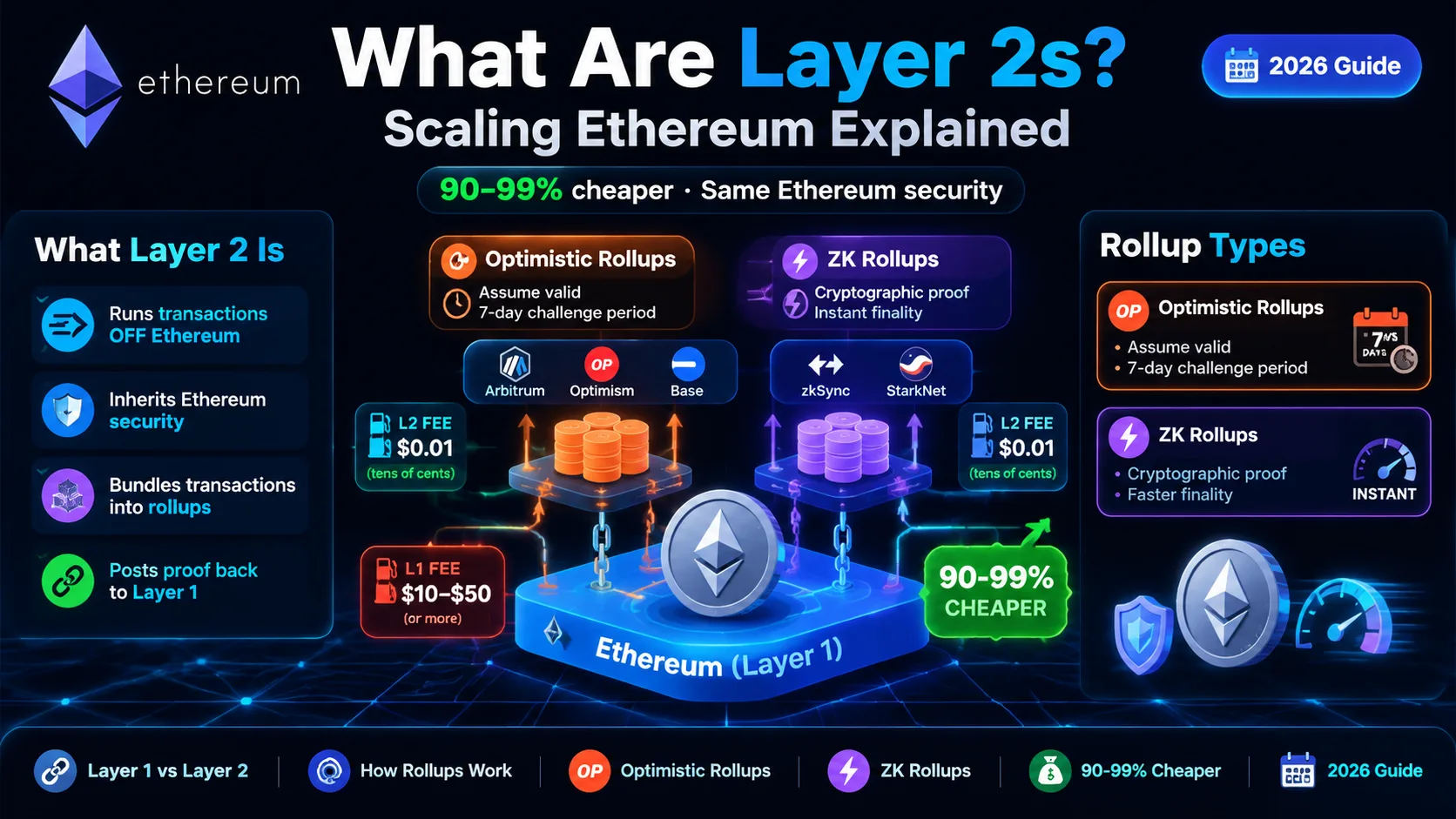
Key takeaways
- A layer 2 is a network that executes transactions off Ethereum and posts a compressed record back, so it inherits Ethereum's security at a fraction of the cost.
- The dominant design is the rollup, which 'rolls up' hundreds of transactions into one batch; the two families are optimistic (fraud proofs) and ZK (validity proofs).
- Fees on layer 2s run from a fraction of a cent to a few cents — 90–99% cheaper than mainnet — thanks to the 'blobs' introduced in 2024.
- The main trade-off is the withdrawal delay: optimistic rollups hold funds for roughly 7 days (a challenge window) before they can leave.
- The real risk lives in the bridge, not the network itself — bridges are a top hack target, so test with small amounts and use an exchange's native L2 support to skip the wait.
A layer 2 (L2) is a network that runs crypto transactions off Ethereum but settles them back onto Ethereum — which is how the same operation can cost a few cents instead of a few dollars. Think of it as a busy highway’s express lanes: the cars (transactions) move faster and cheaper off to the side, but they still report back to the main road that everyone trusts.
This guide explains what layer 2s are, how the two main designs (optimistic and ZK rollups) work, which networks matter in 2026, and — most usefully — the one thing that surprises every beginner: why your withdrawal can take a week, and how to avoid waiting.
What Is a Layer 2?
A layer 2 is a separate network built on top of a layer-1 blockchain. “Layer 1” is the base chain — Ethereum, Bitcoin, Solana — the network that does the real, expensive work of securing a shared ledger. A layer 2 sits above it, runs transactions on its own rails at high speed and low cost, then posts a compressed record of the results back down to layer 1.
The key insight is why this is safe. A proper layer 2 publishes its transaction data to Ethereum. That means Ethereum’s thousands of validators can, at any time, verify and reconstruct what happened on the layer 2 — even if the layer 2’s own operators vanished tomorrow. Ethereum’s own documentation frames it exactly this way: a layer 2 “inherits the security guarantees of Ethereum” while doing the heavy lifting itself.
This is the whole trick, and it matters more than any jargon: the layer 2 borrows Ethereum’s trust. It does not create a new, weaker trust system. It offloads the work while keeping the security anchored to the chain everyone already trusts.
Why Does Ethereum Need Layer 2s?
Because Ethereum mainnet is slow and, at peak, expensive. The base network processes roughly 15–30 transactions per second — and when demand spikes, everyone bids against everyone else for that limited block space, which is exactly what drives the fee spikes covered in our gas fees guide. A swap that costs a few dollars at quiet times can cost tens of dollars during a hot token launch.
The layer 2 is the fix that does not require rewriting Ethereum. Instead of every transaction fighting for space on the main chain, a layer 2 handles the flood of activity on the side and sends only a small, compressed summary back to Ethereum. The result, measured by L2Beat’s public data, is that by 2026 layer 2s were carrying the majority of Ethereum-ecosystem transaction volume — while charging a tiny fraction of the price.
The one-sentence mental model: Ethereum is the settlement layer; layer 2s are the everyday lanes. Ethereum stays secure and slightly expensive by design; the layer 2s absorb the volume.
How Rollups Work
The dominant type of layer 2 is the rollup, and the name is literal. A rollup rolls up hundreds or thousands of individual transactions into a single batch, executes them on its own fast network, and posts one compressed summary to Ethereum. Only that summary — not every transaction — pays Ethereum’s expensive layer-1 fee, and the cost is spread across everyone in the batch.
That is why the economics work. Ten thousand swaps might cost ten thousand small fees on the rollup, but only one compressed bundle has to touch Ethereum. Optimism’s explainer describes it as the difference between a busy city running every errand through one crowded downtown, versus batching the errands and sending one courier.
Rollups split into two families, distinguished by how they prove a batch is honest:
- Optimistic rollups assume every batch is valid unless someone challenges it. A challenge window opens after each batch, during which anyone can submit a fraud proof showing the batch was wrong.
- ZK rollups attach a validity proof — a compact cryptographic proof — to every batch, so Ethereum can verify it was correct the moment it lands, with no challenge needed.
The next section unpacks the difference, because it changes one very practical thing: how long you wait to get your money back out.
Optimistic vs ZK Rollups
The two families make opposite bets on trust, and that bet shows up in real-world behavior.
Optimistic rollups are “trust by default.” They post a claim about the new state of the chain, then wait — typically around 7 days on Arbitrum and OP Mainnet, and about 3.5 days on Base — for anyone to prove the claim false. If a fraud proof wins, the bad result is rolled back and the dishonest party loses a bond they put up. The trade-off: depositing is instant, but withdrawing to Ethereum waits out the full window. The delay is the safety mechanism, not an arbitrary annoyance.
ZK rollups are “prove as you go.” Every batch arrives with a cryptographic proof that the result is correct, and Ethereum verifies it in a single step. There is no challenge window because there is nothing to challenge, so finality is far faster — zkSync Era has cited around 3 hours versus the multi-day optimistic wait. The trade-off is cost and complexity: generating proofs is computationally heavy, and ZK rollups have historically been harder to make Ethereum-compatible.
In practice, as of 2026, optimistic rollups lead in adoption — Arbitrum, Base, and OP Mainnet together hold the bulk of layer-2 activity — while ZK rollups (zkSync Era, Starknet, Linea, Scroll) are widely seen as the long-term technical end state but trail in usage and locked value. A useful rule of thumb: for a beginner sending and trading crypto, you will almost certainly be using an optimistic rollup, which means the 7-day withdrawal rule is the one to know.
The Big Layer 2s in 2026
Three optimistic rollups dominate, and they now matter to regular users because major exchanges support them directly. The mid-2026 picture (TVL figures move a lot, so treat these as orders of magnitude):
| Network | Rollup type | Rough TVL (mid-2026) | Typical transfer fee |
|---|---|---|---|
| Arbitrum | Optimistic | ~$14–19B (largest) | ~$0.01–0.04 |
| Base | Optimistic | ~$10–12B | under ~$0.02 (cheapest) |
| OP Mainnet | Optimistic | ~$4B | ~$0.01–0.09 |
The fee column is the headline: all three run in the fractions of a cent to a few cents range for simple transfers, versus several cents to over a dollar on Ethereum mainnet. That collapse happened because of “blobs” — a separate, cheap data lane for rollups introduced by the Dencun upgrade (March 2024) and expanded through the Pectra (May 2025) and Fusaka (December 2025) upgrades. Zelcore’s breakdown traces exactly how blob scaling turned single-digit-cent fees into the norm.
Two cautions keep this honest. First, fees have converged so much that you should not pick a network on fees alone — the marginal difference is fractions of a cent, and ecosystem fit matters more (Arbitrum for deep DeFi, Base for easy on-ramping via Coinbase). Second, TVL is volatile: in the broad 2026 drawdown, layer-2 locked value fell sharply along with the rest of the market. The mechanism is durable even when the dollar number swings.
The Withdrawal Delay: What Actually Surprises Beginners
The single most common layer-2 gotcha is not a hack or a bug — it is the ~7-day withdrawal delay on optimistic rollups, and it hits people who were never warned.
Here is what happens. When you bridge from Ethereum onto Arbitrum, the money appears almost instantly — no waiting, because the risk of a fraudulent withdrawal has not started yet. But when you bridge back out to Ethereum through the canonical bridge, the transaction must sit through the full challenge window before the bridge releases your funds. Your money is not lost, and it is not stuck — it is just held by design while watchers get their chance to flag fraud.
The workarounds are practical, not exotic:
- Withdraw through an exchange that supports the network natively. Binance supports several layer-2 networks. When you send funds from the exchange straight to your L2 address — or back again — the exchange fronts the liquidity and you skip the multi-day wait entirely.
- Use a fast bridge. Services like Across or Hop advance you the funds immediately for a fee and absorb the waiting risk themselves.
- Stay on the layer 2. Keep everyday activity — swaps, transfers, apps — on the L2, and only make the round trip to mainnet when you actually need to.
The mental model that prevents the panic: deposits are instant, exits are gated. Know which direction you are moving before you click.
Bridges: The Risk That Lives Between
If the network itself is generally safe, the real layer-2 risk sits in the bridge — the set of smart contracts that move funds between Ethereum and the layer 2.
Bridges are an attractive target precisely because they concentrate value: a bridge contract holds a large pool of funds, and a bug in its code can be drained in one exploit. This is why bridges, across the industry, have been among the most consistently targeted pieces of infrastructure. The network-level security a rollup inherits from Ethereum does not automatically protect you from a bridge bug.
The sensible habits are the same ones you already know, applied to bridges: test with a small amount first, double-check the network and address, and keep the transaction hash. If you can route through an exchange’s native support instead of a bridge, you dodge the risk category almost entirely — the exchange is the trusted middleman, and it handles the bridge on the back end. For the full security picture that surrounds this, our wallet security guide covers the rules in one place.
Layer 2 vs Sidechain vs Layer 1
The labels blur, but the security difference is sharp, and it is worth thirty seconds to internalize.
- A layer 1 is a base chain — Ethereum, Bitcoin, Solana — with its own validators and its own security.
- A rollup (layer 2) posts its data to Ethereum, so Ethereum can verify it. It inherits Ethereum’s security.
- A sidechain (like Polygon PoS or BNB Smart Chain) runs its own validators and its own security budget. It is a separate chain that happens to be Ethereum-compatible, but Ethereum has no visibility into it.
The distinction is the whole point of the word “layer 2.” A rollup is cheaper because it reuses Ethereum’s security rather than paying for a new one. A sidechain can also be cheap and fast, but it does not give you the same guarantee that you can always reconstruct your balance from Ethereum. When a project calls itself a layer 2, the useful question is: does it post its data to Ethereum? If not, you are looking at a sidechain wearing a layer-2 nametag.
Should You Use a Layer 2?
For most beginners, the honest answer is: yes, and you probably already are without realizing it.
If you have ever withdrawn USDT or ETH from an exchange and picked a cheaper network than Ethereum mainnet, you have used a layer 2. If you have held funds on Coinbase’s Base network, you have used one. The layer 2 is not a niche product for DeFi traders — it has become the default lane for cheap crypto movement, and exchanges have quietly made it the norm.
The decision framework is short:
- Moving or trading small-to-medium amounts? Use a layer 2. The fee difference is the single biggest saving available to you, and the math is covered in our gas fees guide.
- Need to withdraw to Ethereum specifically? Expect the ~7-day window on optimistic rollups, or withdraw through an exchange that supports the network to skip it.
- Holding long-term? Consider whether you want your assets on an L2 at all, or in a wallet you fully control — our how to store crypto guide walks through the trade-offs.
The one thing to stop doing is paying mainnet prices for a transaction that belongs on a layer 2. If your fee quote looks like a real amount of money, you are on the wrong lane.
💡 Don't have a Binance account yet? Sign up now — 20% fee rebate on spot and futures — enter the referral code BN2688.
Before any of this matters, you need crypto to move in the first place. If you have not opened an account yet, start with our step-by-step guide to buying crypto — and when you withdraw, the network-selection step is where the layer-2 savings actually happen. If you want the fuller picture of what a layer 2 is scaling in the first place, our Ethereum guide explains the base chain, smart contracts, and why it works the way it does.
The Bottom Line
A layer 2 is a network that runs transactions off Ethereum but settles them back onto it, borrowing Ethereum’s security to offer fees 90–99% lower. The dominant design is the rollup, split into optimistic (trust by default, with a ~7-day challenge window) and ZK (prove every batch, near-instant finality). The cost is now so low that the fees barely matter; the things that do matter are the withdrawal delay, the bridge risk, and the difference between a rollup and a sidechain.
The practical summary: use a layer 2 for everyday movement, expect the ~7-day exit on optimistic rollups, and route through your exchange’s native network support to skip both the wait and the bridge risk. Do that, and a transaction that would have cost dollars on mainnet comes in at cents — without giving up the security of the chain you already trust.
Don't have a Binance account yet?Sign up nowenter the referral codeBN2688
Frequently asked questions
What is a layer 2 network?
What is the difference between optimistic and ZK rollups?
Why does it take 7 days to withdraw from a layer 2?
Are layer 2 networks safe?
How do I move my crypto onto a layer 2?
What is the difference between a layer 2 and a sidechain?
Editor-in-Chief & Lead Researcher
Editor of MyCryptoStart. Independent researcher of cryptocurrency exchanges, focused on fees, security, KYC, and onboarding — publishes step-by-step guides in plain English for beginners.
View author page →Some links on this page are affiliate links: we may earn a commission at no extra cost to you. This content is educational and is not financial, investment, or legal advice. Affiliate disclosure · Disclaimer.
Continue reading

What Is AI Crypto? AI Tokens Explained (2026)
AI crypto combines artificial intelligence and blockchain — GPU networks, data markets, and autonomous agents. Learn how AI tokens work and the real risks.
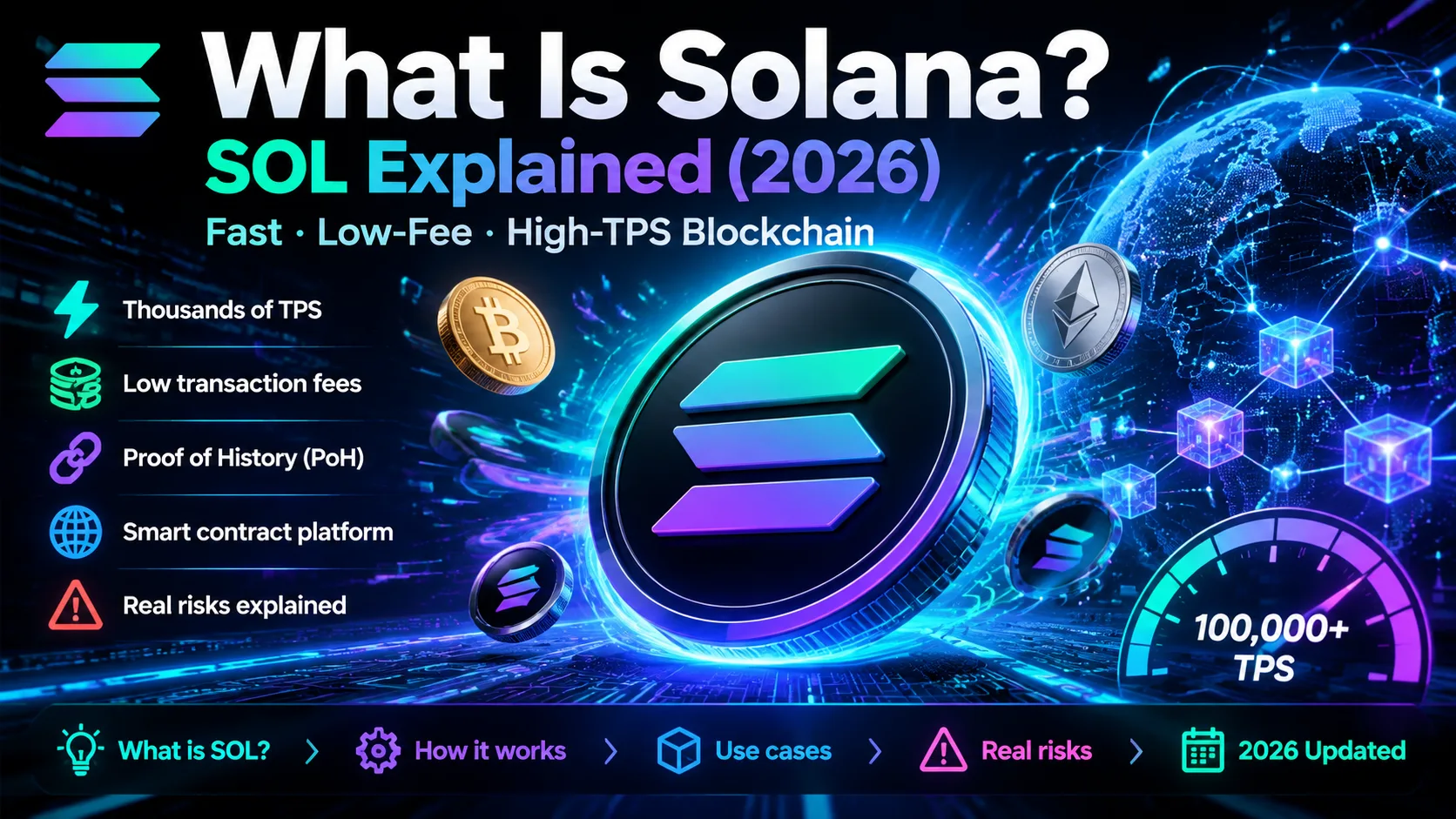
What Is Solana? SOL Explained (2026)
Solana is a fast, low-fee blockchain built to process thousands of transactions per second. Learn what SOL is, how it works, and the real risks.
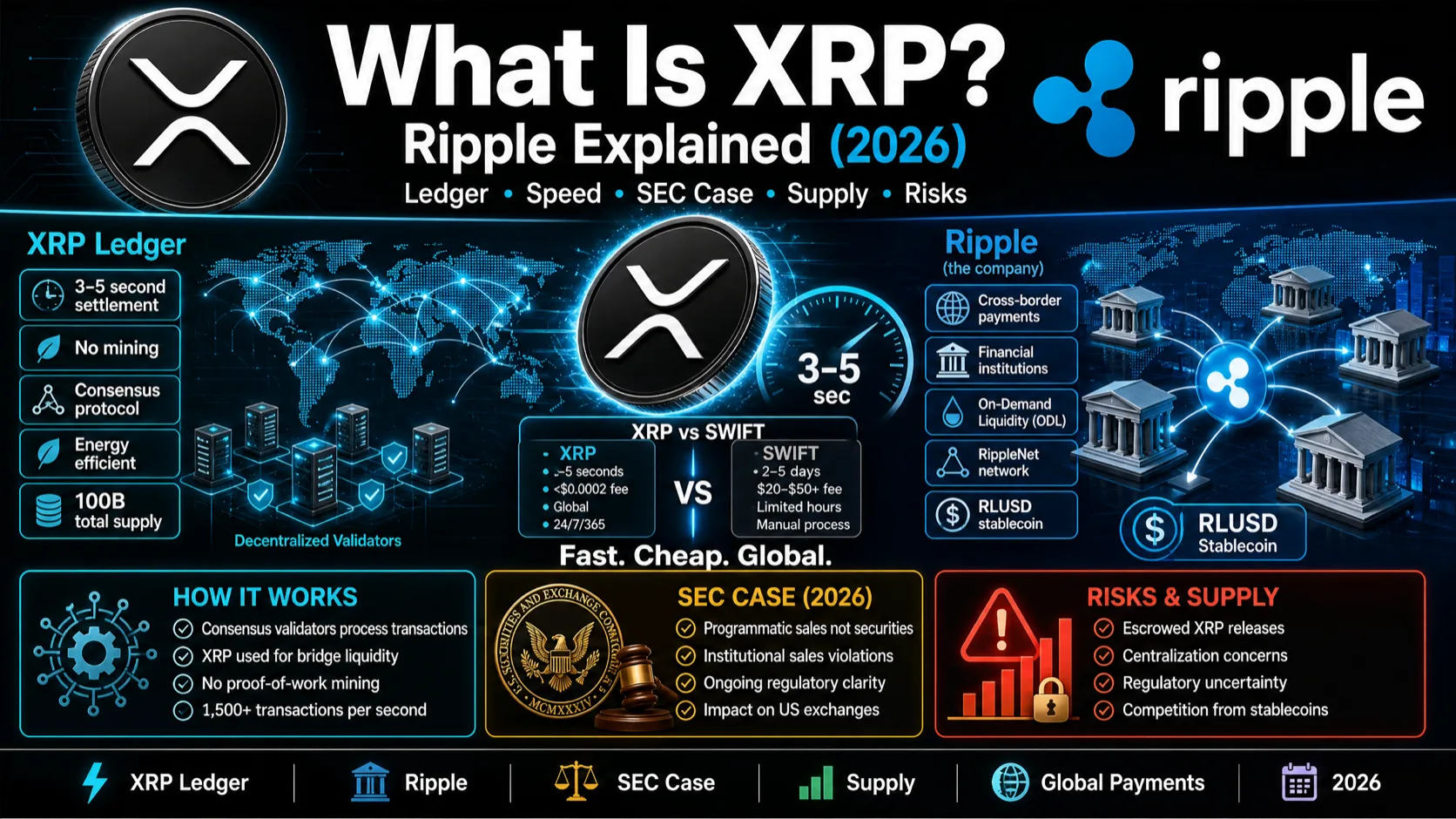
What Is XRP? Ripple Explained (2026)
XRP is the native coin of the XRP Ledger, which settles payments in 3–5 seconds without mining. How it works in 2026, the SEC case, supply, and risks.