
What Are Real-World Assets (RWA)? 2026 Guide
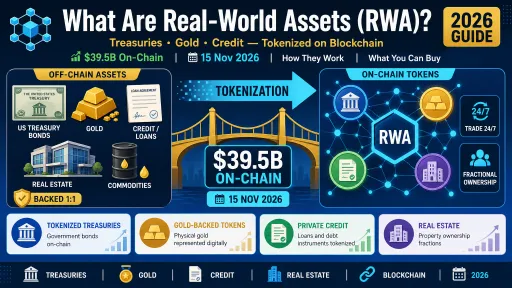
RWAs are blockchain tokens backed by off-chain assets like Treasuries, gold and credit. $39.5B sat on-chain on 15 Nov 2026 — how they work and what you can buy.
 Lucas Almeida 5 min read
Key takeaways
- Real-world assets (RWAs) are blockchain tokens that represent a claim on an off-chain asset such as a Treasury bill, gold bar, loan or share.
- On 15 November 2026, RWA.xyz counted $39.53B in distributed on-chain asset value across 7,041 assets and 5.75M holder addresses; its broader represented value was $421.73B.
- Tokenized US Treasuries were the largest category at about $14.2B in early November 2026, roughly 35% of the distributed total.
- Most tokenized Treasury funds are not retail products: BUIDL, USDY and similar tokens restrict transfers to eligible or non-US investors, and the token is a claim on an issuer, not the bond itself.
- Buying ONDO or PAXG on an exchange is not the same as buying a tokenized Treasury fund: ONDO is a governance token, while PAXG is a claim on allocated gold held by Paxos.
Real-world assets (RWAs) are blockchain tokens that represent a claim on something that exists off-chain — a US Treasury bill, a gold bar, a loan, a share or a property. The token does not move the asset onto the blockchain; it moves the ownership record. On 15 November 2026, RWA.xyz counted $39.53B in distributed on-chain asset value across 7,041 assets, with 5.75 million holder addresses.
That distinction is the whole subject in one sentence. A tokenized Treasury fund still holds its bills at a custodian; the token is a claim on the fund. A tokenized gold product still stores metal in a vault; the token is a redemption claim. When the issuer, custodian or legal wrapper fails, the token does not magically become the asset.
This guide covers the 2026 market size and why the numbers disagree, the main RWA categories, how issuance and redemption actually work, what a retail buyer can and cannot purchase, the risks that matter, and how the SEC framed tokenized securities in 2026.
⚠️ The most important thing first: don’t tap Sign Up directly in the app — you’ll miss the new-user rewards. The welcome benefits only apply when you register through an invite link or enter the referral code BN2688. Remember this.
💡 Don't have a Binance account yet? Sign up now — 20% fee rebate on spot and futures — enter the referral code BN2688.
What are real-world assets in crypto?
Real-world assets are tokens whose value comes from an off-chain asset, and the token gives the holder a legal or economic claim on that asset. The claim can be direct ownership, a fund share, a debt obligation or a synthetic exposure, and the difference matters more than the token’s ticker.
A typical tokenized fund has four layers:
- The asset — a Treasury bill, a corporate loan, gold, a share or a property.
- The legal wrapper — usually a special-purpose vehicle (SPV) or a fund that holds the asset off-chain.
- The custodian and transfer agent — a regulated institution that safekeeps the asset and maintains the ownership record.
- The token — a blockchain entry that the issuer promises to redeem or that gives transfer rights in the wrapper.
Tokenization changes the plumbing, not the asset. The SEC’s staff put it directly in a joint statement on 28 January 2026: tokenization changes the way ownership is recorded and transferred, but the federal securities laws still apply to the underlying instrument. A tokenized share is still a share; a tokenized fund interest is still a fund interest.
That is why two tokens with similar names can be completely different products. PAXG is a claim on allocated gold. ONDO is a governance token for a protocol that issues tokenized funds. BUIDL is a share class of a money-market fund. They are all called “RWA” in market coverage, but only one of them gives you a claim on a Treasury bill.
How big is the RWA market in 2026?
The RWA market was about $39.5B in distributed on-chain value on 15 November 2026, according to RWA.xyz. The same dashboard showed $421.73B in “represented asset value,” and the gap between those two numbers explains most of the conflicting headlines.
| Measure | Value on 15 Nov 2026 | What it counts |
|---|---|---|
| Distributed asset value (RWA.xyz) | $39.53B | Tokens actually issued and tracked on-chain, excluding stablecoins |
| Represented asset value (RWA.xyz) | $421.73B | Underlying assets represented by those tokens, including large non-tradable records |
| Tokenized US Treasuries | About $14.2B (early Nov 2026) | Treasury and money-market products, roughly 35% of the distributed total |
| Stablecoins (tracked separately) | $277.43B | Tokenized fiat, 306.51M holder addresses |
| Tokenized gold (XAUT + PAXG) | About $4.7B | Two largest gold products on RWA.xyz |
| Number of tracked assets | 7,041 | Equities, credit, rates, commodities, real estate, alternatives |
| Holder addresses | 5.75M | Addresses, not unique people |
The represented value is larger because it includes assets that are recorded on-chain but not freely tradable. In November 2026, for example, Canton and Broadridge accounted for roughly $320.7B in tokenized repo records — a real use of blockchain for record-keeping, but not a $320B market that a retail buyer can trade.
Methodology also varies by tracker. CoinDesk Research put the market at $38.6B at the end of September 2026, up about 51% from $25.5B in late 2025. Token Terminal and CryptoBriefing used a broader measure of about $46.1B excluding stablecoins in early November 2026. The Block’s explainer, updated in September 2026, said RWAs had grown from $100M in 2021 to over $60B — a figure that includes stablecoins.
A November 2026 comparison by TokenBank put the published range at $21.4B to $358B, depending on what each source counts. That is not a scandal; it is a definition problem. When you read an RWA market-size claim, check whether it includes stablecoins, whether it counts represented assets, and whether the assets are transferable.
What types of RWAs exist?
The largest RWA categories are tokenized Treasuries and money-market funds, private credit, commodities, equities and real estate. RWA.xyz tracked 7,041 assets on 15 November 2026, but the count is dominated by tokenized stocks while the value is dominated by Treasuries and gold.
| Category | Tracked assets | Examples and size on 15 Nov 2026 |
|---|---|---|
| US Treasuries and money market | 114 Treasury products within 142 rates assets | Ondo USDY $2.4B, USYC $2.0B; BlackRock BUIDL $1.7B; Franklin BENJI $1.3B |
| Private credit | 205 credit assets | Maple syrupUSDC $886.8M; JAAA $581.4M; PRIME $543.6M |
| Commodities | 88 assets | Tether Gold XAUT $3.0B; Paxos Gold PAXG $1.7B |
| Equities and private equity | 6,488 equities | Tokenized stock wrappers, mostly small; BCAP private equity $938.3M |
| Real estate | 63 assets | GRO $95.2M; smaller fractional property tokens |
| Alternatives and active strategies | 55 assets | eurSAFO $2.0B; sUSDe $1.2B |
Tokenized Treasuries are the cleanest product to understand. The issuer buys short-term US government debt, holds it with a custodian, and issues a token that can be redeemed for cash or transferred to an eligible investor. The yield comes from the bills, minus the issuer’s fee. The token is not a bearer bond, and the holder usually has to pass KYC and meet transfer restrictions.
Private credit is the fastest-growing category by narrative but the hardest to underwrite. A token may represent a slice of a loan portfolio with limited disclosure, and the advertised yield can include both interest and protocol incentives. In a stress event, the secondary market for these tokens can be much thinner than the headline market size suggests.
Commodities are the most retail-accessible category. XAUT and PAXG each represent allocated gold, and both trade on major exchanges. They are still custodial claims: you rely on the issuer’s vault, audit and redemption process, not on a bar stored in your own safe.
Tokenized equities are the noisiest category by count. Thousands of tokens can represent the same handful of stocks through different wrappers and jurisdictions, and many are not available to US persons. Ondo Global Markets, for example, passed $1B in TVL within eight months of launch and offers tokenized stocks and ETFs outside the United States; the tokens are backed by shares held through a broker-dealer, but they are not the same as holding a share in a US brokerage account.
How does tokenization actually work?
Tokenization works by separating the asset from its ownership record: the asset stays with a custodian, while the token becomes the transferable record of the claim. The issuer’s legal documents decide whether that claim survives the issuer’s bankruptcy.
The process usually runs in five steps:
- Acquire the asset. The issuer buys the Treasury bills, gold, loans or shares.
- Place it in a wrapper. A fund or SPV holds the asset, often bankruptcy-remote from the issuer.
- Appoint a custodian. A regulated bank or custodian safekeeps the asset and produces attestations or audits.
- Issue the token. A tokenization platform mints tokens that represent units in the wrapper, with transfer restrictions coded into the contract.
- Enable redemption. The issuer buys back tokens at a defined price or lets holders redeem through a process, subject to gates and eligibility.
The legal wrapper is where most of the risk sits. A properly structured SPV with segregated assets and an independent custodian can keep the underlying asset out of the issuer’s bankruptcy estate. A synthetic token that merely promises to track an asset, or an issuer that commingles customer assets, gives you a much weaker claim.
The blockchain layer adds three practical properties: 24/7 transfer, near-instant settlement and composability with DeFi. Those properties are real, but they do not remove the off-chain dependency. A token can trade at 3 a.m. while the custodian’s redemption desk is closed.
What RWA products can retail investors actually buy?
Retail buyers can access tokenized gold, some tokenized equity wrappers and governance tokens on public exchanges; direct tokenized Treasury funds are mostly restricted to eligible or non-US investors. The product name tells you much less than the eligibility page.
| Product | What you actually own | Who can buy it |
|---|---|---|
| PAXG | A claim on one fine troy ounce of allocated LBMA gold held by Paxos | Retail where the token is listed, subject to Paxos terms |
| XAUT | A claim on allocated gold held by Tether | Retail where listed, subject to issuer terms |
| ONDO | A governance token for the Ondo protocol | Retail on exchanges; not a claim on USDY or USYC |
| USDY | A yield-bearing note backed by short-term Treasuries | Non-US investors after KYC; US persons excluded |
| BUIDL | Shares in a tokenized money-market fund | Qualified purchasers through Securitize |
| BENJI | Shares in Franklin Templeton’s on-chain money-market fund | Depends on jurisdiction and brokerage |
| Tokenized stocks (Ondo GM and similar) | Economic exposure backed by shares held via a broker-dealer | Mostly non-US investors; check the issuer’s restrictions |
If you want RWA exposure from a crypto exchange, the practical options are PAXG, XAUT and ONDO. Binance lists PAXG and ONDO on spot, and it has become the largest venue for RWA perpetual futures: CoinMarketCap data cited in January 2026 put Binance at 68.37% of year-to-date RWA perps volume, ahead of OKX at 14.63%.
That is a different product from a tokenized Treasury fund. A perpetual future is a leveraged derivative with funding payments and liquidation risk; it gives you price exposure, not ownership. A governance token gives you exposure to a protocol’s success, not to the assets it tokenizes. Neither is a substitute for a Treasury bill.
Before buying, read three things: the issuer’s redemption terms, the transfer restrictions, and the custody arrangement. If the product page does not say who holds the asset and how you get your money back, the yield is not the most important number on the page.
What are the biggest risks in RWAs?
The biggest RWA risks are custody and issuer failure, redemption gates, thin liquidity, smart-contract bugs and regulatory change — not the price volatility of the token alone. Most of these risks are invisible on an exchange chart.
| Risk | What it looks like | What to check |
|---|---|---|
| Issuer or custodian failure | The token still trades, but redemptions stop | Bankruptcy-remote structure, segregated custody, audited reserves |
| Redemption gates | Withdrawals are paused or limited to large holders | Redemption terms, notice periods, minimum sizes |
| Liquidity | A large market cap with a thin order book | Secondary-market depth, bid-ask spread, daily volume |
| Smart contract | A bug, upgrade or bridge exploit drains the token | Audits, admin keys, upgrade controls, chain risk |
| Regulatory | The token is deemed a security or restricted in your country | Offering documents, transfer restrictions, local rules |
| Synthetic exposure | You hold a promise, not the asset | Counterparty, collateral, whether the token is backed 1:1 |
| Depeg | The token trades below its net asset value | Premium/discount history, redemption mechanics |
The 2026 market has already produced examples of each. Tokenized real estate has repeatedly struggled with liquidity: a property token can be easy to buy and hard to sell, and the valuation only updates when an appraiser or issuer marks it. Tokenized private credit can offer a high yield because the underlying loans are illiquid and the disclosure is limited. Tokenized gold is more liquid, but it still depends on the issuer’s vault and redemption process.
There is also a definition risk. A product can be marketed as “RWA” while the token gives you no legal claim on the asset at all. A synthetic stock token, a perp or a governance token may be a legitimate product, but it is not the same as owning the underlying. The label is not the legal structure.
How are RWAs regulated in 2026?
In 2026, regulators moved from asking whether tokenization is legal to applying existing rules to tokenized instruments. The SEC’s staff statement on 28 January 2026 set the tone: tokenization changes the plumbing, not the regulatory perimeter.
The SEC staff described two broad categories. Issuer-sponsored tokenized securities are issued by the company itself, with the token integrated into the official shareholder record or issued alongside an off-chain security. Third-party sponsored tokenized securities include custodial models, where a token represents an entitlement to a security held by a custodian, and synthetic models, where the token provides economic exposure without ownership.
The SEC followed with a five-category crypto taxonomy on 17 March 2026, proposed a tailored “Regulation Crypto Assets” offering regime on 18 August 2026, and proposed modernized transfer-agent and custody rules later in the year. The CLARITY Act, which would have set a statutory market-structure framework, passed the House in July 2025 but failed a Senate procedural vote on 15 September 2026, leaving much of the framework to agency guidance.
For a buyer, the practical test is simple: if the token is a security, securities law applies; if it is a fund share, fund rules apply; if it is a commodity claim, commodity rules apply. The token wrapper does not create a regulatory hole. In the EU, tokenized securities generally fall under MiFID II, while stablecoins fall under MiCA.
Should beginners buy RWAs?
Beginners should treat RWAs as a small, satellite position after they understand the claim, the custodian and the redemption process — not as a substitute for cash or a bond fund. The category is real and growing, but the products are not interchangeable.
A sensible learning path is to start with the simplest structure and read the documents before buying:
- Tokenized gold (PAXG or XAUT) is the easiest to understand: one token, one ounce, a named custodian. It still carries issuer and redemption risk.
- A tokenized Treasury fund (USDY, BUIDL, BENJI) is a claim on short-term government debt, but access is restricted and the yield is not free money.
- A governance token (ONDO) is a bet on a protocol, not a savings product.
- A perpetual future is a leveraged trade with funding and liquidation risk, not an RWA holding.
Keep position sizes small, check the issuer’s audit and redemption terms, and avoid any product that promises a fixed yield without explaining where the yield comes from. If a platform markets an RWA with a “guaranteed” return, treat that as a red flag.
Our guides to stablecoins, DeFi and custodial vs non-custodial wallets explain the building blocks. If you plan to buy PAXG or ONDO on Binance, the registration guide and fee guide cover the account and cost side.
Frequently asked questions
Are stablecoins real-world assets?
Stablecoins are tokenized fiat, so they are technically RWAs, but most trackers report them separately. RWA.xyz counted $277.43B of stablecoins and $39.53B of other distributed RWAs on 15 November 2026. Mixing the two is why some articles claim the RWA market is over $300B.
What is the difference between RWA and tokenization?
Tokenization is the process; an RWA is the result. Tokenization puts a legal claim on an off-chain asset into a blockchain token, and that token is the RWA. The underlying bond, gold bar or loan still sits with a custodian off-chain.
Can I buy BlackRock’s BUIDL token?
Not as an ordinary retail investor. BUIDL is a tokenized money-market fund offered through Securitize and aimed at qualified purchasers, a US category that generally requires at least $5 million in investments. Retail access depends on your jurisdiction and the issuer’s transfer restrictions.
Is PAXG the same as owning gold?
PAXG is a claim on one fine troy ounce of allocated LBMA gold held by Paxos, redeemable under the issuer’s terms. You own a redemption claim against a custodian, not a bar in your hand, and you rely on Paxos’s reserves, audits and redemption process.
What is the ONDO token?
ONDO is the governance token of the Ondo protocol, not a share of the USDY or USYC funds. Buying ONDO gives you exposure to the project’s token, while buying USDY would give you a yield-bearing claim on short-term Treasuries, subject to eligibility rules.
Do RWAs pay interest?
Some do. Tokenized Treasury and money-market products pass through the yield on the underlying bills, minus fees; RWA.xyz showed a seven-day average yield of about 3.63% for the Treasuries category in early November 2026. Governance tokens and tokenized collectibles do not pay interest.
Can I buy RWAs on Binance?
Binance lists liquid RWA-adjacent tokens such as PAXG for tokenized gold and ONDO for the Ondo protocol, and it is the largest venue for RWA perpetual futures. It does not list restricted tokenized Treasury funds such as BUIDL or USDY for retail buyers.
What happens if the RWA issuer fails?
Your recovery depends on the legal structure. A bankruptcy-remote SPV with a segregated custodian may protect the underlying asset, while a synthetic token or an unsegregated issuer balance sheet may leave you as a general creditor. Read the offering documents before buying.
Bottom line
Real-world assets are a genuine bridge between traditional finance and blockchains, but the token is a claim, not the asset. The market held about $39.5B in distributed on-chain value on 15 November 2026, led by tokenized Treasuries and gold, while the much larger represented value includes assets that are not freely tradable.
For a beginner, the useful distinction is between three products that all get called RWA: a tokenized fund share (a regulated claim with eligibility rules), a commodity token (a custodial claim on gold) and a governance token (a bet on a protocol). Buy only the one whose structure you can explain, check the custodian and redemption terms, and keep the position small. This guide is educational and is not investment advice.
Don't have a Binance account yet?Sign up nowenter the referral codeBN2688
Frequently asked questions
Are stablecoins real-world assets?
What is the difference between RWA and tokenization?
Can I buy BlackRock's BUIDL token?
Is PAXG the same as owning gold?
What is the ONDO token?
Do RWAs pay interest?
Can I buy RWAs on Binance?
What happens if the RWA issuer fails?
Editor-in-Chief & Lead Researcher
Editor of MyCryptoStart. Independent researcher of cryptocurrency exchanges, focused on fees, security, KYC, and onboarding — publishes step-by-step guides in plain English for beginners.
View author page →Some links on this page are affiliate links: we may earn a commission at no extra cost to you. This content is educational and is not financial, investment, or legal advice. Affiliate disclosure · Disclaimer.
Continue reading
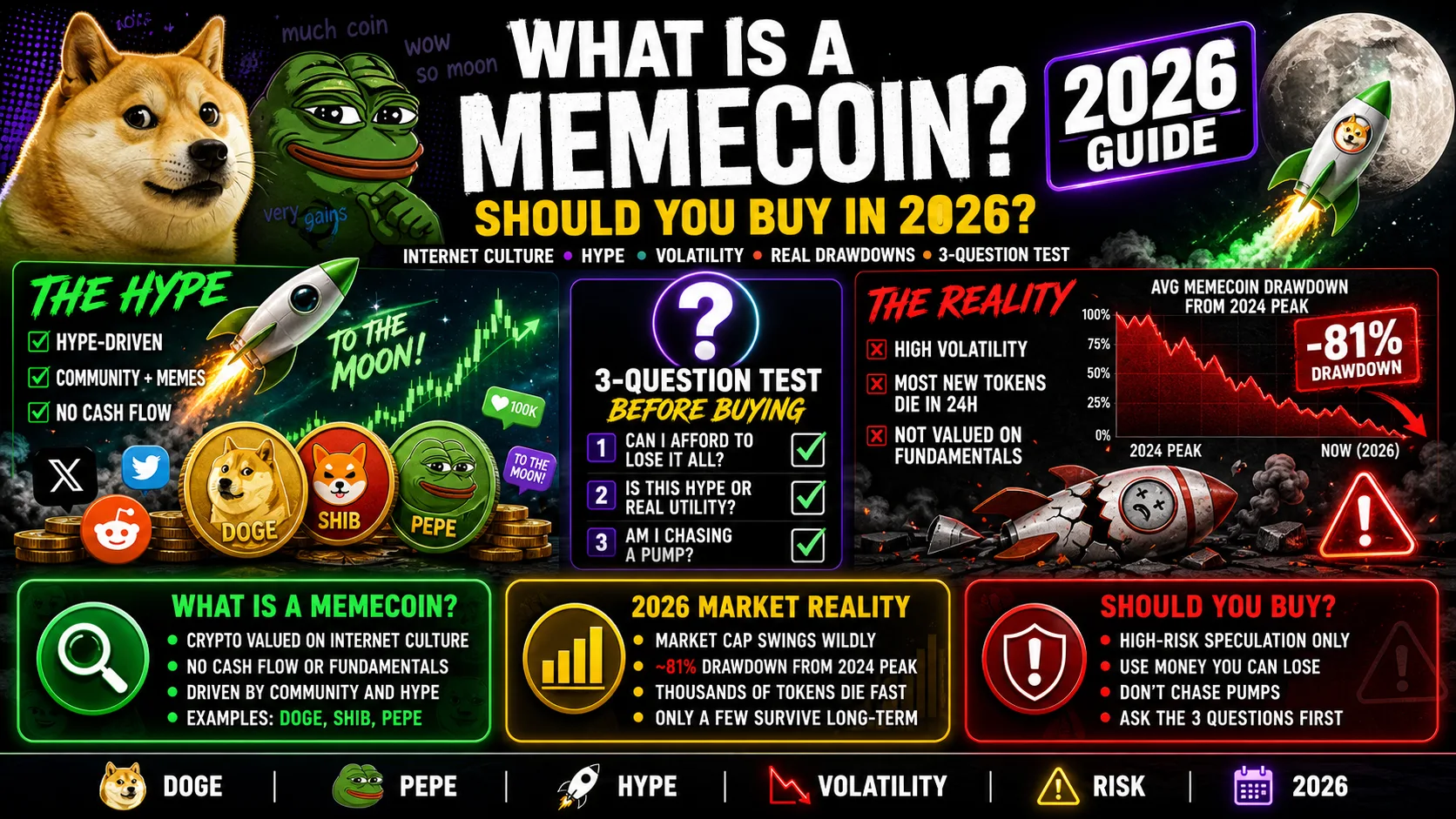
What Is a Memecoin? Should You Buy in 2026?
A memecoin is crypto valued on internet culture, not cash flow. See 2026 market data, real drawdowns, and a three-question test before buying one.
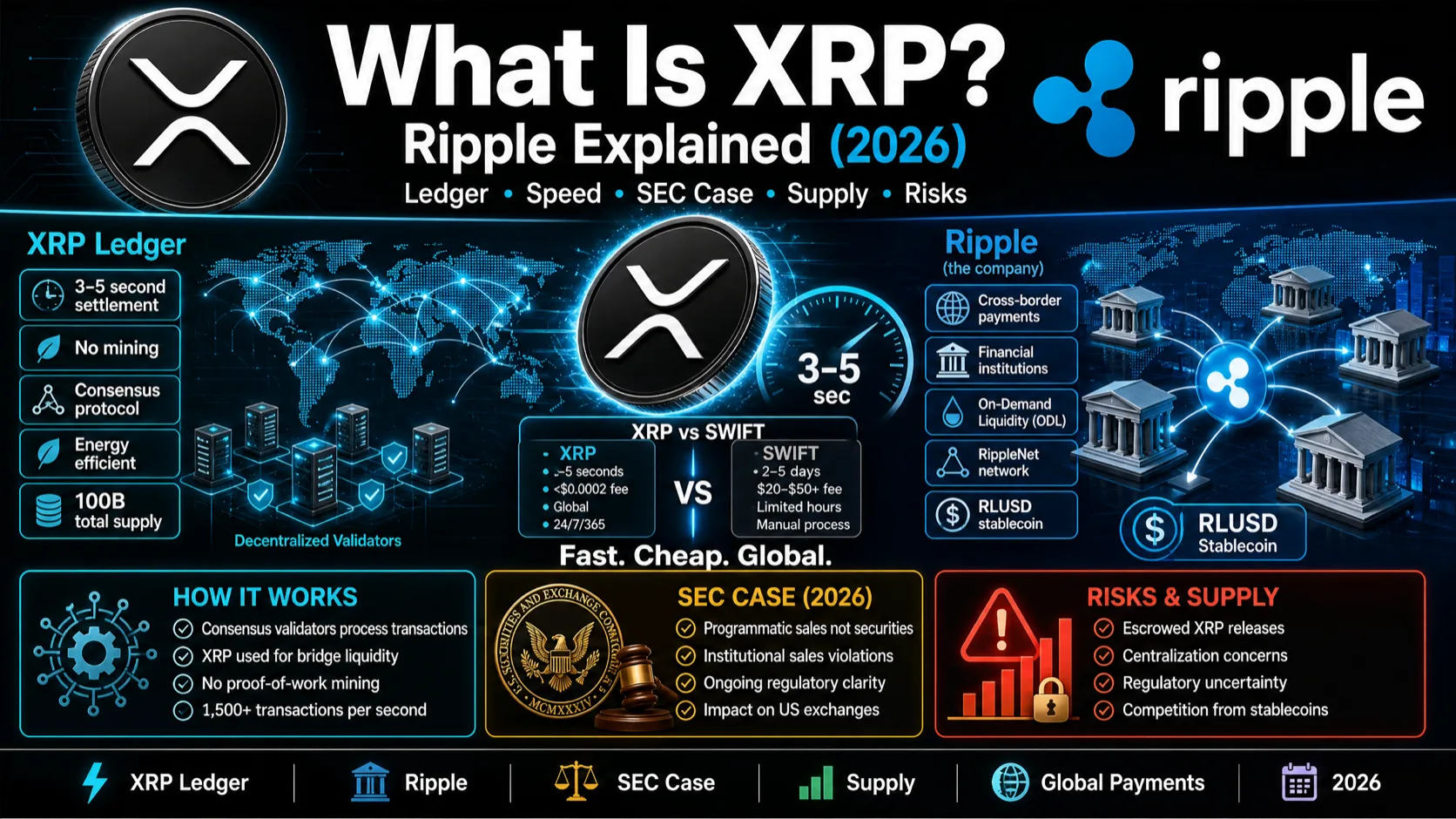
What Is XRP? Ripple Explained (2026)
XRP is the native coin of the XRP Ledger, which settles payments in 3–5 seconds without mining. How it works in 2026, the SEC case, supply, and risks.
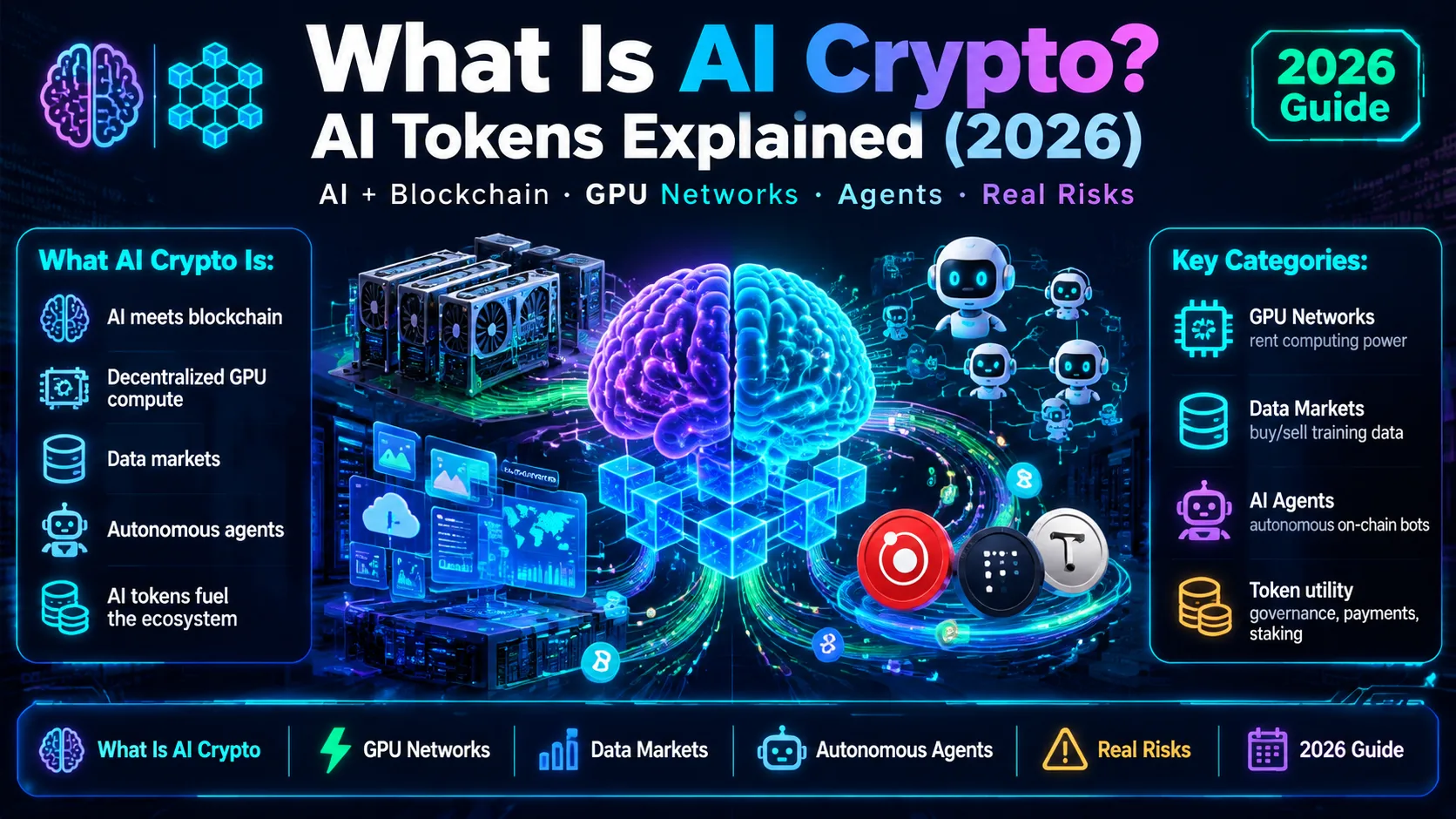
What Is AI Crypto? AI Tokens Explained (2026)
AI crypto combines artificial intelligence and blockchain — GPU networks, data markets, and autonomous agents. Learn how AI tokens work and the real risks.