
What Is a Memecoin? Should You Buy in 2026?
A memecoin is crypto valued on internet culture, not cash flow. See 2026 market data, real drawdowns, and a three-question test before buying one.
 Lucas Almeida 5 min read
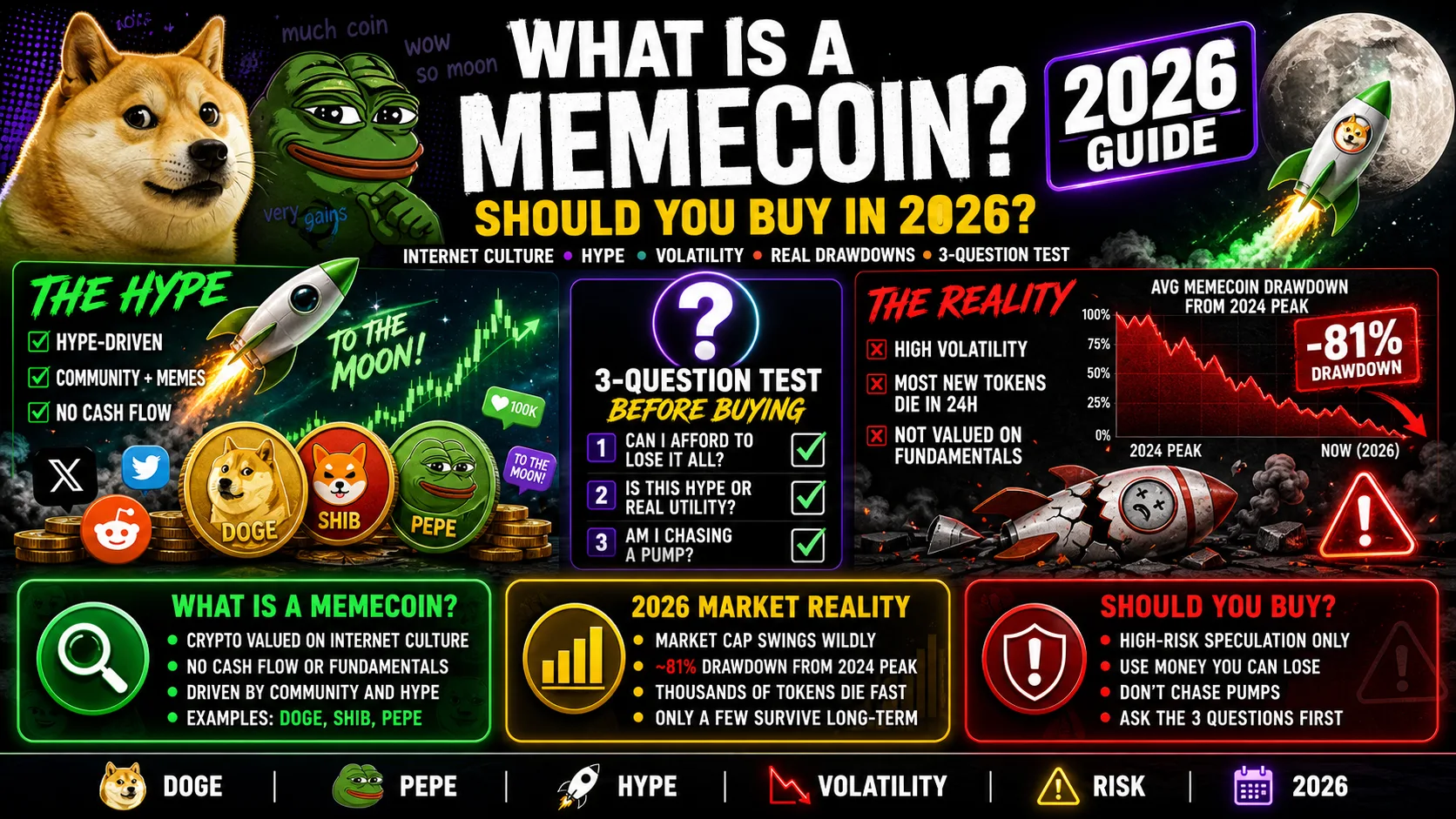
Key takeaways
- A memecoin is a cryptocurrency whose price is driven by internet culture and attention rather than revenue or technology, so there is no analytical floor under it and it can go to zero.
- The whole category was worth about $24 billion on 14 November 2026 — roughly 1% of the crypto market and 84% below its $150.6 billion peak in December 2024.
- Even the survivors lost most of their value: Dogecoin trades 91% below its 2021 high, while PEPE, BONK, WIF and TRUMP sit 85–98% below theirs.
- The launch math is brutal — of about 24 million tokens created on pump.fun, only 312 have ever held a market cap above $100,000 (DailyCoin, 3 November 2026).
- The defensible way to hold one is a capped lottery ticket: a few percent of your crypto at most, money you can lose entirely, and only after a core Bitcoin or Ethereum position.
A memecoin is a cryptocurrency whose price is driven by internet culture and community attention rather than revenue, technology or cash flow. There is no product to value, no earnings to discount, and nothing under the price except what the next buyer will pay. On 14 November 2026 the entire category was worth about $24 billion — roughly 1% of a $2.29 trillion crypto market, and 84% below its $150.6 billion peak in December 2024.
That short version answers the “what”. The useful part is the rest: why these tokens exist at all, what the launch numbers say about your odds of picking a winner, what happened to every famous memecoin since its peak, and the three questions worth answering before you spend anything.
⚠️ The most important thing first: don’t tap Sign Up directly in the app — you’ll miss the new-user rewards. The welcome benefits only apply when you register through an invite link or enter the referral code BN2688. Remember this.
💡 Don't have a Binance account yet? Sign up now — 20% fee rebate on spot and futures — enter the referral code BN2688.
What Is a Memecoin in Simple Terms?
A memecoin is a token whose only product is attention — the supply is real and recorded on a blockchain, but the demand behind it comes from a joke, a mascot, a person or a slogan rather than from anything the token does.
Technically, a memecoin is an ordinary crypto token. It has a total supply, it trades on an exchange or a decentralized swap, and it lives on a blockchain — usually Solana, Ethereum or BNB Chain. What makes it a memecoin is where the demand comes from. Bitcoin has a security budget and a fixed issuance schedule you can study. A memecoin has a frog picture and a Telegram group.
That difference decides everything about how the asset behaves:
| Productive crypto (BTC, ETH) | Memecoin | |
|---|---|---|
| What you own | A stake in a network with measurable usage and fee revenue | A token with no claim on anything |
| What drives the price | Adoption, supply schedule, macro liquidity | Attention, narrative, community size |
| What could restore the price after a crash | Continued usage and new capital | A new wave of attention — or nothing |
| Main risk | Volatility, regulation | Total loss |
One detail trips up almost every beginner, so it is worth stating plainly: the price of a single coin tells you nothing. PEPE trades around $0.00000423, which feels cheap next to Bitcoin, but PEPE has about 421 trillion tokens in circulation. Multiply the two and you get a market cap of roughly $1.8 billion. For PEPE to double, about $1.8 billion of new money has to arrive. That is the number to check before any purchase — market cap, not unit price. A token priced at “less than a cent” can still be more expensive than one priced at $60,000.
Why Do Memecoins Have Any Value at All?
Memecoins have value because attention is genuinely scarce and a token makes it tradeable — but attention is also the one input that can vanish overnight, which is why the price has no floor.
Three forces do the work:
- Attention as an asset. A joke that millions of people recognise is a real cultural object. Before memecoins, you could not buy a share of it. A token turns a shared meme into something with a live price, available 24 hours a day.
- Coordination and identity. Communities form around tickers. Holding DOGE or WIF signals membership in a group, and groups spend money to keep their shared symbol alive. A few projects pushed past the joke into real products — Shiba Inu built its own exchange and a layer-2 network — though the token’s price still depends on belief, not on those products’ revenue.
- Reflexivity. The chart is the marketing. A rising price recruits new buyers, and new buyers push the price higher, which recruits more. The loop runs in both directions; it is equally effective at manufacturing a collapse.
The honest accounting matters here, because it changes how you should size a position. A memecoin trade transfers money between participants; it does not create value. When you sell at a profit, someone else bought at your price, and both of you paid fees to an exchange or a launchpad. Add up the whole category and it is a negative-sum game — the opposite of a stock, where a growing business can make every long-term holder richer at once.
None of that means “never buy”. It means knowing which game you joined: not investing, but trading against other traders, a large share of whom are bots running faster than you can click.
Where Did Memecoins Come From?
Memecoins began in 2013 as a joke and became, by late 2024, a $150 billion market — and the timeline explains most of the behaviour you see in 2026.
| Date | What happened |
|---|---|
| Dec 2013 | Dogecoin launches as a parody of Bitcoin, using the Shiba Inu dog meme |
| Aug 2020 | Shiba Inu launches; its anonymous founder sends half the supply to Vitalik Buterin, who burns about 41% of all SHIB |
| May 2021 | DOGE peaks at $0.73 during the retail boom; SHIB peaks that October |
| Apr 2023 | PEPE launches with a 420.69 trillion supply, a nod to Pepe the Frog |
| Jan 2024 | pump.fun goes live on Solana and makes launching a token a two-click, few-dollar operation |
| Dec 2024 | The sector peaks at $150.6 billion, driven by political and launchpad tokens (CoinGecko) |
| Jan 2025 | TRUMP and MELANIA launch; TRUMP peaks at $73.43 on 19 January |
| Nov 2025 | The sector falls to roughly $47 billion, about 70% off the peak |
| Nov 2026 | About $24 billion — 84% below the peak, with DOGE still the largest name |
The 2024 peak had a specific cause: launching a token became free and instant, so supply exploded, and political tokens gave the category a mainstream headline. Both of those tailwinds reversed. In 2026 the launch machine still runs — roughly 24 million tokens had been created on pump.fun by November — but new money no longer arrives fast enough to lift the average token. What survives is a smaller set of durable names, a handful of live subcultures (AI-agent tokens, Chinese-language memes, Base and BNB Chain launchpads), and a much lower total valuation.
The Launch Math: Why You Are Almost Never Early
On pump.fun, about 1 in 78,000 tokens has ever reached a $100,000 market cap — which means the crowd buying a fresh launch is usually the exit liquidity, not the early entry.
The numbers are not close. DailyCoin reported on 3 November 2026 that of roughly 24 million tokens launched on pump.fun, only 312 had ever climbed above a $100,000 valuation. An earlier CoinGecko study, reported by Blockchain.News on 23 June 2026, looked at 18.67 million tokens and found that 68.67% never traded again after their launch day, 80.37% were dead within two days, and only 4.55% were still trading after 90 days. Fewer than 1% ever “graduate” from the bonding curve to a real decentralized exchange.
The mechanics explain the outcome. On a launchpad, anyone can mint a token in a couple of clicks for a few dollars. Early buyers push the price up along a bonding curve, and the deployer plus a set of wallets they control usually hold a large slice of the supply bought at the very bottom. By the time a token appears on a trending list or in your feed, those wallets are sitting on a 10x or 100x paper gain. The person buying at that moment is not early. They are the buyer the earlier holders need.
This is structural, not bad luck. A launch where insiders hold 30% of supply and paid almost nothing for it is a market designed to transfer money from late buyers to early ones. Understanding that does not make you immune, but it should change the size of your bet.
What Happened to the Biggest Memecoins?
Every major memecoin is 85% to 98% below its all-time high, and none has reclaimed its peak — a pattern that matters more than the slogan that “memecoins go to zero”.
Prices below are CoinGecko data pulled on 14 November 2026:
| Memecoin | Peak date | Peak price | Price now | Below peak | Market cap now |
|---|---|---|---|---|---|
| Dogecoin (DOGE) | 7 May 2021 | $0.7316 | $0.0630 | −91% | $9.9B |
| Shiba Inu (SHIB) | 27 Oct 2021 | $0.00008616 | $0.00000417 | −95% | $2.5B |
| Pepe (PEPE) | 9 Dec 2024 | $0.00002803 | $0.00000423 | −85% | $1.8B |
| Bonk (BONK) | 19 Nov 2024 | $0.00005825 | $0.00000264 | −95% | $232M |
| dogwifhat (WIF) | 31 Mar 2024 | $4.83 | $0.1463 | −97% | $146M |
| Official Trump (TRUMP) | 19 Jan 2025 | $73.43 | $1.068 | −98.5% | $301M |
Three things stand out.
Surviving is not the same as profitable. Every coin in that table is a survivor — still listed, still liquid, still in the top few hundred assets. And every one of them destroyed most of its value for anyone who bought near the top. The popular framing (“95% of memecoins go to zero”) understates the risk, because a token does not have to go to zero to ruin a buyer; it only has to fall 90% and stay there.
Recovery needs a multiple, not a rally. Shiba Inu needs about 21 times its current price to reach its 2021 high, WIF about 33 times, and TRUMP about 69 times. PEPE, the least damaged, still needs about 6.6 times. Those are not targets a trader can plan around; they are a description of how far the price would have to travel.
And yet the category has durable names. Dogecoin has now survived three market cycles and still ranks around 12th by market cap, with roughly 157 billion coins in circulation. So “they all go to zero” is also false. The accurate version is narrower and less comforting: a few tokens endure, and even they spend most of their life far below the price that made them famous.
How Risky Are Memecoins, Really?
Memecoins concentrate every risk in crypto at once, plus a few of their own — and the specific failure modes are worth knowing by name.
- Rug pulls and pulled liquidity. The deployer adds liquidity to a pool, waits for buyers, then withdraws it — the price goes to zero in one transaction and the token cannot be sold. If a launchpad shows liquidity as unlocked, treat the token as a trap.
- Insider supply and unlocks. TRUMP is the clearest case: about 20% of its one billion tokens circulated at launch in January 2025, with the remaining 80% held by affiliated entities and released over three years. That schedule is a permanent overhang — every unlock adds sell pressure, no matter how good the narrative is.
- Snipers, MEV and bots. Automated wallets buy in the same block a token launches and sell into the first wave of human buyers. On-chain trading is a latency race most people lose.
- Narrative collapse. There is no earnings floor to catch a memecoin. When the story stops being funny or the timeline moves on, the bid disappears and there is nothing underneath.
- A scam ecosystem built around them. Fake airdrops, wallet drainers, and lookalike tokens with near-identical tickers are standard, and they target exactly the newcomers memecoins attract. Our guide to common crypto scams covers the patterns.
- Regulation and tax. The SEC’s staff said in February 2025 that typical memecoins are not securities — but that is guidance, not a shield, and fraud enforcement still applies. In most countries each sale is a taxable event, so a hundred small trades can mean a hundred line items in your return.
How Do You Buy a Memecoin Without Getting Burned?
There are two routes, and they carry very different risk: buying an established memecoin on a large exchange, or buying a new launch on-chain through a launchpad or decentralized swap.
| Exchange route | On-chain route | |
|---|---|---|
| What you can buy | Listed majors: DOGE, SHIB, PEPE, BONK, WIF, TRUMP, PENGU, FLOKI | Any token, including launches minutes old |
| Identity check | KYC required | None |
| Typical cost per trade | About 0.06% with fee discounts | Around 1% platform fee plus gas and slippage |
| Custody | The exchange holds the coins | Your wallet holds them |
| Main risk | Exchange risk, volatility | Rug pulls, drainers, total loss |
The cost gap is bigger than it looks. On Binance, the standard spot fee is 0.1%; paying it in BNB cuts 25%, and a referral rebate trims it further, which brings an effective rate near 0.06% — roughly $0.30 on a $500 purchase. A round trip on a launchpad typically costs 2–4% once the 1% platform fee, network fees and slippage are added, so entering and exiting a $100 position can cost more than $5. Fees do not decide whether you make money on a memecoin, but on small bets they can eat most of a gain.
If you go the exchange route, note that Binance covered customer losses in full after the October 2026 hot-wallet breach, while its SAFU insurance fund fell from about 15,000 BTC to roughly 7,500 BTC with no published timetable to refill it — a reminder that “safe exchange” always has limits. Our Binance review covers the trade-offs in detail.
Whichever route you choose, five habits prevent most disasters:
- Verify the contract address before buying, from the project’s official site or a listing page — never from a comment, a direct message or an ad.
- Check the holder distribution. If the top 10 wallets control more than 40% of supply, you are buying from people who can end the market whenever they like.
- Use a fresh wallet with a small balance for on-chain trades, and revoke token approvals afterwards.
- Never share a seed phrase, and treat every “support agent” who messages you first as an attacker.
- Decide your exit before you enter. A price target and a stop level, written down, is the difference between a bet and a hope.
Should You Buy a Memecoin? A Three-Question Test
Buy only if you can lose the entire amount, you already own a core position, and you are early to a narrative rather than late to a headline.
1. Can you afford to lose 100% of it? Not “would it hurt” — could it go to zero and leave your life unchanged? If the answer is no, the bet is too large regardless of how good the story sounds. A common ceiling is 5% of your crypto holdings, and for most beginners a smaller number is better.
2. Do you have a core position first? The order matters more than the percentage. A core holding in Bitcoin or Ethereum — accumulated steadily, as described in our dollar-cost averaging guide — is what a memecoin bet is supposed to be a satellite around. If a memecoin is your first purchase, you are not diversifying; you are starting at the riskiest end of the market.
3. Are you early or late? If you heard about the token on mainstream news, in a group chat full of newcomers, or after it already appeared on a trending list, you are almost certainly late. TRUMP peaked on 19 January 2025, two days after launch, and has fallen 98.5% since. “Early” means you understood the joke before the chart did — which, for most people, is never.
If all three answers point the same way, keep the position small, use an exchange rather than a launchpad where possible, and treat the money as spent. If any answer is no, the honest move is to skip it — there is no shortage of memecoins, and the next one will arrive within the hour.
The Bottom Line
A memecoin is a tradeable claim on attention, and attention is real, scarce and completely capable of disappearing in a weekend. The category produced a few durable names, a genuinely new way for communities to coordinate, and an enormous amount of loss — the sector is worth about $24 billion today, down 84% from its December 2024 peak, and even Dogecoin trades 91% below its high.
If you want exposure to the idea, the sane version is small, capped, and bought on a large exchange after you already own Bitcoin or Ethereum. If you want to understand the asset class before spending anything, start with what cryptocurrency actually is, then read how to buy crypto safely and how to store it. The hour you spend there is worth more than any single pick.
Don't have a Binance account yet?Sign up nowenter the referral codeBN2688
Frequently asked questions
What is a memecoin?
Do memecoins have any real value?
Which memecoin is the biggest in 2026?
Can a memecoin recover after a 95% drop?
Are memecoins securities?
How much should a beginner put into memecoins?
Editor-in-Chief & Lead Researcher
Editor of MyCryptoStart. Independent researcher of cryptocurrency exchanges, focused on fees, security, KYC, and onboarding — publishes step-by-step guides in plain English for beginners.
View author page →Some links on this page are affiliate links: we may earn a commission at no extra cost to you. This content is educational and is not financial, investment, or legal advice. Affiliate disclosure · Disclaimer.
Continue reading

What Is AI Crypto? AI Tokens Explained (2026)
AI crypto combines artificial intelligence and blockchain — GPU networks, data markets, and autonomous agents. Learn how AI tokens work and the real risks.
What Are Layer 2s? Scaling Ethereum Explained
Layer 2s are networks that run transactions off Ethereum but inherit its security — making crypto 90–99% cheaper. Learn how rollups work, optimistic vs ZK, and why withdrawals take 7 days.
What Is Solana? SOL Explained (2026)
Solana is a fast, low-fee blockchain built to process thousands of transactions per second. Learn what SOL is, how it works, and the real risks.