
Bitcoin Halving Explained: What It Means (2026)
The halving cuts Bitcoin's mining reward in half every four years, slowing new supply. Learn how it works and why it does not guarantee a price rise.
 Lucas Almeida 5 min read
Key takeaways
- A halving cuts the reward miners earn for each block in half, on a fixed schedule of every 210,000 blocks — roughly every four years — with no committee able to change it.
- Four halvings have happened so far (2012, 2016, 2020, 2024), and the current reward of 3.125 BTC per block will fall to 1.5625 BTC around April 2028.
- The halving's only guaranteed effect is on supply: it slows new-bitcoin issuance to roughly 0.8% a year today, lower than gold's, and eventually to zero at the 21-million cap.
- The popular claim that 'Bitcoin always pumps after a halving' is not a law — the 2024 halving was followed by a fall, not a rise, before the October 2025 peak.
- For a beginner the halving is context, not a trading signal: the sensible move is the same as ever — a small, long-term position bought on a schedule.
For a beginner, the honest one-line answer is: the Bitcoin halving is the rule that cuts the reward miners earn for each block in half every four years, which slows the rate at which new bitcoin is created — and it does not, by itself, guarantee the price will go up. It is the mechanism that gives Bitcoin its famously predictable supply, but it is not a switch that reliably prints gains on schedule.
This guide explains what the halving actually is, why it exists, what it does to miners, and — most usefully — why the “buy before the halving” hype you hear every four years is mostly noise. Understanding it properly matters because the halving is the one thing Bitcoin’s price narrative keeps coming back to, and it is also the one thing most beginners misunderstand.
What Is a Bitcoin Halving?
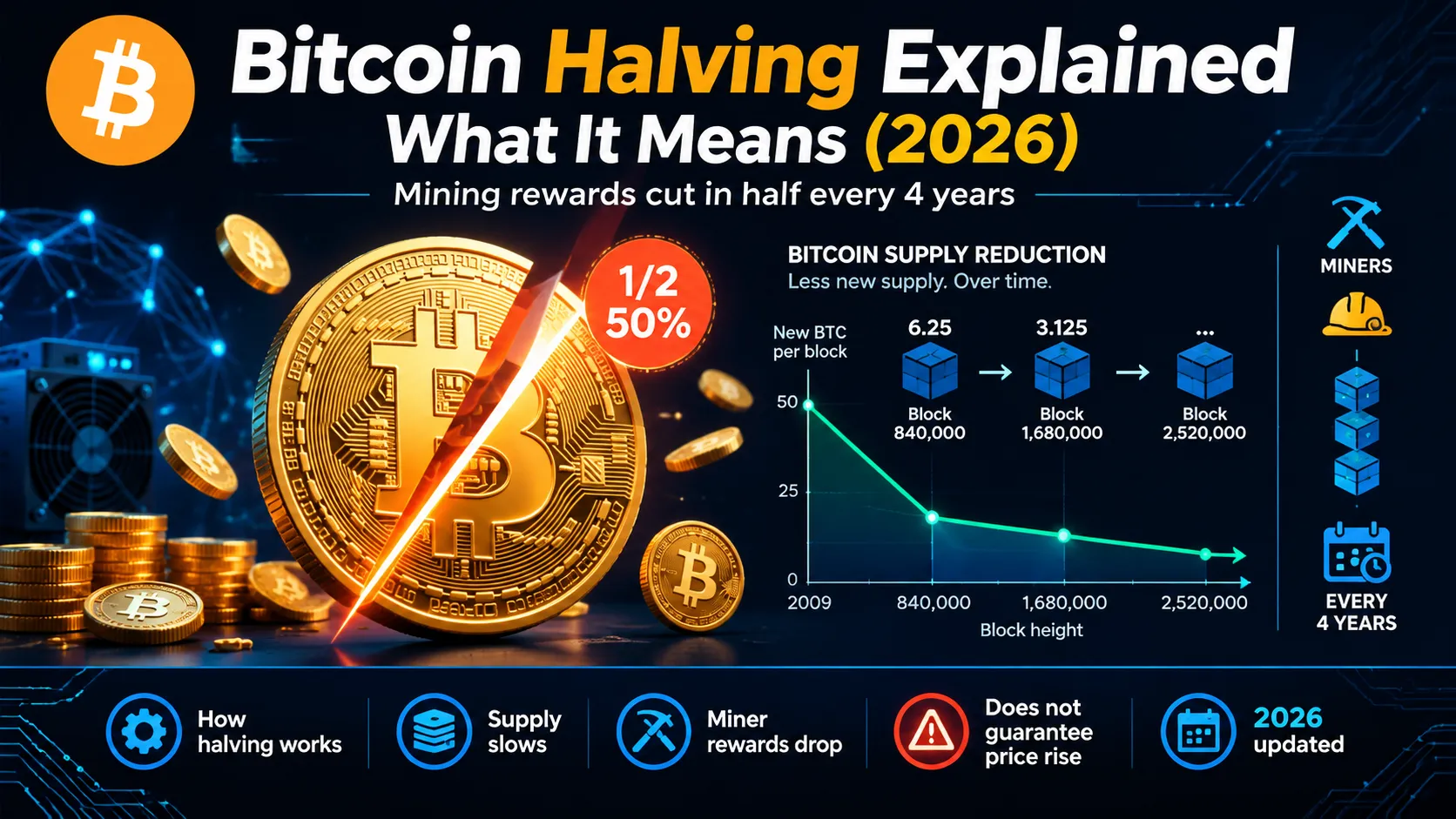
A halving is exactly what it sounds like: the reward for mining a block of Bitcoin is cut in half. It happens automatically every 210,000 blocks, and because blocks arrive roughly every ten minutes, 210,000 blocks work out to about four years.
The reward started at 50 BTC per block when Bitcoin launched in 2009, and it has been halved four times since. As of 2026, miners earn 3.125 BTC per block, and the next halving — around April 2028 — will cut that to 1.5625 BTC.
The key detail most summaries skip: the halving is tied to block height, not a calendar date. There is no “the price will halve on April 15” event; the network simply counts blocks, and when block number 1,050,000 arrives, the reward changes. The date is only an estimate based on the ten-minute average. You can see the mechanics in more depth in our blockchain guide, which explains mining and block rewards from the ground up.
Why Does the Halving Exist?
The halving is Bitcoin’s answer to the problem that defines money: inflation. Every central bank in the world can create more of its currency whenever it chooses, and most have — which is why a dollar today buys less than it did a decade ago.
Bitcoin’s creator built the opposite property into code. The total supply is hard-capped at 21 million coins, and the rate at which new coins are released is on a fixed, published schedule that no government, company, or developer can change. The halving is that schedule: by cutting the reward every four years, it slows new supply to a predictable crawl, and eventually to zero.
You can see the shape of it in the numbers:
| Halving | Date | Reward per block |
|---|---|---|
| Launch | 2009 | 50 BTC |
| 1st | November 2012 | 25 BTC |
| 2nd | July 2016 | 12.5 BTC |
| 3rd | May 2020 | 6.25 BTC |
| 4th | April 2024 | 3.125 BTC |
| 5th | ~April 2028 | 1.5625 BTC |
The reason this matters is scarcity, which we cover in the Bitcoin guide. Around 19.9 million of the 21 million bitcoins already existed by 2026, and the final satoshi is expected around the year 2140. Between now and then, each halving makes the remaining trickle of new supply smaller.
What Does the Halving Do to Miners?
The halving’s most immediate, concrete effect is on miners — the operators who run the computers that secure the network — and it is worth understanding because it is where the halving is genuinely hard.
When the reward halves, a miner’s revenue from new coins halves overnight. A miner who was earning 6.25 BTC per block woke up on April 20, 2024 to a reward of 3.125 BTC for the same work and the same electricity bill. The first thing that happens is that the least efficient miners shut off — older machines whose electricity costs now exceed what they earn. The network’s total computing power (hash rate) dips briefly, and then the network’s built-in difficulty adjustment — which recalibrates roughly every two weeks — brings block times back to the ten-minute target.
The longer-term consequence is the part beginners rarely hear: miners are slowly shifting from being paid in new coins to being paid in transaction fees. Each halving shrinks the new-coin subsidy, so by the time the last bitcoin is mined around 2140, the plan is for fees alone to keep the network secure. Whether that works at scale is one of the genuinely open questions about Bitcoin’s long-term design — it is not a solved problem, and honest discussions of Bitcoin name it as such.
Does the Halving Make the Price Go Up?
This is the question everyone actually asks, and the honest answer is more boring than the hype suggests: there is no reliable rule that “halving = price rise.”
The claim usually comes with a chart showing that Bitcoin’s price has risen over each four-year cycle. The chart is real, but the causal story is looser than it looks:
- The halving is known years in advance. Everyone who could act on it already knows exactly when it happens, down to the block. In an efficient market, an event this predictable is largely priced in long before it arrives.
- The 2024 halving is the clearest counterexample. Bitcoin’s price did not pump after April 2024 — it slid through much of 2024 and into 2025 before eventually reaching a peak near US$126,000 in October 2025, then falling roughly a third by late 2026. Anyone who bought because of the halving and expected an immediate reward was disappointed.
- The most popular formal model — “stock-to-flow” — predicts price from the growing scarcity ratio, and it has been repeatedly and publicly criticized for overfitting: it fits the past well and has been badly wrong at specific moments.
A first-hand pattern worth internalizing, because it repeats every cycle: in the months before each halving, social media fills with confident countdowns and “get in before the halving” posts, and the most certain-sounding predictions are usually the ones that age worst. The people who do well aren’t timing the halving; they are holding through full cycles and ignoring the noise. Our invest-in-bitcoin guide goes into what that actually looks like.
None of this means the halving is meaningless. It means its effect is long-term and on supply, not a short-term price switch.
Why the Halving Still Matters: Supply, Not Price
Strip away the price predictions, and the halving does something concrete and measurable: it drives Bitcoin’s supply inflation rate down to a level lower than gold’s.
After the 2024 halving, the network creates roughly 450 bitcoin per day — about 164,000 per year — against the roughly 19.9 million that already exist. That works out to an annual supply growth of under 1%, and after the 2028 halving it drops toward 0.4%. Gold, by comparison, adds roughly 1–2% to its supply each year from mining. So on the narrow question of “how fast is new supply appearing,” Bitcoin is now scarcer than gold, and getting scarcer.
That is the defensible core of the halving story: a hard-capped, ever-slower supply is a real property, published a century in advance, that no committee can reverse. It does not tell you the price will rise — a falling supply only pushes prices up if demand holds steady or grows, and demand can evaporate — but it is the reason Bitcoin is taken seriously as “digital gold” rather than dismissed as digital confetti.
Should the Halving Change What You Do?
For almost everyone, the answer is no — and that is the most useful conclusion this guide can give you.
The halving is background context: a reason to understand Bitcoin’s supply, not a reason to time a purchase. If you were already comfortable with a small Bitcoin position, the halving changes nothing about how you should hold it. If you were not, the halving should not be the thing that talks you into one. The decision rules that actually hold up — buy a small amount you could lose entirely, on a schedule, for a multi-year horizon — are exactly the same before and after any halving, and they are laid out in our investing guide.
If you do decide Bitcoin belongs in your portfolio, the practical path is the same one every beginner takes: open an account on a large, regulated exchange, verify your identity, and buy — you can buy a fraction of a coin, since one bitcoin divides into 100 million satoshis.
The deeper point is that the halving is best treated the way it was designed: as a fact about supply, not a prediction about price. Knowing that a predictable, ever-slowing supply is the whole idea — and that a predictable event is therefore already in the price — is the difference between understanding Bitcoin and chasing it.
The Bottom Line
The Bitcoin halving is a fixed, code-enforced schedule that halves the mining reward every four years, steadily slowing new supply toward the 21-million cap. That is a real and consequential property — it is what makes Bitcoin scarcer than gold on a supply-growth basis — but it is not a price switch. The 2024 halving, followed by a fall before the October 2025 peak, is the reminder that a known-in-advance event is largely priced in.
For a beginner who has not yet opened an account, the right takeaway is to understand the halving as context, not to act on it. Learn what Bitcoin is, decide honestly whether a small, long-term position fits you, and if it does, buy on a schedule rather than on a headline. The halving will keep happening whether you watch the countdown or not — what matters is the reasoning you use when you finally do something.
Don't have a Binance account yet?Sign up nowenter the referral codeBN2688
Frequently asked questions
What is the Bitcoin halving in simple terms?
When is the next Bitcoin halving?
Does Bitcoin go up after every halving?
How does the halving affect miners?
What happens when all 21 million bitcoins are mined?
Should I buy Bitcoin because of the halving?
Editor-in-Chief & Lead Researcher
Editor of MyCryptoStart. Independent researcher of cryptocurrency exchanges, focused on fees, security, KYC, and onboarding — publishes step-by-step guides in plain English for beginners.
View author page →Some links on this page are affiliate links: we may earn a commission at no extra cost to you. This content is educational and is not financial, investment, or legal advice. Affiliate disclosure · Disclaimer.
Continue reading
How to Stake Crypto and Earn Yield (2026)
Crypto staking locks your coins to secure a proof-of-stake network and earn rewards — typically 2–8% a year. Learn how it works, the real risks, and how to start.
Dollar-Cost Averaging (DCA) in Crypto (2026)
Dollar-cost averaging buys a fixed dollar amount of crypto on a set schedule. Learn how DCA works, what backtests show, and when lump sum wins.

Crypto Taxes Explained: Rates & Rules (2026)
Selling, swapping, or spending crypto is a taxable event; buying and holding is not. How US crypto taxes work in 2026: rates, rules, and how to file.