
How to Buy Bitcoin in India: UPI Guide (2026)
Buy Bitcoin in India with UPI in about 20 minutes: Binance KYC with PAN, a P2P USDT purchase, then BTC/USDT — plus the 30% tax, 1% TDS and bank-freeze risks.
 Lucas Almeida 5 min read
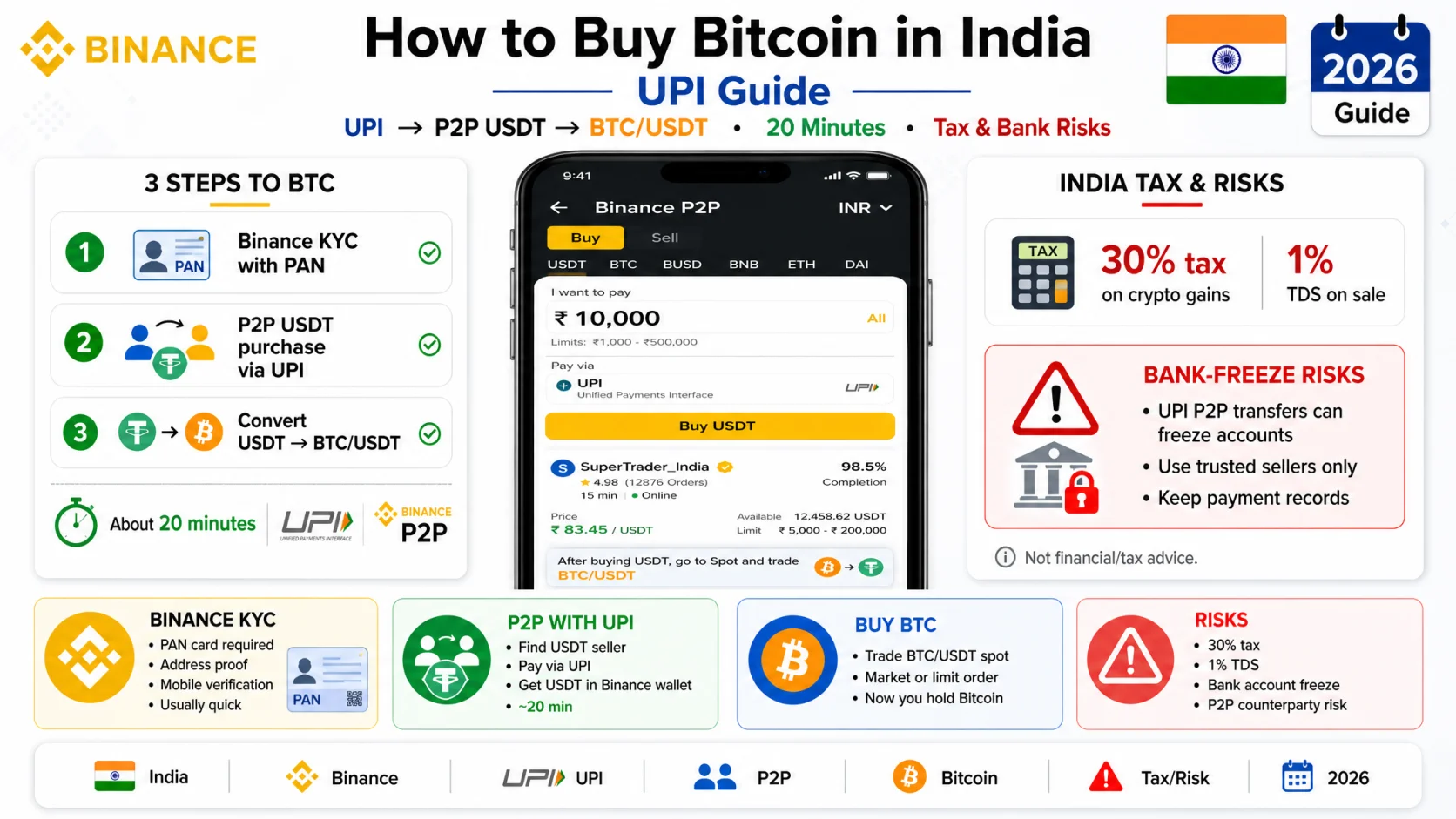
Key takeaways
- Binance is FIU-IND registered and works for Indian users, but it has no BTC/INR spot order book: the practical route is USDT/INR on P2P, then BTC/USDT on spot.
- PAN-based KYC and two-factor authentication are required before you deposit. P2P payments must come from a bank or UPI account in your own name.
- Since 22 June 2026, every external crypto deposit or withdrawal by an Indian user needs sender or beneficiary details under the Travel Rule — no minimum amount.
- Tax is 30% on gains plus 4% cess (about 31.2%), with 1% TDS on gross transfers and no loss set-off. Crypto-to-crypto swaps are taxable transfers too.
- P2P tainted funds caused more than 3,200 Indian account freezes in 2025, and Binance's 29 October 2026 incident shows why long-term holdings belong in self-custody.
You can buy Bitcoin in India with UPI in about 20 minutes, but not through a direct rupee order book. The working route is Binance P2P: pay a verified seller by UPI, receive USDT from escrow, then convert USDT to BTC on the spot market. Binance is FIU-IND registered and available to Indian users, but it does not list a BTC/INR spot pair, so anyone who tells you to “just buy BTC/INR on Binance” has not checked the app.
Three 2026 changes matter before you start: the Travel Rule now requires sender or beneficiary details on every external crypto transfer, the Income-tax Act, 2025 carries the 30% tax and 1% TDS into a new numbering from 1 April 2026, and Binance restored withdrawals in phases after the 29 October 2026 theft. This guide covers the full purchase, the real cost, the tax and the two risks that cost Indian buyers the most: P2P-linked bank freezes and exchange custody.
⚠️ The most important thing first: don’t tap Sign Up directly in the app — you’ll miss the new-user rewards. The welcome benefits only apply when you register through an invite link or enter the referral code BN2688. Remember this.
💡 Don't have a Binance account yet? Sign up now — 20% fee rebate on spot and futures — enter the referral code BN2688.
What changed for Indian buyers in 2026?
India now has a compliance-heavy but workable crypto market: FIU-registered platforms, a 30% tax with 1% TDS, 18% GST on fees, and a Travel Rule that reaches every wallet transfer. There is still no dedicated crypto law.
The direction of travel is not uniform. The RBI told a parliamentary committee in July 2026 that it favours a policy “leaning towards prohibition,” while the Finance Ministry has argued for limited regulatory clarity. The government’s long-promised discussion paper was shelved indefinitely in 2026, leaving the tax and AML rules to do the work of a policy. For a buyer, that means the activity is legal in practice, but the rulebook can change.
Four practical changes landed this year:
- Travel Rule, since 22 June 2026. Indian users must provide the sender’s full name, PAN or national ID, address and PIN code when receiving crypto from another wallet or exchange, and the beneficiary’s name, country, city and receiving exchange when sending. It applies to every transfer, with no minimum amount. Spot trading, internal Binance transfers and fiat on/off-ramps are unaffected.
- The Income-tax Act, 2025, effective 1 April 2026. The 30% VDA tax moved to Section 194, the 1% TDS to Section 393, and the VDA definition to Section 2(109). The substance did not change.
- New reporting penalties. Budget 2026 added a ₹200-per-day penalty for failure to furnish crypto transaction statements and a ₹50,000 penalty for inaccurate reporting under Section 509. These fall on reporting entities such as exchanges, not directly on individual filers — but the data they file makes mismatches with your return easier to find.
- The 29 October 2026 Binance incident. About $6.3 billion was moved from hot wallets. Binance says it absorbed the loss, replenished about 95% of affected assets within days, and reopened withdrawals in phases from 1 November. The SAFU Bitcoin reserve was cut from about 15,000 BTC to about 7,500 BTC.
If you only want to buy and hold Bitcoin, the Travel Rule and the tax rules matter more than the product restrictions. The exchange incident matters for where you store the coins.
What do you need before you start?
You need five things: a PAN, a government photo ID, a bank account and UPI ID in your own name, a smartphone, and a record-keeping habit.
| Requirement | Why it matters |
|---|---|
| PAN | Used in Binance’s India verification flow and in the Travel Rule forms for crypto transfers |
| Government photo ID | Passport, driving licence or another accepted ID; the name must match your PAN record |
| Bank account in your name | P2P payments must come from an account whose holder matches your Binance name |
| UPI access | The standard P2P payment rail in India, alongside IMPS and NEFT |
| Record sheet | Every buy, sell, swap and transfer is a potential tax or TDS line |
The name match is not cosmetic. If you pay a P2P seller from a friend’s account, a joint account with a different primary holder, or a business account, the seller can refuse to release the crypto and Binance’s dispute process will not treat the payment as valid. Use an account that carries exactly the name on your PAN and ID.
You should also be at least 18 and buying only with money you can afford to lose. Bitcoin can fall 50% or more in a year; a 20-minute purchase does not make the asset safe.
Step 1: Create your Binance account with the invite code
Open the Binance sign-up page through an invite link rather than tapping Sign Up cold in the app. The link fills the Referral ID field automatically, and that field is the only place the code can be applied.
- Register with email or phone. Email is easier to recover if you lose your phone number.
- Use a strong, unique password. A password manager beats a password you reuse.
- Check the Referral ID field. It should show the code before you submit. If you registered directly and the field is empty, enter the code now — after the account is created, the binding generally cannot be added or changed.
The code does two things: it links your account to the referrer and can return part of the trading fee as a rebate. On this site the code is BN2688, and the configured rebate is 20% of spot and futures fees. It does not change the base fee Binance charges.
For the full walkthrough, see how to create a Binance account and how the referral code works.
Step 2: Verify your identity with PAN
Indian rules require customer identification, and Binance applies them before you can deposit or trade. The India flow asks for your PAN, personal details, a government photo ID and a liveness check.
- Open the verification section in the app and select India.
- Enter your PAN and personal details exactly as they appear on the PAN record.
- Choose the document type the app offers for India and photograph both sides. All four corners must be visible, with no glare and no fingers covering the text.
- Complete the liveness check: look at the camera, follow the prompts, and use a well-lit room without a hat, glasses or a filter.
Binance’s identity verification FAQ says review is generally within 48 hours. If the check is rejected, the cause is almost always a cropped document, a reflection, or a name that does not match the PAN record. Fix the photo and resubmit rather than opening a second account; duplicate accounts create a tax and AML mess.
Our Binance KYC guide covers the document rules in more detail.
Step 3: Secure the account before you deposit
Set up security before any money enters the account. A password alone is not enough for an account that can move rupees and Bitcoin.
- Use an authenticator app, not SMS. SMS codes can be intercepted through SIM-swap fraud.
- Add a passkey if your phone supports it; Binance treats it as a stronger second factor.
- Set an anti-phishing code, a word that appears in every genuine Binance email so you can spot fakes.
- Enable a withdrawal address whitelist so funds can only leave to addresses you have approved.
These four settings take about five minutes and close the most common account-takeover paths. Our account security guide explains each one.
Step 4: Buy USDT from a verified P2P merchant with UPI
This is the step that replaces a rupee deposit. Binance P2P is an escrow market: the seller’s USDT is locked when the order opens, you pay by UPI or bank transfer, and the crypto is released when the seller confirms.
- Open Trade → P2P, set the fiat to INR, and choose Buy → USDT.
- Filter the payment method to UPI, IMPS or NEFT, depending on what your bank supports.
- Pick a merchant by completion rate and order history, not by the cheapest price alone. A merchant with a 98%+ completion rate and hundreds of completed orders is a better starting point than a new account offering 0.3% better.
- Enter the amount. Each advertisement sets its own minimum and maximum, often a few hundred rupees at the low end.
- Read the seller’s terms, then place the order. The USDT moves into escrow.
- Pay the exact amount to the UPI ID shown inside the order, from an account in your own name.
- Tap Transferred, Notify Seller only after the payment has actually gone through. Never tap it before paying, and never pay outside the order.
- Wait for the seller to release the USDT. If they do not, open a chat in the order and use Binance’s appeal process with your payment proof.
Three safety rules matter more than the price:
- Never accept or make a third-party payment. If the seller asks you to pay a different UPI ID, or a “friend” offers to pay for you, cancel the order.
- Keep everything inside the order. Payment details, chat and proof should stay in Binance’s system so the appeal has evidence.
- Do not cancel a paid order before a refund is confirmed. Cancelling after paying is how buyers lose money.
The P2P price is not the mid-market rate. Sellers build a premium into the quote, commonly in the 0.5%–1.5% range, and that premium is the real cost of the rupee leg. Compare the final USDT quantity you receive, not the headline rate.
If P2P is unavailable on your account, Binance also shows card purchase options. They are faster but typically cost 2%–5% more, which is 20 to 50 times the spot fee on the same amount.
Step 5: Convert USDT to BTC on the spot market
Binance does not have a BTC/INR spot pair, so the Bitcoin purchase happens against USDT. Move the USDT from your funding wallet to spot, then trade BTC/USDT.
- Open Wallet → Transfer and move USDT from Funding to Spot. Internal transfers are free.
- Search for BTC/USDT and open the pair.
- Choose Limit if you want to name your price, or Market if you want the purchase done now.
- Enter the amount in USDT, not BTC, to avoid a decimal mistake.
- Review the estimated BTC quantity and the fee before confirming.
- Confirm and check that BTC appears in your spot wallet.
The spot fee is 0.10% at VIP 0, or 0.075% if you hold BNB and pay fees with it. The 20% invite rebate applies to the fee you actually pay, so the effective spot cost is about 0.08%, or 0.06% with BNB. GST at 18% may be added to the fee under India’s rules; see the cost section below.
A market order fills at the best available price, which can be slightly worse than the headline quote when the book is thin. BTC/USDT is one of the deepest books on Binance, so the gap is usually small; a limit order avoids paying for it entirely.
Step 6: Withdraw to a wallet you control
Coins held on an exchange are held in the exchange’s custody. That is fine for amounts you plan to trade, but long-term holdings belong in a wallet you control — especially after the October 2026 incident.
- Leave a trading balance on Binance if you buy and sell regularly.
- Withdraw larger holdings to a hardware wallet and keep the seed phrase offline, on paper or metal, never in a photo or cloud note.
- Test with a small amount first. Send a small BTC withdrawal, confirm it arrives, then send the rest.
- Expect the Travel Rule form. Since June 2026, every external withdrawal requires the beneficiary’s name, country, city and receiving exchange, and you must say whether the destination is self-hosted or a VASP wallet. Deposits from your own wallet require the same kind of sender details.
Our guides to hardware wallets and storing crypto safely cover the setup. If you withdraw BTC, choose the Bitcoin network and double-check the address — a wrong address cannot be reversed, and the network fee is shown before you confirm.
How much does it cost to buy Bitcoin in India?
The dominant cost is the P2P premium, not the Binance spot fee. The deposit itself is free because there is no exchange deposit; you are paying a seller, not Binance.
| Cost | Amount (November 2026) | Notes |
|---|---|---|
| P2P premium | Typically 0.5%–1.5% | Built into the USDT/INR quote; the real rupee-leg cost |
| Spot trading fee | 0.10% | 0.075% with BNB |
| Invite-code rebate | 20% of the fee | Effective spot cost about 0.08%, or 0.06% with BNB |
| GST | 18% on the platform fee | Applies to the fee, not the principal; may not appear as a separate line |
| BTC withdrawal | Network fee shown in the app | Depends on the Bitcoin network at the time |
| Card purchase | Typically 2%–5% | Faster, but far more expensive than P2P |
A worked example: you buy ₹10,000 of USDT through P2P at a 1% premium, then convert to BTC.
- P2P premium: about ₹100.
- Spot fee at 0.10% on ₹9,900: ₹9.90.
- Rebate of 20%: ₹1.98 back, so the net fee is ₹7.92.
- GST at 18% on the ₹9.90 fee: ₹1.78.
- All-in cost: about ₹109.70, or roughly 1.1%.
At a 0.5% P2P premium the total falls to about 0.6%; at 1.5% it rises to about 1.6%. On the same ₹10,000, a card purchase at 3.5% would cost ₹350 — more than three times the P2P route. That gap, not the choice between Bitcoin and another coin, is the biggest avoidable cost for an Indian beginner.
Is buying Bitcoin legal in India?
Yes in practice, but not because a crypto law says so. India has no dedicated crypto statute. Buying, holding and selling are not banned, and the Supreme Court struck down the RBI’s banking ban in 2020.
What exists instead is an AML and tax framework:
- FIU-IND registration. Binance registered as a reporting entity in August 2024, after being blocked in January 2024 and paying a penalty of about ₹18.82 crore. Its India page carries an FIU-IND Registered badge. By March 2026, 54 VDA providers were registered; the tax department separately estimates that about 39 million Indians hold crypto.
- PMLA obligations. FIU registration means AML reporting, not RBI licensing or deposit protection. If an exchange fails, there is no equivalent of deposit insurance.
- RBI opposition. The central bank has repeatedly recommended prohibiting crypto and barring banks from exposure. That is a policy preference, not a current ban on individuals.
- No policy paper. The government’s discussion paper was shelved in 2026, so the tax and AML rules remain the de facto policy.
Tax is separate from legality, and it is where most beginners get surprised.
How is Bitcoin taxed in India?
Crypto gains are taxed at a flat 30% plus 4% cess — about 31.2% — with 1% TDS on the gross transfer value and no loss set-off. The rate does not depend on how long you held the coin.
The rules in force for FY 2026-27:
| Rule | Detail |
|---|---|
| Gains tax | 30% flat under Section 194 of the Income-tax Act, 2025 (formerly 115BBH), plus 4% cess |
| TDS | 1% on gross consideration under Section 393 (formerly 194S) |
| TDS threshold | ₹50,000 per financial year for an individual specified person; ₹10,000 for other payers |
| No PAN | TDS rises to 20% under Section 206AA |
| Deductions | Only the cost of acquisition; trading fees are not deductible |
| Losses | Cannot be set off against gains or other income, and cannot be carried forward |
| Taxable events | Selling for INR, crypto-to-crypto swaps, and spending crypto |
| Not taxable | Buying and holding, and moving coins between your own wallets |
| Reporting | Schedule VDA in ITR-2 or ITR-3, usually due 31 July |
A worked example: you buy BTC for ₹1,00,000 and later sell for ₹1,20,000.
- Gain: ₹20,000.
- Tax at 30%: ₹6,000.
- Cess at 4%: ₹240.
- Total tax: ₹6,240, or 31.2% of the gain.
- TDS already deducted at 1% of ₹1,20,000, if the sale runs through a platform that withholds: ₹1,200.
- Balance payable: ₹5,040, assuming the TDS is reflected in Form 26AS or AIS.
If you sell at a loss, the loss cannot offset anything, but the TDS is still deducted and can be claimed as a refund or adjusted against other tax. That is one reason record-keeping matters even in a losing year.
The P2P TDS trap
The USDT-first route creates more than one VDA transfer. When you pay INR for USDT, you are the person paying consideration for a transfer of a virtual digital asset. For an individual specified person, the 1% TDS obligation can fall on you once your aggregate consideration in the financial year crosses ₹50,000. Binance is not your Indian tax deductor on P2P trades.
Then the USDT-to-BTC conversion is another transfer, and it is also taxable. In strict terms, the route can create a TDS event on the USDT purchase and a 30% tax event on the USDT-to-BTC swap, even before you sell the Bitcoin for rupees. Most retail buyers do not model this, and the compliance trail is one reason Indian exchanges that deduct TDS automatically remain popular despite higher fees.
This is not DIY territory. Keep every order ID, bank reference, quantity and fee, and ask a chartered accountant how to report the USDT leg. Our crypto taxes guide explains the general principles; the Income Tax Department publishes the current VDA rules.
What are the biggest risks?
The two risks that actually cost Indian buyers money are P2P-linked bank freezes and exchange custody — not Bitcoin’s price.
P2P bank freezes
When a buyer pays you with funds traced to fraud, police can freeze every account in the money trail under Section 106 BNSS, including an innocent seller’s. More than 3,200 accounts were frozen in 2025 over P2P-linked fraud, according to reporting on the problem; about 90% were released within 30 days when traders followed the right steps.
The documented cases are small and arbitrary: a ₹22,500 Binance P2P transfer in Punjab triggered a debit freeze over a ₹3,010 dispute, and some freezes involved amounts under ₹2,000. KYC and escrow do not guarantee clean fiat.
If it happens:
- Ask the bank for the lien details in writing: amount, date, police station, FIR or complaint number.
- Collect the Binance order ID, in-app chat, bank statement and UTR proof.
- Send a written representation to the investigating officer.
- If the lien is not lifted, approach the jurisdictional magistrate or the High Court; the bank cannot release it on its own.
Exchange custody
The 29 October 2026 Binance incident is the clearest recent reminder. About $6.3 billion was moved from hot wallets across multiple chains. Binance said it would absorb the loss, replenished about 95% of affected assets within days, reported the top ten assets as fully backed, and restored withdrawals in phases from 1 November. The FBI attributed the theft to North Korea’s TraderTraitor group, and roughly $3 billion was frozen on-chain.
The response was strong, but the cost was real: Binance’s SAFU Bitcoin reserve fell from about 15,000 BTC to about 7,500 BTC, and the fund has promised to rebuild to $1 billion without a deadline. For a buyer, the lesson is not “avoid Binance”; it is “do not treat an exchange balance as a vault.” Keep trading amounts on the platform and move long-term holdings to self-custody.
Other risks
- Fake apps and phishing. Download only from Binance’s official site or the official app-store listing, and verify the publisher. No Binance employee will ask for your password, OTP or seed phrase.
- Volatility. Bitcoin can fall sharply and stay down for years. Size positions so a 50% drawdown does not change your life.
- Regulatory change. The RBI wants prohibition; a future law could restrict access or change the tax treatment. Do not assume today’s rules are permanent.
- GST disputes. Indian authorities apply 18% GST to platform fees, and Binance has reportedly faced a large GST demand. The charge may not always appear as a separate line, so budget for it.
Binance vs Indian exchanges
A local exchange is usually simpler for a first purchase; Binance is usually cheaper and deeper once you know the flow. The difference is not just fees — it is who handles TDS and reporting.
| Exchange | INR route | Reported spot fee | TDS handling | Strengths | Trade-offs |
|---|---|---|---|---|---|
| Binance | P2P via UPI/IMPS; card | 0.10% (0.075% with BNB) | You handle P2P TDS | Deep global liquidity, 600+ coins, low fee | No direct INR bank deposit or BTC/INR book; P2P freeze risk; Travel Rule forms |
| CoinDCX | UPI / IMPS / NEFT | Roughly 0.1%–0.2% | Auto-deducted | 500+ coins, direct INR rails, FIU-registered | Higher than Binance; 2025 wallet breach shook confidence |
| CoinSwitch | UPI / IMPS / NEFT | Simple mode uses a spread; Pro around 0.1% taker | Auto-deducted | Simplest onboarding, large user base | Simple mode hides the cost in the spread |
| ZebPay | UPI / IMPS / NEFT | Reported around 0.45% at the entry tier; lower at volume | Auto-deducted | Oldest Indian exchange, cold-storage focus | Smaller coin list, higher entry fee |
Fee figures for Indian exchanges vary by source and change often; check the exchange’s own fee page before you trade. The structural point is stable: an Indian exchange gives you a direct BTC/INR purchase, automatic TDS and a rupee statement, while Binance gives you a lower fee and a global book but leaves more of the compliance work to you.
WazirX is still working through the aftermath of its 2024 hack and is not a first choice for a new buyer. If you want a local route, compare CoinDCX, CoinSwitch and ZebPay on the live fee page and on INR withdrawal charges, not on marketing pages.
Common problems and fixes
| Problem | Likely cause | Fix |
|---|---|---|
| KYC rejected | Cropped or glared document; name mismatch with PAN | Retake the photo in good light with all four corners visible |
| P2P order cancelled after payment | Seller did not confirm, or you paid a different UPI ID | Never pay outside the order; open a chat and appeal with proof |
| USDT not released | Seller claims no payment | Upload the UTR and screenshot in the order appeal; do not cancel first |
| Bank account frozen | Incoming P2P funds traced to fraud | Get lien details, gather order proof, respond to the investigating officer |
| Withdrawal blocked | Travel Rule details missing, or the asset is still in phased restoration | Complete the beneficiary form; check the withdrawal status page |
| Referral code missing | Account created without a code | Binding generally cannot be changed; check the rebind rules before opening another account |
| Tax mismatch | Schedule VDA does not match Form 26AS or AIS | Reconcile exchange statements, TDS entries and bank records with a CA |
The two failures that cost the most time are a name mismatch at KYC and a P2P payment made outside the order. Both are avoidable before any money moves.
Conclusion
Buying Bitcoin in India with UPI is a P2P purchase plus a spot conversion: create a Binance account with the invite code, verify with PAN, buy USDT from a verified merchant, then trade BTC/USDT. The purchase takes about 20 minutes; the compliance trail lasts until you file your return.
Before you start, confirm four things: the bank and UPI account are in your own name, you understand that the P2P premium is the main cost, you have a record-keeping system for every transfer, and you are buying only what you can afford to lose. Then follow the Binance registration guide step by step, and move any long-term holding to a wallet you control.
Not investment advice. Bitcoin is volatile and you can lose money. This guide explains how the purchase works, not whether you should buy.
Facts in this guide were checked on 21 November 2026. Binance’s India availability and FIU-IND badge come from its India page; KYC review times from the identity verification FAQ; the Travel Rule from Outlook Money, June 2026 and Inc42, 23 June 2026; the 30% rate, 1% TDS and new penalties from Fortune India, Budget 2026 and Moneycontrol; the Section 194/393 renumbering from Livemint; the 194S thresholds from TaxClue; GST treatment from KoinX; the P2P freeze pattern from Crypto Times, June 2026; the RBI stance from Reuters, July 2026; India’s adoption ranking from Outlook Money; the October incident and compensation from Binance’s Recovery Update #4 and The Defiant. Fees, tax rules, Travel Rule forms and platform availability change without notice — confirm the current terms in the app and with a chartered accountant before trading.
Don't have a Binance account yet?Sign up nowenter the referral codeBN2688
Frequently asked questions
Can I buy Bitcoin in India with UPI?
Is Binance legal in India?
What is the minimum amount to buy Bitcoin in India?
How much tax do I pay on Bitcoin in India?
Do I have to deduct TDS on Binance P2P?
Why was my bank account frozen after a P2P trade?
Can I use Binance in India without PAN?
Is my Bitcoin safe on Binance?
Editor-in-Chief & Lead Researcher
Editor of MyCryptoStart. Independent researcher of cryptocurrency exchanges, focused on fees, security, KYC, and onboarding — publishes step-by-step guides in plain English for beginners.
View author page →Some links on this page are affiliate links: we may earn a commission at no extra cost to you. This content is educational and is not financial, investment, or legal advice. Affiliate disclosure · Disclaimer.
Continue reading
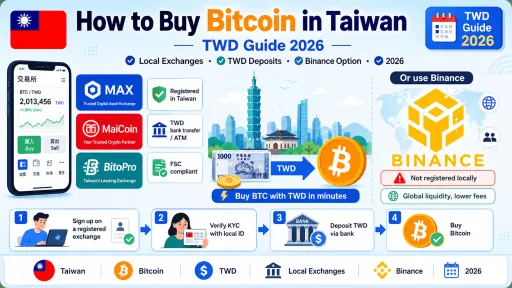
How to Buy Bitcoin in Taiwan: TWD Guide 2026
Buy Bitcoin in Taiwan with TWD in minutes on registered exchanges like MAX, MaiCoin or BitoPro — or through Binance, which is not registered locally.
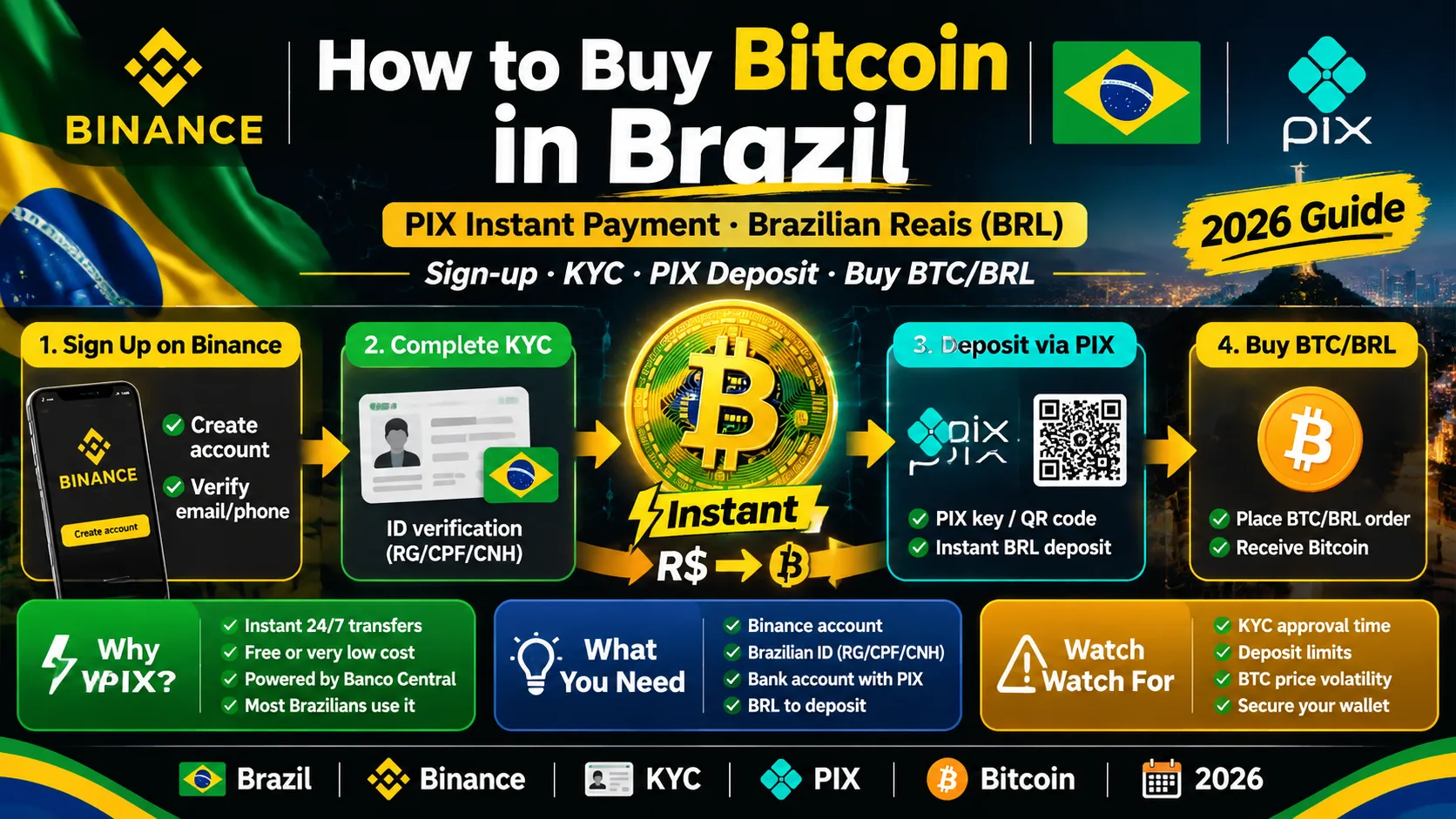
How to Buy Bitcoin in Brazil: PIX Guide (2026)
Buy Bitcoin in Brazil with PIX in about 15 minutes: Binance sign-up with CPF, KYC, a free reais deposit, and a BTC/BRL order — 2026 fees and rules.
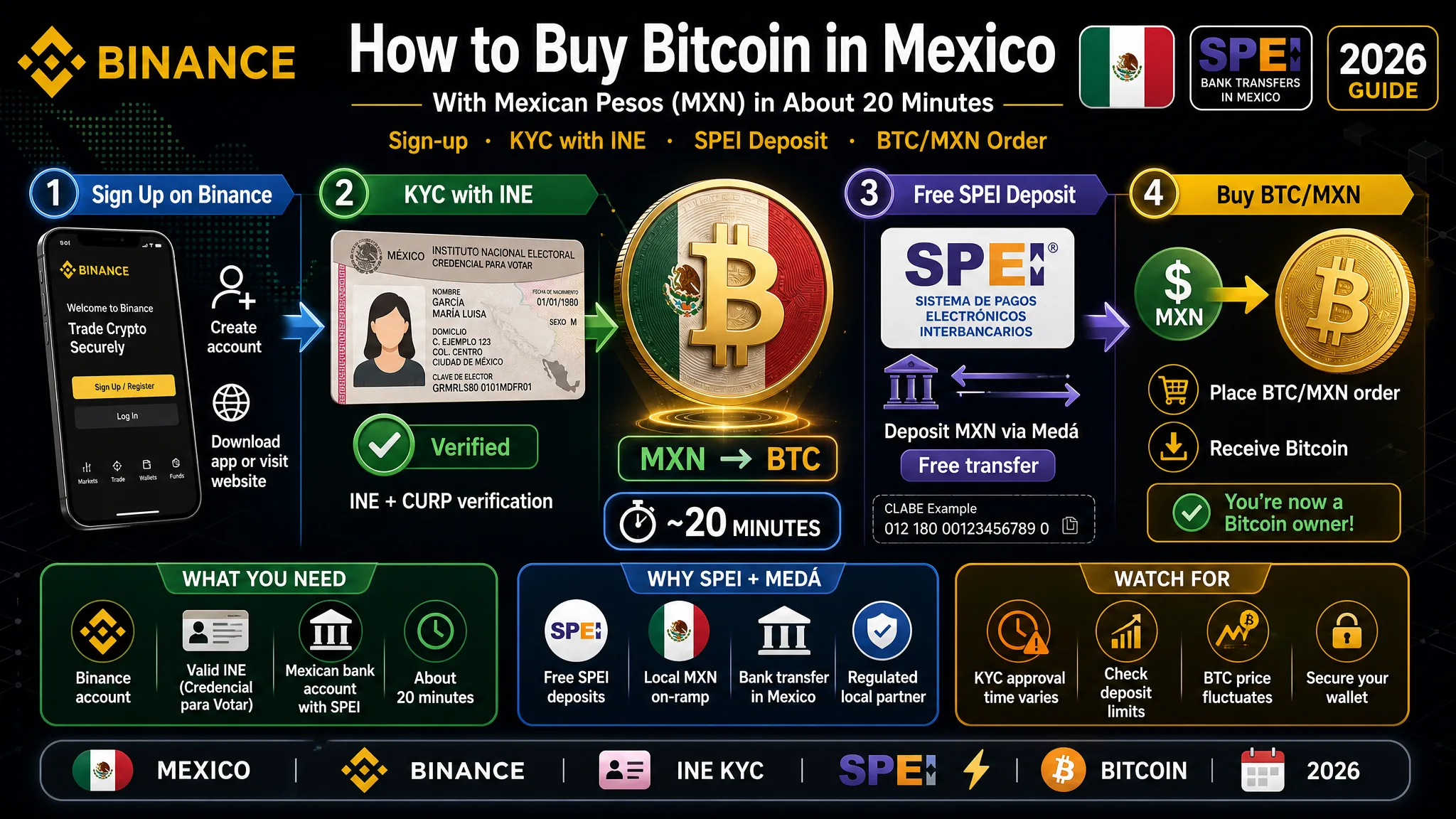
How to Buy Bitcoin in Mexico (SPEI, 2026)
Buy Bitcoin in Mexico with pesos in about 20 minutes: Binance sign-up, KYC with INE, a free SPEI deposit through Medá, and a BTC/MXN order.