
How to Buy Bitcoin in Taiwan: TWD Guide 2026
Buy Bitcoin in Taiwan with TWD in minutes on registered exchanges like MAX, MaiCoin or BitoPro — or through Binance, which is not registered locally.
 Lucas Almeida 5 min read
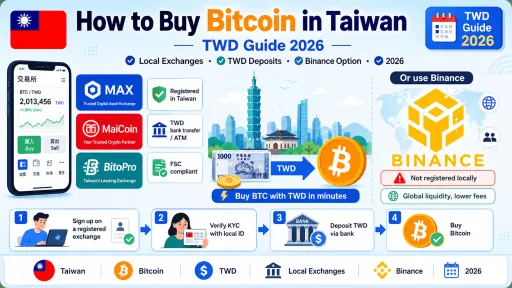
Key takeaways
- The fastest route for most people in Taiwan is a locally registered exchange — MAX, MaiCoin, BitoPro or TWEX — because TWD deposit, identity verification and withdrawal all happen in one place, usually within 10–30 minutes after verification.
- As of 29 September 2026, 11 operators had completed anti-money-laundering registration with Taiwan's Financial Supervisory Commission, including MAX, MaiCoin, BitoPro, TWEX, XREX, HOYA BIT and Liminal.
- Binance has no direct TWD deposit route in Taiwan and has not completed FSC AML registration. Taiwan's VASP association added it to its warning list on 10 August 2026.
- On an NT$10,000 order, MAX's standard taker fee of 0.16% costs NT$16, while MaiCoin's all-in quote spread of roughly 0.5%–2% costs NT$50–200 and a Binance card purchase costs about NT$330 in fees.
- Taiwan taxes individual crypto gains as property transaction income at 5%–40%, and withdrawals of NT$500,000 or more trigger bank reporting under AML rules.
You can buy Bitcoin in Taiwan with TWD in about 10–30 minutes on a registered local exchange such as MAX, MaiCoin, BitoPro or TWEX. The TWD deposit, identity check and withdrawal all happen in one place. Binance offers deeper liquidity, but it has no direct TWD deposit route and is not registered with Taiwan’s Financial Supervisory Commission (FSC), so most first-time buyers use a local platform for the cash leg.
The confusing part is that “legal exchange” is used loosely online. Taiwan currently runs an anti-money-laundering (AML) registration regime, not a full licence regime. Eleven operators had completed that registration as of 29 September 2026, and the Virtual Asset Service Act will replace the system with licensing from the first quarter of 2027.
This guide covers the registered route step by step, the real cost of an NT$10,000 purchase, the Binance workaround and its regulatory caveat, and how Taiwan taxes the gain when you sell.
⚠️ The most important thing first: don’t tap Sign Up directly in the app — you’ll miss the new-user rewards. The welcome benefits only apply when you register through an invite link or enter the referral code BN2688. Remember this. If you plan to use Binance from Taiwan, also read the regulatory section below: the platform may not legally market or provide services onshore.
💡 Don't have a Binance account yet? Sign up now — 20% fee rebate on spot and futures — enter the referral code BN2688.
What is the fastest way to buy Bitcoin in Taiwan in 2026?
A registered local exchange is the fastest route because it removes the currency conversion: you deposit TWD, buy BTC/TWD, and withdraw TWD later without touching USDT. A complete application is usually verified within one business day, and the actual purchase takes seconds after the money arrives.
There are five realistic routes, and they are not equally good for a beginner:
| Route | Best for | TWD deposit | Fee on NT$10,000 | Main catch |
|---|---|---|---|---|
| MAX | Lowest transparent fees | Free bank transfer | NT$8 maker / NT$16 taker | Order book takes one extra step |
| MaiCoin | One-tap buying | Free bank transfer | About NT$50–200 (quote spread) | Fee is hidden in the price |
| BitoPro | Familiar local brand | Free bank transfer | NT$10 maker / NT$20 taker | Convenience-store top-ups ended in May 2025 |
| TWEX | Very small first purchases | Bank account link | Promotional through 31 Dec 2026 | Limited coin selection |
| Binance via P2P | Global liquidity and coin range | No direct TWD | About NT$56–206 including spread | Unregistered locally; P2P counterparty risk |
For a first purchase under NT$50,000, MAX or TWEX is the simplest. For someone who already holds USDT and wants a wider market, the Binance P2P route can make sense — as long as you understand the regulatory position.
Which crypto exchanges are registered in Taiwan?
Eleven operators had completed FSC AML registration as of 29 September 2026, according to the Securities and Futures Bureau’s VASP list. The consumer-facing names include MAX, MaiCoin, BitoPro, TWEX, XREX, HOYA BIT and Liminal.
That number matters because it is widely misreported. Some 2026 articles still say “five legal exchanges” or list Bitget, BingX or Binance as local options. The FSC list is the source of truth, and it changes: the count went from nine to eight in January 2026 when one operator closed, then rose to eleven by late September.
Registration is not a government guarantee. It means the operator has met the AML requirements in force today, including customer due diligence and transaction reporting. Customer assets are not insured the way bank deposits are, and the exchange can still fail, be hacked or freeze an account during a review.
A second distinction is easy to miss. A platform can be registered for AML and still not hold a full VASP licence, because the licensing regime does not start until the new act takes effect. The FSC’s own page separates registered operators from the 17 former compliance-declaration firms that never completed registration and may no longer serve customers.
How do you buy Bitcoin with TWD, step by step?
The process below works on MAX, MaiCoin and BitoPro with small differences. Budget 20–40 minutes for the first purchase, most of it for verification.
1. Choose the exchange that matches your buying style. If you want to place limit orders and pay the lowest fee, use MAX. If you want to type an amount and accept the quote, use MaiCoin. If you want the familiar BitoPro app, use BitoPro. If you only want NT$100–500 of BTC or ETH, TWEX is the lowest-friction option.
2. Register in your own legal name. Use your phone number or email, set a unique password, and enable two-factor authentication immediately. Do not let a friend register the account for you; the name on the exchange, the bank account and the withdrawal destination must all match.
3. Complete identity verification. Taiwanese residents normally upload their national ID card and a second document such as a health insurance card or driver’s licence. Foreign residents usually need an ARC and passport. The flow includes a liveness selfie, and a mismatched or expired document is the usual cause of delay.
4. Bind a bank account in the same name. The exchange gives you a dedicated virtual account at a partner bank — MAX and MaiCoin use Far Eastern Bank. Transfers must come from your own verified account. Cash deposits at a counter, third-party transfers and someone else’s bank app are rejected.
5. Deposit TWD. Send the amount by online banking or ATM to the virtual account shown in the app. The platform charges no deposit fee. Your bank may charge NT$0–30 depending on the transfer type and your account tier, and most transfers arrive within 5–15 minutes during banking hours.
MAX applies lower limits to new accounts: in the first 31 days, NT$100,000 per transaction and per day, with a cumulative cap of NT$3 million. The limit rises automatically after the account has been open for 31 days and has met the monthly deposit condition. If you plan a larger first purchase, raise the limit before you need it.
6. Buy BTC on the TWD market. On MAX and BitoPro, open the BTC/TWD order book. A limit order at the best ask is filled as a maker order and pays the lower fee; a market order fills instantly and pays the taker fee. Check the estimated fee and the final amount before you confirm.
7. Withdraw to a wallet you control. For anything you do not plan to trade soon, withdraw BTC to your own wallet. Send a small test amount first. Taiwan’s Travel Rule, phased in from October 2026, requires beneficiary information for crypto withdrawals of NT$30,000 or more, so the first transfer to a new address may ask for the recipient’s name and date of birth.
A detail most guides miss: BitoPro stopped convenience-store top-ups on 29 May 2025 to comply with AML rules. Articles that still describe FamilyMart or Hi-Life deposits are out of date; bank transfer is now the route.
What does buying NT$10,000 of Bitcoin actually cost?
On an NT$10,000 order, the fee ranges from NT$8 to about NT$330 depending on the route. The quoted percentage is only part of the cost: on a quote-based platform the spread is the fee, and on a card purchase the foreign-transaction charge is often larger than the crypto fee itself.
| Platform and order type | Rate | Cost on NT$10,000 |
|---|---|---|
| MAX maker order | 0.08% | NT$8 |
| MAX taker order | 0.16% | NT$16 |
| MAX with MAX Token discount (30% off) | 0.056% maker / 0.112% taker | NT$5.60 / NT$11.20 |
| BitoPro maker order | 0.10% | NT$10 |
| BitoPro taker order | 0.20% | NT$20 |
| BitoPro with BITO discount (20% off) | 0.08% / 0.16% | NT$8 / NT$16 |
| MaiCoin quote spread | About 0.5%–2% | NT$50–200 |
| Binance P2P to USDT, then BTC | 0.5%–2% spread + 0.10% spot | About NT$60–210 |
| Binance with BNB discount and 20% rebate | 0.5%–2% spread + about 0.06% spot | About NT$56–206 |
| Binance card purchase | About 1.8% + 1.5% foreign transaction | About NT$330 |
Two corrections to widely repeated numbers. First, MAX’s standard fee is 0.08% maker and 0.16% taker, not the 0.05%/0.15% that older blog posts still quote; the current rates were confirmed in 2026 fee guides and MAX’s published schedule. Second, buying USDT and then BTC on MAX is two trades, so you pay the fee twice — use the direct BTC/TWD pair if you only want Bitcoin.
MaiCoin is not expensive by accident; it is priced for convenience. Its service fee is built into the buy and sell quote, so you cannot see a separate line item. The practical test is to compare its BTC buy price with MAX’s best ask at the same moment. If the gap is above 1%, MAX is cheaper for that trade.
For an NT$10,000 purchase, the difference between the cheapest and most expensive route is roughly NT$320 — about 3.2% of the money. That is real, but it is smaller than the price move Bitcoin can make in a day. Do not let fee optimisation stop you from learning the flow with a small first order.
Can you buy Bitcoin on Binance in Taiwan?
You can trade on Binance from Taiwan, but you cannot deposit TWD directly. The usual workaround is Binance P2P: buy USDT from a merchant who accepts a Taiwanese bank transfer, then trade USDT for BTC on the spot market.
The regulatory caveat comes first. On 10 August 2026, the Taiwan VASP association added Binance to its warning list because Binance had not completed AML registration with the FSC. The association’s wording is that the platform may not provide virtual-asset services in Taiwan or advertise and solicit Taiwanese customers. The listing does not say that holding a Binance account is illegal, and it does not label Binance as a fraud platform.
That distinction matters for how you read this guide and any other. The prohibition is aimed at the operator’s onshore business and marketing, not at an individual who chooses to use an offshore account. Taiwan is also tightening the rules: the Virtual Asset Service Act, passed on 30 June 2026, creates a licensing regime with capital requirements and criminal penalties for unlicensed operation, and foreign platforms that want to serve Taiwan legally will need a local licence.
If you still choose the Binance route, the practical steps are:
- Register through an invite link or enter the referral code BN2688 so the 20% fee rebate applies. A code cannot be added after registration.
- Complete KYC with your passport or ARC. Approval normally takes 30 minutes to a few hours, and the official outer limit is 48 hours.
- Open P2P, choose USDT, select TWD and filter for verified merchants with a high completion rate.
- Pay by bank transfer from an account in your own name, and release the crypto only after you have confirmed the payment in your own banking app.
- Transfer the USDT to your spot wallet and place a BTC/USDT order. The spot fee is 0.10%, or 0.075% with BNB, and the rebate brings the effective cost to about 0.06%.
The costs are the merchant’s spread, typically 0.5%–2%, plus the spot fee. On NT$10,000 that is roughly NT$56–206 all-in. The bigger risks are not fees: a merchant can dispute a payment, a bank can flag repeated P2P transfers, and an unregistered platform gives you no local supervisory channel if an account is frozen. Use a merchant with a long history, never trade outside the platform’s escrow, and keep the chat and transfer receipt.
A card purchase is the most expensive option. Binance charges a processing fee of about 1.8%, and a Taiwanese card usually adds a 1.5% foreign-transaction fee, for about 3.3% before the spread. Many local banks also block crypto merchants, so the payment may simply fail.
Is Bitcoin legal in Taiwan?
Yes. Individuals can buy, hold and sell Bitcoin in Taiwan, and Bitcoin is not legal tender. The regulated activity is running a virtual-asset business, not owning the asset.
The regime changed twice in 2026. The FSC had required VASPs to register under the AML rules since 2021, and that registration list is what consumers can check today. Then the Legislative Yuan passed the Virtual Asset Service Act on 30 June 2026, and the president promulgated it on 22 July 2026.
| Milestone | Date | What it changes |
|---|---|---|
| VASP AML registration regime | Since 2021 | 11 operators registered as of 29 Sep 2026 |
| Virtual Asset Service Act passed | 30 June 2026 | Moves the sector to a licensing system |
| Act promulgated | 22 July 2026 | Effective date left to the Executive Yuan |
| Nine sub-laws pre-announced | 3 November 2026 | Sets capital, custody and reporting rules |
| Target effective date | Q1 2027 | Licensing begins; 12 months to apply, 21 months to obtain a licence |
The draft rules are strict. A trading platform or custodian would need at least NT$100 million in capital, a lender NT$200 million, and an exchange or transfer business NT$50 million. Trading platforms would also post an NT$30 million operating bond. Operating without a licence carries up to seven years in prison and a fine of up to NT$100 million.
For a user, the practical takeaway is to check the FSC list before opening an account with any platform that markets itself as Taiwanese. A foreign exchange with a Chinese-language website and local payment methods is not automatically registered — Binance’s warning-list entry is the clearest example.
How is Bitcoin taxed in Taiwan?
Individual crypto gains are generally treated as property transaction income, not as securities gains, and are added to your consolidated income tax at progressive rates of 5%–40%. There is no special crypto exemption, and the tax is triggered when you sell or otherwise dispose of the asset.
The taxable amount is the sale price minus the original cost and related fees. If you bought for NT$600,000 and sold for NT$1,000,000, the taxable gain is NT$400,000. At a 20% marginal rate that is NT$80,000 of tax; at the top 40% rate it is NT$160,000. This is an illustration, not a prediction of your own rate.
Three practical points decide most of the bill:
- Domestic versus offshore. Gains from a domestic exchange are domestic-source property income. Gains from an offshore exchange may fall under the alternative minimum tax, where overseas income above NT$1 million must be included in the basic income calculation, and the 20% AMT applies only if basic income exceeds NT$7.5 million.
- Records. Without proof of cost, the tax office can assess the sale at zero cost, which turns the whole proceeds into taxable income. Export your trade history every year and keep the bank transfers that funded the account.
- Reporting triggers. Under AML rules, a bank withdrawal of NT$500,000 or more is reported to the tax authority. That does not automatically create a tax bill, but it does put the transaction on the record.
Crypto-to-crypto swaps, mining, staking rewards and airdrops are less clearly defined, and the treatment can depend on the facts. The filing deadline is 31 May. Confirm your own position with a Taiwanese accountant before you sell a large position.
How do you keep Bitcoin safe after buying?
Move long-term holdings off the exchange and secure the account you use for trading. Exchange balances are custodial: the platform holds the keys, and an account freeze, hack or insolvency can interrupt access even when the Bitcoin itself is safe on-chain.
Start with the account: enable two-factor authentication using an authenticator app rather than SMS, set an anti-phishing code, and add a withdrawal address whitelist. Our account security guide covers each setting. Then move the holding: a hardware wallet keeps the private key offline, and the storage guide explains the trade-offs.
Write the seed phrase on paper or metal, never in a photo, email or cloud note. Send a small test withdrawal first, confirm it arrived, then send the rest. If someone messages you offering to “help” with the transfer, it is a scam; no exchange support agent will ask for your seed phrase or remote access.
Frequently asked questions
The answers above cover the main routes, costs and rules. These are the questions that come up most often from first-time buyers in Taiwan.
Can foreigners buy Bitcoin in Taiwan?
Yes. Foreign residents can register with an ARC and passport, and visitors may find that some exchanges only accept resident applicants. If you are not a resident, an international platform with a card or P2P route may be the only practical option, and you should check the tax and reporting rules in your home country.
Is TWEX a good place to start?
TWEX is the lowest-friction option for a very small first purchase: it opened to all users on 5 January 2026, lets you start from NT$100, and runs inside the Taiwan Mobile or Fubon Securities app. Its promotion gives eligible users a 10% trading-fee discount for 370 days through 31 December 2026. The trade-off is a narrower selection of coins than MAX or Binance.
Can I still deposit cash at a convenience store?
Not at BitoPro. It suspended convenience-store top-ups on 29 May 2025 to comply with AML rules. Most registered exchanges now require a bank transfer from an account in your own name. Treat any 2026 guide that promises FamilyMart or Hi-Life top-ups as outdated.
Which is cheaper, MAX or Binance?
MAX is cheaper for a simple TWD purchase because there is no currency conversion and no P2P spread: a taker order costs 0.16%, or NT$16 on NT$10,000. Binance becomes competitive only if you already hold USDT or need a coin that MAX does not list. Compare the all-in cost, not the headline trading fee.
Do I need to buy USDT first?
No. MAX and BitoPro quote BTC/TWD directly, and MaiCoin sells BTC for TWD. Buying USDT first adds a second trade and a second fee. The USDT step is only necessary on platforms that do not support TWD pairs, which is the case for Binance.
How much should I start with?
Start with an amount you can afford to lose and that is large enough to make the fees meaningful. NT$1,000–5,000 is a reasonable first purchase for learning the flow; NT$100 is enough to test TWEX. Avoid borrowing money or using a credit card for a first crypto purchase.
Bottom line
For most people in Taiwan, the cleanest path is a registered local exchange: verify once, deposit TWD by bank transfer, buy BTC/TWD, and withdraw long-term holdings to a wallet you control. MAX is the cheapest transparent option, MaiCoin is the simplest, BitoPro is the familiar alternative, and TWEX is the lowest-minimum starting point.
Binance remains useful for global liquidity and a wider coin list, but it is not a TWD on-ramp and it is not registered with Taiwan’s FSC. If you use it, enter the referral code BN2688 at registration — it cannot be added later — and keep the arrangements simple: P2P from your own bank account, a verified merchant, and no transfers outside the platform’s escrow.
Whichever route you choose, buy only what you can afford to lose, keep records for tax, and move long-term holdings off the exchange. This guide is educational and is not investment or tax advice.
Don't have a Binance account yet?Sign up nowenter the referral codeBN2688
Frequently asked questions
What is the easiest way to buy Bitcoin in Taiwan?
Can I buy Bitcoin on Binance in Taiwan?
Is Binance legal in Taiwan?
How much does it cost to buy NT$10,000 of Bitcoin?
Which documents do I need for KYC in Taiwan?
How long does verification take?
Is Bitcoin legal in Taiwan?
Do I have to pay tax when I sell Bitcoin in Taiwan?
Editor-in-Chief & Lead Researcher
Editor of MyCryptoStart. Independent researcher of cryptocurrency exchanges, focused on fees, security, KYC, and onboarding — publishes step-by-step guides in plain English for beginners.
View author page →Some links on this page are affiliate links: we may earn a commission at no extra cost to you. This content is educational and is not financial, investment, or legal advice. Affiliate disclosure · Disclaimer.
Continue reading
How to Buy Bitcoin in India: UPI Guide (2026)
Buy Bitcoin in India with UPI in about 20 minutes: Binance KYC with PAN, a P2P USDT purchase, then BTC/USDT — plus the 30% tax, 1% TDS and bank-freeze risks.
How to Buy Bitcoin in Brazil: PIX Guide (2026)
Buy Bitcoin in Brazil with PIX in about 15 minutes: Binance sign-up with CPF, KYC, a free reais deposit, and a BTC/BRL order — 2026 fees and rules.
How to Buy Bitcoin in Mexico (SPEI, 2026)
Buy Bitcoin in Mexico with pesos in about 20 minutes: Binance sign-up, KYC with INE, a free SPEI deposit through Medá, and a BTC/MXN order.