
How to Buy Bitcoin in Brazil: PIX Guide (2026)
Buy Bitcoin in Brazil with PIX in about 15 minutes: Binance sign-up with CPF, KYC, a free reais deposit, and a BTC/BRL order — 2026 fees and rules.
 Lucas Almeida 5 min read
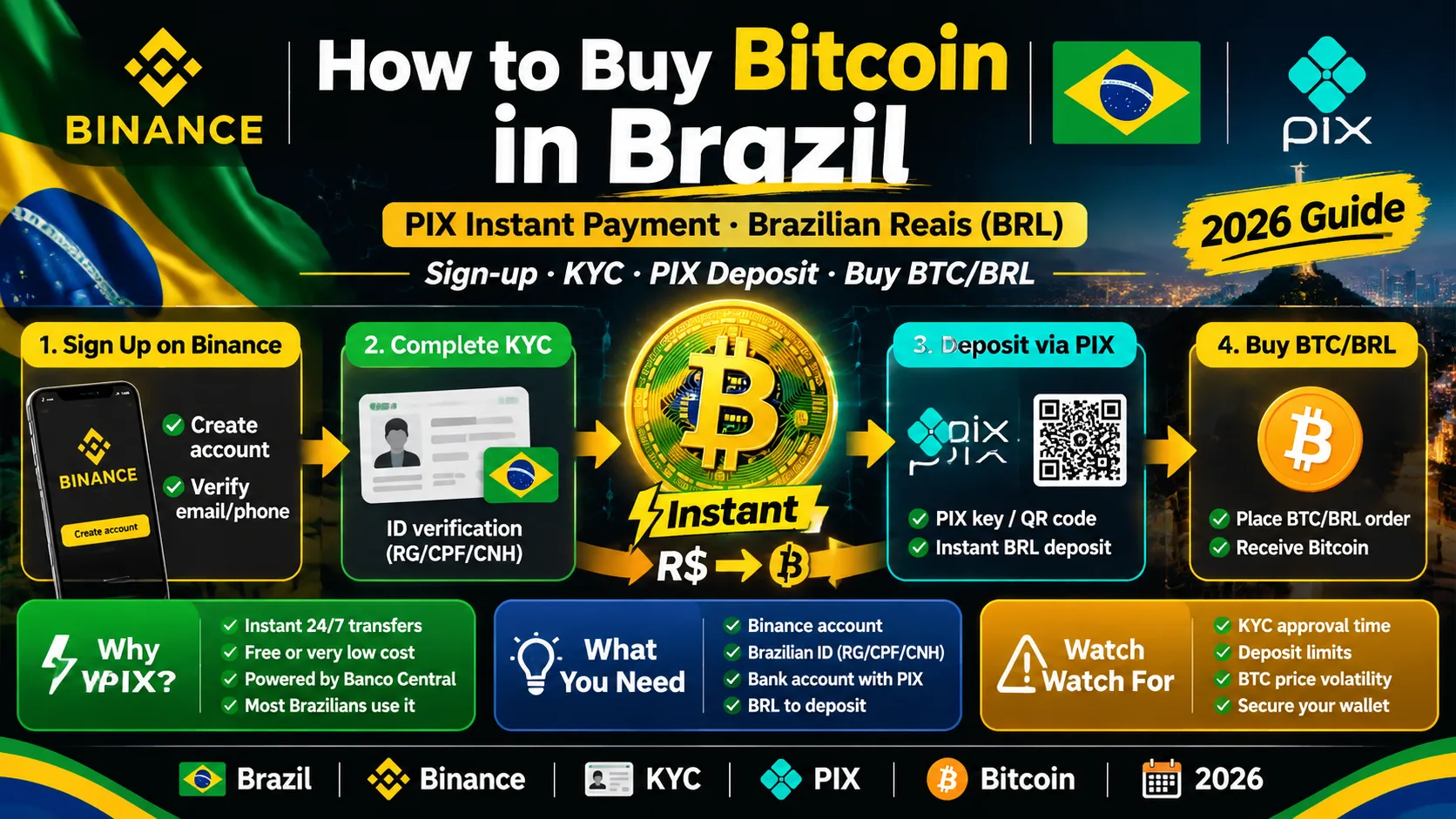
Key takeaways
- You can buy Bitcoin in Brazil with PIX in about 15 minutes: create a Binance account, verify with your CPF, deposit reais for free, and place a BTC/BRL order.
- Since October 2026, Binance routes BRL deposits through a payment account opened with Brazilian brokerage Sim;paul, which generates a PIX key in your name.
- Binance filed for a Brazilian central-bank licence on 23 October 2026 and keeps operating while the application is reviewed; eight products and 22 tokens were restricted on 27 October 2026.
- The base spot fee is 0.10%, or 0.075% with the BNB discount; the invite-code rebate brings the effective spot cost to about 0.06%.
- Your bank account name must match your Binance name exactly — a mismatch is the most common reason a PIX deposit fails.
You can buy Bitcoin in Brazil in about 15 minutes with PIX: create a Binance account, verify your identity with your CPF, send reais from your bank app, and place a BTC/BRL order. PIX deposits are free and usually arrive within seconds to minutes.
Two things changed in 2026 and matter before you start. First, Binance now routes BRL deposits through a payment account opened with Brazilian brokerage Sim;paul, which creates a PIX key in your name. Second, Brazil’s central bank began licensing crypto firms in February 2026; Binance filed its application on 23 October 2026 and continues to operate while the regulator reviews it. Core buying and selling works, but eight products and 22 tokens were restricted in late October 2026.
This guide walks through the full purchase, the real fees, and the problems that most often block a first PIX deposit.
⚠️ The most important thing first: don’t tap Sign Up directly in the app — you’ll miss the new-user rewards. The welcome benefits only apply when you register through an invite link or enter the referral code BN2688. Remember this.
💡 Don't have a Binance account yet? Sign up now — 20% fee rebate on spot and futures — enter the referral code BN2688.
What changed for Brazilian buyers in 2026?
Brazil now regulates crypto firms as virtual-asset service providers (SPSAVs), and Binance is operating under a transitional status while its licence application is reviewed.
The framework comes from Law 14.478/2022 and three central-bank resolutions published in November 2025, which took effect on 2 February 2026. Firms that already served Brazilian customers had until 30 October 2026 to apply for authorisation. Binance filed on 23 October 2026 through a local entity, BBrasil Sociedade Prestadora de Serviços de Ativos Virtuais Ltda.
Filing is not the same as being licensed. The central bank’s review can reportedly take up to two years, and firms that filed before the deadline can keep operating in the meantime. From 6 November 2026, banks and payment institutions are barred from serving crypto providers that did not apply.
What that means in practice for a beginner:
- Buying and selling Bitcoin with reais still works. The core spot market is available.
- Eight products were restricted on 27 October 2026: Binance Loans, Pool, Cloud Mining, margin trading, Launchpool, Megadrop, HODLer Airdrops, and Alpha 2.0.
- Twenty-two tokens were delisted on the same date, including XVG, USDE, USTC, DCR, DUSK, PIVX, MANTRA, ONE, GMT, and ZIL.
- BRL deposits now run through Sim;paul. The app asks you to open a payment account “at Binance in partnership with Sim;paul”, and that account receives your PIX transfers.
If your goal is simply to buy and hold Bitcoin, none of the restricted products affect you. If you were planning to use margin, Launchpool, or the Earn pool, check the app first — the menu may no longer show them for Brazilian accounts.
What do you need before you start?
You need four things: a CPF, a government photo ID, a Brazilian bank account in your own name, and a phone with the Binance app.
| Requirement | Why it matters |
|---|---|
| CPF | Required for identity verification and for the PIX key linked to your payment account |
| RG, CNH, or passport | Photo ID used in the KYC check; the document must be valid and unobstructed |
| Bank account in your name | PIX transfers must come from an account whose holder matches your Binance name |
| Smartphone | The PIX flow, QR code, and selfie check are all built for the app |
The name match is not a formality. If the bank account is in your mother’s name, your company’s name, or a joint account that shows a different holder, the deposit can be held or returned. Use an account that carries exactly the name on your ID.
You should also be at least 18 years old and buying only with money you can afford to lose. Bitcoin can fall 50% or more in a year; the fact that the purchase takes 15 minutes does not make the asset safe.
Step 1: Create your Binance account with the invite code
Open the Binance sign-up page through an invite link rather than tapping Sign Up cold in the app. The link fills the Referral ID field automatically, and that field is the only place the code can be applied.
- Register with email or phone. Either works; email is easier to recover if you lose your phone.
- Use a strong, unique password. A password manager is better than a password you reuse on other sites.
- Check the Referral ID field. It should show the code before you submit the form. If you registered directly and the field is empty, enter the code now — after the account is created, the binding generally cannot be added or changed.
The invite code does two things: it links your account to the person who referred you, and it can return part of the trading fee as a rebate. On this site the code is BN2688, and the configured rebate is 20% of spot and futures fees. It costs you nothing and does not change the base fee Binance charges.
For the full walkthrough, see how to create a Binance account and how the referral code works.
Step 2: Verify your identity with your CPF
Brazilian providers must identify customers, so KYC is mandatory before you can deposit or trade. Binance asks for your CPF, a photo ID, and a selfie.
- Open the verification section in the app and select Brazil.
- Enter your CPF and personal details exactly as they appear on your ID.
- Photograph the front and back of your RG, CNH, or passport. All four corners must be visible, with no glare and no fingers covering the text.
- Complete the liveness check: look at the camera, follow the prompts, and use a well-lit room.
Most checks are reviewed in minutes to a few hours; Binance’s official guidance allows up to 48 hours during busy periods. If it is rejected, the reason is almost always a cropped document, a reflection on the plastic, or a name that does not match the CPF record. Fix the photo and resubmit rather than opening a second account.
Our Binance KYC guide covers the document rules in more detail.
Step 3: Turn on two-factor authentication before you deposit
Set up 2FA before any money enters the account. A password alone is not enough for an account that can move reais and Bitcoin.
- Use an authenticator app such as Google Authenticator or Authy, not SMS. SMS codes can be intercepted through SIM-swap fraud.
- Add a passkey if your phone supports it; Binance treats it as a stronger second factor.
- Set an anti-phishing code, a word that appears in every genuine Binance email so you can spot fakes.
- Enable a withdrawal address whitelist so funds can only leave to addresses you have approved.
These four settings take about five minutes and close the most common account-takeover paths. Our account security guide explains each one.
Step 4: Deposit reais with PIX
PIX is the cheapest and fastest way to fund a Binance account in Brazil. The deposit itself is free, and most transfers are credited within seconds to minutes.
Here is the flow, as it appears in the app in November 2026:
- Open Add Funds, then Deposit BRL.
- Choose PIX as the payment method.
- If this is your first BRL deposit, follow the prompt to open a payment account with Sim;paul. The account is opened in your name and generates a PIX key automatically.
- Copy the PIX key or scan the QR code shown by Binance.
- Pay from your bank app. The sender account must be in your name.
- Return to Binance and confirm that you have sent the funds, if the app asks.
A detail that trips people up: if you have BC Protege+ enabled, the central bank’s tool can block the creation of the new payment account. Brazilian press reported in October 2026 that users need to disable BC Protege+ temporarily, open the account, and then reactivate it. If the app loops or refuses to create the account, check that setting first.
The minimum deposit is low — local comparison sites cite around R$10 for PIX, and the app shows the exact limit before you send. A first deposit of R$100 to R$500 is enough to test the flow without exposing much money.
If PIX is unavailable on your account, the alternatives are a card purchase (convenient but usually 3% to 5% more expensive) or Binance P2P, where you buy USDT from a seller and pay by bank transfer. P2P works, but the seller’s margin is typically 0.5% to 2%, and you must trade only with verified merchants.
Step 5: Buy Bitcoin on the BTC/BRL market
Binance gives you two ways to buy, and they are not the same product.
| Route | How it works | Cost | Best for |
|---|---|---|---|
| Convert | Enter reais, the app quotes a BTC amount, tap confirm | Spread is built into the quote; no separate fee line | One-tap buys and small amounts |
| Spot BTC/BRL | Place a market or limit order on the order book | 0.10% fee, or 0.075% with BNB | Larger buys and control over price |
For a first purchase, Convert is simpler. For anything above a few hundred reais, the spot market is usually cheaper because the fee is explicit and the order book shows the real price.
To buy on spot:
- Search for BTC/BRL and open the pair.
- Choose Limit if you want to name your price, or Market if you want the purchase done now.
- Enter the amount in reais — not in BTC — to avoid a decimal mistake.
- Review the estimated quantity and the fee before confirming.
- Confirm the order and check that the BTC appears in your spot wallet.
A market order fills at the best available price, which can be slightly worse than the headline quote when the book is thin. Brazilian BTC/BRL liquidity is decent during local banking hours but thinner overnight; a limit order avoids paying for that gap.
Step 6: Move long-term holdings to your own wallet
Coins held on an exchange are held in the exchange’s custody. That is fine for amounts you plan to trade, but long-term holdings belong in a wallet you control.
- Leave a trading balance on Binance if you plan to buy and sell regularly.
- Withdraw larger holdings to a hardware wallet and keep the seed phrase offline, on paper or metal, never in a photo or cloud note.
- Test with a small amount first. Send a small BTC withdrawal, confirm it arrives, then send the rest.
Our guides to hardware wallets and storing crypto safely cover the setup. If you withdraw BTC, choose the Bitcoin network and double-check the address — a wrong address cannot be reversed.
How much does it cost to buy Bitcoin in Brazil?
A PIX purchase on Binance costs the trading fee plus the spread; the deposit itself is free. For most beginners the all-in cost is well under 1%.
| Cost | Amount (November 2026) | Notes |
|---|---|---|
| PIX deposit | R$0 | Binance does not charge; your bank may charge its own transfer fee |
| Spot trading fee | 0.10% | 0.075% if you hold BNB and pay fees with it |
| Invite-code rebate | 20% of the fee | Effective spot cost about 0.06% |
| BRL withdrawal | About R$3.50 | Fixed fee per PIX withdrawal |
| Card purchase | Typically 3%–5% | Fast but the most expensive route |
| P2P | 0.5%–2% seller margin | No visible fee, but the price includes it |
A worked example: you deposit R$1,000 by PIX and buy BTC on the spot market.
- Trading fee at 0.10%: R$1.00.
- With BNB discount at 0.075%: R$0.75.
- With the 20% rebate on the fee: about R$0.15 returned, so the net fee is roughly R$0.60.
- PIX deposit: R$0.
- All-in cost: about 0.06% of the purchase.
On the same R$1,000, a card purchase at 3.5% would cost R$35 — more than 50 times the PIX route. That gap, not the choice between Bitcoin and another coin, is usually the biggest avoidable cost for a Brazilian beginner.
Is buying Bitcoin legal in Brazil?
Yes. Individuals can legally buy, hold, and sell crypto in Brazil, and the activity is now supervised under the central bank’s virtual-asset framework.
The legal basis is Law 14.478/2022, which made the central bank the primary regulator of virtual-asset service providers. The rules that took effect in February 2026 cover authorisation, minimum capital, customer identification, and reporting. Binance is operating while its application is reviewed, and the products restricted in October 2026 reflect that transitional status.
Tax is separate from legality. Brazil taxes gains when you dispose of crypto, not when you buy and hold. The rules changed repeatedly in 2025 and 2026 — including a provisional measure that proposed a flat 17.5% rate and whose legislative status has been disputed, plus monthly reporting through the DeCripto system. Do not rely on a blog post, including this one, for your tax position: keep every purchase and sale record and speak to a Brazilian accountant.
Our crypto taxes guide explains the general principles, and the Receita Federal publishes the current reporting rules.
Common problems and fixes
| Problem | Likely cause | Fix |
|---|---|---|
| PIX deposit not credited | Sender name differs from the Binance account; wrong key; deposit under review | Check Orders → Deposits, confirm the sender name, contact support with the bank receipt |
| Cannot open the payment account | BC Protege+ is active on your CPF | Disable BC Protege+ temporarily, open the account, then reactivate it |
| KYC rejected | Cropped or glared document; expired ID; name mismatch | Retake the photo in good light with all four corners visible |
| Referral code missing | Account was created without a code | Binding generally cannot be changed; check the limited rebind rules before opening another account |
| Product missing from the menu | One of the eight products restricted on 27 October 2026 | Use spot trading, which remains available |
| Bank blocks the transfer | Bank’s own crypto or fraud policy | Ask the bank, use another account in your name, or use P2P |
| Withdrawal to wallet not arriving | Wrong network or address | Check the txid on a block explorer; a wrong address cannot be reversed |
The two failures that cost the most time are the name mismatch and BC Protege+. Both are fixable before you send any money, so check them first.
Binance vs Brazilian exchanges
Binance is not the only place to buy Bitcoin in Brazil, and a local exchange is sometimes the simpler choice.
| Exchange | BRL deposit | Spot fee | Strengths | Trade-offs |
|---|---|---|---|---|
| Binance | PIX via Sim;paul account | 0.10% (0.075% with BNB) | Deep global liquidity, low fees, wide coin list | Transitional licence status; some products restricted |
| Mercado Bitcoin | PIX / TED | Roughly 0.3%–0.7% depending on volume | Long-established local exchange, simple interface | Higher fees, fewer international pairs |
| Foxbit | PIX | Roughly 0.5%–1% | Local support, beginner-friendly app | Smaller order book |
| Bitso | PIX | Roughly 0.5%–1% | Strong in Latin America, simple app | Higher fees than Binance for active trading |
The decision rule is simple. If you want the lowest fee and access to a global order book, Binance wins. If you want a fully licensed local provider with Portuguese support and no transitional status, a Brazilian exchange is the safer choice and worth the higher fee. Many people use both: a local exchange for reais on-ramp and Binance for trading.
Whichever you choose, check the provider’s current authorisation status with the central bank before depositing a large amount. The regulatory picture in Brazil is moving quickly, and a page written in November 2026 may be out of date by the time you read it.
Conclusion
Buying Bitcoin in Brazil takes about 15 minutes: register with an invite code, verify with your CPF, open the Sim;paul payment account, send reais by PIX, and buy BTC/BRL. The PIX route is free and far cheaper than a card, and the effective spot fee with the invite rebate is about 0.06%.
Before you start, confirm three things: the bank account is in your name, BC Protege+ will not block the new payment account, and you are buying only what you can afford to lose. Then follow the Binance registration guide step by step, and move any long-term holding to a wallet you control.
Not investment advice. Bitcoin is volatile and you can lose money. This guide explains how the purchase works, not whether you should buy.
Don't have a Binance account yet?Sign up nowenter the referral codeBN2688
Frequently asked questions
Can I buy Bitcoin in Brazil with PIX?
What is the minimum amount to buy Bitcoin in Brazil?
How long does a PIX deposit take on Binance?
Do I need a CPF to buy Bitcoin in Brazil?
Is Binance legal in Brazil?
Why is my PIX deposit not showing on Binance?
How much are Binance fees in Brazil?
Can I withdraw reais from Binance to my bank?
Do I have to pay tax when I buy Bitcoin in Brazil?
Editor-in-Chief & Lead Researcher
Editor of MyCryptoStart. Independent researcher of cryptocurrency exchanges, focused on fees, security, KYC, and onboarding — publishes step-by-step guides in plain English for beginners.
View author page →Some links on this page are affiliate links: we may earn a commission at no extra cost to you. This content is educational and is not financial, investment, or legal advice. Affiliate disclosure · Disclaimer.
Continue reading
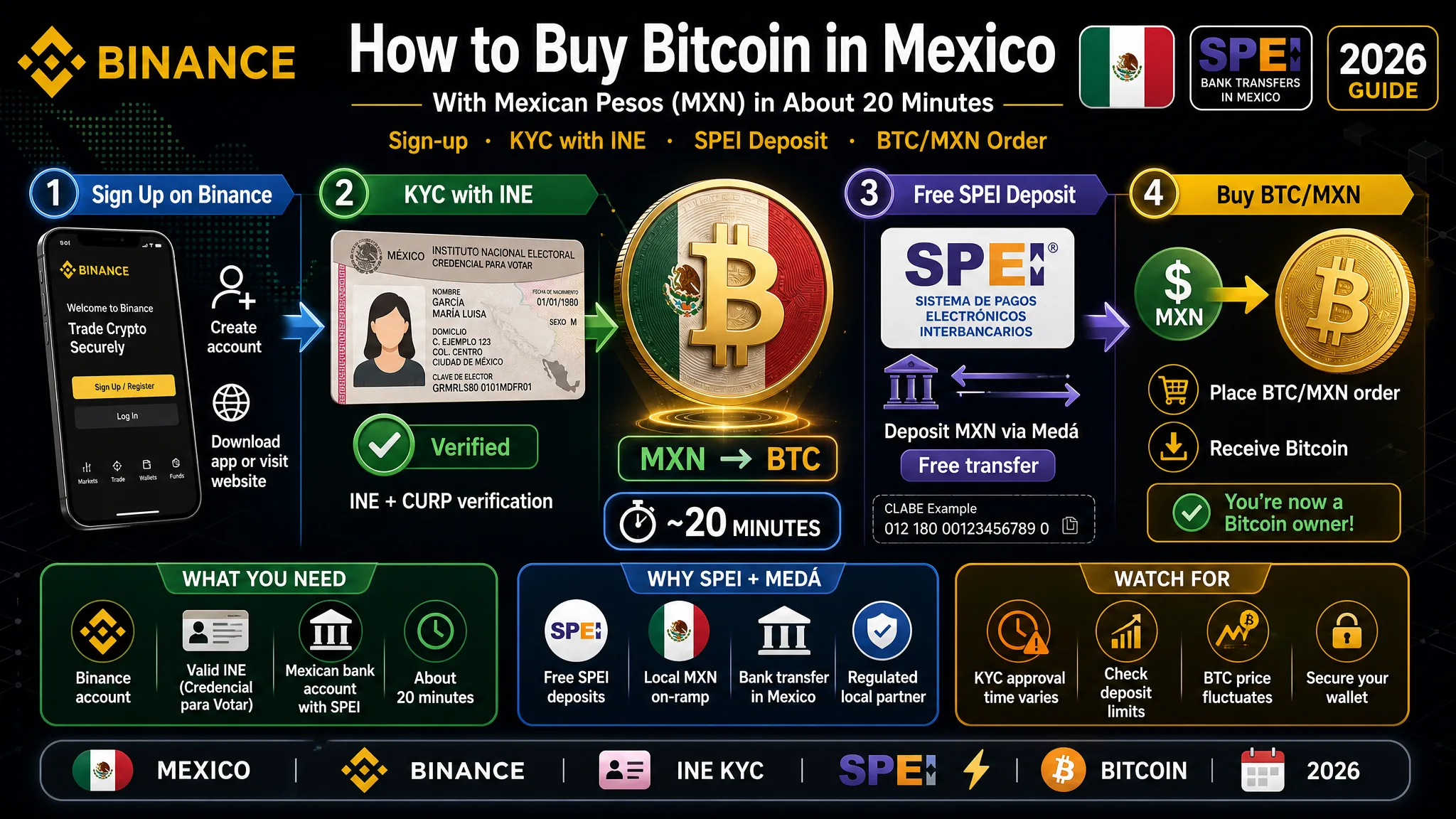
How to Buy Bitcoin in Mexico (SPEI, 2026)
Buy Bitcoin in Mexico with pesos in about 20 minutes: Binance sign-up, KYC with INE, a free SPEI deposit through Medá, and a BTC/MXN order.
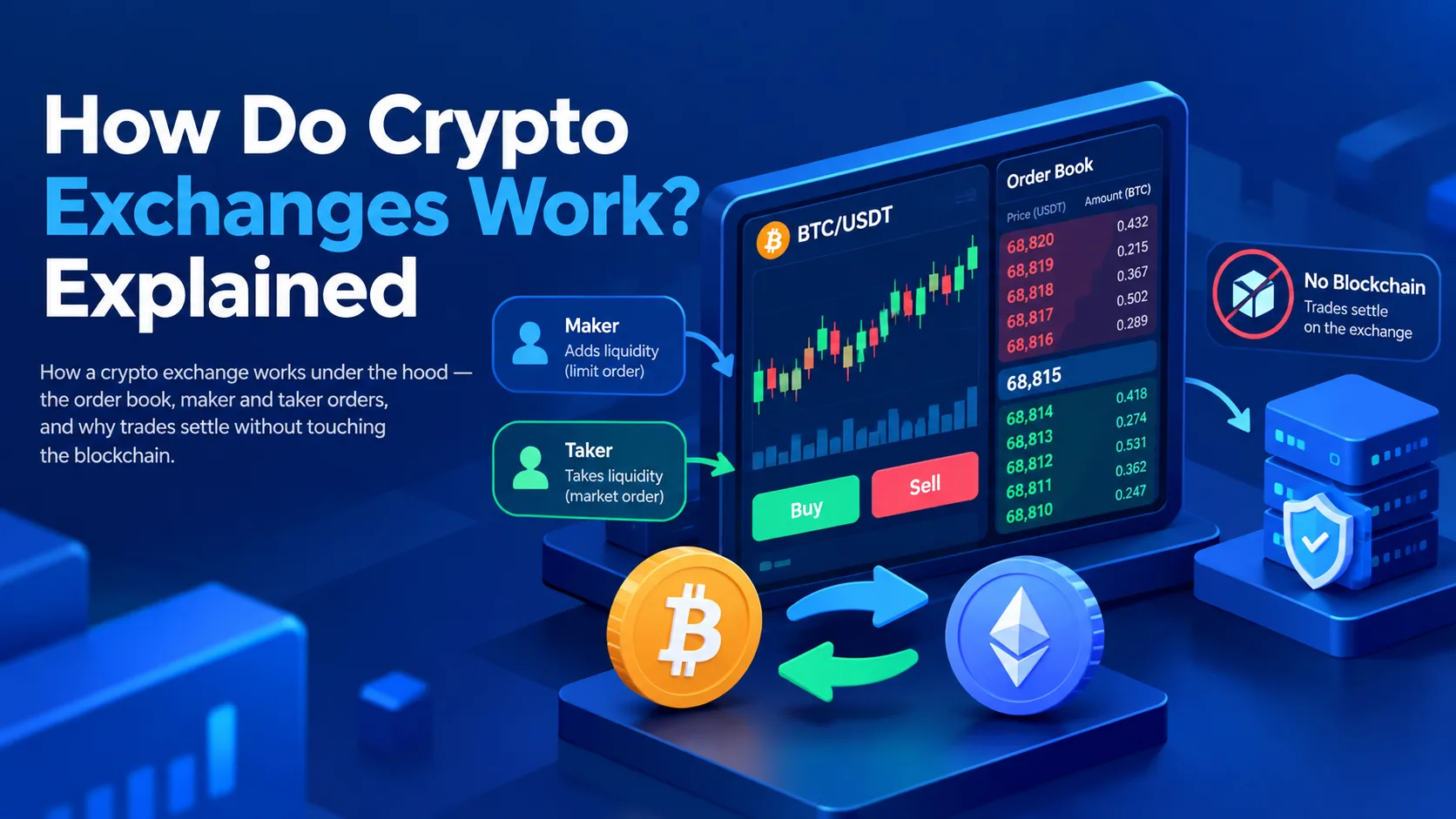
How Do Crypto Exchanges Work? Explained
How a crypto exchange works under the hood — the order book, maker and taker orders, and why trades settle without touching the blockchain.
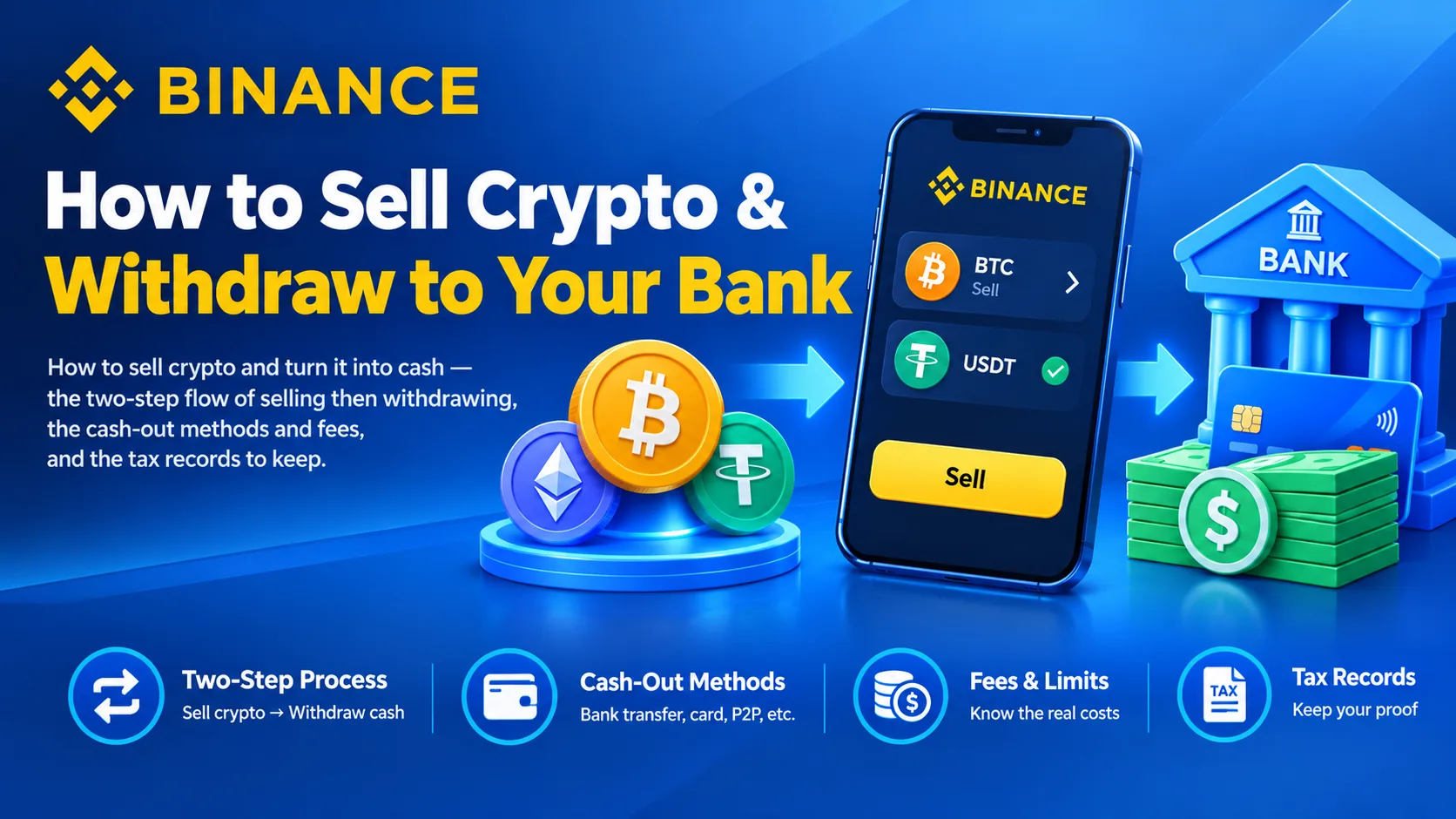
How to Sell Crypto & Withdraw to Your Bank
How to sell crypto and turn it into cash — the two-step flow of selling then withdrawing, the cash-out methods and fees, and the tax records to keep.