
How to Buy Crypto Without an Account (2026)
No account? The cheapest beginner route is a 15–20 minute KYC exchange account. Compare P2P, ATMs and DEXs on $1,000, with real fees and steps.
 Lucas Almeida 5 min read
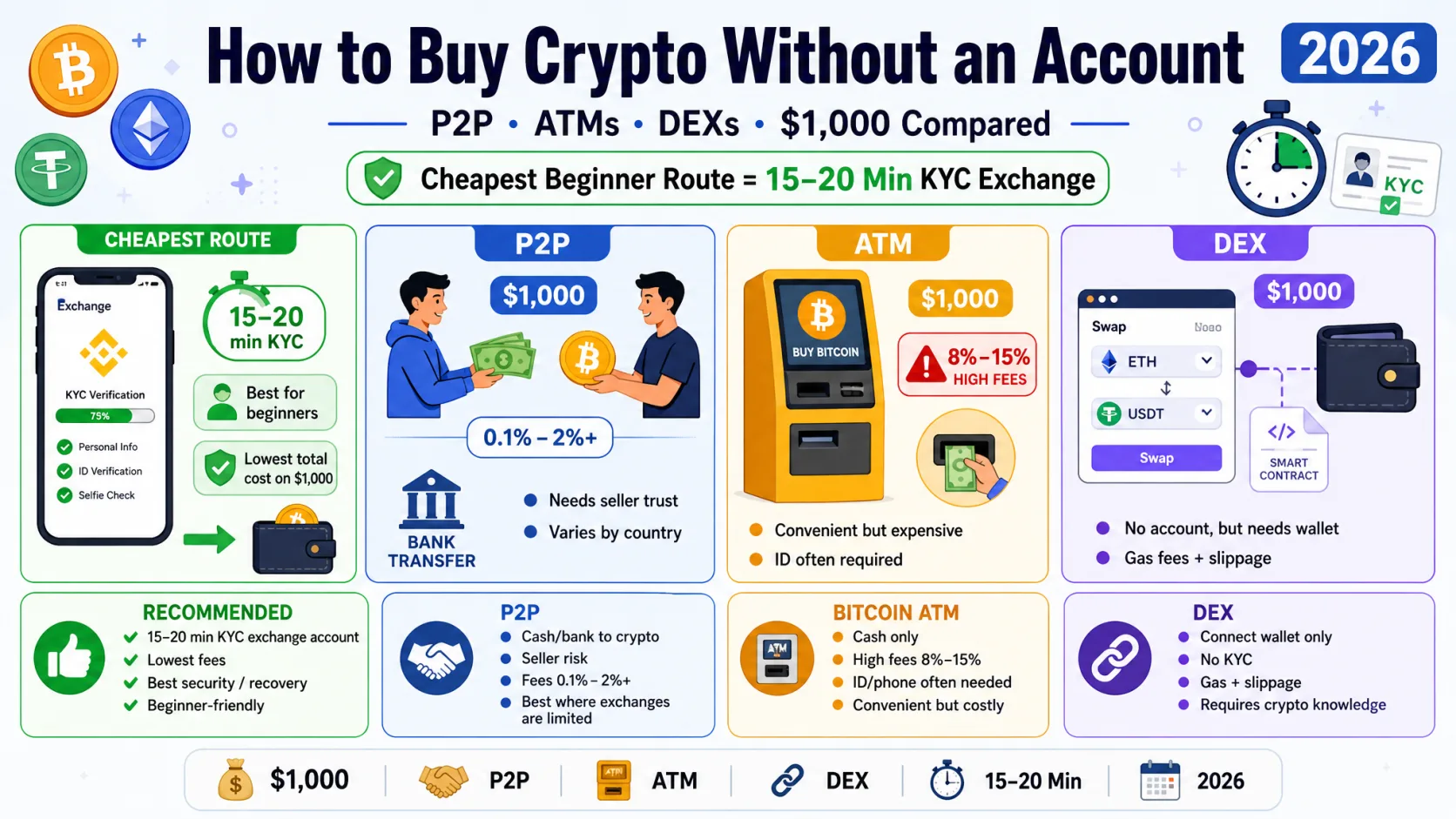
Key takeaways
- You can buy crypto without an exchange account, but for a complete beginner holding only cash, the only low-cost route is a 15–20 minute signup with KYC.
- Off-platform P2P, Bitcoin ATMs and DEXs are not cheaper: ATMs commonly charge 7%–15%, and a DEX requires crypto and gas before you can swap.
- On a $1,000 purchase, an exchange P2P spread of 0.5%–2% leaves roughly $979–994, while an ATM at 7%–15% leaves $850–930.
- A 20% referral rebate is worth 0.02% of trading volume: $0.20 on $1,000 and $20 on $100,000. It does not reduce the P2P spread.
- Enter the code at registration. Binance allows late binding only in narrow 30-day and 90-day cases, and never when a referrer is already attached.
You can buy crypto without an exchange account, but for a complete beginner holding only cash in 2026, the only low-cost route is a 15–20 minute exchange signup with KYC. Off-platform P2P, Bitcoin ATMs and DEXs either charge 7%–15%, require crypto and gas first, or leave you with no dispute protection. This guide prices the four routes on a $1,000 purchase and then walks through the shortest first-buy path.
⚠️ The part most guides bury: don’t tap Sign Up directly inside the app. Register through the invite link or enter the code BN2688 — that is what attaches the 20% fee rebate and the task-based new-user rewards. Without it, the account is created, but the benefits are not.
💡 Don't have a Binance account yet? Sign up now — 20% fee rebate on spot and futures — enter the referral code BN2688.
What does “no account” actually mean?
“No account” usually mixes three different gaps: no exchange account, no completed KYC, and no self-custody wallet. Each blocks a different step, and only the first one is really about buying your first crypto.
| What you are missing | What it blocks | Can you buy? | Most common mistake |
|---|---|---|---|
| No exchange account | Registration on Binance, Coinbase, Kraken, etc. | Yes, after signup and KYC | Assuming you need someone to buy for you |
| No completed KYC | Identity verification on an existing account | View-only on most platforms | Depositing before verifying |
| No self-custody wallet | MetaMask, Trust Wallet, hardware wallet | Does not block an exchange purchase | Treating a wallet as a prerequisite |
| All three | Everything above | Only the exchange route works from cash | Chasing “anonymous, no-KYC” claims |
For a first purchase, the only gap you must close is the first row: open an exchange account and finish KYC. A wallet can wait until you hold enough to justify it. KYC is not optional on a regulated platform; it is the gate to deposits, trading and withdrawals. Mixing the three gaps together is what makes “I have no account” feel like a dead end.
Can you really buy crypto without an account?
Yes, but not at a low cost and not with real protection. The phrase is technically true for P2P deals, Bitcoin ATMs and DEX swaps. Each works without a conventional exchange login, and each replaces the account with something else: a stranger’s escrow, a machine’s fee, or a wallet you must secure yourself.
The practical question is not “is it possible?” but “who holds the asset, and who can help when something goes wrong?” An exchange account gives you custody, a transaction record and an appeals process. An off-platform P2P deal gives you a bank transfer screenshot. For a first purchase, a recovery path matters more than a shortcut.
What are the four routes from zero?
A beginner holding only cash has four realistic routes: an exchange account, on-platform P2P, off-platform P2P and a Bitcoin ATM. DEXs are a fifth option only for people who already hold crypto.
| Route | Usable from zero? | Who holds the asset? | Dispute support? | Best for |
|---|---|---|---|---|
| Exchange account + P2P | Yes, with KYC | The exchange | Platform support and appeals | First purchase, from about $50 |
| Exchange account + card | Yes, with KYC | The exchange | Platform support | Small, urgent purchases |
| On-platform P2P | Yes, but still needs an account and KYC | Platform escrow | Platform arbitration | Users seeking a tighter spread |
| Off-platform P2P | Technically yes | Nobody | Almost none | Experienced users who can absorb a total loss |
| Bitcoin ATM | Some machines abroad | ATM operator | The operator | Small emergency purchases |
| DEX / instant swap | No; needs crypto and gas | You | Nobody | People who already hold crypto |
| Account rental / proxy buyer | Technically yes | Someone else | None | Nobody |
The difference that matters is not whether you can get coins; it is what happens after the payment goes wrong. Exchange P2P has escrow and arbitration. Off-platform P2P has neither. An ATM has a receipt and a operator, but its fee is already gone. A DEX has no support desk at all.
Why is “no account” usually more expensive?
Skipping signup saves minutes and adds spread, network fees and counterparty risk. The table prices a $1,000 purchase across the routes, using 2026 public ranges; the live quote depends on the platform and the moment.
| Route | Visible cost | Hidden cost | Approx. value from $1,000 | Worst case |
|---|---|---|---|---|
| Exchange P2P | 0.5%–2% spread + 0.1% spot fee | Merchant disputes, bank-freeze risk | $979–994 | Merchant does not release; you can appeal |
| Exchange card purchase | 2%–5% card fee | Opaque FX rate, limits | $950–980 | Same as above |
| Off-platform P2P | 1%–3% premium | No escrow, no appeal | $970–990 | Paid and blocked; 100% loss |
| Bitcoin ATM | 7%–15% | Location, limits, camera records | $850–930 | Machine failure, fake ATM |
| DEX / instant swap | 0.1%–0.3% swap + gas | Seed phrase, approvals, fake tokens | Depends on the fiat on-ramp | Approval drained, token goes to zero |
| Proxy buyer / rented account | “0 fee” verbally | The account is not yours; KYC mismatch | Unpredictable | Frozen account, assets transferred out |
The exchange’s 0.5%–2% P2P spread is an order of magnitude cheaper than a 7%–15% ATM fee. On $1,000, an ATM may leave you with $850–930, while exchange P2P leaves about $979–994 — a $50–140 difference. “No signup” saves a few minutes and costs tens to over a hundred dollars.
Now the trading fee. Binance’s standard spot fee is 0.1%; paying with BNB cuts it by 25% to 0.075%, and the BN2688 rebate returns 20% of the fee, bringing the effective cost to roughly 0.06% (2026-11 check)1. But the 0.1% fee was never the beginner’s main cost. On a $1,000 trade it is $1, and the rebate is $0.20; the P2P spread at 0.5%–2% is $5–20. Fix the spread first, then optimize the fee.
One-line formula: true first-purchase cost ≈ on-ramp spread + trading fee − rebate. The rebate reduces only the last term.
What do you need to open an exchange account?
Opening a first account takes three things: a government-issued ID, a phone number or email that receives codes, and a stable connection. The submission takes about 15–20 minutes; KYC review is separate. Eligibility depends on your country, so check the platform’s restrictions before you start.
| Requirement | What you need | Common blocker |
|---|---|---|
| ID | Passport, national ID or driver’s licence, depending on country | Glare, cropped edges, details that do not match |
| Phone or email | Able to receive verification codes | Codes expire in about 30 minutes; repeated requests get rate-limited |
| Age | 18 or older | Minors cannot open an account |
| Region | Eligible under the platform’s terms | Restricted regions cannot sign up or use some features |
| Connection | Stable access to the signup and KYC pages | Distinguish a network problem from a regional block |
| Referral code | BN2688 entered at signup | Adding it later is limited to narrow exceptions |
KYC normally clears in minutes, can take a few hours at peak times, and is officially quoted at up to 48 hours. Daily attempts are limited. If it fails, fix the photo and lighting instead of resubmitting repeatedly. On Binance, verification unlocks deposits, trading and withdrawals, so “deposit first, verify later” is the wrong order. The full walkthrough is in our Binance registration guide and KYC guide2.
What is the shortest path from signup to first buy?
The standard path is six steps: register, verify, complete KYC, buy USDT through P2P, buy spot, and secure the account. In a smooth run it takes 20–30 minutes, plus KYC review time.
| Step | Action | Time | Key reminder |
|---|---|---|---|
| 1 | Open the invite link and confirm BN2688 | 2 min | Do not sign up cold inside the app |
| 2 | Verify email or phone | 2 min | Codes are valid for about 30 minutes |
| 3 | Set a password and enable 2FA | 3 min | At least 8 characters, with uppercase and a number |
| 4 | Submit KYC: ID plus face scan | 5–10 min | Even lighting; remove hats and glare |
| 5 | Buy USDT through P2P | 5 min | Pay from your own bank account, then mark as paid |
| 6 | Buy BTC or ETH on spot | 2 min | Minimum order about 5 USDT; check the pair |
Step 1 is the easiest to skip and the most expensive to get wrong. A Binance referral code is normally bound at registration and cannot be changed. Late binding is limited to a 30-day self-bind for accounts with no deposit and no trade, and a 90-day recall for dormant accounts that never had a referrer. Once a referrer is attached, none of those routes apply. Our guide to adding a code after signup covers the exact conditions.
Step 5, P2P, is where beginners get hurt. Choose merchants by completion rate, registration age and trade count, not price alone. Pay from a bank account in your own name, do not write “Bitcoin” or “USDT” in the transfer note, and always return to Binance to mark the order as paid. If the merchant does not release, use platform arbitration; never move the conversation to a private chat app.
Does the referral code matter?
Yes, but treat the rebate as a long-term discount, not a signup jackpot. BN2688 returns 20% of each trading fee, which equals 0.02% of volume. It becomes meaningful through repetition, not through one registration.
| Monthly volume | Standard fee at 0.1% | 20% rebate returned | Effective rate with BNB |
|---|---|---|---|
| $1,000 | $1 | $0.20 | About 0.06% |
| $10,000 | $10 | $2 | About 0.06% |
| $100,000 | $100 | $20 | About 0.06% |
The welcome bonus is not cash, and it is not guaranteed. Binance’s headline “up to $19,800” is a task-based ceiling: it is made up of vouchers and rewards that require deposits, trading volume and manual claiming within deadlines. Most beginners receive far less. The rebate is the part that is defined up front, which is why it is the honest reason to use a code.
And the rebate does not touch the P2P spread. A 1% merchant markup on $1,000 is $10; the rebate is $0.20. Push the spread down to 0.5%–1% first, then optimize the fee. The full mechanics, including why the rebate arrives in USDC, are in our Binance referral code guide3.
How much should you buy first?
Start with $20–50, buy BTC, ETH or simply hold USDT, and avoid low-unit-price altcoins. That amount completes the signup, deposit, order and balance-check loop without risking money you need.
| Budget | What to buy | Fee share | Focus |
|---|---|---|---|
| $20–50 | USDT or BTC | About 0.1%–2% | Complete the loop and learn the interface |
| $100–300 | BTC, ETH | About 0.1%–1% | Split into two orders to reduce slippage |
| $500+ | BTC, ETH; consider cold storage | About 0.1% | Learn withdrawals and network checks |
Binance spot orders start at about 5 USDT, and P2P minimums are commonly around $10–15. Do not chase “the bottom” on your first buy, and do not assume a $0.001 token is cheap. A low unit price only means a large supply; meme coins carry far higher volatility and zero-risk than BTC or ETH. When you are ready to move coins off the exchange, read how to store crypto.
Which “no account” claims are traps?
Every shortcut around an account and KYC trades the platform’s custody and appeals for trust in a stranger. These lines are common in search results and chat groups, and you absorb the downside.
| Claim | Reality | Consequence |
|---|---|---|
| “Use my account; I’ll buy for you” | The account is not in your name, and the asset is not yours at platform level | They change the password or withdraw; you have no claim |
| “Buy a verified account” | Breaks the platform’s terms; reused KYC triggers risk controls | Frozen account, funds stuck |
| “Off-platform P2P is cheaper” | No escrow; paying first gives you no protection | Blocked, 100% loss |
| “Buy anonymously without KYC” | Regulated platforms require KYC; on-chain activity is pseudonymous, not anonymous | Legal and financial exposure |
| “My mentor guarantees returns” | Standard pig-butchering script | Principal goes to zero |
| “Support needs screen sharing” | Real support never asks for codes or remote control | Account drained |
Regulation also matters. In the US, FinCEN-registered exchanges require KYC; in the EU, MiCA imposes identity checks on crypto service providers. “No account” routes tend to sit outside those protections, which is exactly why they are cheaper to advertise and more expensive to use. Check your local rules and the platform’s eligibility page before signing up. For the scam patterns behind these claims, see our crypto scams guide.
Conclusion
The answer to “how do I buy crypto without an account” is not a clever workaround; it is a 20-minute account. Off-platform P2P, ATMs and DEXs look like they skip registration, but they replace it with a 7%–15% fee, a crypto-and-gas prerequisite, or 100% counterparty risk. For a first purchase, an exchange account is the only route that combines low cost, custody and a dispute process.
Remember the order: register through the invite link with BN2688, complete KYC, then use $20–50 to buy your first USDT through P2P. The rebate only reduces the trading fee; the spread is the bigger number. Get the loop working before you size up or move to a wallet. If you get stuck on the first deposit, our Binance deposit guide covers the common failures.
Footnotes
-
Source: Binance Support, “Fee Structure on Binance,” standard spot fee 0.1% and 25% BNB discount, updated 2026-10-21; checked 2026-11-29. ↩
-
Source: Binance Support identity-verification documentation and the platform’s signup flow, checked 2026-11-29; the 48-hour figure is the official outer limit, not a promise. ↩
-
Source: Binance Support Referral Pro FAQ and the site’s referral-code guide, checked 2026-11-29; referral percentages are configured in this site’s affiliate settings. ↩
Don't have a Binance account yet?Sign up nowenter the referral codeBN2688
Frequently asked questions
Can I buy crypto without an account?
Do I need KYC to buy crypto?
Can a friend buy crypto for me?
What is the minimum first purchase?
Can I add BN2688 after signing up?
How much does a 20% rebate actually save?
Is a Bitcoin ATM cheaper than an exchange?
Where should I store crypto after buying it?
Editor-in-Chief & Lead Researcher
Editor of MyCryptoStart. Independent researcher of cryptocurrency exchanges, focused on fees, security, KYC, and onboarding — publishes step-by-step guides in plain English for beginners.
View author page →Some links on this page are affiliate links: we may earn a commission at no extra cost to you. This content is educational and is not financial, investment, or legal advice. Affiliate disclosure · Disclaimer.
Continue reading
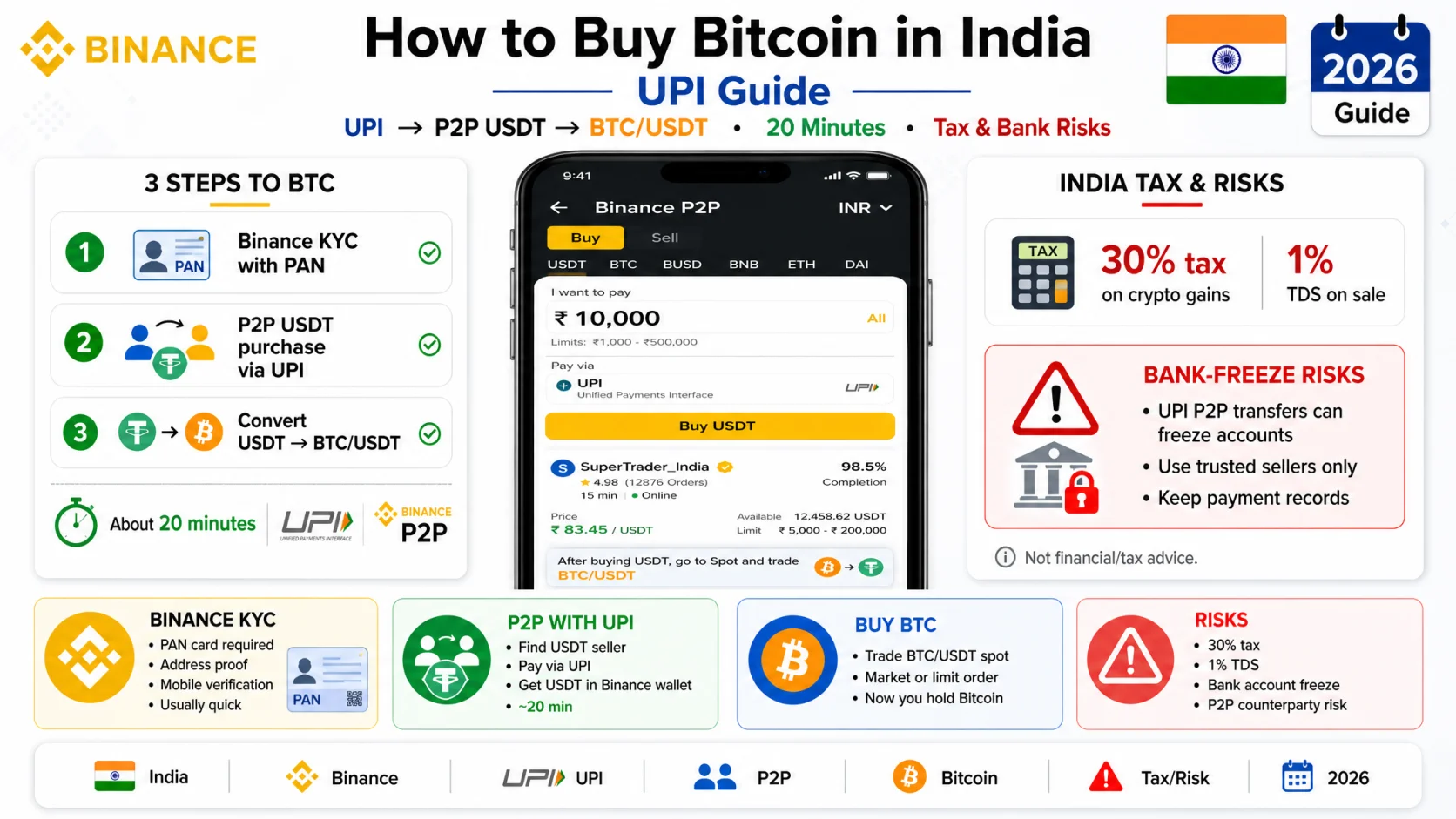
How to Buy Bitcoin in India: UPI Guide (2026)
Buy Bitcoin in India with UPI in about 20 minutes: Binance KYC with PAN, a P2P USDT purchase, then BTC/USDT — plus the 30% tax, 1% TDS and bank-freeze risks.
How to Buy Bitcoin in Taiwan: TWD Guide 2026
Buy Bitcoin in Taiwan with TWD in minutes on registered exchanges like MAX, MaiCoin or BitoPro — or through Binance, which is not registered locally.
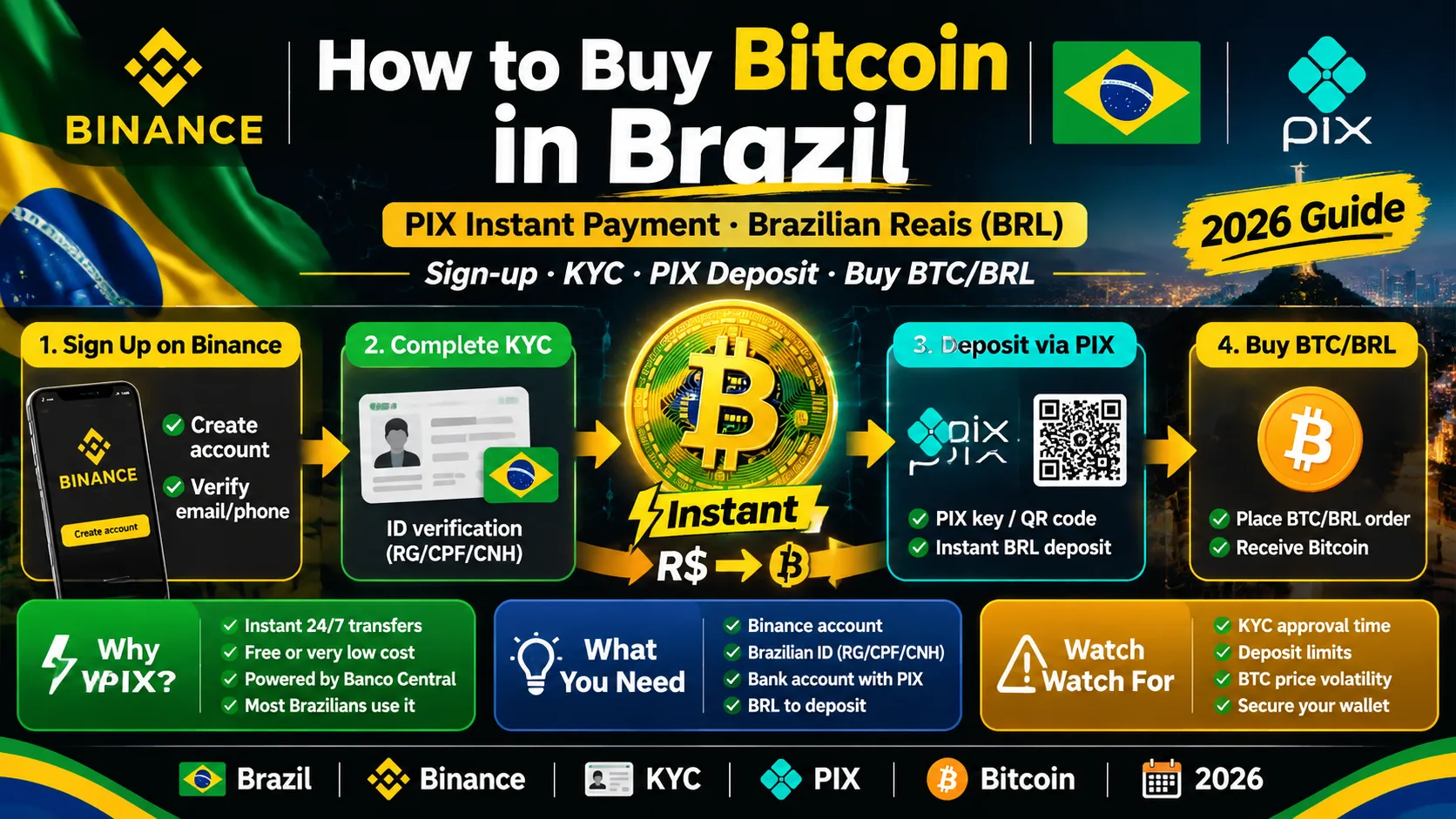
How to Buy Bitcoin in Brazil: PIX Guide (2026)
Buy Bitcoin in Brazil with PIX in about 15 minutes: Binance sign-up with CPF, KYC, a free reais deposit, and a BTC/BRL order — 2026 fees and rules.