
Binance Referral Code Not Working? 7 Fixes
Binance rejects your code or no rebate appears? Seven fixes for the collapsed Referral ID field, stripped links, region blocks, and missing USDC.
 Lucas Almeida 5 min read
Key takeaways
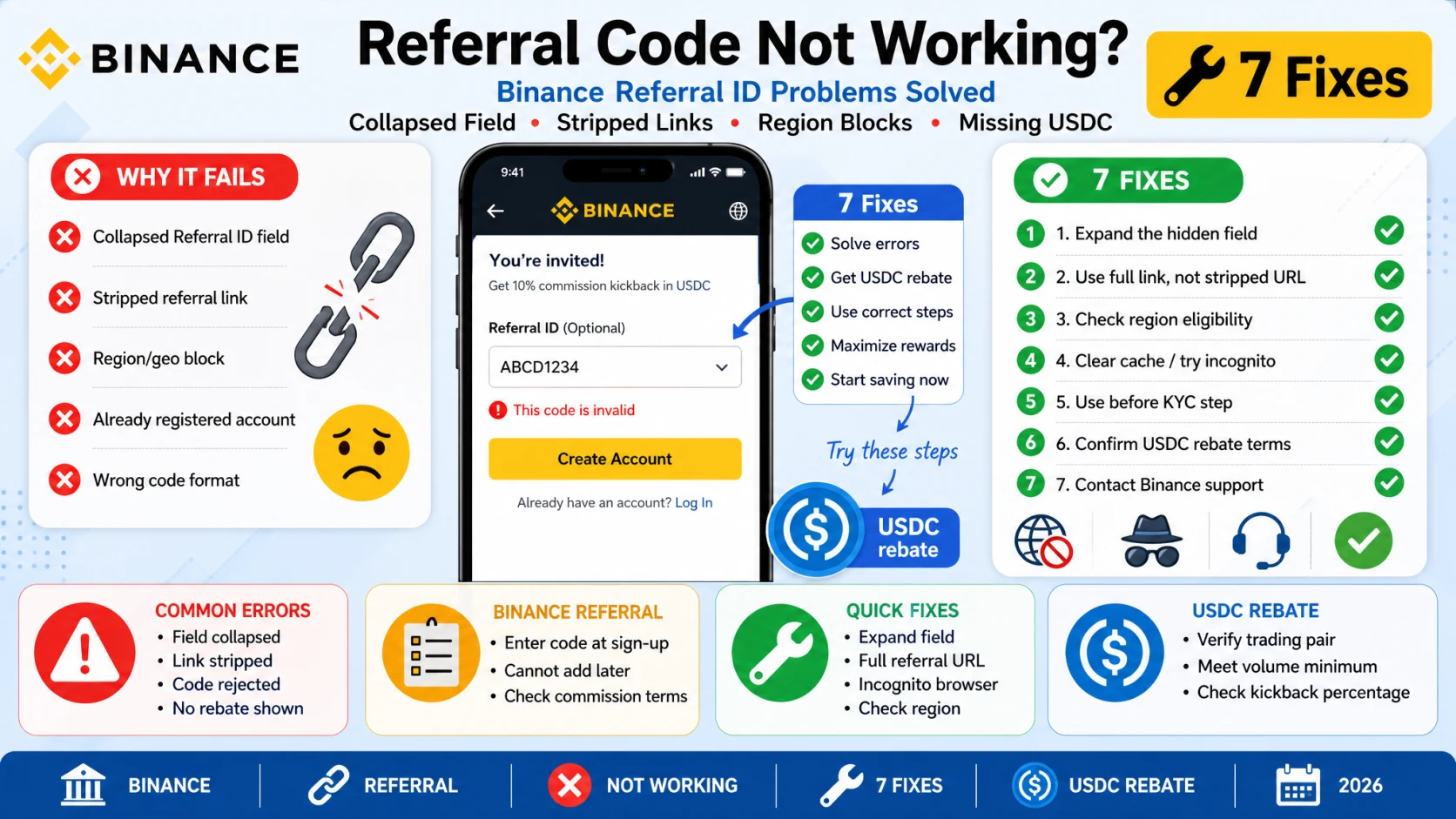
- The most common reason a Binance referral code "doesn't work" is that it was never entered: the Referral ID field is optional and collapsed on mobile, and some app sign-up flows only show it after the first account-creation screen.
- Binding normally happens once, at registration. Binance's Referral Pro FAQ describes a narrow late-binding route within 30 days only if the account has no deposits and no trades — so do not deposit or trade to "test" before the code is attached.
- A code that applied correctly can still look broken: the rebate arrives later as USDC in your Spot account, not as a smaller fee on the trade, and a referrer is allowed to set the rebate to zero.
- "Invalid referral code" is usually a typo, a trailing space, or a promo code pasted into the Referral ID field. Referral links avoid the problem because they fill the field automatically.
- No code fixes a blocked region. US residents need Binance.US, which has its own separate program, and Binance stopped onboarding new EU/EEA users on 1 July 2026. A VPN does not change the account's eligibility and can get it frozen.
A Binance referral code usually fails for one of seven reasons, and the most common is that the code was never actually entered. The Referral ID field is labeled optional and is collapsed on mobile, so many people create the account without ever seeing it. If you have not registered yet, open Binance through a referral link so the field fills itself in; if the account already exists, changing the referrer is normally impossible.
Work through the fixes below in order. The table tells you which one matches what you are seeing. Program terms were last reviewed on 23 November 2026 and are linked so you can verify them yourself.
Why is my Binance referral code not working?
Match the symptom first, then jump to the fix. “Not working” covers at least four different failures: the code was never applied, the code was rejected, the code applied but the rebate is invisible, or the account is in a region where the program does not run.
| What you see | Most likely cause | Fix |
|---|---|---|
| No Referral ID field, or the field was empty | Code never entered; field is optional and collapsed on mobile | Fix 1 |
| “Invalid referral code” or the form rejects it | Typo, stray space, promo code in the wrong field | Fix 3 |
| Code worked on the page, then disappeared in the app | The ?ref= parameter was lost in an app-store redirect | Fix 4 |
| “You already have an account” | The account was created earlier, with or without a code | Fix 2 |
| Country not supported, or sign-up blocked | Regional restriction, not a code problem | Fix 5 |
| Code accepted, but no rebate after trading | Rebate arrives as USDC later; rate may be zero; Lite vs Pro | Fix 6 |
| Welcome bonus did not appear | Task-based offer not completed, or KYC missed the 30-day window | Fix 7 |
One warning before you start: do not deposit or trade to “test” whether the code worked. If the account is unbound and less than 30 days old, a deposit or a trade can disqualify you from Binance’s late-binding route. Check the referral dashboard first.
Fix 1: Make sure the Referral ID field is actually filled
The Referral ID field must contain the code before you tap Create Account. If it is empty, the account is created with no referrer, and no later trade will fix that.
The field is labeled Referral ID (Optional). On the mobile app it is usually collapsed behind a small chevron, which is exactly why so many people miss it. On some app versions the referral step appears on the screen after the first email-and-password screen, so check the next screen before closing the app.
The reliable method is a referral link, not manual entry:
- Open the full referral link in a normal browser (Safari or Chrome), not inside a chat app.
- Check the address bar contains
?ref=followed by a code before the page loads. - On the sign-up form, confirm the Referral ID field is populated — usually with a green check or a “Linked” tag.
- If the field is greyed out and non-editable, that is normal: the link already attached the code. Do not clear it.
- Submit the form only after the field shows the code.
A referral page set at the full spot rebate normally advertises “Up to 20% Trade Rebates”. If the page only offers a generic welcome reward and never mentions a rebate, the code may be a Lite or zero-rebate link — see Fix 6.
💡 Don't have a Binance account yet? Sign up now — 20% fee rebate on spot and futures — enter the referral code BN2688.
Fix 2: Check whether the account already exists
If the account exists, the referral field is gone — the question becomes whether the account is bound or can still be bound. Binding normally happens once, at registration, and Binance does not let users change or remove it afterwards.
Open Profile → Referral → Referral Pro. That dashboard shows whether a referrer is attached and what rebate rate is set. Three outcomes matter:
| What the dashboard shows | What it means | What you can do |
|---|---|---|
| A referrer is attached | Some code is bound — check it is the one you intended | If it is the wrong referrer, it cannot be switched; see the scam warning below |
| No referrer, account under 30 days, no deposits or trades | You may qualify for late binding | Use Binance’s Referral Pro binding route now, before depositing or trading |
| No referrer, but you have deposited or traded | The normal late-binding route is closed | Check the 90-day recall program with the referrer; do not pay anyone to “rebind” |
If the dashboard shows a referrer you do not recognise, the account is bound to someone else’s code. Binance does not let you switch, and no third party can change it.
Binance’s Referral Pro FAQ describes the 30-day self-serve route. The conditions are strict: the account must be within 30 days of registration, have no deposits and no trades, have no existing referrer, be a main account rather than a sub-account, and use KYC details that were not used on another account in the previous 180 days. A single deposit is enough to lose the route.
For older accounts there is an Affiliate Recall Program. It requires an account older than 90 days, no trading or product use in the past 90 days, and no code ever bound. The referrer must be an affiliate and must initiate it through their newest invite link; typing a code does not work. Binance lowered the age threshold from 180 days to 90 days on 24 March 2026, which is why older guides quote the longer period (Affiliate Recall FAQ).
Two things not to do. Do not open a second account under the same identity to chase a code — duplicate accounts can be frozen during KYC, and self-referral is prohibited. And do not believe anyone on Telegram who offers to change your referrer “from the backend” for a fee; that is account theft with extra steps.
Fix 3: Retype the code instead of pasting it
“Invalid referral code” is almost always a formatting problem, not a broken code. Referral codes are short and exact: one wrong character, one trailing space, or one invisible character from a copy-paste is enough to fail.
Check these in order:
- Trailing spaces and hidden characters. Mobile keyboards and chat apps love to append a space. Clear the field completely and type the code by hand, in capitals if the code uses capitals.
- The wrong code type. A promotional voucher code, a campaign code, or another user’s UID is not a referral code. Promo codes are redeemed later in the Rewards Hub, not in the Referral ID field.
- The wrong code entirely. If a friend sent a screenshot rather than a link, confirm the characters with them. Referral IDs are short, exact strings, not phone numbers.
- An already auto-filled field. If a referral link filled the field and it is greyed out or marked as linked, leave it alone. Replacing a working auto-filled code with a typed one is a common way to break a working signup.
- A stale page. Reload from a fresh referral link rather than reusing a tab that has been open for hours or days.
Our own code is BN2688 and sits at the 20% spot rebate cap; the referral code comparison explains why many “20%” codes pay less on futures. If you are typing a code manually, that is the one to check character by character.
Fix 4: Stop the link from losing the code
Referral links work by carrying a ?ref= parameter, and several common detours strip it. When the parameter disappears, the sign-up page has no code to pre-fill, and the field comes up empty even though you clicked the right link.
The usual culprits:
- App-store redirects. A link that opens the App Store or Google Play, then hands off to the app, can lose the referral parameter during the handoff. Install the app first, then open the referral link from a browser on the same phone.
- In-app browsers. Links opened inside Telegram, WhatsApp, Instagram, or X sometimes load a stripped or wrapped URL. Use the “open in browser” option, or copy the link and paste it into Safari or Chrome.
- URL shorteners and redirect wrappers. A chain of redirects can drop the query string. Use the full link, and check the address bar before the page finishes loading.
- Typing the referral page address manually. The sign-up page without the parameter cannot know who invited you. The code must be in the URL or typed into the field.
If the field is still empty after all that, stop and type the code manually before submitting. Registering first and hoping to add it later is the one mistake that is usually permanent.
Fix 5: Make sure your country can use the code
A referral code cannot override a regional restriction. Availability follows the Binance entity that serves your country, not the code, and the rules changed sharply in 2026.
| Region | Status in November 2026 | What it means for a code |
|---|---|---|
| United States | Global binance.com is closed to US residents | Use Binance.US, which runs a separate referral program; binance.com codes do not transfer |
| United Kingdom | New retail sign-ups paused since October 2023 | A binance.com referral code cannot create a UK retail account today |
| EU / EEA | New-user onboarding stopped on 1 July 2026 | Existing users can withdraw; new accounts and codes are not available |
| Most of Asia, Latin America, Africa, the Middle East, Oceania | binance.com onboarding generally open | Check your local entity and program terms before registering |
The EU change followed Binance’s withdrawal of its MiCA application; the company said it would reapply through another member state (Binance’s announcement). France, Italy, Poland and Spain were the first markets affected, and the rest of the EEA was covered by the same 1 July 2026 deadline.
If your country is restricted, do not use a VPN to fake a location. Binance’s KYC checks the identity document and the account’s risk profile, not just the IP address; a mismatch can freeze the account after a deposit. Our Binance availability guide tracks the current country list.
Fix 6: The code worked, but the rebate looks missing
A working referral code does not reduce the fee you see at trade time. You pay the full fee, and Binance later credits a separate rebate to your Spot account in USDC. Many users conclude the code failed because they were looking at the wrong number.
Since 13 February 2025, Binance has converted referral rebates to USDC on an hourly basis and credited them within about 6 hours (Referral Pro FAQ). The trade history always shows the full fee. That is normal.
A worked example at the standard 0.1% spot rate (Binance fee schedule):
| Step | Amount |
|---|---|
| Trade | $1,000 of BTC at 0.1% |
| Fee paid at trade time | $1.00 |
| Rebate at the 20% spot cap | about $0.20 in USDC |
| Where it appears | Spot wallet, usually within 6 hours |
If the relationship exists but no USDC ever arrives, one of these is true:
- The referrer set the rebate to zero. A bound relationship with a 0% rebate is a valid state; the referrer keeps the whole commission.
- You registered through a Referral Lite link. Lite pays one-time vouchers in the Rewards Hub, not an ongoing rebate. The two modes are mutually exclusive (official FAQ).
- The trade generated no fee. A zero-fee promotion or a balance conversion can produce a trade with no fee to rebate.
- The rebate period ended. Spot and margin rebates run while the account is below VIP 3; futures rebates run for 12 months from opening the futures account (Referral Pro FAQ).
To confirm what you should be receiving, open Profile → Referral → Referral Pro and read the rebate rate. If it says 20%, a $1.00 fee should return about $0.20. If the dashboard shows no referrer at all, the code never bound — go back to Fix 1 or Fix 2.
Fix 7: The welcome bonus did not arrive
The welcome reward is a separate, task-based offer, not part of the referral code. A code can bind perfectly and the bonus can still be zero, because the bonus depends on completing identity verification and trading milestones within a deadline.
The “up to $19,800” figure advertised on affiliate pages is a ceiling across a task pool; Binance’s own welcome-rewards FAQ describes the beginner tasks and vouchers behind it. New users unlock slices by completing KYC within 30 days, making a qualifying deposit, and reaching trading-volume tiers. Most people receive a small fraction, often as fee vouchers or trial funds rather than withdrawable cash. The offer is also unavailable in a long list of countries.
Check the Rewards Hub for outstanding tasks and expiry dates before assuming the reward failed. Our sign-up bonus breakdown separates the rebate from the task rewards, because the two are routinely conflated by affiliate pages.
If none of these worked: contact Binance support correctly
Binance support is the only channel that can inspect a binding, and a good first message saves days. Use the in-app chat or the official support page — not a Telegram account, a WhatsApp number, or a “support agent” who messages you first.
Include:
- Your UID (not your email address).
- The registration date and time, with the time zone.
- The referral code you tried, exactly as written.
- Screenshots of the sign-up field, any error message, and the Referral Pro dashboard.
- Whether you have deposited or traded since registering — this decides which exception may apply.
Support can check whether a relationship exists and whether an exception applies. Support cannot invent a rebind for an account that is already bound, and no legitimate agent will ask for your password, 2FA code, seed phrase, or a screen share.
| Scam pattern | What it looks like | Reality |
|---|---|---|
| “Backend rebind” | A Telegram or WhatsApp agent offers to change your referrer for a fee | No individual can change a referrer; paying gives away your account |
| Fake support | Someone messages first, uses a Binance logo, asks for your 2FA code | Binance support does not cold-message users or ask for codes |
| “Reactivation” fee | A page says your code is “locked” and needs a payment to unlock | Codes are not unlocked with payments |
| Phishing link | A domain like binance-support.com or binance-referral.net | Only binance.com or your local Binance entity’s domain is legitimate |
The 60-second check before you register
Five checks prevent almost every problem on this page, and they take less time than reading the fixes. Run them before you tap Create Account, not after.
- Open the referral link in a normal browser, not inside a chat app.
- Confirm
?ref=is in the address bar before the page loads. - Confirm the Referral ID field shows the code — do not leave it collapsed.
- Confirm your country is supported and that you are on binance.com, not Binance.US.
- Confirm you have no existing Binance account under the same identity.
If all five pass, complete registration and KYC, then place one small trade and check your Spot wallet the next day. That is the only end-to-end proof that the rebate works.
The bottom line
A Binance referral code that “doesn’t work” is usually a code that was never entered, a typo that the form rejected, or a rebate that arrived quietly as USDC instead of showing up as a discount. Binding normally happens once, so the safest path is a referral link that fills the field automatically — and if you registered without one, check the referral dashboard before depositing, because a deposit can close the 30-day late-binding route.
If you are registering for the first time, start with our step-by-step Binance account guide, then confirm the rate in your own dashboard. And if you want a code set at the 20% spot cap, ours is BN2688 — verify it in Referral Pro after signing up rather than trusting this page or any other.
Don't have a Binance account yet?Sign up nowenter the referral codeBN2688
Frequently asked questions
Why is my Binance referral code not working?
Can I add a referral code after signing up?
What does "invalid referral code" mean on Binance?
How do I know if the referral code was applied?
Why is there no rebate after I trade?
Does the Binance referral code work in the US or EU?
Can I change my referrer after registering?
Is the up-to-$19,800 Binance sign-up bonus guaranteed?
Editor-in-Chief & Lead Researcher
Editor of MyCryptoStart. Independent researcher of cryptocurrency exchanges, focused on fees, security, KYC, and onboarding — publishes step-by-step guides in plain English for beginners.
View author page →Some links on this page are affiliate links: we may earn a commission at no extra cost to you. This content is educational and is not financial, investment, or legal advice. Affiliate disclosure · Disclaimer.
Continue reading
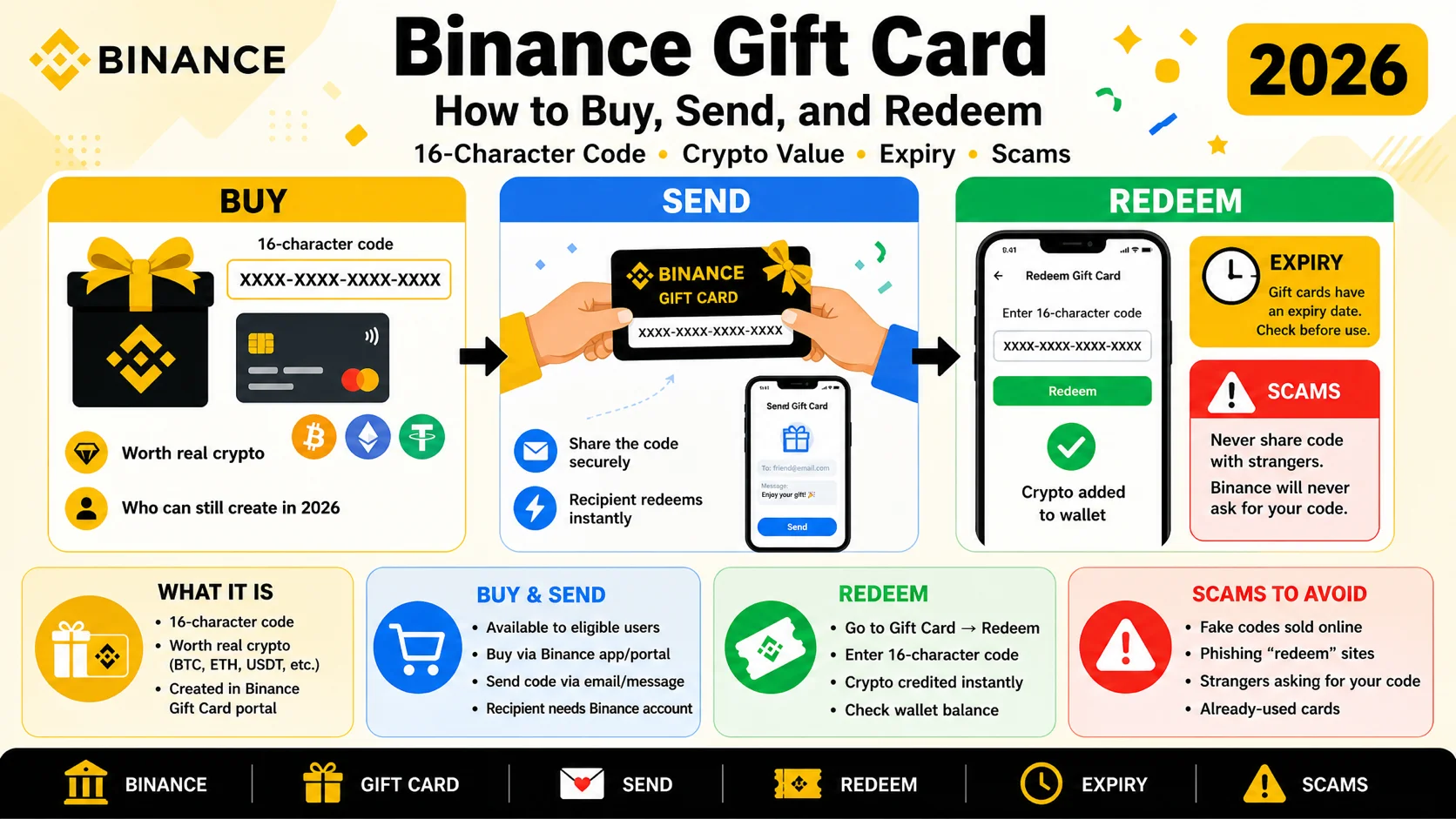
Binance Gift Card: How to Buy, Send, and Redeem (2026)
A Binance Gift Card is a 16-character code worth real crypto. Who can still create one in 2026, where to buy, how to redeem, when it expires, and the scams to avoid.
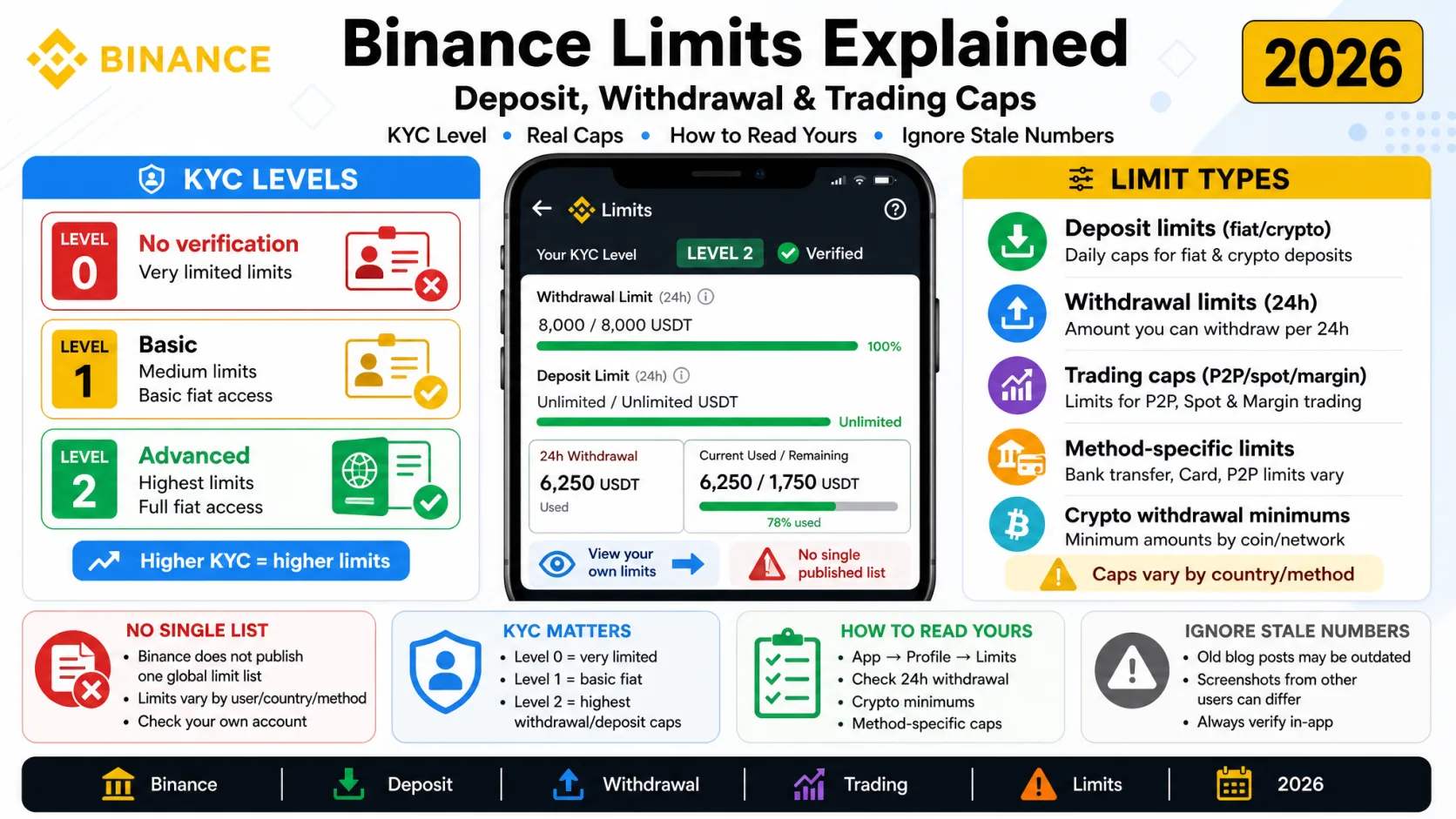
Binance Limits Explained: Deposit, Withdrawal, and Trading Caps (2026)
Binance publishes no single limit list. The real withdrawal, deposit and trading caps by KYC level, how to read your own, and the stale numbers to ignore.
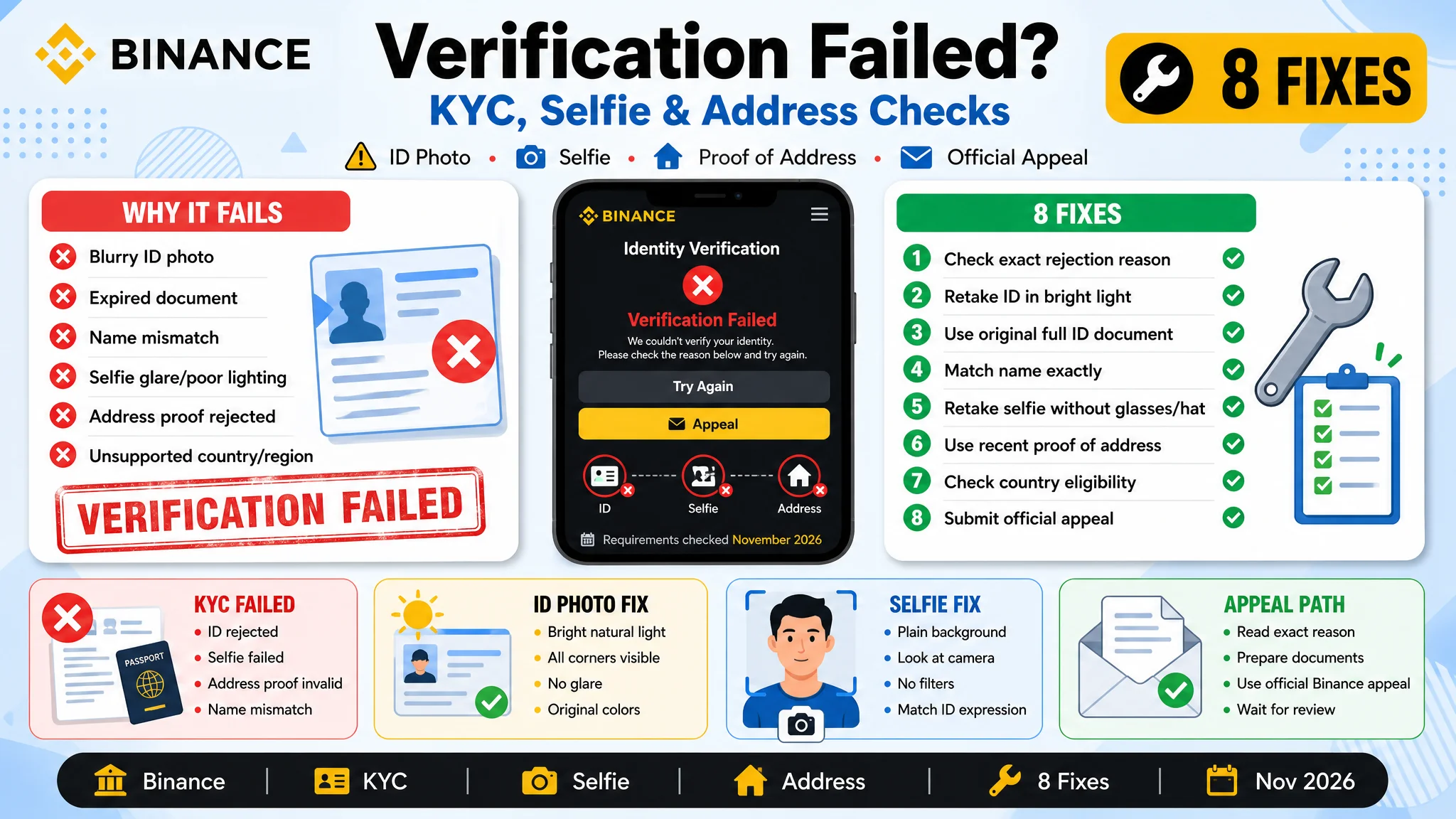
Binance Verification Failed? 8 Fixes for KYC, Selfie, and Address Checks (2026)
Binance verification failed? Find the exact rejection, fix the ID photo, selfie or address proof, and use the official appeal path. Requirements checked November 2026.