
Binance Account Requirements 2026 (Age, ID)
Binance requires 18+, a supported country and KYC with a government ID. The full eligibility checklist, real costs and the rules for 2026.
 Lucas Almeida 5 min read
Key takeaways
- You can open a Binance account if you are at least 18, live in a country where Binance operates, and have a government-issued ID plus an email address or phone number.
- Opening an account, verifying your identity and holding a balance all cost nothing — Binance only charges when you trade or withdraw.
- Age is not asked when you create the account; it is checked during identity verification from your ID's date of birth, and a false date can get the account closed.
- Under-18s have one legitimate route: Binance Junior, a parent-owned sub-account for ages 6–17 that cannot trade or withdraw on-chain.
- A referral code must be entered at sign-up. It cannot be added later except in a narrow 90-day re-binding case, so register through the invite link rather than tapping Sign Up in the app.
You can open a Binance account if you are at least 18, live in a country where Binance operates, and have a government-issued ID plus an email address or phone number. It costs nothing, takes about 10 to 15 minutes including identity verification, and has no minimum balance. One detail decides whether you get the fee discount: the referral code must be entered at sign-up, because it cannot be added later.
This guide is the pre-flight check — who is eligible, what documents actually work, which countries are supported, what it costs, and the traps that get accounts rejected or closed after the fact. The step-by-step sign-up itself is in our Binance registration guide.
⚠️ The most important thing first: don’t tap Sign Up directly in the app — you’ll miss the new-user rewards. The welcome benefits only apply when you register through an invite link or enter the referral code BN2688. Remember this.
💡 Don't have a Binance account yet? Sign up now — 20% fee rebate on spot and futures — enter the referral code BN2688.
Who can open a Binance account?
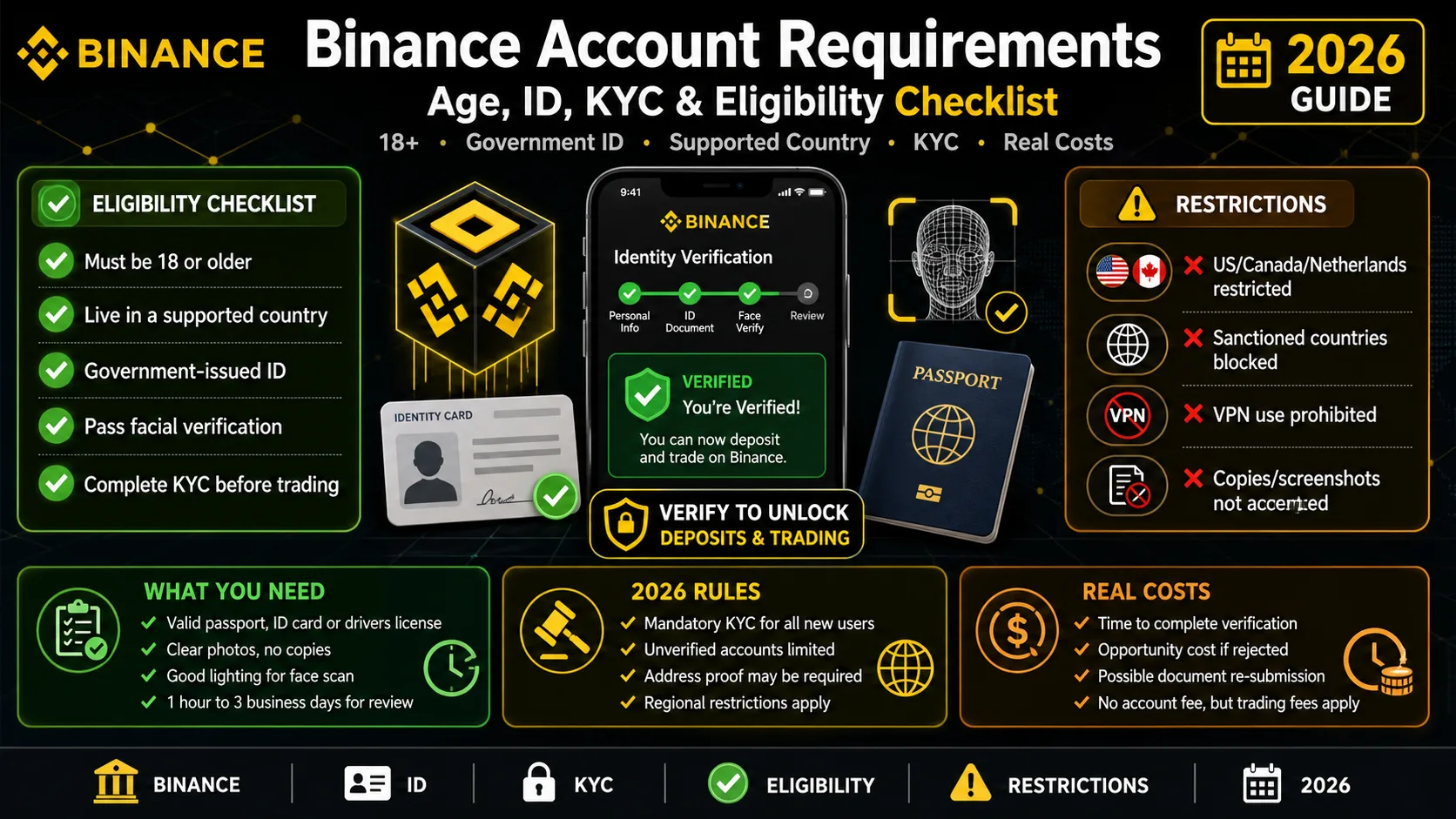
Binance’s eligibility rules come down to four checks: age, residency, identity document, and one account per person — and failing any of them stops the application at verification rather than at sign-up.
| Requirement | What actually counts | What happens if you don’t meet it |
|---|---|---|
| Age | 18 or older, per Binance’s Terms of Use | KYC fails when the ID’s date of birth is checked |
| Residency | A country where Binance operates, and the correct local entity | Sign-up or verification is blocked; VPN use risks a frozen account |
| Identity | A valid, unexpired government ID in your own name | No deposits, no trading, no withdrawals |
| Account count | One active account per person | Duplicate accounts can all be closed |
Everything else people worry about — a bank account, a credit card, a minimum deposit, a specific phone number — is optional or irrelevant. You can register with an email address alone, fund the account later by transferring crypto from another wallet, and never link a bank.
What is the age limit on Binance?
The age limit is 18, and it is enforced at identity verification rather than at sign-up — which is why some under-18s get a working login and then discover they cannot trade.
When you create the account, Binance asks for an email or phone number and a password. It does not ask your date of birth. That comes later, from the ID you upload during KYC, where the date of birth is one of the fields the system checks. If the document shows you are 17, verification does not pass, and an unverified account cannot deposit, trade or withdraw a single dollar.
Trying to work around this is a bad trade. Entering a false date of birth is a breach of the Terms of Use, and the mismatch surfaces the moment a document is checked — at which point Binance can close the account, and any balance in it becomes a support problem rather than an investment. Using a parent’s ID is worse: the face check will not match, and both accounts are at risk.
What about Binance Junior?
Binance Junior is the only legitimate route for under-18s: a parent-owned sub-account for children aged 6 to 17, launched on 3 December 2025 and updated in May 2026.
The structure matters more than the marketing. The parent must already have a verified Binance account with 2FA enabled, creates the Junior account from the main app, and remains the legal owner of it. Up to five Junior accounts can be attached to one parent. The child signs in through a separate Junior app by scanning a QR code.
What the child can do is deliberately narrow:
- Receive funds from the parent’s account or by on-chain deposit, and hold them.
- Earn in Junior Flexible Simple Earn, where enrollment is automatic.
- From age 13 — or 14, 15 or 16 in some countries — send funds to other Junior accounts and to the parent, capped at 400 US dollars per day.
What the child cannot do is the part that matters: no trading on the exchange, and no on-chain withdrawals. Funds can only move between Junior accounts and the linked parent account. Availability depends on local law and the app cannot be downloaded in every region, so check before promising a teenager anything.
What ID do you need?
You need one valid, unexpired government-issued ID in your own name — typically a passport, a national identity card or a driver’s licence, depending on what your country’s verification flow accepts.
The exact list is shown in the app when you start verification, and it varies by jurisdiction, so the app’s list beats any blog post, including this one. Three conditions decide whether it works:
- It must be genuine and unexpired. An expired passport fails, even if it expired last week.
- The details must match what you typed. The name and date of birth on the account must match the document exactly — a middle name left out, or a transliteration difference, is enough to trigger a manual review.
- The photo must be readable. Flat, well lit, no glare, all four corners inside the frame. Blur and glare are the most common rejection reasons, and they cost a day rather than a minute.
There is no verified-account workaround. Binance has required identity verification for trading since 2021, and every licensed exchange now does the same. An account without KYC is a login that can hold nothing.
Does Binance operate in your country?
Binance is available in most countries but not all, and not as one product — the entity you sign up with determines the rules, the coins and often whether a referral code works at all.
The main split is between global Binance and Binance.US, which is a separate company with separate accounts, spot-only products, and a referral programme that does not accept the global code. Binance also runs local entities in some markets, such as Binance Japan. Beyond that, several countries are restricted or have had new sign-ups paused, and the list changes with regulation rather than on a schedule you can predict.
Two practical rules follow. First, residency decides eligibility, not citizenship — living in a supported country with a passport from somewhere else is fine; the reverse is not. Second, check before you register. Our country availability guide tracks which markets are open, restricted or exited, and Binance’s own prohibited-country list is the final authority.
Do not use a VPN to get around a restriction. Binance’s terms require you to be resident in a supported jurisdiction, and an account that trips a location check can be frozen mid-review — with your money sitting inside it and no way to withdraw until the review ends.
Can you have more than one Binance account?
No — one active account per person, and the rule is written into Binance’s Terms of Use: each registration is for a single user, and each user may hold only one active account.
The rule catches people in three ordinary situations:
- Couples and families. Two adults in the same household are fine, because each opens their own account with their own ID. Sharing one login is not — it breaks the single-user rule and puts the account at risk.
- “A second account for trading.” There is no benefit that justifies it. Fees, limits and rebates are attached to your identity, not to the account, so a duplicate adds risk and nothing else.
- Businesses. A company should apply for a corporate account rather than registering a personal one in an employee’s name.
If you already have a duplicate, the safe move is to stop using the extra account and contact support before they find it, rather than after.
Does it cost anything to open an account?
Nothing. Creating the account, verifying your identity, receiving crypto and holding a balance are all free, and there is no minimum balance or monthly fee.
The costs start when money moves:
| Action | Cost |
|---|---|
| Create account, complete KYC | Free |
| Deposit crypto | Network fee only, charged by the sending side |
| Spot trade | 0.10% per side |
| Spot trade paying fees in BNB | 0.075% |
| Spot trade with a 20% referral rebate | About 0.06% |
| Withdraw crypto | Per coin and network, shown before you confirm |
Two numbers matter for a first deposit. The first is the minimum order size: on 8 November 2026, 488 of Binance’s 518 USDT spot pairs required 5 USDT per order and 30 required 1 USDT, so a 5 USDT buy is the practical floor for Bitcoin, Ethereum and most majors. The second is the withdrawal fee, which is charged per network and can be larger than the trade itself on very small amounts. Our minimum deposit guide has the pair-by-pair detail.
What should you prepare before you start?
Have an email address you control, your ID in hand, good light and ten uninterrupted minutes — that covers the whole process, verification included.
- An email address, or a phone number. Either works. Use an address you actually own and can recover; the account’s recovery flow runs through it.
- Your government ID. Physical document, not a photo of a photo, and not expired.
- A referral link or the code. Decide before you start. The code is attached during registration and is not something you can fix afterwards in the normal case — the narrow exception is an account at least 90 days old, never previously bound to a code, and inactive recently. Do not plan around it.
- A quiet, well-lit spot. The face check is the step people rush, and rushing it is what produces a rejection and a 24-hour wait.
- A password manager. Binance requires at least 8 characters with a number and an uppercase letter; a generated password is strictly better than one you invent.
Budget about 10 to 15 minutes in total. Sign-up itself takes two or three; verification takes the rest. The review is usually minutes, can stretch to hours at busy times, and in a small share of cases moves to manual review that takes up to a few business days.
Why do applications get rejected?
Most rejections are photo problems or mismatched details, not eligibility problems — and nearly all of them are fixable on resubmission.
| Rejection reason | What it looks like | Fix |
|---|---|---|
| Blurry or cropped ID | Text unreadable, corners cut off | Reshoot on a flat surface, all four corners in frame |
| Glare | A bright reflection over the ID number | Move away from a direct light or window |
| Expired document | Date has passed | Use a different valid ID |
| Name mismatch | Account name differs from the ID | Correct the account details before resubmitting |
| Face check failed | Poor light, glasses, hat, looking away | Retry in even light, glasses off, face the camera |
| Country not supported | Verification blocked with no document step | Check the country’s status; do not retry with a VPN |
Binance allows a limited number of attempts per day, so fix the cause rather than submitting the same photo again. Our KYC guide goes through each failure mode in detail.
What happens after your account is verified?
A verified account can deposit, trade and withdraw immediately, and the first three things worth doing are security, not trading.
Turn on two-factor authentication with an authenticator app, not SMS. Then decide how you will fund the account — a crypto transfer from another wallet is free apart from the network fee, while card purchases are fast but carry a processing fee. Only then place a first order, and keep it small: the point of the first trade is to learn the interface, not to make money.
If the account is new, the one thing worth checking before you trade is that the referral code actually applied. Our referral code guide shows where the rebate appears and what to do if it is missing — the difference is 20% of every fee you pay, for as long as the account exists.
The Bottom Line
Binance’s requirements are simple and non-negotiable: 18 or older, resident in a supported country, one valid ID, one account per person. There is no fee to open an account and no minimum to keep one, and the whole process takes about a quarter of an hour. Under-18s have exactly one route, Binance Junior, and it is a parent’s account, not a workaround.
The one decision worth making before you start is the referral code, because it is the only part of the process that cannot be fixed later. Register through the invite link rather than tapping Sign Up in the app, confirm the code shows during sign-up, and then follow the registration walkthrough step by step.
Don't have a Binance account yet?Sign up nowenter the referral codeBN2688
Frequently asked questions
What is the minimum age for Binance?
Can a teenager use Binance at all?
Can I open a Binance account without an ID?
How many Binance accounts can I have?
Does it cost anything to open a Binance account?
Can I use a VPN to sign up for Binance?
Editor-in-Chief & Lead Researcher
Editor of MyCryptoStart. Independent researcher of cryptocurrency exchanges, focused on fees, security, KYC, and onboarding — publishes step-by-step guides in plain English for beginners.
View author page →Some links on this page are affiliate links: we may earn a commission at no extra cost to you. This content is educational and is not financial, investment, or legal advice. Affiliate disclosure · Disclaimer.
Continue reading
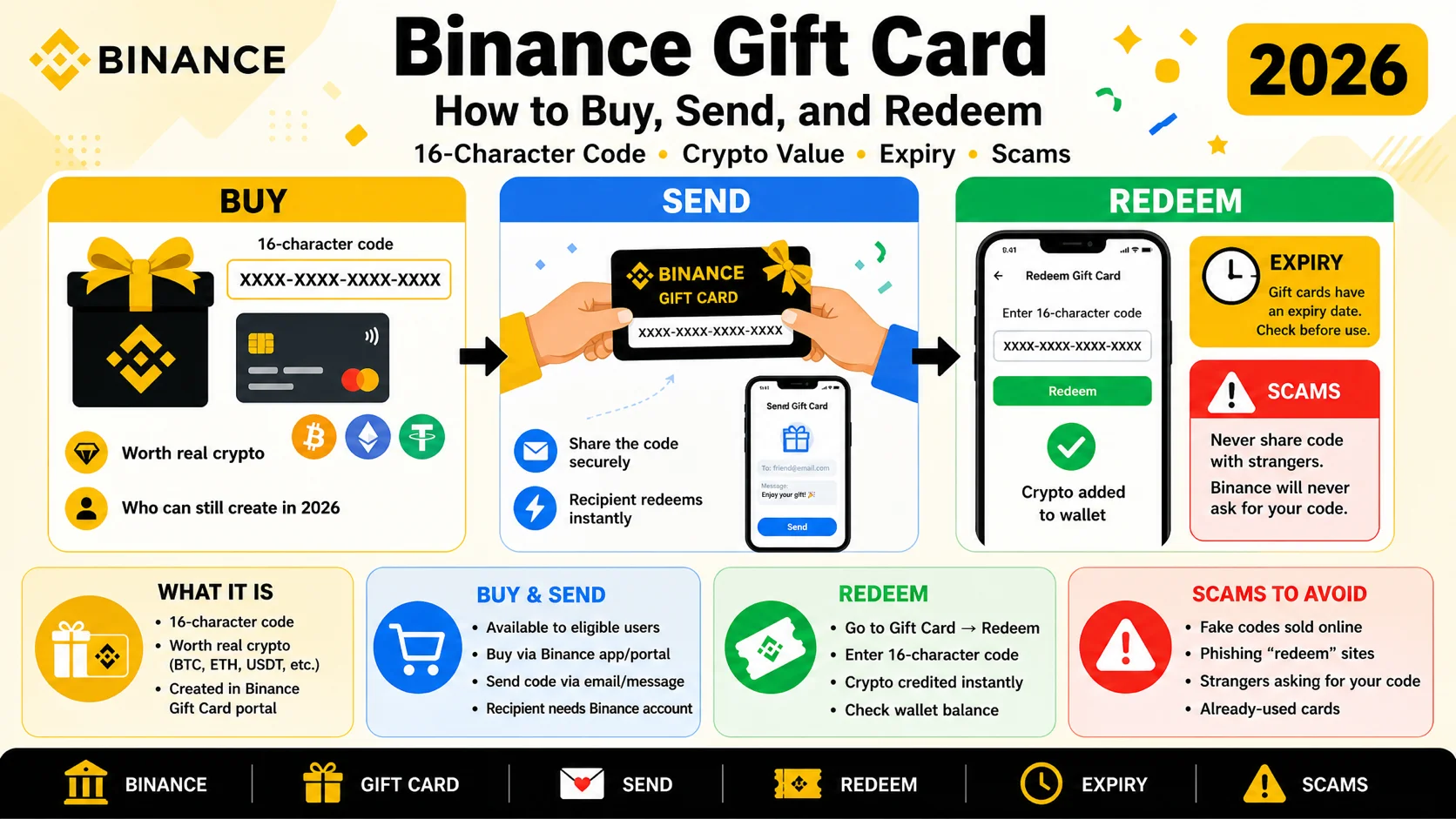
Binance Gift Card: How to Buy, Send, and Redeem (2026)
A Binance Gift Card is a 16-character code worth real crypto. Who can still create one in 2026, where to buy, how to redeem, when it expires, and the scams to avoid.
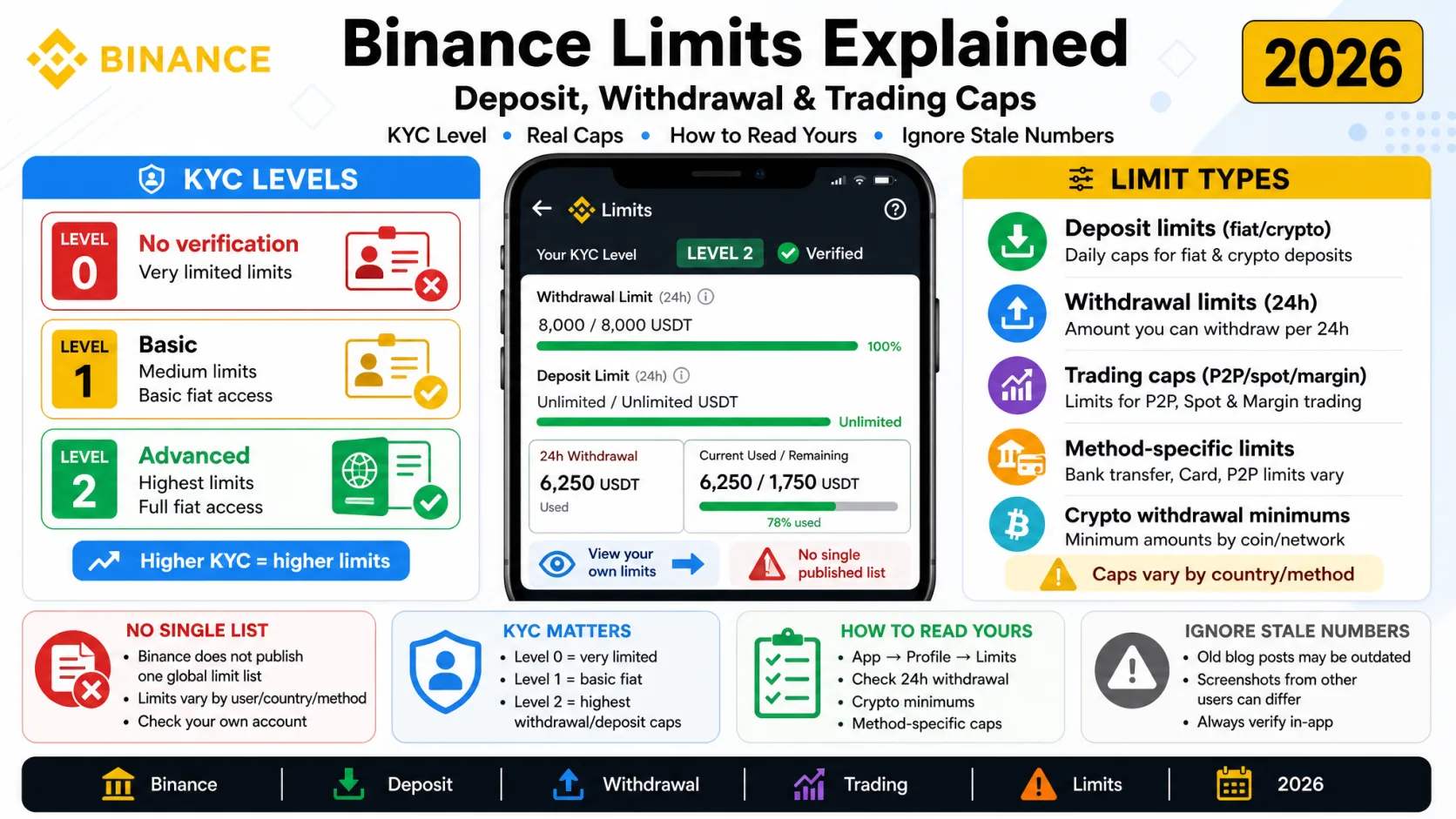
Binance Limits Explained: Deposit, Withdrawal, and Trading Caps (2026)
Binance publishes no single limit list. The real withdrawal, deposit and trading caps by KYC level, how to read your own, and the stale numbers to ignore.
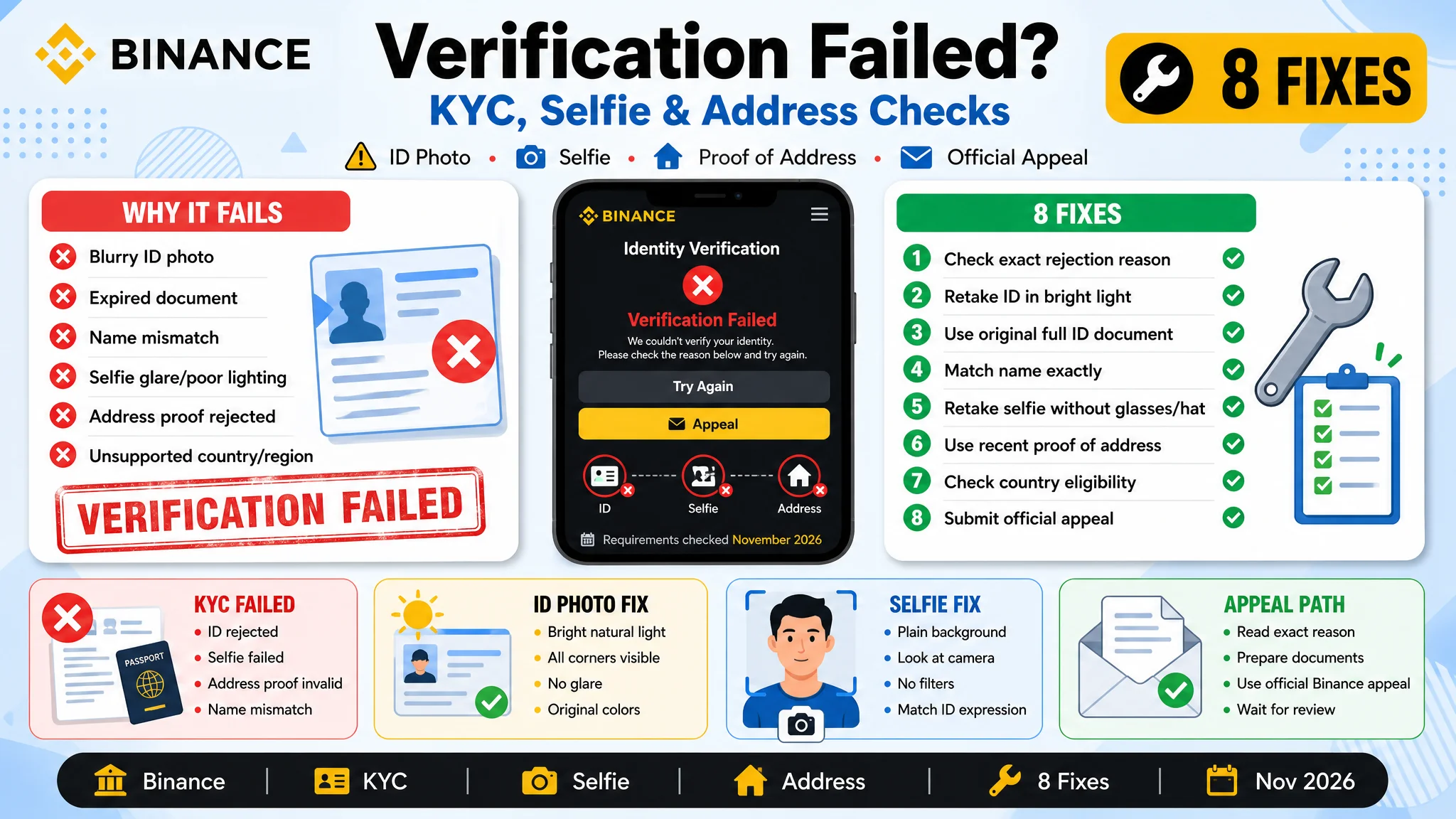
Binance Verification Failed? 8 Fixes for KYC, Selfie, and Address Checks (2026)
Binance verification failed? Find the exact rejection, fix the ID photo, selfie or address proof, and use the official appeal path. Requirements checked November 2026.